
Quick Summary
Full stack development requires strong knowledge of frontend, backend, database, and deployment technologies. This guide explains the most important full stack developer languages, including JavaScript, Python, Java, PHP, TypeScript, Golang, Rust, and C#. Furthermore, it covers essential frontend technologies like HTML5, CSS3, React.js, and TypeScript. Additionally, the blog explores backend frameworks such as Node.js, Django, Spring Boot, Laravel, and ASP.NET Core. It also explains SQL and NoSQL databases, popular development stacks like MERN and MEAN, DevOps basics, cybersecurity practices, AI-powered development trends, and future career opportunities for modern full stack developers in 2026.
Top Essential Full Stack Developer Languages for Modern Web Apps 2026
Full stack development continues to dominate modern software engineering. Businesses now demand scalable applications, responsive interfaces, and secure backend systems. Furthermore, companies prefer developers who handle frontend and backend development together. Additionally, cloud computing, APIs, and AI-powered development increase the need for versatile programming skills. A full stack developer works across user interfaces, databases, servers, and deployment pipelines. Therefore, choosing the right full stack developer languages becomes essential for long-term growth. Modern web development relies on performance, scalability, and security. This guide explains the most important programming languages, frameworks, and technologies every full stack engineer should understand in 2026 and beyond.
What Is a Full Stack Developer?
A full stack developer handles both client-side development and server-side programming. Furthermore, this professional manages databases, APIs, authentication systems, and deployment environments. Additionally, a full stack engineer builds complete applications without relying entirely on separate frontend and backend teams. Modern companies value developers who understand application development from end to end.
Frontend and backend developers focus on different areas. However, a full stack developer combines both skill sets. They create user interfaces, manage business logic, optimize databases, and integrate third-party services. Furthermore, they work with software development technologies like JavaScript, Python, Java, and PHP. Additionally, they understand cloud deployment, CI/CD pipelines, and cybersecurity principles.
A modern web developer also collaborates with designers, DevOps teams, and product managers. Therefore, communication and problem-solving become critical skills. Companies prefer software engineers who adapt quickly and build scalable applications efficiently.
Why Programming Languages Matter in Full Stack Development
Programming languages define how developers build modern applications. Furthermore, every language offers unique strengths for frontend, backend, database integration, and automation. Additionally, choosing the correct coding languages improves scalability, performance, and long-term maintainability.
JavaScript powers dynamic websites and interactive interfaces. Python simplifies rapid application development and AI integration. Additionally, Java supports enterprise software with strong security and multithreading capabilities. PHP remains essential for CMS and ecommerce development. Therefore, language selection directly impacts project success.
Modern software development technologies also influence hiring trends. Companies look for developers with versatile programming skills and practical framework experience. Furthermore, businesses prioritize scalable architecture and cloud-native applications. Additionally, developers who understand multiple languages solve problems faster across different environments.
Learning full stack developer languages also improves career flexibility. Developers can switch industries, contribute to open-source projects, and work remotely. Therefore, mastering the right languages creates long-term professional opportunities.
Evolution of Full Stack Development in 2026
Full stack development continues to evolve rapidly in 2026. Furthermore, businesses now prioritize AI-powered development, scalable applications, and cloud computing solutions. Additionally, modern web development focuses heavily on automation, microservices, and performance optimization.
Earlier applications relied on monolithic architecture. However, modern systems now use distributed infrastructure and serverless deployment models. Furthermore, developers integrate APIs, AI tools, and real-time services more frequently. Additionally, frameworks continue simplifying frontend and backend development workflows.
Cloud-native platforms like AWS, Azure, and Google Cloud reshape software engineering practices. Furthermore, DevOps pipelines automate testing, deployment, and infrastructure management. Additionally, modern applications prioritize security-first development strategies.
AI-assisted coding tools also transform application development. Developers now use intelligent automation for debugging, testing, and code generation. Therefore, full stack engineers must adapt continuously to remain competitive in the evolving technology landscape.
Frontend vs Backend vs Database Technologies
Frontend technologies manage everything users see and interact with directly. Furthermore, client-side development focuses on responsive design, browser compatibility, animations, and accessibility. Additionally, HTML, CSS, JavaScript, and TypeScript remain essential frontend technologies.
Backend technologies handle server-side programming and application logic. Furthermore, backend systems process requests, manage authentication, and communicate with databases. Additionally, languages like Python, Java, PHP, C#, and Node.js dominate backend development environments.
Database management systems store and organize application data. Relational databases like PostgreSQL and MySQL handle structured information efficiently. Additionally, NoSQL databases like MongoDB manage unstructured and scalable datasets. APIs connect frontend applications with backend services and databases.
Modern full stack development requires understanding all three layers. Therefore, developers who master frontend, backend, and database technologies build more efficient and scalable applications.
Core Responsibilities of a Full Stack Developer
Frontend Development Responsibilities
Frontend development focuses on building responsive and visually engaging user interfaces. Furthermore, full stack developers create layouts that improve usability and browser compatibility. Additionally, they optimize performance for desktops, tablets, and mobile devices.
Developers use HTML5, CSS3, JavaScript, and frontend libraries like React.js or Vue.js. Furthermore, they implement responsive design principles using Flexbox and CSS Grid. Additionally, accessibility standards and SEO-friendly structures improve overall user experience.
Frontend responsibilities also include optimizing loading speed and reducing unnecessary rendering. Developers test applications across multiple browsers and devices. Therefore, modern web design requires strong attention to performance, functionality, and user interaction.
Backend Development Responsibilities
Backend development powers the core functionality of web applications. Furthermore, developers create server-side logic, authentication systems, and REST APIs. Additionally, backend systems manage business logic and database communication.
Full stack developers use frameworks like Express.js, Django, Laravel, Spring Boot, and ASP.NET Core. Furthermore, they optimize APIs for scalability and security. Additionally, developers implement role-based authentication and encrypted data handling.
Backend development also involves server optimization and infrastructure management. Developers monitor performance, troubleshoot errors, and improve response times. Therefore, backend engineering remains essential for scalable and secure applications.
Database Management and Integration
Database management ensures applications store and retrieve data efficiently. Furthermore, developers design schemas, optimize database queries, and maintain data consistency. Additionally, they work with relational databases and NoSQL databases depending on project requirements.
MySQL and PostgreSQL remain popular relational databases for structured applications. Furthermore, MongoDB and Firebase support flexible and scalable architectures. Additionally, developers integrate databases with APIs and backend frameworks.
Modern applications process large amounts of user data daily. Therefore, full stack developers must understand indexing, caching, and query optimization strategies. Efficient database integration improves performance and scalability significantly.
API Development and Third-Party Services
APIs connect applications with external systems and services. Furthermore, developers create JSON APIs and integrate payment gateways, authentication tools, and cloud services. Additionally, API integration improves application flexibility and automation.
REST APIs remain standard for web services. Furthermore, microservices architecture separates application functionality into manageable components. Additionally, developers use APIs for communication between frontend and backend systems.
Third-party integrations simplify modern application development. Developers connect analytics platforms, email systems, and cloud storage services efficiently. Therefore, API development remains a critical responsibility for full stack engineers.
DevOps and Deployment Basics
Modern full stack developers often handle DevOps responsibilities. Furthermore, they manage CI/CD pipelines, Docker containers, and Kubernetes environments. Additionally, cloud deployment simplifies scalability and infrastructure management.
Developers automate testing and deployment workflows using GitHub Actions, Jenkins, and GitLab CI/CD. Furthermore, Docker improves environment consistency across development and production. Additionally, Kubernetes manages container orchestration efficiently.
Cloud platforms like AWS and Azure support scalable deployment strategies. Therefore, understanding DevOps fundamentals helps developers build reliable and production-ready applications.
Security Best Practices for Full Stack Developers
Cybersecurity remains critical in modern software development. Furthermore, developers implement authentication, authorization, and secure coding practices. Additionally, they protect applications from SQL injection, XSS attacks, and data breaches.
HTTPS encryption secures communication between users and servers. Furthermore, developers validate user input and sanitize database queries. Additionally, secure authentication systems reduce unauthorized access risks.
Regular updates and vulnerability testing improve application security. Therefore, full stack developers must prioritize data protection and security-first development practices.
Top Essentials Full Stack Developer Languages You Must Learn
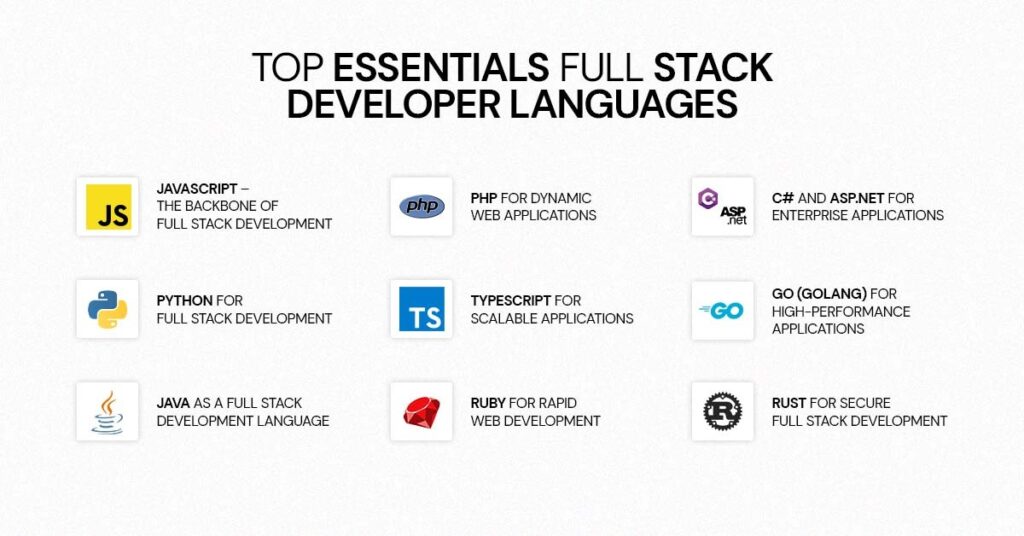
JavaScript – The Backbone of Full Stack Development
JavaScript dominates modern web development because it supports both frontend and backend ecosystems. Furthermore, developers use JavaScript frameworks to create dynamic websites and scalable web apps. Additionally, Node.js allows server-side JavaScript execution for complete full stack development.
Why JavaScript Dominates Modern Web Development
JavaScript powers interactive web applications across industries. Furthermore, browsers support JavaScript natively without additional plugins. Additionally, developers build single-page applications and real-time apps efficiently using modern frameworks.
Frontend JavaScript Frameworks
React.js, Angular, and Vue.js remain leading frontend libraries. Furthermore, these frameworks simplify component-based architecture and state management. Additionally, they improve developer productivity and application scalability.
Backend Development with Node.js
Node.js enables backend development using JavaScript. Furthermore, Express.js simplifies REST API creation and server-side logic. Additionally, developers build scalable backend systems with asynchronous programming.
Best Use Cases for JavaScript
JavaScript works best for real-time applications, social platforms, and single-page applications. Furthermore, startups prefer JavaScript for rapid development cycles. Additionally, companies use it for scalable web applications and cross-platform development.
Python for Full Stack Development
Python remains one of the most beginner-friendly programming languages. Furthermore, developers use Python for web development, automation, AI, and enterprise applications. Additionally, its readable syntax improves rapid development workflows.
Benefits of Python
Python simplifies coding with clean and readable syntax. Furthermore, developers build scalable backend systems quickly. Additionally, Python supports automation, data science, and machine learning integration.
Popular Python Frameworks
Django, Flask, and FastAPI dominate Python web development. Furthermore, Django provides built-in authentication and ORM support. Additionally, FastAPI improves API performance significantly.
Python in AI-Powered Web Applications
AI-powered development continues growing rapidly. Furthermore, Python integrates easily with machine learning and artificial intelligence frameworks. Additionally, developers use Python for predictive analytics and automation tools.
When to Choose Python
Python works best for scalable backend systems, automation platforms, and enterprise applications. Furthermore, startups prefer Python for MVP development. Additionally, AI-focused businesses rely heavily on Python ecosystems.
Java as a Full Stack Development Language
Java remains essential for enterprise software and large-scale applications. Furthermore, companies trust Java because of its scalability, reliability, and security advantages. Additionally, Java supports cross-platform development through the JVM ecosystem.
Java Enterprise Ecosystem
Java powers secure enterprise applications across banking, healthcare, and government sectors. Furthermore, developers use Java for robust and scalable software systems. Additionally, large organizations rely on Java for long-term maintenance.
Spring Boot for Backend Development
Spring Boot simplifies backend architecture and RESTful APIs. Furthermore, developers create production-ready applications with minimal configuration. Additionally, Spring Security improves authentication and authorization workflows.
Scalability and Security Advantages
Java supports multithreading and distributed systems efficiently. Furthermore, enterprise applications benefit from Java’s strong security ecosystem. Additionally, developers optimize performance for large-scale environments.
PHP for Dynamic Web Applications
PHP continues powering millions of websites globally. Furthermore, developers use PHP for server-side scripting, CMS development, and ecommerce platforms. Additionally, Laravel modernizes PHP application development significantly.
Laravel and Modern PHP
Laravel simplifies backend development using MVC architecture. Furthermore, developers build scalable web application frameworks efficiently. Additionally, Laravel improves routing, authentication, and database management.
PHP for CMS and Ecommerce Platforms
WordPress and WooCommerce depend heavily on the PHP ecosystem. Furthermore, businesses use PHP for content management systems and Ecommerce development. Additionally, PHP hosting compatibility reduces infrastructure costs.
Explore More
Also Learn about What Does a Full-Stack WordPress Developer Do? A Complete Guide
Advantages and Limitations of PHP
PHP offers fast development and open-source flexibility. Furthermore, developers deploy applications easily across hosting providers. Additionally, older PHP applications sometimes face maintainability challenges.
TypeScript for Scalable Applications
TypeScript improves JavaScript with static typing and better tooling. Furthermore, developers use TypeScript for scalable codebases and enterprise frontend systems. Additionally, it improves debugging and maintainable code structures.
Type Safety and Better Code Quality
Static typing reduces runtime errors significantly. Furthermore, developers identify issues during development instead of production. Additionally, maintainable code improves collaboration in large teams.
TypeScript vs JavaScript
JavaScript offers flexibility and faster learning. However, TypeScript improves frontend scalability and developer productivity. Furthermore, enterprise applications benefit from stricter type systems.
TypeScript in Enterprise Applications
Large applications require predictable architecture and maintainability. Furthermore, TypeScript improves long-term code management. Additionally, enterprise software teams prefer TypeScript for scalable frontend development.
Ruby for Rapid Web Development
Ruby supports fast and efficient web application development. Furthermore, Ruby on Rails simplifies startup development and rapid prototyping. Additionally, developers prefer Ruby for agile workflows.
Ruby on Rails Ecosystem
Rails framework emphasizes convention over configuration. Furthermore, developers build applications quickly using reusable components. Additionally, MVC architecture improves maintainability.
Startup-Friendly Development
Startups prefer Ruby for MVP development and fast deployment cycles. Furthermore, agile development teams iterate features rapidly. Additionally, Ruby improves developer productivity significantly.
Pros and Cons of Ruby
Ruby offers flexible syntax and strong developer experience. Furthermore, developers build prototypes quickly. Additionally, performance limitations may appear in extremely large-scale systems.
C# and ASP.NET for Enterprise Applications
C# powers enterprise backend systems through Microsoft development ecosystems. Furthermore, ASP.NET Core supports cross-platform development and secure APIs. Additionally, businesses use C# for financial software and corporate systems.
Microsoft Ecosystem Benefits
Azure cloud and Visual Studio improve enterprise solutions significantly. Furthermore, Microsoft ecosystems support long-term scalability. Additionally, businesses benefit from enterprise-grade infrastructure tools.
ASP.NET Core Features
ASP.NET Core improves performance and cross-platform compatibility. Furthermore, developers create secure backend APIs efficiently. Additionally, modern tooling simplifies deployment workflows.
Best Enterprise Use Cases
C# works best for business applications and enterprise systems. Furthermore, financial industries rely heavily on secure backend architectures. Additionally, Microsoft ecosystems support corporate scalability.
Go (Golang) for High-Performance Applications
Golang continues growing because of its high performance and scalability. Furthermore, developers build cloud-native apps and distributed systems efficiently. Additionally, Golang simplifies concurrent programming.
Why Golang Is Growing Rapidly
Go supports lightweight applications and fast execution. Furthermore, developers build scalable infrastructure with minimal complexity. Additionally, cloud platforms rely heavily on Golang ecosystems.
Concurrency and Scalability
Goroutines simplify concurrent programming workflows. Furthermore, distributed systems perform efficiently under heavy workloads. Additionally, Golang handles microservices architecture effectively.
Cloud-Native Application Development
Docker containers and Kubernetes integrate naturally with Go. Furthermore, developers build scalable cloud-native apps efficiently. Additionally, Golang supports modern infrastructure management.
Rust for Secure Full Stack Development
Rust focuses heavily on memory-safe programming and performance optimization. Furthermore, developers use Rust for secure applications and high-performance systems. Additionally, Rust reduces common security vulnerabilities.
Memory Safety Features
Rust prevents memory leaks and unsafe operations effectively. Furthermore, zero-cost abstractions improve performance optimization. Additionally, secure coding practices become easier with Rust.
Rust Web Frameworks
Rocket framework and Actix Web support backend development. Furthermore, developers build fast APIs and scalable systems. Additionally, Rust frameworks improve execution efficiency.
Why Developers Are Switching to Rust
Developers value Rust for safety guarantees and fast execution. Furthermore, companies prioritize secure backend systems increasingly. Additionally, Rust continues gaining popularity across modern programming communities.
Essential Frontend Languages Every Full Stack Developer Should Know
HTML5 Fundamentals
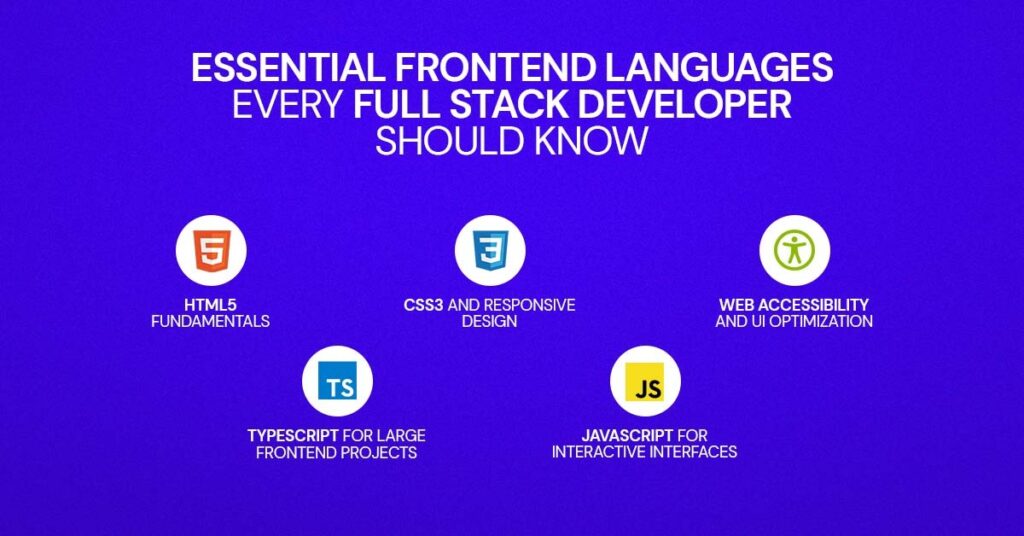
HTML5 provides webpage structure and semantic HTML elements. Furthermore, developers organize content for accessibility and SEO-friendly websites. Additionally, HTML remains the foundation of frontend development.
CSS3 and Responsive Design
CSS3 controls styling, animations, and responsive web design. Furthermore, Flexbox and CSS Grid simplify layout management. Additionally, responsive interfaces improve mobile usability.
JavaScript for Interactive Interfaces
JavaScript enables DOM manipulation and event handling. Furthermore, developers create asynchronous programming workflows for dynamic applications. Additionally, interactive interfaces improve user engagement.
TypeScript for Large Frontend Projects
TypeScript improves typed frontend development for scalable applications. Furthermore, enterprise frontend systems benefit from maintainable architecture. Additionally, debugging becomes more efficient.
Web Accessibility and UI Optimization
Accessibility standards improve usability for all users. Furthermore, optimized UX design supports SEO-friendly websites. Additionally, accessible interfaces improve compliance and customer experience.
Best Backend Languages for Full Stack Development
Node.js with JavaScript
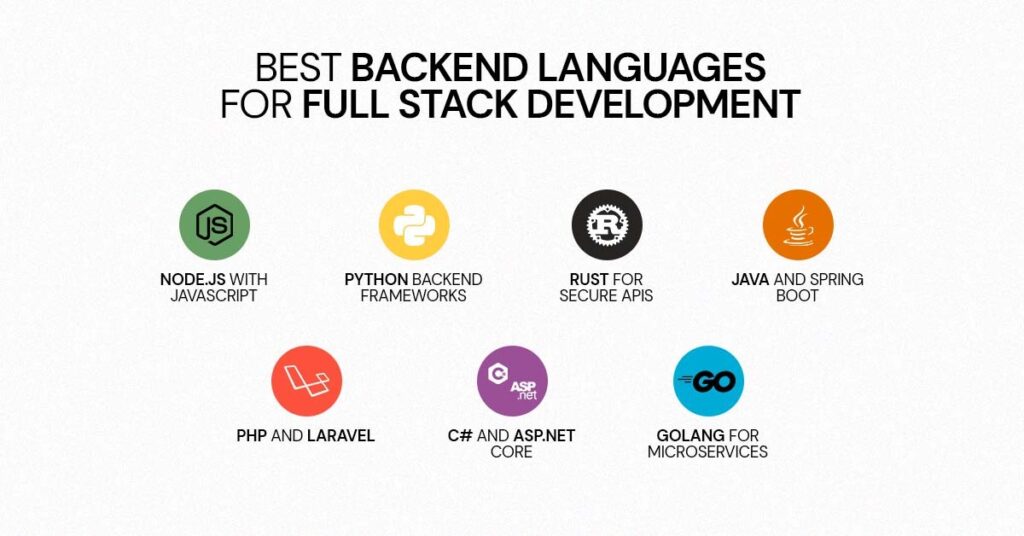
Node.js powers backend JavaScript applications efficiently. Furthermore, Express.js framework simplifies REST APIs and server logic. Additionally, developers build scalable real-time applications.
Python Backend Frameworks
Django backend systems support enterprise scalability. Furthermore, Flask APIs simplify lightweight development workflows. Additionally, FastAPI performance improves modern API development.
Java and Spring Boot
Java backend systems dominate enterprise APIs and secure infrastructure. Furthermore, Spring Boot improves backend architecture efficiency. Additionally, businesses rely on Java scalability.
PHP and Laravel
Laravel ecosystem modernizes PHP backend development. Furthermore, developers create scalable web applications quickly. Additionally, CMS development depends heavily on PHP.
C# and ASP.NET Core
Microsoft backend frameworks support secure enterprise APIs. Furthermore, ASP.NET Core improves performance optimization. Additionally, enterprise systems benefit from Microsoft infrastructure.
Golang for Microservices
Golang simplifies microservice architecture and cloud infrastructure development. Furthermore, distributed systems perform efficiently using Go. Additionally, developers optimize scalable services easily.
Rust for Secure APIs
Rust supports secure backend APIs with high-performance servers. Furthermore, memory-safe programming reduces vulnerabilities. Additionally, developers prioritize Rust for security-first systems.
Best Database Technologies for Full Stack Developers
SQL Databases Explained
SQL databases manage structured data using relational databases. Furthermore, developers write SQL queries for efficient data management. Additionally, businesses rely on transactional consistency.
MySQL
MySQL remains popular for web applications and CMS platforms. Furthermore, developers value its simplicity and performance. Additionally, startups adopt MySQL frequently.
PostgreSQL
PostgreSQL supports advanced relational database features. Furthermore, developers use PostgreSQL for scalable enterprise systems. Additionally, it handles complex queries efficiently.
Microsoft SQL Server
Microsoft SQL Server integrates well with enterprise ecosystems. Furthermore, businesses use it for corporate systems and analytics. Additionally, security features improve compliance.
NoSQL Databases
NoSQL databases support unstructured data and flexible scaling. Furthermore, developers build cloud-native systems using document databases. Additionally, modern applications require distributed data management.
MongoDB
MongoDB powers scalable document databases efficiently. Furthermore, developers use MongoDB for flexible application schemas. Additionally, startups adopt MongoDB for rapid scaling.
Firebase
Firebase simplifies backend infrastructure and real-time synchronization. Furthermore, developers build mobile and web applications rapidly. Additionally, Google cloud integration improves scalability.
Cassandra
Cassandra handles distributed systems and large-scale datasets. Furthermore, developers use Cassandra for high-availability environments. Additionally, scalability improves significantly.
Graph Databases and Modern Data Systems
Graph databases like Neo4j manage connected datasets efficiently. Furthermore, graph data modeling improves relationship-based queries. Additionally, recommendation engines rely heavily on graph structures.
Choosing Between SQL and NoSQL
SQL databases work best for structured data and transactional systems. Furthermore, NoSQL databases support unstructured and scalable databases. Additionally, developers select technologies based on application requirements.
Most Popular Full Stack Development Frameworks
MERN Stack
MERN Stack combines MongoDB, Express.js, React.js, and Node.js. Furthermore, developers build full JavaScript applications efficiently. Additionally, startups prefer MERN for rapid scalability.
MEAN Stack
MEAN Stack uses Angular instead of React. Furthermore, Angular improves enterprise frontend architecture. Additionally, developers maintain consistent JavaScript workflows.
Django Stack
Django framework simplifies Python full stack development. Furthermore, developers build secure and scalable applications quickly. Additionally, built-in features reduce development complexity.
Ruby on Rails Stack
Rails ecosystem supports startup applications and rapid prototyping. Furthermore, developers launch MVPs quickly. Additionally, convention-based architecture improves productivity.
.NET Full Stack Ecosystem
ASP.NET Core supports Microsoft stack development. Furthermore, businesses build enterprise applications efficiently. Additionally, Azure integration improves scalability.
JAMstack Architecture
JAMstack focuses on static websites and serverless deployment. Furthermore, headless CMS platforms improve flexibility. Additionally, JAMstack improves performance and security.
How to Choose the Best Full Stack Programming Language
Based on Career Goals
Developers should align language selection with software engineering career goals. Furthermore, frontend-focused roles require strong JavaScript skills. Additionally, enterprise careers favor Java and C# expertise.
Based on Project Requirements
Scalable applications require different technologies than lightweight platforms. Furthermore, performance optimization influences backend language selection. Additionally, project complexity affects framework choices.
Based on Community Support
Developer communities improve learning and troubleshooting significantly. Furthermore, open-source ecosystems accelerate development workflows. Additionally, active communities provide long-term framework support.
Based on Learning Curve
Beginner programming languages like Python simplify learning. Furthermore, easy coding languages improve confidence during early development stages. Additionally, developers should avoid unnecessary complexity initially.
Based on Scalability Needs
Enterprise scalability and distributed systems require robust backend technologies. Furthermore, Golang and Java handle large-scale workloads effectively. Additionally, cloud-native architectures influence language selection.
Based on Salary Potential
Developer salary trends vary across industries and technologies. Furthermore, AI-focused developers often earn higher compensation. Additionally, enterprise software and cloud engineering remain high-paying tech careers.
Best Language Combinations for Full Stack Developers
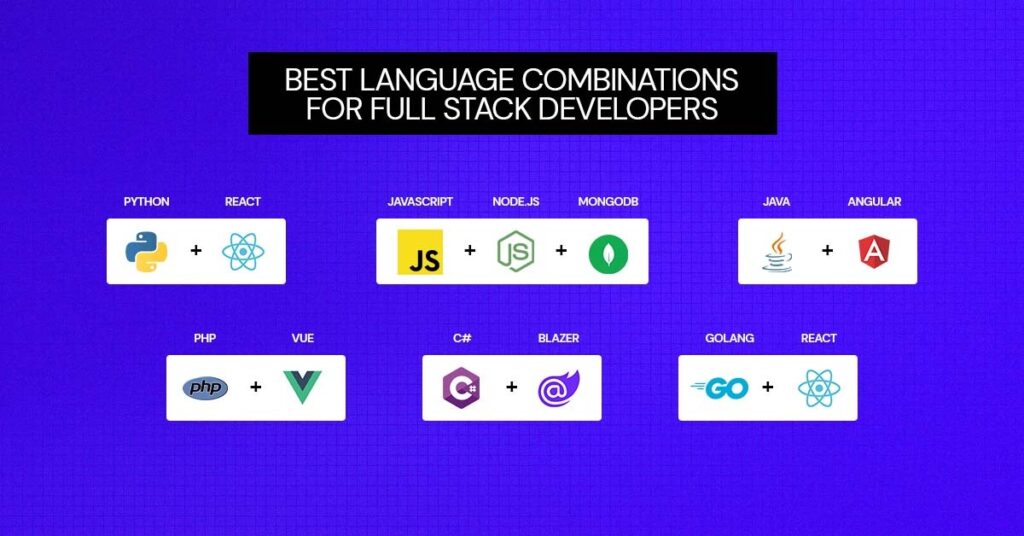
JavaScript + Node.js + MongoDB
This combination powers modern MERN applications efficiently. Furthermore, developers manage frontend and backend systems using JavaScript. Additionally, MongoDB supports scalable document databases.
Python + React
Python handles backend scalability while React improves frontend flexibility. Furthermore, startups prefer this combination for AI-powered platforms. Additionally, rapid development improves MVP creation.
Java + Angular
Java supports enterprise backend systems while Angular manages scalable interfaces. Furthermore, large organizations trust this architecture. Additionally, security and maintainability improve significantly.
PHP + Vue.js
PHP simplifies backend development while Vue.js improves frontend responsiveness. Furthermore, ecommerce platforms benefit from this stack. Additionally, development remains cost-effective.
C# + Blazor
Blazor enables frontend development using C#. Furthermore, Microsoft ecosystems improve enterprise productivity. Additionally, developers manage unified technology stacks efficiently.
Golang + React
Golang powers scalable backend services while React handles dynamic interfaces. Furthermore, cloud-native platforms rely on this combination increasingly. Additionally, performance optimization improves significantly.
Emerging Trends in Full Stack Development Languages
AI-Assisted Development
GitHub Copilot and AI coding assistants improve developer productivity. Furthermore, AI tools automate debugging and code generation. Additionally, developers build applications faster with intelligent suggestions.
WebAssembly and Rust
WebAssembly improves browser performance significantly. Furthermore, Rust integrates efficiently with WebAssembly apps. Additionally, developers optimize computational workloads directly in browsers.
Serverless Full Stack Architecture
AWS Lambda and serverless computing reduce infrastructure complexity. Furthermore, developers focus more on application logic than server management. Additionally, serverless deployment improves scalability.
Edge Computing
Edge servers reduce latency for global applications. Furthermore, low-latency applications improve real-time user experiences. Additionally, distributed infrastructure supports modern cloud ecosystems.
Low-Code and No-Code Integration
Automation platforms simplify repetitive development tasks. Furthermore, visual development tools accelerate prototyping workflows. Additionally, developers integrate low-code systems with traditional applications.
AI-Native Application Development
Generative AI apps continue transforming software development. Furthermore, AI-first software integrates automation deeply into user experiences. Additionally, businesses prioritize intelligent application ecosystems.
Common Mistakes Developers Make When Learning Full Stack Languages
Learning Too Many Languages at Once
Developers often switch technologies too frequently. Furthermore, this approach slows long-term progress. Additionally, mastering one stack first improves learning efficiency.
Ignoring Backend Fundamentals
Some developers focus only on frontend frameworks. Furthermore, backend fundamentals remain essential for scalability and APIs. Additionally, server-side programming improves overall problem-solving.
Not Building Real Projects
Tutorial-based learning alone limits practical experience. Furthermore, real projects improve debugging and architecture skills. Additionally, portfolios demonstrate practical expertise to employers.
Focusing Only on Frameworks
Frameworks change frequently across industries. Furthermore, strong programming fundamentals remain valuable long term. Additionally, developers should understand core concepts deeply.
Ignoring Security Best Practices
Security vulnerabilities create major application risks. Furthermore, developers must implement secure coding practices consistently. Additionally, cybersecurity awareness improves software reliability.
Best Resources to Learn Full Stack Developer Languages
Online Coding Platforms
Platforms like freeCodeCamp, Codecademy, and Coursera simplify learning. Furthermore, interactive coding improves retention significantly. Additionally, structured lessons support beginners effectively.
Open Source Contributions
Open-source ecosystem participation improves practical development experience. Furthermore, developers collaborate with global communities. Additionally, contribution history strengthens professional portfolios.
Coding Bootcamps
Coding bootcamps accelerate skill development rapidly. Furthermore, intensive programs focus heavily on practical applications. Additionally, mentorship improves learning efficiency.
University Degrees vs Self-Learning
University degrees provide theoretical computer science knowledge. Furthermore, self-learning offers flexibility and faster specialization. Additionally, many successful developers combine both approaches.
YouTube Channels and Developer Communities
Developer communities and technical YouTube channels simplify complex topics. Furthermore, peer discussions improve troubleshooting abilities. Additionally, community engagement accelerates continuous learning.
GitHub Portfolio Building
GitHub portfolios showcase real-world development skills. Furthermore, recruiters evaluate coding quality and project consistency. Additionally, strong portfolios improve hiring opportunities significantly.
Career Opportunities for Full Stack Developers
Industries Hiring Full Stack Developers
Healthcare, finance, ecommerce, and SaaS industries actively hire full stack developers. Furthermore, startups and enterprises require scalable web applications. Additionally, cloud computing expands job demand globally.
Remote Work Opportunities
Remote software engineering continues growing rapidly. Furthermore, companies hire global talent for frontend and backend development. Additionally, remote work improves career flexibility.
Startup vs Enterprise Careers
Startups offer broader responsibilities and rapid growth opportunities. Furthermore, enterprise careers provide stability and structured environments. Additionally, developers choose based on long-term goals.
Freelancing Opportunities
Freelancing allows developers to work independently across industries. Furthermore, businesses outsource application development frequently. Additionally, full stack developers manage diverse client projects.
Expected Salary Trends in 2026
Developer salary trends remain strong globally. Furthermore, AI-powered development and cloud engineering increase compensation levels. Additionally, enterprise backend specialists continue earning competitive salaries.
Future of Full Stack Development Languages
Will JavaScript Continue Dominating?
JavaScript remains central to modern web development. Furthermore, frontend and backend ecosystems continue expanding. Additionally, full JavaScript stacks simplify development workflows.
Rise of AI-Powered Development
AI-powered development tools reshape software engineering practices. Furthermore, automation improves debugging and productivity. Additionally, developers integrate AI features into applications increasingly.
Future of Cross-Platform Applications
Cross-platform frameworks continue improving efficiency. Furthermore, developers build web and mobile apps using shared codebases. Additionally, businesses reduce development costs significantly.
Security-First Development Trends
Security-first development becomes essential for modern applications. Furthermore, businesses prioritize cybersecurity and compliance. Additionally, developers must integrate secure coding practices consistently.
Future Demand for Full Stack Developers
Demand for full stack developers remains strong globally. Furthermore, businesses require professionals with versatile technical expertise. Additionally, cloud computing and AI continue increasing opportunities.
FAQs About Top Essentials Full Stack Developer Languages
Which language is best for full stack development?
JavaScript remains the most versatile option because it supports both frontend and backend development. Furthermore, MERN and MEAN stacks simplify full stack workflows. Additionally, Python and Java remain strong alternatives for enterprise and AI applications.
Can I become a full stack developer using only JavaScript?
Yes. Furthermore, JavaScript supports frontend frameworks like React and backend technologies like Node.js. Additionally, developers can build complete applications using JavaScript ecosystems alone.
Is Python better than JavaScript for full stack development?
Python works better for AI, automation, and backend-heavy systems. However, JavaScript dominates interactive web applications and frontend ecosystems. Furthermore, project requirements usually determine the better choice.
Which full stack language pays the highest salary?
Java, Golang, Rust, and AI-focused Python roles often offer higher salaries. Furthermore, enterprise and cloud-native development remain highly profitable. Additionally, experience level influences compensation significantly.
How long does it take to become a full stack developer?
Most beginners require 8 to 18 months of consistent learning and project building. Furthermore, practical experience accelerates progress. Additionally, specialization improves long-term career growth.
Should beginners learn MERN or MEAN stack?
MERN Stack usually offers an easier learning experience because React provides flexibility. Furthermore, startups adopt MERN widely. Additionally, Angular in MEAN requires stricter architecture understanding.
Is Rust good for full stack development?
Rust works well for secure backend systems and high-performance applications. Furthermore, WebAssembly integration increases its popularity. Additionally, developers use Rust for modern cloud-native systems.
What is the easiest backend language for beginners?
Python remains one of the easiest backend languages because of its readable syntax. Furthermore, frameworks like Flask simplify development. Additionally, Python supports rapid learning and automation.
Conclusion
Choosing the right full stack developer languages depends on career goals, project requirements, and scalability needs. Furthermore, JavaScript continues dominating modern web development because of its flexible ecosystem. Additionally, Python, Java, PHP, TypeScript, Golang, and Rust each provide unique advantages for different application types.Techstack Digital‘s Developers focus on strong programming fundamentals instead of chasing every new framework. Building real projects, understanding backend architecture, and practicing secure coding remain essential for long-term success. Furthermore, AI-powered development, cloud computing, and serverless architecture continue reshaping the industry. Therefore, developers who adapt continuously and master practical technologies will remain highly valuable in 2026 and beyond.