
TL;DR Quick Summary
PHP full-stack development involves building complete web applications using frontend, backend, and database technologies. Furthermore, a PHP full-stack developer handles everything from UI design to server-side logic and deployment. Additionally, PHP remains relevant due to its strong ecosystem, frameworks like Laravel, and widespread use in CMS and web applications. This guide explains roles, responsibilities, tools, and career paths in detail. It also highlights real-world use cases, required skills, and future opportunities. Therefore, it helps beginners and professionals understand how to start and grow in this field effectively.
What is a PHP Full-Stack Developer? Skills, Roles & Career Guide
Introduction to PHP Full-Stack Development
PHP full-stack development refers to building complete web applications using both frontend and backend technologies. Furthermore, it covers everything from user interfaces to server-side logic and databases. Additionally, developers handle deployment and maintenance for scalable systems. This approach follows the client-server model and supports dynamic websites. PHP remains widely used for CMS development and backend scripting. Therefore, businesses still rely on PHP full-stack engineers for cost-effective solutions. Additionally, the open-source ecosystem and frameworks like Laravel simplify development workflows. Companies like Techstack Digital leverage PHP full-stack development to build scalable, high-performance web applications tailored to modern business needs. This guide explains what a PHP full-stack developer does and why it matters.
What “Full-Stack” Means in Modern Web Development
Full-stack means working across frontend, backend, and database layers. Furthermore, developers design complete web application architecture. Additionally, they manage client-server communication and ensure smooth data flow. A full-stack engineer builds interfaces, handles APIs, and controls databases. Therefore, they understand the entire lifecycle of application development. Additionally, this role reduces dependency on multiple teams and improves efficiency.
Why PHP Still Matters for Full-Stack Web Applications
PHP remains relevant due to its flexibility and strong ecosystem. Furthermore, platforms like WordPress dominate CMS development globally. Additionally, frameworks like Laravel provide structured MVC architecture. PHP supports dynamic content generation and backend scripting efficiently. Therefore, it remains a reliable server-side language. Additionally, its open-source nature reduces development costs and increases adoption.
What is PHP Full-Stack Developer?
Simple Definition of a PHP Full-Stack Developer
A PHP full-stack developer builds complete web applications using PHP and frontend tools. Furthermore, they manage client-server architecture. Additionally, they develop APIs and integrate databases. This role combines application development with system design. Therefore, it requires understanding both frontend and backend layers. Additionally, it focuses on delivering end-to-end solutions.
Difference Between PHP Developer, Backend Developer, and Full-Stack Developer
A PHP developer focuses mainly on backend scripting. Furthermore, a backend developer handles server-side logic in different languages. Additionally, a full-stack developer works on both frontend and backend. Therefore, full-stack roles require broader skills. Additionally, they manage complete development workflows instead of isolated tasks.
Who is a PHP Full-Stack Developer?
A PHP full-stack developer is a coding professional who handles entire web systems. Furthermore, they act as software engineers responsible for architecture and deployment. Additionally, they collaborate with teams using agile methods. Therefore, they contribute to scalable and efficient applications. Additionally, they bridge gaps between frontend and backend development.
What Does a PHP Full-Stack Developer Do?
Frontend Development Responsibilities
Frontend development focuses on user interface and browser rendering. Furthermore, developers create responsive layouts and ensure usability. Additionally, they improve UI/UX for better engagement. Therefore, frontend work directly impacts user experience.
Building Layouts with HTML
Developers use HTML5 to structure web pages. Furthermore, they apply semantic tags for accessibility. Additionally, clean markup improves SEO and readability.
Styling Interfaces with CSS
Developers use CSS3 to design layouts. Furthermore, they implement Flexbox and Grid systems. Additionally, responsive design ensures compatibility across devices.
Adding Interactivity with JavaScript
Developers use JavaScript to add dynamic behavior. Furthermore, they handle DOM manipulation and events. Additionally, ES6 features improve code efficiency.
Working with Responsive Design and UI/UX
Developers use frameworks like Bootstrap for mobile-first design. Furthermore, they optimize layouts for different screens. Additionally, UI/UX improvements increase engagement.
Backend Development Responsibilities
Backend development handles server-side logic and APIs. Furthermore, developers manage data flow and application logic. Additionally, they ensure performance and scalability.
Writing Server-Side Logic in PHP
Developers write backend code using PHP. Furthermore, they apply OOP and MVC patterns. Additionally, structured code improves maintainability.
Handling Authentication, Sessions, and Validation
Developers implement user authentication systems. Furthermore, they manage sessions and cookies. Additionally, secure login systems protect user data.
Managing Business Logic and App Workflows
Developers design backend logic for workflows. Furthermore, they define system behavior and rules. Additionally, efficient architecture improves performance.
Database Management
Database management ensures proper data storage and retrieval. Furthermore, developers design efficient schemas. Additionally, they optimize performance and security.
Designing Schemas
Developers create structured database models. Furthermore, they use normalization techniques. Additionally, proper schema design improves scalability.
Writing SQL Queries and CRUD Operations
Developers use MySQL and PostgreSQL for queries. Furthermore, they perform CRUD operations. Additionally, optimized queries improve speed.
Data Security, Backup, and Optimization
Developers implement encryption and indexing. Furthermore, they ensure database security. Additionally, backups prevent data loss.
API Integration and Deployment
Developers integrate APIs and deploy applications. Furthermore, they connect external services. Additionally, deployment ensures live functionality.
REST API Development
Developers create APIs using REST API. Furthermore, they use JSON and HTTP methods. Additionally, APIs enable system communication.
Third-Party API Integration
Developers integrate services like Stripe and Google APIs. Furthermore, these enhance functionality. Additionally, integrations improve scalability.
Hosting, Deployment, and Monitoring
Developers deploy apps using AWS, Docker, and cPanel. Furthermore, monitoring ensures uptime. Additionally, cloud hosting improves reliability.
What is Full Stack Development?
Frontend Layer Explained
Frontend includes UI frameworks like React and Vue.js. Furthermore, developers build interactive interfaces. Additionally, UI frameworks speed development.
Backend Layer Explained
Backend handles server-side processing. Furthermore, PHP engines process requests. Additionally, backend ensures data handling and logic execution.
Database Layer Explained
Database layer stores application data. Furthermore, systems like MongoDB support NoSQL storage. Additionally, relational databases ensure structured storage.
How All Layers Work Together in a PHP Stack
A common stack includes Linux, Apache, MySQL, and PHP. Furthermore, this LAMP stack enables full application flow. Additionally, each layer interacts seamlessly.
Explore More
Also Learn about Top 10+ Full Stack Development Companies
Why Learn PHP Full-Stack Development?
Strong Market Demand
PHP developers remain in demand for web applications. Furthermore, freelancing and remote jobs increase opportunities. Additionally, companies seek versatile developers.
Beginner-Friendly Learning Curve
PHP offers simple syntax. Furthermore, it supports rapid learning. Additionally, community support helps beginners.
Cost-Effective Open-Source Ecosystem
Tools like Composer and GitHub support development. Furthermore, open-source tools reduce cost. Additionally, they accelerate workflows.
Real-World Use Cases of PHP
PHP powers a wide range of real-world web applications across industries. Furthermore, its flexibility supports dynamic content and scalable backend systems. Additionally, businesses rely on PHP for cost-effective development.
- Content Management Systems (CMS)
Platforms like WordPress use PHP to manage websites. Furthermore, they enable easy content updates. Additionally, they support plugins and themes. - E-commerce Platforms
Online stores use PHP for product management and payments. Furthermore, platforms integrate with tools like Stripe. Additionally, they handle orders and transactions. - Web Applications and SaaS Products
PHP supports scalable web applications. Furthermore, frameworks like Laravel simplify development. Additionally, SaaS platforms rely on PHP for backend logic. - Custom Business Applications
Companies build internal tools using PHP. Furthermore, these include CRM and ERP systems. Additionally, they improve workflow automation and data management. - API Development and Integrations
PHP builds REST APIs for system communication. Furthermore, it connects with third-party services. Additionally, it enables seamless data exchange between platforms.
Essential Skills Required for a PHP Full-Stack Developer
Core Technical Skills
Developers need programming, frameworks, and database knowledge. Furthermore, they must understand system design. Additionally, technical skills ensure performance.
PHP Programming Fundamentals
Learn syntax, variables, and functions. Furthermore, practice coding regularly. Additionally, fundamentals build strong foundations.
Object-Oriented Programming in PHP
Use classes and inheritance. Furthermore, OOP improves code structure. Additionally, reusable code increases efficiency.
MVC Architecture
Use frameworks like Symfony. Furthermore, MVC separates logic and UI. Additionally, it improves maintainability.
Frontend Technologies
Use HTML5, CSS3, and JavaScript. Furthermore, these build interfaces. Additionally, AJAX improves interaction.
Database Knowledge
Work with MySQL and PostgreSQL. Furthermore, understand NoSQL basics. Additionally, data handling improves efficiency.
Version Control with Git and GitHub
Use Git and GitHub. Furthermore, version control tracks changes. Additionally, it supports collaboration.
Framework Knowledge
Use CodeIgniter and Symfony. Furthermore, frameworks speed development. Additionally, they improve security.
Soft Skills
Problem-Solving
Develop logical thinking. Furthermore, debugging improves accuracy. Additionally, problem-solving ensures stability.
Communication and Teamwork
Work in Agile and Scrum environments. Furthermore, teamwork improves delivery. Additionally, communication ensures clarity.
Time Management
Manage deadlines and sprints. Furthermore, planning improves productivity. Additionally, it ensures timely delivery.
Debugging Mindset
Identify and fix errors. Furthermore, testing improves quality. Additionally, debugging ensures reliability.
Tools and Technologies for PHP Full-Stack Development
Code Editors and IDEs
VS Code
VS Code provides lightweight editing with extensions. Furthermore, it supports PHP syntax highlighting, debugging, and Git integration. Additionally, developers customize workflows using plugins for productivity.
PHPStorm
PHPStorm offers advanced PHP development features. Furthermore, it includes debugging, testing, and framework integration. Additionally, it improves productivity for large-scale projects with intelligent code assistance.
Sublime Text
Sublime Text is fast and minimal. Furthermore, it supports PHP syntax and plugins. Additionally, developers prefer it for lightweight coding without heavy IDE configurations or system resource usage.
Local Development Environment
XAMPP
XAMPP provides Apache, PHP, and MySQL in one package. Furthermore, it simplifies local setup. Additionally, beginners use it to quickly start PHP development without manual configuration.
WAMP
WAMP is designed for Windows users. Furthermore, it includes Apache, PHP, and MySQL. Additionally, it offers a simple interface for managing local server environments efficiently.
MAMP
MAMP supports macOS and Windows systems. Furthermore, it provides Apache, PHP, and MySQL. Additionally, developers use it for local testing and consistent environment configuration across projects.
Web Servers
Apache
Apache is widely used for PHP applications. Furthermore, it handles HTTP requests efficiently. Additionally, it integrates easily with PHP and supports flexible configuration for hosting dynamic websites.
Nginx
Nginx delivers high performance and scalability. Furthermore, it handles concurrent connections efficiently. Additionally, developers use it for modern applications requiring speed and optimized resource usage.
Frontend Tools and Libraries
Bootstrap
Bootstrap simplifies UI development. Furthermore, it offers responsive components and grid systems. Additionally, developers use it to build mobile-friendly layouts quickly without writing extensive CSS code.
jQuery
jQuery simplifies JavaScript operations. Furthermore, it handles DOM manipulation and events easily. Additionally, developers use it for quick interactivity without writing complex JavaScript code.
React or Vue.js with PHP backend
React and Vue improve frontend performance. Furthermore, they create dynamic interfaces. Additionally, developers integrate them with PHP backends for scalable and modern web applications.
Database and Admin Tools
MySQL
MySQL stores structured application data. Furthermore, it supports relational database management. Additionally, developers use it for scalable and efficient data storage in PHP applications.
phpMyAdmin
phpMyAdmin provides a graphical interface for MySQL. Furthermore, it simplifies database management. Additionally, developers use it to run queries, manage tables, and monitor performance easily.
Project and Collaboration Tools
GitHub
GitHub hosts repositories for collaboration. Furthermore, it supports version control workflows. Additionally, developers share code, manage projects, and track issues efficiently using its platform.
GitLab
GitLab offers repository hosting and CI/CD pipelines. Furthermore, it supports DevOps workflows. Additionally, teams use it for automation, deployment, and project collaboration in development environments.
Jira and Trello
Jira and Trello manage project tasks. Furthermore, they support agile workflows. Additionally, teams track progress, assign tasks, and improve collaboration across development cycles effectively.
Setting Up Your Development Environment (Localhost Setup Guide)
A proper development environment helps you build, test, and debug PHP projects before publishing them online. Furthermore, it gives you a safe localhost setup where you can make changes without affecting a live website. Additionally, it helps you understand how PHP, Apache, MySQL, and your code editor work together. For beginners, this setup builds confidence because you can test every feature locally. Therefore, before creating full-stack PHP applications, you need a stable local environment, version control, and a simple project folder structure.
Installing PHP, Apache, and MySQL (LAMP/WAMP Stack)
Start by installing PHP, Apache, and MySQL on your system. Furthermore, you can use XAMPP, WAMP, MAMP, or a manual LAMP setup, depending on your operating system. These tools create a local server where PHP files can run properly. Additionally, MySQL lets you store and manage application data. Once installed, start Apache and MySQL from the control panel. Then, place your PHP files inside the server directory, such as htdocs in XAMPP. Open your browser and test the project using localhost. Therefore, this setup gives you a basic working environment for PHP development.
Choosing a Code Editor (VS Code Extensions)
Choose a code editor that helps you write clean and organized PHP code. Furthermore, VS Code is a popular option because it is lightweight, fast, and supports many extensions. Additionally, PHPStorm is useful for advanced PHP development because it includes strong debugging and framework support. If you use VS Code, install helpful extensions like PHP Intelephense, PHP Debug, Prettier, GitLens, and Laravel Blade Snippets. These tools improve syntax highlighting, formatting, autocomplete, and version tracking. Therefore, a good editor saves time and reduces coding mistakes. Additionally, it makes your workflow smoother when working on frontend, backend, and database files.
Configuring Git and Version Control (Git Workflow)
Git helps you track changes in your code. Furthermore, it allows you to save different versions of your project and restore older code when needed. Start by installing Git and setting your username and email. Then, create a repository inside your project folder using git init. Add your files with git add . and save changes with git commit. Additionally, you can connect your project to GitHub or GitLab for cloud backup and collaboration. A simple Git workflow includes creating branches, making changes, testing code, and merging updates. Therefore, version control keeps your PHP project organized and safe.
Creating Your First Local PHP Project (Beginner Project Setup)
Create a simple project folder inside your local server directory. Furthermore, add an index.php file as the main entry point. Inside it, write a basic PHP script to test whether the server works. Additionally, create folders such as assets, css, js, includes, and config to keep your files organized. If your project uses a database, create a MySQL database through phpMyAdmin and connect it using PDO or MySQLi. Then, test pages through localhost/project-name. Therefore, this beginner setup helps you understand routing, file structure, database connection, and server rendering in a simple way.
Understanding the Basics of PHP
Syntax and Variables
PHP syntax defines how code is written. Furthermore, variables store data using dollar signs. Additionally, developers assign values and reuse variables across scripts for dynamic functionality.
Data Types and Operators
PHP supports data types like strings, integers, arrays, and booleans. Furthermore, operators perform calculations and comparisons. Additionally, they help manipulate data efficiently within applications.
Control Structures and Loops
Control structures manage program flow. Furthermore, if-else statements handle conditions. Additionally, loops like for and while repeat tasks, improving efficiency and reducing repetitive code writing.
Functions and Form Handling
Functions organize reusable code blocks. Furthermore, they improve structure and readability. Additionally, PHP handles form data using GET and POST methods for processing user input securely.
Error Handling and Debugging
Error handling identifies issues in code. Furthermore, developers use logs and exceptions. Additionally, debugging tools help trace errors, ensuring stable and reliable PHP application performance.
Introduction to HTML, CSS, and JavaScript for PHP Developers
HTML Essentials
HTML structures web pages using elements and tags. Furthermore, developers create forms, inputs, and layouts. Additionally, semantic structure improves accessibility, SEO, and integration with PHP backend systems.
CSS Basics and Responsive Design
CSS styles web pages using layouts, colors, and typography. Furthermore, responsive design adapts content across devices. Additionally, media queries and Flexbox ensure a consistent user experience on screens.
JavaScript Essentials
JavaScript adds interactivity to web pages. Furthermore, it handles events, animations, and dynamic updates. Additionally, ES6 features improve code readability and performance in modern frontend development workflows.
DOM Manipulation and Event Handling
DOM manipulation updates page content dynamically. Furthermore, event handling responds to user actions like clicks. Additionally, JavaScript connects frontend interactions with PHP backend for dynamic experiences.
Combining PHP with HTML, CSS, and JavaScript
Embedding PHP in HTML
Embedding PHP within HTML allows server-side rendering. Furthermore, developers insert PHP tags inside markup. Additionally, this approach generates dynamic content before sending output to browsers.
Processing Forms with PHP
PHP processes form data using GET and POST methods. Furthermore, it validates user input. Additionally, secure handling prevents errors and ensures proper data submission workflows.
Passing Data Between Frontend and Backend
Data flows using AJAX and APIs. Furthermore, JavaScript sends requests to PHP servers. Additionally, backend processes data and returns responses, enabling dynamic interaction without reloading pages.
Rendering Dynamic Content
PHP renders dynamic content based on user data. Furthermore, templates and engines like Blade help structure views. Additionally, this improves scalability and maintainability.
Working with Databases in PHP Full-Stack Projects
Creating and Connecting to a Database
Developers create databases using MySQL. Furthermore, PHP connects using MySQLi or PDO. Additionally, connection scripts enable applications to access, store, and manage data efficiently.
CRUD Operations in PHP
CRUD operations handle create, read, update, and delete tasks. Furthermore, PHP executes SQL queries. Additionally, these operations manage application data consistently across web applications and systems.
Using MySQLi vs PDO
MySQLi supports MySQL databases only. Furthermore, PDO supports multiple databases. Additionally, PDO provides flexibility, prepared statements, and better security, making it preferred for scalable applications.
Securing Queries with Prepared Statements
Prepared statements prevent SQL injection attacks. Furthermore, they separate queries from data inputs. Additionally, developers use them to ensure secure database interactions and protect sensitive application information.
Using Frameworks and Libraries
Frameworks simplify development and improve structure. Furthermore, they enhance security and scalability. Additionally, they reduce coding effort.
Why Laravel is Popular for PHP Full-Stack Development
Laravel provides tools like Eloquent ORM. Furthermore, it simplifies database handling. Additionally, it improves productivity.
When to Use CodeIgniter or Symfony
Use CodeIgniter for lightweight apps. Use Symfony for complex systems. Additionally, choose based on project needs.
Benefits of Frameworks
Frameworks improve speed, security, and scalability. They standardize code structure. Additionally, they reduce errors.
How to Become a PHP Full-Stack Developer
Learn the Fundamentals in the Right Order
Start with HTML, CSS, and JavaScript basics. Furthermore, learn PHP syntax and backend logic. Additionally, understand databases and APIs to build a strong full-stack development foundation.
Build Practice Projects
Create small projects like CRUD apps and login systems. Furthermore, practice real scenarios. Additionally, projects improve problem-solving skills and prepare you for real-world application development challenges.
Create a Portfolio
Build a portfolio showcasing your projects. Furthermore, host code on GitHub. Additionally, include live demos to demonstrate skills and attract recruiters or freelance clients effectively.
Prepare for Interviews and Coding Tests
Practice coding problems and system design questions. Furthermore, review core concepts. Additionally, mock interviews help improve confidence and communication during technical hiring processes.
Consider Certifications or Structured Training
Enroll in online courses or bootcamps. Furthermore, certifications validate your skills. Additionally, structured learning provides guidance, helping beginners follow a clear path toward becoming job-ready developers.
Career Path of a PHP Full-Stack Developer
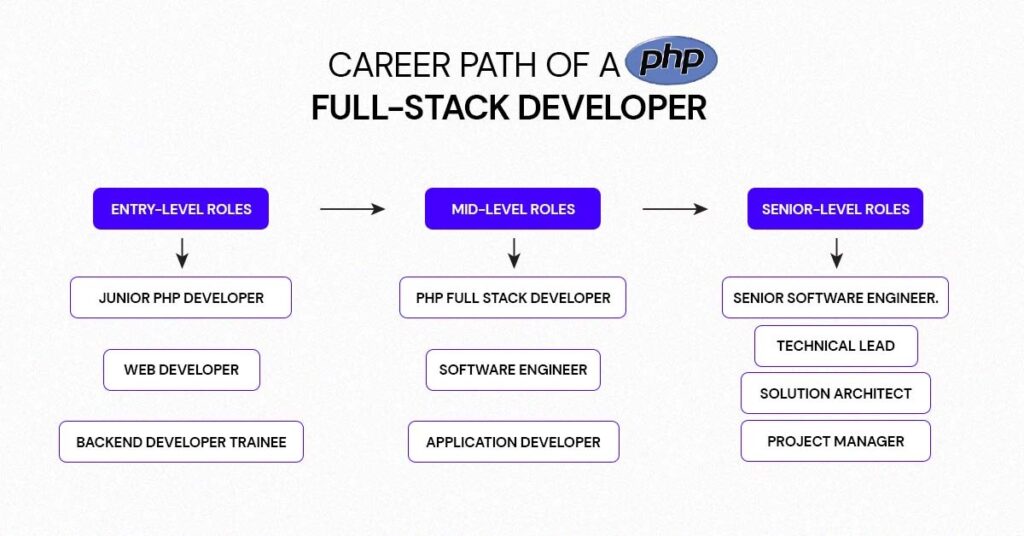
Entry-Level Roles
Junior PHP Developer
Focus on writing basic PHP scripts and debugging. Furthermore, assist senior developers. Additionally, learn frameworks, databases, and version control to build strong foundational development skills.
Web Developer
Work on frontend and backend tasks. Furthermore, build simple websites and features. Additionally, gain experience with UI design, APIs, and database integration in real-world projects.
Backend Developer Trainee
Focus on server-side logic and databases. Furthermore, learn APIs and authentication systems. Additionally, improve coding skills while assisting in backend development tasks under supervision.
Mid-Level Roles
PHP Full Stack Developer
Handle complete application development. Furthermore, manage frontend, backend, and databases. Additionally, build scalable systems and contribute to architecture decisions in team environments.
Software Engineer
Design and develop complex applications. Furthermore, optimize performance and code quality. Additionally, collaborate with teams to deliver efficient and scalable software solutions.
Application Developer
Build and maintain business applications. Furthermore, handle integrations and workflows. Additionally, ensure application performance, usability, and reliability across different platforms and environments.
Senior-Level Roles
Senior Software Engineer
Lead development processes and mentor juniors. Furthermore, design system architecture. Additionally, ensure code quality, scalability, and performance across large and complex applications.
Technical Lead
Guide development teams and define technical direction. Furthermore, manage architecture decisions. Additionally, ensure alignment between business goals and technical implementation strategies.
Solution Architect
Design high-level system architecture. Furthermore, choose technologies and frameworks. Additionally, ensure scalability, security, and integration across multiple systems and platforms.
Project Manager
Manage timelines, teams, and deliverables. Furthermore, coordinate development workflows. Additionally, ensure projects meet business requirements, deadlines, and quality standards efficiently.
Salary Scope and Job Opportunities
Salary by Experience Level
Salaries vary based on experience and location. Furthermore, junior developers earn less initially. Additionally, senior developers and specialists earn significantly higher due to advanced skills and responsibilities.
Industries Hiring PHP Full-Stack Developers
Industries include IT services, e-commerce, SaaS, and startups. Furthermore, digital agencies frequently hire Php developer. Additionally, businesses building web applications rely heavily on PHP full-stack developers.
Freelance vs Full-Time Opportunities
Freelancing offers flexibility and project-based income. Furthermore, full-time roles provide stability. Developers choose based on career goals, financial needs, and preferred work environments.
Remote Work Opportunities
Remote jobs are increasing globally. Furthermore, companies hire developers worldwide. PHP full-stack developers benefit from flexible work environments and access to international job markets.
Future Scope of PHP Full-Stack Development
PHP in Modern Web Development
PHP continues evolving with modern frameworks. Furthermore, it supports scalable applications. Additionally, it remains relevant due to its flexibility and large developer community worldwide.
The Role of Laravel, APIs, and Cloud Deployment
Frameworks like Laravel simplify development. Furthermore, APIs enable integration. Additionally, cloud platforms improve scalability and deployment efficiency for modern applications.
Long-Term Career Outlook
PHP full-stack development offers long-term growth. Furthermore, developers can specialize in backend or DevOps. Additionally, evolving technologies create continuous learning and career advancement opportunities.
Step-by-Step Sample Project Roadmap
Build a Simple CRUD Web App
Start by building a CRUD application. Furthermore, create database tables. Additionally, implement forms and queries to manage data operations effectively within your PHP project.
Add Authentication
Implement login and registration systems. Furthermore, manage sessions securely. Additionally, protect routes and ensure user authentication for secure and personalized application experiences.
Connect APIs
Integrate external APIs for additional features. Furthermore, use JSON and HTTP methods. Additionally, APIs enhance functionality and allow communication between different services and systems.
Deploy the Project Live
Deploy applications on hosting platforms. Furthermore, configure servers and domains. Additionally, monitor performance and ensure applications run smoothly in production environments.
Common Challenges and How to Overcome Them
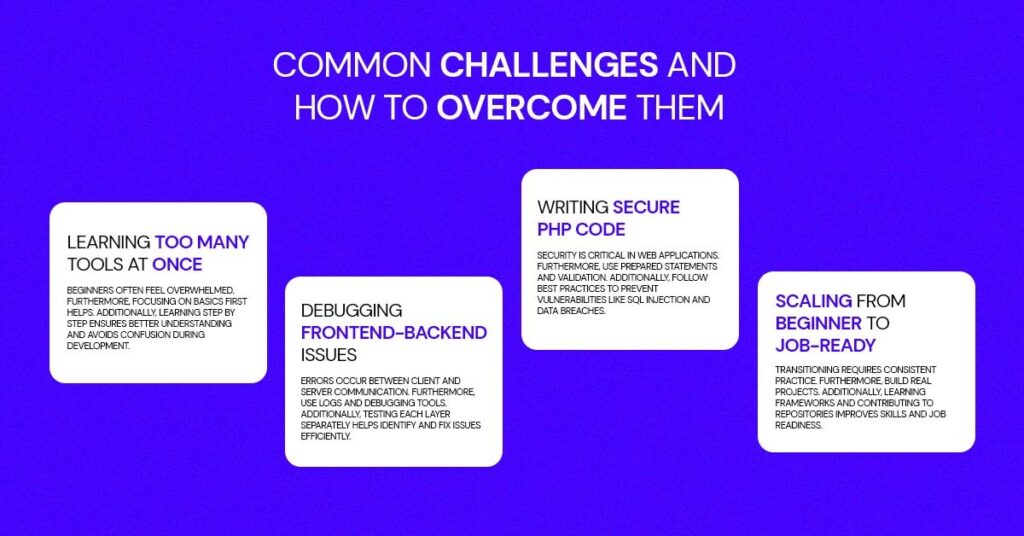
Learning Too Many Tools at Once
Beginners often feel overwhelmed. Furthermore, focusing on basics first helps. Additionally, learning step by step ensures better understanding and avoids confusion during development.
Debugging Frontend-Backend Issues
Errors occur between client and server communication. Furthermore, use logs and debugging tools. Additionally, testing each layer separately helps identify and fix issues efficiently.
Writing Secure PHP Code
Security is critical in web applications. Furthermore, use prepared statements and validation. Additionally, follow best practices to prevent vulnerabilities like SQL injection and data breaches.
Scaling from Beginner to Job-Ready
Transitioning requires consistent practice. Furthermore, build real projects. Additionally, learning frameworks and contributing to repositories improves skills and job readiness.
Best Practices for PHP Full-Stack Developers
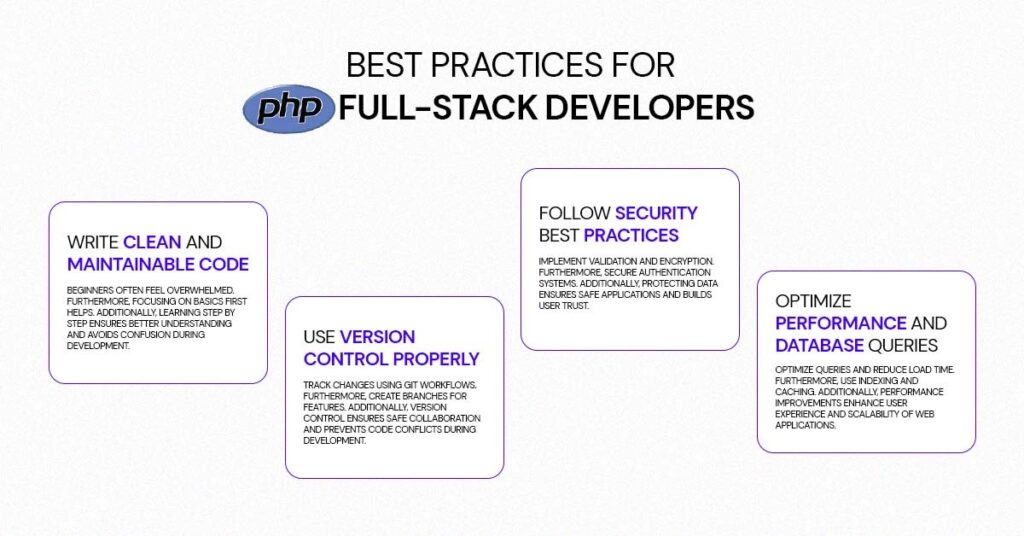
Write Clean and Maintainable Code
Use proper structure and naming conventions. Furthermore, follow coding standards. Additionally, clean code improves readability and simplifies maintenance for long-term projects.
Use Version Control Properly
Track changes using Git workflows. Furthermore, create branches for features. Additionally, version control ensures safe collaboration and prevents code conflicts during development.
Follow Security Best Practices
Implement validation and encryption. Furthermore, secure authentication systems. Additionally, protecting data ensures safe applications and builds user trust.
Optimize Performance and Database Queries
Optimize queries and reduce load time. Furthermore, use indexing and caching. Additionally, performance improvements enhance user experience and scalability of web applications.
FAQs About PHP Full-Stack Developers
Is PHP full-stack development a good career?
Yes, it offers strong demand, stable growth opportunities, and flexibility across freelance, remote, and full-time development roles globally.
Does a PHP full-stack developer need React or Vue?
Not mandatory, but learning React or Vue.js improves frontend capabilities and helps build modern, scalable user interfaces.
Is Laravel required?
No, but Laravel simplifies development, improves structure, and accelerates building secure and scalable PHP applications efficiently.
Can beginners become PHP full-stack developers?
Yes, beginners can become developers with consistent practice, structured learning, and building real-world projects to gain practical experience.
What projects should I build first?
Start with CRUD applications, authentication systems, and simple CMS projects to understand full-stack workflows and build practical development skills.
Conclusion
PHP full-stack development remains a practical and scalable approach for building modern web applications. Furthermore, it allows developers to manage complete systems from frontend to backend. Additionally, PHP continues to evolve with frameworks, cloud integration, and API-driven architectures. This makes it relevant for businesses and developers alike. Learning this skill opens doors to freelance, remote, and full-time opportunities. Therefore, it provides long-term career growth. Additionally, mastering both technical and soft skills ensures success. Companies like Techstack Digital continue to leverage PHP full-stack technologies to deliver scalable, secure, and performance-driven digital solutions for modern businesses. Overall, a PHP full-stack developer plays a critical role in modern web development ecosystems.