
Quick Summary
A Full Stack Ruby on Rails developer builds complete web applications using Ruby, Rails, APIs, databases, frontend frameworks, and cloud deployment tools. This guide covers essential Rails skills, MVC architecture, PostgreSQL, React, Hotwire, CI/CD pipelines, Docker, AWS, GitHub workflows, and scalable backend development. Furthermore, it explains career paths, salary trends, SaaS development, API integrations, testing frameworks, and modern deployment practices. Additionally, businesses hiring Rails developers learn how to evaluate technical skills, portfolios, and DevOps expertise effectively. The article also highlights AI integration, microservices architecture, cloud-native applications, and why Ruby on Rails remains relevant for startups, enterprise software, and scalable SaaS platforms.
Full Stack Ruby on Rails Developer: Skills, Roles, Career Path & Hiring Guide
A Full Stack Ruby on Rails developer builds complete web applications from frontend to backend. These professionals handle databases, APIs, business logic, user interfaces, and deployment processes. Furthermore, companies prefer Ruby on Rails because it supports fast development and scalable applications. Additionally, startups and enterprises use Rails to reduce development time and improve product quality. A full stack engineer works across multiple layers of web development while maintaining clean and efficient systems. Therefore, demand for skilled Ruby on Rails developers continues to grow in modern software development. This guide explains skills, tools, responsibilities, career paths, salaries, hiring practices, and future opportunities in the Ruby on Rails ecosystem.
What is a Full Stack Ruby on Rails Developer?
Definition and Overview
A Full Stack Ruby on Rails developer manages frontend interfaces, backend systems, databases, APIs, and cloud deployment workflows efficiently. Furthermore, these developers contribute across the complete software development lifecycle for scalable web applications.
Ruby on Rails simplifies application development through convention-based architecture and reusable backend structures effectively. Additionally, businesses hire best full stack developer to improve collaboration, reduce development complexity, and accelerate product delivery significantly.
Frontend vs Backend Responsibilities
Frontend developers manage user interfaces, responsive layouts, animations, and browser compatibility using HTML, CSS, JavaScript, React, and Vue.js. Furthermore, backend developers handle APIs, authentication systems, databases, and application logic efficiently.
Full stack engineers combine frontend and backend expertise for better project coordination and faster issue resolution. Additionally, businesses benefit from scalable architecture, improved communication, and streamlined development workflows significantly.
Why Ruby on Rails for Full Stack Development?
Ruby on Rails supports rapid application development, clean coding practices, and scalable backend architecture for modern web applications efficiently. Furthermore, MVC architecture improves maintainability, organization, and long-term software scalability significantly.
Startups and SaaS businesses prefer Rails because it accelerates MVP development and deployment workflows effectively. Additionally, strong community support and open-source libraries simplify API integrations, authentication, and cloud-based application development consistently.
Core Skills Required for a Full Stack Ruby on Rails Developer
Backend Development Skills (Ruby, Rails, APIs)
Backend development includes Ruby programming, Rails architecture, API integration, authentication systems, and scalable server-side application logic management efficiently. Furthermore, developers use MVC architecture, routing systems, and background jobs for backend workflows.
RESTful APIs, caching mechanisms, and secure validation processes improve application scalability and backend performance significantly. Additionally, strong backend expertise supports maintainable architecture, secure integrations, and long-term software stability effectively.
Frontend Development Skills (HTML, CSS, JavaScript)
Frontend development uses HTML5, CSS3, JavaScript, React, and Vue.js to create responsive and interactive user interfaces efficiently. Furthermore, developers improve accessibility, browser compatibility, and mobile responsiveness consistently.
Hotwire and Turbo effectively simplify frontend workflows and reduce JavaScript complexity in Rails applications. Additionally, strong frontend development improves user engagement, application performance, and responsive web experiences significantly.
Explore More
Also Learn about How to become a full stack javascript developer?
Database Management (PostgreSQL, MySQL)
Database management supports scalable applications through PostgreSQL, MySQL, SQLite, and ActiveRecord ORM integration efficiently. Furthermore, developers optimize queries, indexes, and relationships for improved backend performance consistently.
Secure database architecture improves scalability, maintainability, and long-term application reliability effectively. Additionally, strong database management skills help developers build stable enterprise systems and SaaS applications successfully.
Version Control Systems (Git, GitHub)
Git, GitHub, and GitLab help developers manage source code, collaboration workflows, and project version history efficiently. Furthermore, branching strategies improve deployment workflows and reduce development conflicts significantly.
Version control systems strengthen transparency, teamwork, and open-source collaboration within Agile development environments effectively. Additionally, GitHub repositories help recruiters evaluate coding quality, project structure, and technical expertise clearly.
DevOps and Deployment Skills (Docker, CI/CD, Cloud)
DevOps skills include Docker containerization, CI/CD pipelines, cloud deployment, and infrastructure management for scalable applications efficiently. Furthermore, developers automate testing and deployment workflows across production environments successfully.
Cloud platforms like AWS and Heroku improve scalability, monitoring, and deployment flexibility significantly. Additionally, DevOps expertise strengthens backend reliability, release speed, and infrastructure optimization for modern software applications.
Ruby on Rails Tech Stack Explained
Ruby Programming Language
Ruby is an object-oriented programming language designed for developer productivity, clean syntax, and scalable backend application development. Furthermore, developers use Ruby for APIs, reusable modules, and maintainable software architecture efficiently.
Ruby simplifies backend workflows while reducing coding complexity and improving development speed significantly. Additionally, strong community support and flexible programming patterns strengthen the Ruby on Rails ecosystem continuously.
Rails Framework Components (MVC Architecture)
Ruby on Rails follows the MVC architecture pattern for organizing application logic, frontend interfaces, and database operations efficiently. Furthermore, Models, Views, and Controllers improve scalability and maintainable backend development workflows.
ActiveRecord ORM, routing systems, and built-in testing tools simplify backend architecture and database management processes. Additionally, Rails conventions improve development speed, security, and long-term software maintainability significantly.
Frontend Technologies (React, Vue, Hotwire)
Modern Rails applications integrate frontend technologies like React, Vue.js, and Hotwire for responsive and interactive user experiences. Furthermore, these frameworks improve frontend scalability and real-time application functionality significantly.
Hotwire and Turbo reduce JavaScript complexity while improving frontend performance and responsiveness effectively. Additionally, React and Vue.js support component-based frontend development for scalable web applications efficiently.
Databases and ORM (ActiveRecord)
ActiveRecord simplifies communication between Ruby on Rails applications and relational databases through readable Ruby-based database interactions. Furthermore, developers manage queries, validations, and migrations more efficiently using ORM systems.
Relational databases like PostgreSQL support scalable backend architecture and application performance optimization effectively. Additionally, ActiveRecord improves maintainability, database consistency, and backend productivity significantly for modern Rails applications.
APIs and Third-Party Integrations
Ruby on Rails simplifies RESTful API development and third-party service integrations for scalable web applications efficiently. Furthermore, developers connect payment gateways, analytics systems, CRMs, and cloud services seamlessly.
APIs improve scalability, automation, and mobile application connectivity across modern software ecosystems consistently. Additionally, Rails supports secure authentication protocols and microservices architecture for flexible backend communication systems.
Roles and Responsibilities of a Full Stack Ruby on Rails Developer
Designing and Developing Web Applications
Full Stack Ruby on Rails developers design scalable web applications while managing frontend interfaces, backend systems, and database interactions efficiently. Furthermore, responsive design improves compatibility, user experience, and long-term application maintainability.
Developers collaborate with designers, stakeholders, and Agile teams to implement business-focused features successfully. Additionally, proper application planning improves scalability, security, and software performance throughout development workflows.
Writing Backend Logic and Business Rules
Backend development includes authentication systems, API endpoints, payment processing workflows, and secure business logic implementation efficiently. Furthermore, Ruby on Rails simplifies backend architecture using reusable structures and organized development practices.
Developers optimize backend performance through caching strategies, background jobs, and efficient database processing techniques. Additionally, clean backend logic improves scalability, debugging efficiency, and long-term software maintainability significantly.
Database Design and Optimization
Database design directly affects application scalability, response speed, and backend performance in modern Rails applications. Furthermore, developers optimize indexing, relational structures, and database queries for efficiency.
Developers continuously monitor performance, create backups, and improve data protection practices effectively. Additionally, secure database architecture supports scalable applications and prevents unauthorized access or operational disruptions significantly.
Testing and Debugging Applications
Testing frameworks like RSpec, Capybara, and Selenium improve software reliability and reduce production errors consistently. Furthermore, developers use automated testing to validate application behavior before deployment processes.
Debugging tools, logs, and monitoring systems help developers resolve issues quickly and improve application stability. Additionally, test-driven development strengthens code quality, deployment confidence, and long-term software maintainability significantly.
Deployment, Monitoring, and Maintenance
Deployment processes move applications from development environments into scalable production systems efficiently. Furthermore, developers use CI/CD pipelines, Docker containers, AWS, and Heroku for automated cloud deployment workflows.
Monitoring tools help developers track uptime, identify issues, and optimize application performance continuously. Additionally, maintenance workflows include updates, security patches, debugging, and infrastructure optimization for long-term application stability.
Full Stack Ruby on Rails Developer Job Description
Key Responsibilities
A Full Stack Ruby on Rails developer manages frontend development, backend systems, APIs, databases, testing workflows, and deployment processes efficiently. Furthermore, developers collaborate with Agile teams to build scalable web applications.
Developers also optimize application performance, improve security, and translate business requirements into technical solutions effectively. Additionally, continuous learning and adaptability remain essential for managing modern frameworks and cloud technologies.
Required Qualifications
Employers require strong Ruby, Rails, JavaScript, HTML5, CSS3, database management, and API development expertise for full stack development positions. Furthermore, DevOps knowledge and CI/CD experience improve technical hiring potential.
Developers should understand Git workflows, cloud deployment platforms, debugging practices, and Agile development standards efficiently. Additionally, practical experience with scalable applications and backend architecture strengthens overall employability significantly.
Preferred Experience
Companies prefer developers with startup, SaaS, API integration, and cloud infrastructure experience for scalable web application development projects. Furthermore, practical experience improves problem-solving and technical decision-making abilities significantly.
Portfolio projects, GitHub repositories, and open-source contributions strengthen developer credibility and technical expertise effectively. Additionally, businesses value developers who manage production systems and scalable backend architecture confidently.
Essential Soft Skills
Communication, collaboration, adaptability, and problem-solving skills remain essential for successful software development careers and Agile team environments. Furthermore, developers must explain technical concepts clearly to stakeholders and teams.
Time management, critical thinking, and teamwork improve project coordination, debugging efficiency, and software quality consistently. Additionally, balanced technical and interpersonal abilities strengthen long-term professional growth opportunities significantly.
How to Become a Full Stack Ruby on Rails Developer
Learn Ruby Programming and Object-Oriented Concepts
Developers should begin by learning Ruby syntax, object-oriented programming concepts, and backend development fundamentals. Furthermore, understanding classes, methods, inheritance, and modules improves coding efficiency and software architecture knowledge. Additionally, practicing coding exercises and problem-solving tasks strengthens logical thinking, programming confidence, and long-term software development skills for beginners effectively.
Master Rails Framework and Build CRUD Applications
After learning Ruby fundamentals, developers should master Rails framework concepts like MVC architecture, routing, migrations, and ActiveRecord database management. Furthermore, building CRUD applications improves backend logic, frontend integration, and deployment workflows. Additionally, developers gain practical experience with authentication systems, APIs, testing frameworks, and scalable application development practices effectively.
Follow Structured Learning Paths like The Odin Project
Structured learning platforms like The Odin Project help developers learn Ruby, Rails, Git workflows, and frontend technologies systematically. Furthermore, guided roadmaps improve consistency, discipline, and practical software development skills effectively. Additionally, coding bootcamps and project-based exercises strengthen problem-solving abilities, collaboration skills, and long-term understanding of scalable application development workflows significantly.
Build Portfolio Projects and GitHub Repositories
Portfolio projects demonstrate practical development skills better than certifications alone in technical hiring processes. Furthermore, developers should create SaaS applications, APIs, e-commerce platforms, and responsive frontend systems consistently. Additionally, GitHub repositories showcase coding quality, deployment workflows, version control practices, and scalable backend architecture expertise for recruiters and employers effectively.
Contribute to Open Source and Developer Communities
Open-source contributions improve coding experience, collaboration skills, and real-world software development knowledge significantly. Furthermore, developers learn debugging, Git workflows, and scalable backend architecture through community-driven projects and technical discussions. Additionally, platforms like GitHub, Stack Overflow, and Reddit support networking, mentorship, and continuous learning opportunities for developers globally.
Full Stack Ruby on Rails Developer Career Path
Junior Ruby Developer Role
Junior Ruby developers focus on coding standards, debugging, Git workflows, and backend development fundamentals. Furthermore, they assist senior developers with testing, feature implementation, and Rails application maintenance tasks.
This stage builds frontend, backend, and database management skills through practical experience. Additionally, mentorship and code reviews help junior developers improve technical quality and long-term career growth.
Mid-Level Full Stack Engineer
Mid-level developers manage independent development tasks, scalable applications, and backend architecture improvements efficiently. Furthermore, they optimize APIs, databases, deployment workflows, and collaborate closely with product teams.
Developers at this level mentor junior engineers and improve application performance regularly. Additionally, mid-level roles strengthen leadership skills and prepare developers for senior engineering responsibilities gradually.
Senior Rails Developer
Senior Rails developers lead backend architecture planning, scalability improvements, and technical decision-making processes effectively. Furthermore, they optimize performance, CI/CD pipelines, and cloud deployment workflows for large-scale applications.
Senior developers also manage code quality, mentorship, and long-term software strategy planning. Additionally, they solve complex security, scalability, and production-related challenges across enterprise systems efficiently.
Tech Lead, Software Architect, or Engineering Manager
Experienced developers transition into leadership roles such as Tech Lead, Software Architect, or Engineering Manager positions. Furthermore, these professionals guide teams, oversee technical implementation, and improve development workflows.
Leadership positions require strong communication, strategic planning, and architecture expertise for scalable applications. Additionally, experienced engineers influence technical standards, Agile processes, and long-term business technology decisions effectively.
Salary and Job Market Trends
Average Salary of Ruby on Rails Developers Globally
Ruby on Rails developers earn competitive salaries depending on experience, location, industry, and technical expertise. According to multiple global salary reports from 2025, the average annual salary for Ruby on Rails developers ranges between $75,000 and $140,000 worldwide. Furthermore, developers with backend architecture, cloud deployment, and DevOps expertise can earn 15%–30% more than general web developers.
Remote work opportunities continue to increase hiring flexibility and salary growth across international technology markets. Additionally, startups, SaaS companies, fintech firms, and enterprise software companies actively hire skilled Rails developers for scalable application development projects. Recent hiring trends show that nearly 60% of software companies now offer hybrid or fully remote opportunities for experienced Rails engineers.
In the United States, senior Ruby on Rails developers commonly earn between $120,000 and $170,000 per year, while developers in Canada and Western Europe earn between $80,000 and $130,000 annually. Furthermore, companies in fintech, healthcare, and AI-powered SaaS sectors often provide performance bonuses, stock options, and additional technical incentives.
Salary by Experience (Junior, Mid-Level, Senior)
Developer salaries increase significantly based on software engineer levels and technical responsibilities within organizations. Junior Ruby on Rails developers with 0–2 years of experience typically earn between $50,000 and $80,000 annually depending on geographic location and company size. Furthermore, entry-level developers with Git, PostgreSQL, REST API, and JavaScript framework knowledge usually secure better compensation packages.
Mid-level Ruby on Rails developers with 3–5 years of experience generally earn between $85,000 and $120,000 annually. Additionally, engineers with expertise in cloud-native infrastructure, Docker, Kubernetes, CI/CD pipelines, and API integrations remain highly valuable in global software markets.
Senior Ruby on Rails developers with 6+ years of experience can earn between $130,000 and $180,000 or more annually in highly competitive markets. Furthermore, senior engineers often lead software architecture, scalability planning, team management, and product optimization strategies. Industry reports also indicate that developers with leadership responsibilities can receive salary increases of up to 40% compared to standard development roles.
Continuous learning and technical specialization significantly improve long-term salary growth opportunities. Additionally, certifications in AWS, Google Cloud, cybersecurity, and DevOps engineering increase demand and improve compensation potential for experienced Ruby on Rails professionals.
Demand for Full Stack Developers in Tech Industry
The demand for full stack developers continues increasing across startups, SaaS companies, and enterprise technology industries globally. Furthermore, businesses value developers who manage frontend, backend, APIs, and deployment workflows efficiently.
Cloud computing, remote jobs, and digital transformation increase hiring opportunities for Rails developers consistently. Additionally, developers with AWS, Docker, and CI/CD expertise remain highly employable in modern software development environments.
Freelance vs Remote Full-Time Opportunities
Freelance development offers flexibility, independent project management, and global client opportunities for experienced Rails developers. Furthermore, freelance Ruby on Rails developers typically charge between $40 and $150 per hour, especially in SaaS development, APIs, and scalable web applications.
Remote full-time positions provide stable income, mentorship, and long-term career growth opportunities consistently. Additionally, remote Ruby on Rails developers commonly earn between $80,000 and $160,000 annually, depending on experience, flexibility, financial goals, and lifestyle preferences.
Industries Hiring Full Stack Ruby on Rails Developers
SaaS Platforms and Cloud-Based Applications
SaaS companies hire Full Stack Ruby on Rails developers for scalable cloud-based application development. Furthermore, Rails supports rapid MVP development, API integration, subscription systems, and backend architecture efficiently.
Cloud-native applications require scalable infrastructure and CI/CD workflows. Additionally, developers with AWS, Docker, and deployment expertise remain highly valuable in modern SaaS development environments.
Startups and Tech Companies
Startups prefer Ruby on Rails because it accelerates product development and reduces operational costs significantly. Furthermore, developers build scalable MVPs quickly using efficient backend architecture and deployment workflows.
Tech companies value full stack engineers who manage frontend, backend, APIs, and databases effectively. Additionally, Rails supports Agile development and rapid product iteration cycles.
E-commerce and Marketplace Platforms
E-commerce businesses use Ruby on Rails for scalable online stores and marketplace platforms. Furthermore, developers create payment systems, inventory management tools, and responsive storefronts efficiently.
Marketplace applications require scalable backend systems and optimized database performance. Additionally, Rails supports secure payment processing, API integration, and customer management workflows effectively.
FinTech, HealthTech, and Enterprise Solutions
FinTech companies use Ruby on Rails for secure financial systems and scalable payment applications. Furthermore, developers implement authentication, encryption, and compliance-focused backend architecture efficiently.
HealthTech and enterprise businesses require scalable cloud-native applications and secure APIs. Additionally, Rails simplifies CRM integrations, backend management, and large-scale enterprise software development workflows.
Benefits of Hiring a Full Stack Ruby on Rails Developer

Cost-Effective Full Stack Development Solution
Hiring a Full Stack Ruby on Rails developer reduces development costs by combining frontend, backend, API, and database management into one role. Furthermore, businesses avoid maintaining multiple specialized teams for smaller projects.
Ruby on Rails supports rapid development through reusable libraries and built-in tools. Additionally, developers improve maintenance efficiency, scalability, and debugging workflows for long-term application growth.
Faster MVP Development and Rapid Prototyping
Ruby on Rails accelerates MVP development and rapid product prototyping for startups and SaaS companies. Furthermore, developers build scalable applications quickly using built-in generators and reusable backend components.
Rapid development workflows improve product validation and customer feedback collection efficiently. Additionally, Rails simplifies deployment, authentication systems, and API integration during early-stage software development cycles significantly.
Scalable and Maintainable Codebase
Ruby on Rails supports scalable architecture through MVC patterns, reusable modules, and organized backend systems. Furthermore, developers improve maintainability by separating frontend interfaces, databases, and application logic efficiently.
Scalable applications require optimized APIs, databases, and cloud infrastructure for long-term performance. Additionally, Rails conventions simplify future updates, testing workflows, and collaborative development processes significantly.
End-to-End Development Expertise
A Full Stack Ruby on Rails developer manages frontend interfaces, backend systems, APIs, databases, and deployment workflows efficiently. Furthermore, this expertise improves communication, debugging speed, and overall project coordination significantly.
End-to-end development knowledge helps businesses deliver products faster with better scalability and flexibility. Additionally, developers adapt quickly to changing requirements while improving software quality and deployment efficiency.
Explore More
Also Learn about How to hire full stack developer
How to Hire the Right Full Stack Ruby on Rails Developer
Evaluate Technical Skills (Ruby, Rails, JavaScript Frameworks)
Businesses should evaluate Ruby, Rails, JavaScript frameworks, databases, and API development expertise before hiring developers. Furthermore, frontend and backend knowledge improves scalability, deployment efficiency, and software architecture quality.
Technical evaluations should include coding ability, problem-solving, Git workflows, and testing framework experience. Additionally, developers with Docker and CI/CD knowledge provide stronger long-term technical value for modern web applications.
Conduct Technical Interviews and Coding Tests
Technical interviews help companies assess coding standards, debugging ability, and backend architecture understanding efficiently. Furthermore, coding tests reveal practical problem-solving skills and development workflow experience clearly.
Interview discussions should focus on APIs, databases, scalability, and software engineering principles. Additionally, strong technical interviews help businesses identify developers with effective communication and performance optimization expertise successfully.
Review GitHub Projects and Portfolio
GitHub portfolios help businesses evaluate coding quality, architecture decisions, and practical development experience effectively. Furthermore, recruiters review repositories, documentation, APIs, and deployment workflows before making hiring decisions.
Strong portfolio projects demonstrate frontend, backend, and scalable application development expertise clearly. Additionally, open-source contributions and live deployment links improve developer credibility and technical hiring confidence significantly.
Choose Between Outsourcing Agencies and In-House Teams
Businesses choose between outsourcing agencies and in-house teams depending on project scope, scalability, and operational goals. Furthermore, in-house teams improve communication and long-term collaboration efficiency significantly.
Outsourcing agencies like Fullstack Labs and Sonatafy Technology provide experienced global developers and flexible scaling opportunities. Additionally, outsourcing reduces recruitment costs and infrastructure management challenges effectively.
Explore More
Also Learn about Full stack development outsourcing-Full guide
Tools and Technologies Used by Ruby on Rails Developers
Development Tools (VS Code, RubyMine, Sublime Text)
Ruby on Rails developers use tools like VS Code, RubyMine, and Sublime Text to improve coding efficiency. Furthermore, these IDEs support debugging, syntax highlighting, Git integration, and project management workflows.
Modern development environments improve productivity, collaboration, and code organization significantly. Additionally, customizable extensions and integrated version control systems simplify frontend and backend development processes for scalable applications.
Testing Tools (RSpec, Capybara, Selenium)
RSpec, Capybara, and Selenium help developers automate testing and improve application reliability efficiently. Furthermore, these testing tools reduce debugging time and support Agile software development workflows.
Automated testing frameworks improve deployment confidence and software quality significantly. Additionally, developers identify frontend, backend, and performance issues earlier through structured testing and CI/CD pipeline integration.
Deployment Platforms (Heroku, AWS, DigitalOcean)
Cloud deployment platforms like Heroku, Amazon Web Services, and DigitalOcean simplify hosting and infrastructure management for Rails applications. Furthermore, developers deploy scalable applications efficiently using cloud-native workflows.
CI/CD pipelines and Docker containers improve deployment automation and scalability significantly. Additionally, cloud platforms support monitoring, infrastructure optimization, and reliable backend performance for modern web applications.
Collaboration Tools (Slack, Jira, Trello)
Collaboration tools like Slack, Jira, and Trello improve communication and project management in Agile development teams. Furthermore, these platforms simplify sprint planning, issue tracking, and workflow organization efficiently.
Remote teams rely heavily on collaboration systems for productivity and transparency. Additionally, integration with GitHub and CI/CD pipelines improves software delivery and project coordination processes significantly.
Common Challenges Faced by Full Stack Ruby on Rails Developers
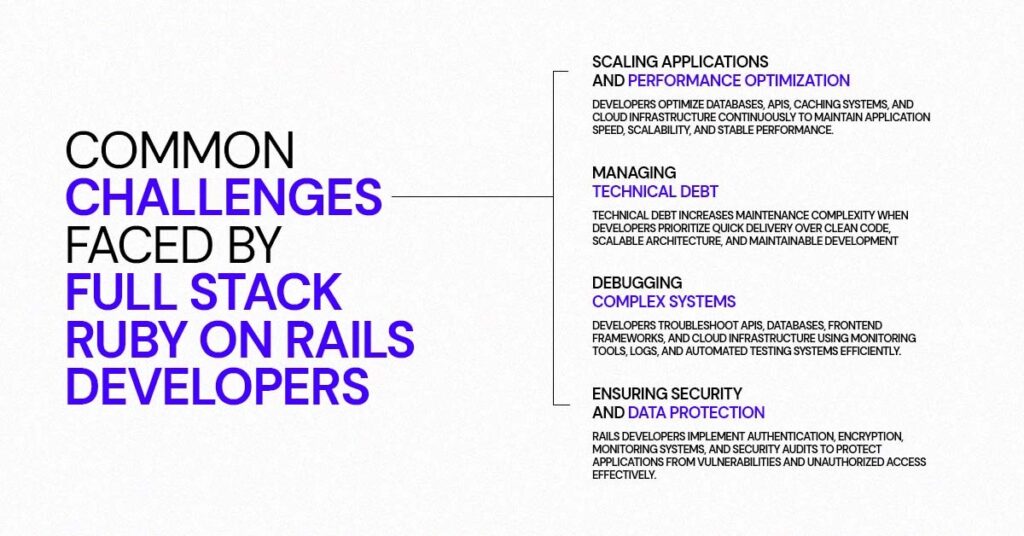
- Scaling Applications and Performance Optimization
Developers optimize databases, APIs, caching systems, and cloud infrastructure continuously to maintain application speed, scalability, and stable performance. - Managing Technical Debt
Technical debt increases maintenance complexity when developers prioritize quick delivery over clean code, scalable architecture, and maintainable development practices. - Debugging Complex Systems
Developers troubleshoot APIs, databases, frontend frameworks, and cloud infrastructure using monitoring tools, logs, and automated testing systems efficiently. - Ensuring Security and Data Protection
Rails developers implement authentication, encryption, monitoring systems, and security audits to protect applications from vulnerabilities and unauthorized access effectively.
Best Practices for Full Stack Ruby on Rails Development
| Best Practice | Description |
| Writing Clean, DRY, and Maintainable Code | Developers follow clean code practices, reusable modules, and DRY principles to improve scalability, readability, maintainability, and long-term software performance. |
| Following MVC Design Pattern | MVC architecture separates application logic, frontend interfaces, and databases efficiently while improving maintainability, debugging speed, and scalable backend development workflows. |
| Test-Driven Development (TDD) | TDD helps developers reduce production errors by writing automated tests before development while improving software quality and debugging efficiency consistently. |
| Continuous Integration and Deployment | CI/CD practices automate testing and deployments efficiently while improving release speed, software reliability, scalability, and long-term application maintenance processes. |
Popular Frameworks and Alternatives to Ruby on Rails
- Django vs Ruby on Rails
Django and Ruby on Rails support scalable web development, but Django emphasizes security while Rails prioritizes rapid development workflows. - Node.js vs Rails
Node.js supports asynchronous and real-time backend systems, while Rails focuses on structured and convention-driven web development architecture. - Laravel vs Rails
Laravel provides flexible PHP-based backend development, while Rails emphasizes productivity, maintainability, and rapid application development processes.
Future of Full Stack Ruby on Rails Development
Rise of Hotwire and Modern Rails Frontend
Hotwire modernizes Rails frontend development by reducing dependency on heavy JavaScript frameworks. Furthermore, developers create faster interfaces with server-rendered updates and minimal frontend complexity. Additionally, Turbo and Stimulus improve responsiveness while maintaining Rails simplicity. Modern Rails frontend architecture improves performance, scalability, and developer productivity for web applications and SaaS platforms significantly.
AI Integration in Web Development
AI integration continues transforming modern web development workflows and software automation. Furthermore, developers use AI tools for debugging, code suggestions, and testing optimization. Additionally, AI-powered applications improve personalization, analytics, and customer experiences. Ruby on Rails developers increasingly integrate machine learning APIs and automation systems into scalable applications and cloud-native software products globally.
Cloud-Native and Microservices Architecture
Cloud-native apps and microservices architecture continue shaping scalable software development. Furthermore, developers separate services into independent modules for flexibility and easier maintenance. Additionally, cloud platforms improve scalability, deployment speed, and infrastructure reliability. Ruby on Rails integrates effectively with APIs, Docker containers, and cloud-native systems for enterprise-grade applications and SaaS development environments.
Long-Term Demand for Rails Developers
Ruby on Rails developers remain in demand across startups, SaaS companies, and enterprise software businesses. Furthermore, Rails supports rapid MVP development and scalable backend architecture efficiently. Additionally, businesses value experienced full stack engineers who manage frontend, backend, APIs, and cloud deployment systems. Long-term demand continues growing alongside digital transformation and cloud-native application development.
Portfolio Project Ideas for Ruby on Rails Developers
Build a SaaS Application with Subscription Model
Building a SaaS application helps developers understand scalable backend systems and subscription workflows. Furthermore, projects include authentication, billing systems, dashboards, and API integration. Additionally, SaaS app development improves deployment and cloud infrastructure knowledge. These portfolio projects demonstrate real-world business application experience and strengthen GitHub portfolios for technical hiring opportunities significantly.
Create an E-commerce Platform
E-commerce projects help developers practice payment systems, product management, and responsive frontend design. Furthermore, developers implement authentication, inventory systems, and checkout workflows within scalable applications. Additionally, marketplace functionality improves backend architecture and API integration skills. E-commerce portfolio projects demonstrate practical web development expertise for startups and enterprise software environments effectively.
Develop a Social Networking App
Social networking applications help developers learn real-time communication and user engagement systems. Furthermore, developers create messaging features, notifications, profiles, and content feeds using Rails APIs. Additionally, these projects improve frontend interaction and database optimization skills. Social networking apps strengthen portfolio projects by showcasing scalable architecture and responsive application development experience effectively.
Build RESTful API Services
RESTful API projects improve backend development and microservices architecture understanding. Furthermore, developers create secure endpoints, authentication systems, and JSON responses for frontend or mobile applications. Additionally, API development strengthens integration skills with cloud platforms and third-party services. These portfolio projects demonstrate backend architecture expertise and scalable application development capabilities for employers.
Certifications and Courses for Ruby on Rails Developers
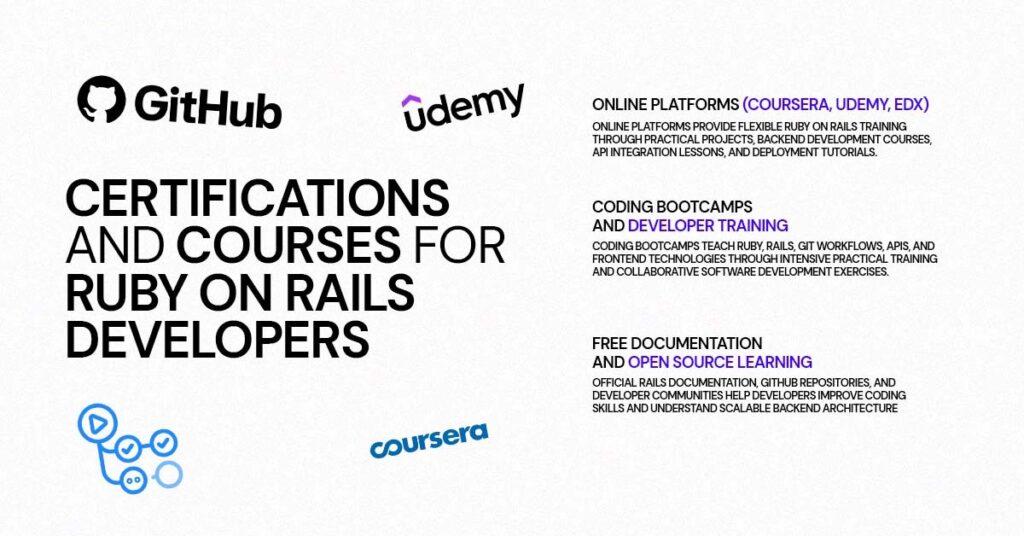
- Online Platforms (Coursera, Udemy, edX)
Online platforms provide flexible Ruby on Rails training through practical projects, backend development courses, API integration lessons, and deployment tutorials. - Coding Bootcamps and Developer Training
Coding bootcamps teach Ruby, Rails, Git workflows, APIs, and frontend technologies through intensive practical training and collaborative software development exercises. - Free Documentation and Open Source Learning
Official Rails documentation, GitHub repositories, and developer communities help developers improve coding skills and understand scalable backend architecture concepts.
FAQs About Full Stack Ruby on Rails Developer
What does a Full Stack Ruby on Rails Developer do?
A Full Stack Ruby on Rails developer builds frontend interfaces, backend systems, APIs, databases, and manages scalable web application deployments efficiently.
Is Ruby on Rails still relevant in modern web development?
Ruby on Rails remains relevant because it supports rapid development, scalable applications, maintainable architecture, and efficient cloud-based deployment workflows globally.
How long does it take to learn Rails?
Learning Rails usually takes several months, depending on consistency, programming knowledge, practical projects, and structured online learning or coding bootcamps.
What companies use Ruby on Rails?
Startups, SaaS companies, marketplaces, and enterprise businesses use Ruby on Rails for scalable, maintainable, and high-performance web application development.
Can beginners learn Rails easily?
Yes, beginners learn Rails easily because of readable syntax, strong documentation, supportive communities, and beginner-friendly development conventions and workflows.
What is the average salary of a Rails developer?
Rails developer salaries vary globally, but experienced full stack developers usually earn competitive salaries across startups, enterprises, and remote opportunities.
Conclusion
A Full Stack Ruby on Rails developer manages every layer of modern web applications. These professionals combine frontend development, backend architecture, database management, testing, and deployment expertise into one role. Furthermore, Ruby on Rails continues supporting scalable applications, SaaS platforms, and startup products worldwide. Additionally, modern technologies like Hotwire, Docker, CI/CD pipelines, and cloud deployment improve the flexibility of Rails development.
The demand for skilled full stack engineers remains strong across startups, enterprises, FinTech, HealthTech, and e-commerce industries. Therefore, learning Ruby, Rails, APIs, frontend frameworks, and DevOps tools creates strong career opportunities. Additionally, companies like Techstack Digital continue supporting scalable software development through modern web technologies and cloud-native solutions. Developers who build portfolio projects, contribute to open source, and master scalable architecture gain long-term advantages in the software development industry.