
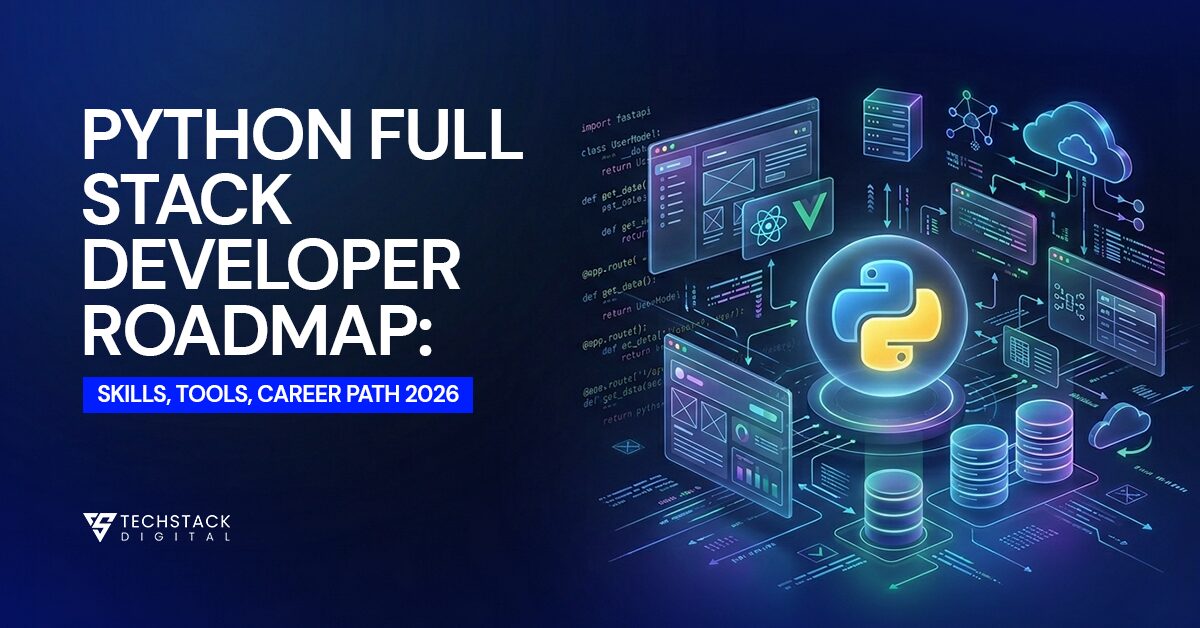
TL;DR – Quick Summary
This guide explains how to become a python full stack developer by covering every essential skill required to build, deploy, and scale modern web applications. It starts with full stack fundamentals, explaining how frontend, backend, databases, and deployment work together, and highlights Python’s role through frameworks like Django, Flask, and FastAPI.
The roadmap outlines prerequisites such as programming basics, algorithms, data structures, and command-line skills. It then dives into core Python concepts, including syntax, OOP, exception handling, libraries, file handling, and testing with Unittest and PyTest. Front-end foundations like HTML, CSS, JavaScript, React, responsive design, and API integration are clearly covered.
On the backend side, it explains databases (PostgreSQL, MySQL, MongoDB, Redis), API design (REST, GraphQL, WebSockets), authentication (JWT, OAuth), and server-side scripting. Deployment and DevOps topics include cloud platforms (AWS, Google Cloud, Azure), Docker, Kubernetes, CI/CD pipelines, and server management.
The guide also covers version control, debugging, advanced Python topics, tools, soft skills, real-world projects, career growth, and future trends like AI/ML integration. It concludes by explaining why structured learning, hands-on projects, and system-level thinking are critical, and why companies like Techstack Digital often look to Hire Python Full stack developer roles for scalable, long-term solutions.
Python Full Stack Developer Roadmap: Skills, Tools, Career Path 2026
Overview of Full Stack Development
Full stack development covers both client-side and server-side responsibilities. It focuses on building complete web applications, from the interface to the infrastructure. Developers handle user experience, server logic, databases, and deployment. Furthermore, full stack development improves development speed and ownership. Teams reduce handoffs and bottlenecks. Additionally, companies prefer professionals who understand the entire product lifecycle. This approach supports faster iteration and better decision-making. Modern businesses rely on full stack roles to align design, performance, and scalability. The demand continues to rise across startups and enterprises.
Role of Python in Full Stack Development
Python plays a central role in modern full stack development. It offers clean syntax and strong community support. Furthermore, Python enables rapid development and easy maintenance. Developers use it for APIs, business logic, and data processing. Additionally, popular frameworks such as Django, Flask, and FastAPI make backend development more efficient. Python integrates well with databases, cloud services, and front-end tools. This flexibility makes Python suitable for scalable applications and startups. Many teams choose Python for long-term projects due to readability and reliability.
Importance of a Roadmap for Aspiring Python Developers
A clear python python for web development roadmap provides structure and direction. It helps learners avoid confusion and skill gaps. Furthermore, a roadmap prioritizes concepts in the correct order. Beginners understand what to learn and when to practice. Additionally, structured learning saves time and effort. It aligns skills with real-world requirements. For anyone aiming to grow into a python full stack developer, a roadmap ensures consistent progress. It also improves confidence and employability by focusing on industry-relevant skills.
Prerequisites for Becoming a Python Full Stack Developer
Basic Programming Skills
Strong programming fundamentals form the base of development. Learners must understand variables, loops, conditions, and functions. Furthermore, clear logic improves code quality and debugging. Python makes learning easier through its readable syntax. Additionally, understanding data types and control flow helps across all frameworks. These basics support future learning in APIs, databases, and testing. Without fundamentals, advanced topics become difficult. Consistent practice builds confidence and accuracy in coding decisions.
Understanding of Algorithms and Data Structures
Algorithms and data structures improve problem-solving ability. They help developers write efficient and scalable code. Furthermore, concepts like arrays, lists, stacks, and queues appear frequently in applications. Additionally, understanding time and space complexity supports performance optimization. Interview processes also test these skills heavily. For backend logic and API design, strong data handling matters. This knowledge strengthens architectural thinking and system design.
Basic Command Line Skills
Command line skills improve productivity. Developers use terminals to manage files, run servers, and install packages. Furthermore, tools like Git and Docker rely on command-line usage. Additionally, basic Linux commands help during deployment and server management. Understanding navigation, permissions, and processes saves time. Command line familiarity supports automation and scripting. It also prepares developers for cloud and DevOps workflows.
Core Python Skills
Python Syntax and Semantics
Python syntax emphasizes clarity and simplicity. Developers must understand indentation, functions, and modules. Furthermore, clean syntax reduces bugs and improves readability. Additionally, understanding semantics ensures correct behavior in applications. Python encourages writing explicit and maintainable code. These skills apply across scripting, APIs, and automation tasks. Mastery of syntax builds confidence for advanced frameworks.
Object-Oriented Programming (OOP) in Python
OOP structures code using classes and objects. It improves reusability and organization. Furthermore, concepts like inheritance and polymorphism support scalable design. Additionally, OOP simplifies complex systems by dividing responsibilities. Most Python frameworks rely on OOP principles. Understanding this paradigm helps in writing clean and testable code. It also improves collaboration in large projects.
Exception Handling
Exception handling ensures application stability. Developers manage errors using try and except blocks. Furthermore, proper handling prevents crashes and data loss. Additionally, meaningful error messages improve debugging. Exception handling supports reliable APIs and user-friendly applications. It also enhances logging and monitoring. Robust error control reflects professional development practices.
Working with Libraries (Standard and Third-Party)
Python offers extensive libraries for various tasks. Standard libraries handle files, math, and networking. Furthermore, third-party libraries extend functionality. Additionally, package management through pip simplifies dependency handling. Libraries speed up development and reduce duplication. Knowing when and how to use them matters. This skill supports rapid and efficient application building.
File Handling and I/O Operations
File handling manages data storage and retrieval. Python supports reading and writing files easily. Furthermore, file operations support logging, configuration, and data processing. Additionally, understanding file modes and paths prevents errors. These skills apply to backend services and automation scripts. Proper file handling ensures data integrity and security.
Testing in Python
Unit Testing
Unit testing verifies individual components. It ensures functions behave as expected. Furthermore, unit tests reduce regressions during updates. Additionally, they support maintainable codebases. Python’s unittest framework provides built-in tools. Testing improves confidence and reliability.
PyTest
PyTest simplifies testing with clean syntax. It supports fixtures and parameterized tests. Furthermore, PyTest improves test readability. Additionally, it integrates well with CI pipelines. Many teams prefer PyTest for modern projects.
Front-End Development for Python Full Stack Developers
Basic Web Technologies:
HTML, CSS, JavaScript Basics
HTML structures content. CSS styles layouts. JavaScript adds interactivity. Furthermore, these technologies define user experience. Additionally, understanding them helps backend developers collaborate better. They form the foundation of user-facing applications.
DOM Manipulation
DOM manipulation updates web pages dynamically. JavaScript handles events and data rendering. Furthermore, this improves responsiveness. Additionally, it enables interactive features. Backend developers benefit from understanding client behavior.
JavaScript Frameworks:
React.js (or Angular/Vue.js alternatives)
Frameworks simplify UI development. React uses component-based architecture. Furthermore, it improves performance and reuse. Additionally, frameworks integrate well with APIs. They dominate modern front-end development.
Integrating Front-End with Back-End
APIs connect front-end and back-end. JSON handles data exchange. Furthermore, integration ensures smooth user flows. Additionally, proper validation improves security. This connection defines full stack functionality.
Responsive Design:
CSS Frameworks (Bootstrap, Tailwind CSS)
Frameworks speed up styling by offering reusable components. Furthermore, they ensure visual consistency across interfaces. Additionally, responsive layouts improve accessibility, usability, and performance on different screen sizes and devices.
Mobile-First Design
Mobile-first design prioritizes small screens. Furthermore, it improves performance. Additionally, search engines favor mobile-friendly sites. This approach enhances usability.
Python Web Frameworks
Django:
Features and Use Cases
Django offers a full-featured framework. It includes authentication, ORM, and admin panels. Furthermore, Django suits large applications. Additionally, it emphasizes security and scalability.
Setting up and Building Django Projects
Django provides a structured project setup. Developers follow conventions. Furthermore, this reduces setup time. Additionally, built-in tools speed development.
Django ORM (Object-Relational Mapping)
ORM abstracts database queries. Developers use Python objects instead of SQL. Furthermore, ORM improves productivity. Additionally, it reduces errors.
Flask:
Lightweight Framework Overview
Flask offers flexibility and simplicity for small to medium projects. Furthermore, it allows custom architecture. Additionally, it supports microservices without enforcing strict conventions or heavy abstractions.
Flask Extensions (Flask-SQLAlchemy, Flask-WTF)
Flask extensions add essential features like database handling and forms. Furthermore, they keep applications lightweight. Additionally, developers include only required components, maintaining flexibility and control.
Building RESTful APIs with Flask
Flask simplifies building RESTful APIs with clear routing and JSON responses. Furthermore, APIs support web and mobile apps. Additionally, Flask integrates easily with third-party tools and services.
FastAPI:
FastAPI vs Django and Flask
FastAPI focuses on high performance and speed. Furthermore, it supports asynchronous operations and automatic documentation. Additionally, it suits modern, scalable APIs better than traditional frameworks.
Asynchronous Programming with FastAPI
Asynchronous programming improves scalability and responsiveness. FastAPI uses async and await syntax. Furthermore, it handles high traffic efficiently. Additionally, it supports real-time, concurrent service architectures.
Back-End Development (Server-Side)
Databases:
Relational Databases (PostgreSQL, MySQL)
Relational databases store structured data with strong consistency. Furthermore, they support transactions and integrity. Additionally, SQL enables complex queries, making them ideal for enterprise-grade applications.
NoSQL Databases (MongoDB, Redis)
NoSQL databases manage unstructured data with high flexibility. Furthermore, Redis supports fast in-memory caching. Additionally, they improve performance and scalability for modern distributed applications.
Database Design and Optimization
Effective database design ensures scalability and reliability. Furthermore, indexing improves query speed. Additionally, normalization reduces redundancy, while optimization lowers operational costs and improves overall system performance.
ORM vs SQL Querying
ORM simplifies database interactions and speeds development. Furthermore, SQL offers precise control and optimization. Additionally, choosing between them depends on complexity, performance needs, and use cases.
APIs:
RESTful API Design and Principles
REST defines clear architectural conventions that improve maintainability. Furthermore, APIs enable seamless system integration. Additionally, REST supports scalability and predictable communication between distributed services.
GraphQL APIs (Alternatives to REST)
GraphQL enables flexible, client-driven queries that reduce over-fetching. Furthermore, it suits complex data relationships. Additionally, adoption is growing in modern, data-intensive applications.
WebSockets for Real-Time Communication
WebSockets enable real-time communication for chats and live updates. Furthermore, they improve user engagement. Additionally, persistent connections reduce latency compared to traditional request-response models.
Authentication & Authorization (JWT, OAuth)
Authentication and authorization protect sensitive data. JWT manages secure tokens. OAuth enables third-party access. Additionally, strong security mechanisms are critical for modern web applications.
Server-side Scripting with Python:
Handling HTTP Requests
Python frameworks handle HTTP requests and responses efficiently. Furthermore, routing manages endpoints. Middleware performs validation, authentication, logging, and request preprocessing across application layers.
Working with APIs and Integrations
APIs and integrations connect multiple services seamlessly. Python consumes and exposes APIs effectively. This supports microservices architecture. Additionally, integrations enable automation and scalable system communication.
Web Hosting and Deployment:
Deploying Python Applications on Cloud Platforms (AWS, Google Cloud, Heroku)
Cloud platforms provide scalable infrastructure and automation. Deployment pipelines reduce downtime. Additionally, cloud expertise increases employability and supports reliable, production-ready Python application deployments.
Continuous Integration and Deployment (CI/CD) with GitHub Actions
CI/CD automates testing and deployment workflows. Furthermore, it improves reliability and consistency. Additionally, teams release features faster with reduced errors and improved development efficiency.
Version Control
Git and GitHub Basics
Git tracks code changes over time, while GitHub hosts repositories. Furthermore, version control supports collaboration. Additionally, it prevents code loss and simplifies teamwork across distributed development teams.
Working with Branches, Merges, and Pull Requests
Branches isolate features for safe development. Pull requests enable reviews. Furthermore, merges combine work. Additionally, this workflow ensures code quality and reduces integration conflicts.
Best Practices in Version Control
Clear commit messages improve understanding and traceability. Regular pushes prevent data loss. Furthermore, consistent naming conventions matter. Additionally, proper documentation helps teams collaborate effectively.
Collaborating on Open-Source Projects
Open-source collaboration builds practical experience and industry exposure. Developers learn from others. Furthermore, contributions improve professional visibility. Additionally, they strengthen portfolios and technical credibility.
Explore More
Also Learn about What Exactly is a Full-stack Developer Meaning?
Testing and Debugging
Unit Testing with PyTest and Unittest
Unit testing ensures code correctness and reliability. Both PyTest and Unittest support automated testing workflows. Furthermore, tests catch bugs early. Additionally, they improve developer confidence, maintainability, and long-term application stability.
TDD (Test-Driven Development)
Test-driven development starts by writing tests before code. It clarifies requirements early. Furthermore, TDD reduces defects. Additionally, it improves code design, readability, and long-term maintainability across projects.
Integration Testing and End-to-End Testing
Integration testing verifies interactions between components, while end-to-end testing simulates real user workflows. Furthermore, these tests ensure system reliability. Additionally, they prevent regressions during updates and feature releases.
Debugging Python Code and Common Pitfalls
Debugging helps identify logic and runtime issues efficiently. Tools, logs, and breakpoints support analysis. Furthermore, common pitfalls include scope errors and assumptions. Additionally, experience significantly reduces repeated mistakes.
Deployment and DevOps Skills
Cloud Platforms:
AWS, Google Cloud, and Microsoft Azure Basics
Cloud platforms host applications and provide scalability. Furthermore, cloud knowledge improves deployment efficiency. Additionally, widespread adoption makes cloud skills essential for modern full stack development roles.
Docker for Containerization
Docker packages applications with dependencies to ensure consistency. Furthermore, containers simplify deployment workflows. Additionally, Docker enables microservices architectures and reliable environment replication across teams.
Kubernetes for Orchestration
Kubernetes orchestrates containers by managing scaling, networking, and recovery. Furthermore, it supports large distributed systems. Additionally, Kubernetes is the industry standard for container orchestration today.
CI/CD Pipelines:
Setting up Automated Pipelines for Testing and Deployment
Automated pipelines reduce human errors and run tests automatically. Furthermore, deployments become predictable. Additionally, teams deliver features faster with consistent, repeatable release processes.
Jenkins and GitLab CI/CD
Jenkins and GitLab CI/CD manage automated pipelines efficiently. They integrate with repositories. Furthermore, they support customization. Additionally, both scale well for small and enterprise teams.
Server Management:
Virtual Private Servers (VPS) vs Cloud Instances
VPS offers simplicity and predictable costs, while cloud instances provide scalability. Furthermore, choice depends on workload requirements. Additionally, budget, flexibility, and growth plans matter.
Nginx vs Apache Server Configuration
Nginx efficiently handles high traffic and concurrency, while Apache offers flexibility. Furthermore, both serve web applications. Additionally, proper configuration knowledge impacts performance and security.
Load Balancing and Autoscaling
Load balancing distributes traffic evenly across servers. Autoscaling adjusts resources automatically. Furthermore, these improve availability. Additionally, they reduce downtime during traffic spikes.
Advanced Python Topics
Asynchronous Programming with Asyncio
Asyncio manages concurrent tasks efficiently and improves performance. Furthermore, async supports I/O-bound operations. Additionally, it suits high-throughput APIs and real-time, event-driven Python applications.
Concurrency and Parallelism
Concurrency manages multiple tasks efficiently, while parallelism uses multiple CPU cores. Furthermore, both improve performance. Additionally, Python provides threading, multiprocessing, and async tools.
Python Design Patterns
Python design patterns solve recurring problems and improve code structure. Furthermore, they enhance maintainability. Additionally, patterns guide clean architecture and scalable application design decisions.
Microservices Architecture with Python
Microservices divide applications into independent services handling single responsibilities. Furthermore, this improves scalability and resilience. Additionally, Python frameworks support building, deploying, and maintaining microservices efficiently.
Tools for Full Stack Python Developers
Code Editors and IDEs
VSCode
VSCode offers powerful extensions and built-in debugging support. Furthermore, it improves developer productivity. Additionally, it is lightweight, fast, and suitable for diverse development workflows.
PyCharm
PyCharm provides advanced development features and intelligent refactoring. Furthermore, it suits large projects. Additionally, it integrates testing, debugging, and version control tools effectively.
Debugging and Profiling Tools
PDB
PDB debugs Python code by inspecting variables and execution flow. Furthermore, it helps trace issues step by step. Additionally, it is built-in and lightweight.
cProfile
cProfile analyzes application performance and identifies bottlenecks. Furthermore, profiling guides optimization decisions. Additionally, it supports scaling by improving execution speed and efficiency.
Package Management with pip and virtualenv
pip manages and installs Python packages efficiently from repositories. virtualenv creates isolated environments for projects. Furthermore, isolation prevents dependency conflicts. Additionally, it supports reproducibility, consistent deployments, easier debugging, and safer experimentation across multiple Python applications.
Soft Skills and Collaboration
- Communication and Teamwork
Clear communication improves outcomes and alignment. Furthermore, collaboration reduces errors and misunderstandings. Additionally, strong teamwork increases efficiency, trust, and overall team morale. - Agile Methodology and Scrum
Agile supports continuous iteration and improvement. Scrum organizes tasks into sprints. Furthermore, teams deliver faster. Additionally, Agile adapts effectively to changing requirements. - Problem Solving and Logical Thinking
Problem-solving drives effective development decisions. Logical thinking improves solution quality. Furthermore, challenges require structured analysis. Additionally, consistent practice sharpens reasoning and technical judgment. - Time Management
Time management ensures consistent productivity and focus. Prioritization helps manage workload. Furthermore, meeting deadlines requires discipline. Additionally, maintaining balance prevents burnout and long-term fatigue.
Building Real-World Projects
Personal Portfolio Projects
Build real-world projects like a task management system, e-commerce store, or blog platform. For example, create a Django-based job board with authentication, payments, and admin dashboards to demonstrate end-to-end ownership.
Contributing to Open Source Projects
Contribute bug fixes or features to libraries like Django, Flask extensions, or FastAPI tools. For example, improving documentation or fixing issues in a GitHub repository shows collaboration skills and real production exposure.
Building Full Stack Web Applications
Develop applications such as SaaS dashboards, booking systems, or CRM tools. For instance, build a React frontend with a FastAPI backend, PostgreSQL database, authentication, and cloud deployment to mirror real business products.
Case Studies: Real-World Applications and Projects
A common real-world application is a customer management system built for a local business. It handles user authentication, customer records, billing, and reporting using Django, PostgreSQL, and role-based access.
Another example is a booking and scheduling platform for clinics or salons. It includes real-time availability, notifications, payment integration, and admin dashboards using FastAPI, React, and cloud deployment.
A third example is an analytics dashboard for marketing teams. It aggregates data from APIs, processes it with Python, stores it in a database, and visualizes insights for decision-making.
Career Growth and Specializations
Transitioning from Junior to Senior Developer
Transitioning from junior to senior developer requires hands-on experience and deeper system understanding. Seniors design scalable architectures. Furthermore, leadership and decision-making matter. Additionally, mentoring juniors, reviewing code, and aligning technical choices with business goals become key responsibilities.
Full Stack Developer vs. Back-End or Front-End Developer
Full stack developers work across frontend and backend, while specialists focus deeply on one layer. Furthermore, career choice depends on interests and strengths. Additionally, both paths offer growth, competitive salaries, and long-term opportunities across different industries.
Continuous Learning and Keeping Up with New Technologies
Technology evolves rapidly, making continuous learning essential. Developers must follow trends, tools, and frameworks. Furthermore, staying updated improves problem-solving ability. Additionally, adaptability ensures long-term relevance and career stability in fast-changing software development environments.
Freelancing vs. Full-Time Employment
Freelancing offers flexibility, independence, and diverse projects. Full-time employment provides stability, benefits, and structured growth. Furthermore, both paths have trade-offs. Additionally, personal goals, risk tolerance, and lifestyle preferences guide the right career choice.
Industry Trends and Future of Python in Full Stack Development
The Growing Role of Python in Full Stack Development
Python adoption continues to grow across industries due to scalability and simplicity. Furthermore, startups favor rapid development. Additionally, enterprises adopt Python widely for maintainable, secure, and long-term full stack application architectures.
Integration of AI/ML with Full Stack Python Applications
AI and machine learning enhance modern applications significantly. Python leads with mature AI libraries. Furthermore, integration enables intelligent systems. Additionally, demand increases for data-driven, automated, and adaptive full stack solutions.
The Future of Web Development with Python
Python remains highly relevant in python for web development. Frameworks continue to evolve. Furthermore, performance improves steadily. Additionally, Python supports innovation through strong ecosystems, community growth, and seamless integration with emerging technologies.
What exactly is a full-stack developer meaning?
FAQs for Python Roadmap
What is a Python Full Stack Developer?
A professional who builds, maintains, and deploys complete web applications using Python across frontend, backend, and infrastructure layers.
Do I need to learn both front-end and back-end technologies to become a Full Stack Developer?
Yes, full stack development requires understanding user interfaces, server logic, databases, and deployment to build complete applications.
Which Python web framework should I learn first?
Django suits beginners due to structure, while Flask offers flexibility for smaller, custom applications and learning core concepts.
How important is front-end development for a Python Full Stack Developer?
Front-end development is critical for usability, performance, and seamless integration between user interfaces and backend systems.
What databases should I learn as a Python Full Stack Developer?
Start with PostgreSQL and MySQL for relational data, then explore MongoDB for flexible, document-based storage needs.
Do I need to learn cloud technologies for Python development?
Yes, cloud skills enable scalable deployment, automation, monitoring, and real-world production readiness for Python applications.
How long does it take to become a Python Full Stack Developer?
With consistent practice and projects, most learners reach job-ready skills within eight to twelve months.
What tools do I need as a Python Full Stack Developer?
You need IDEs, Git, Docker, testing frameworks, package managers, and cloud platforms for development and deployment.
Should I learn Agile and Scrum as a Python Full Stack Developer?
Yes, Agile and Scrum improve collaboration, planning, and delivery in most modern software development teams.
Is learning Python enough to become a Full Stack Developer?
No, you must also learn frontend technologies, databases, APIs, version control, and deployment practices.
What types of projects should I build to gain experience as a Python Full Stack Developer?
Build CRUD applications, dashboards, REST APIs, authentication systems, and complete full stack products.
What are some common mistakes to avoid as a Python Full Stack Developer?
Skipping fundamentals, avoiding testing, poor documentation, and ignoring scalability are frequent and costly mistakes.
Can I work as a Full Stack Developer without learning JavaScript?
No, JavaScript is essential for frontend interactivity, browser logic, and modern user experience development.
What are the best resources to learn Python Full Stack Development?
Official documentation, structured online courses, coding bootcamps, tutorials, and building real-world projects consistently.
Conclusion
Becoming a python full stack developer requires structured learning, consistent practice, and real-world exposure. A clear roadmap simplifies this journey and aligns skills with industry needs. Python offers flexibility, scalability, and strong ecosystem support. Furthermore, combining backend expertise with frontend understanding creates high-value professionals. Additionally, cloud, testing, and DevOps skills enhance career growth. Many companies, including Techstack Digital, prefer developers who understand complete systems. Businesses often look to Hire Python Full stack devloper roles for long-term scalability. Following this roadmap supports sustainable growth, adaptability, and success in modern web development.