
TL;DR- Quick Summary
This blog explains the full-stack developer meaning in a clear, practical way for modern businesses and aspiring developers. It covers what a full-stack developer does, the difference between front-end and back-end responsibilities, and why full-stack roles matter in today’s fast-moving tech industry. The guide breaks down essential skills, core technologies, workflows, tools, career paths, salary trends, and future technologies shaping full-stack development in 2026 and beyond. It also compares full-stack developer meaning with specialists, outlines learning paths, portfolio building, and interview preparation, and includes real-world examples from startups, enterprises, and open-source projects. Overall, the article helps readers understand why full-stack developers are in high demand and how they drive faster, scalable, and more aligned digital product development.
Full-Stack Developer Meaning Explained: Skills, Roles, Career Path 2026
Modern digital products demand speed, flexibility, and technical depth. As a result, companies increasingly rely on professionals who understand the entire development lifecycle. This is where Techstack Digital often explains the importance of clarity around the full-stack developer meaning for modern brands and startups. A full-stack professional does not operate in silos. Instead, they understand how user interfaces connect with servers, databases, and deployment systems.
Furthermore, they help teams move faster by reducing dependency gaps. Additionally, businesses benefit from better collaboration and technical alignment. This article explains the full-stack developer’s role in simple terms, why the role matters today, and how it shapes modern software development decisions across industries.
Overview of Full-Stack Development
Brief definition and role of a full-stack developer
The full-stack developer refers to a professional who can work across the entire software stack. This includes client-side interfaces, server-side logic, databases, and infrastructure. Rather than focusing on a single narrow area, this role integrates all layers into a working system. Furthermore, full-stack professionals understand how data flows from user input to storage and back to presentation. Additionally, they write code that balances performance, usability, and maintainability. Their role often includes building features end-to-end, fixing issues across layers, and supporting deployment workflows. This broad capability makes them valuable in agile teams where ownership and speed matter.
Significance in today’s tech industry
Today’s tech industry prioritizes rapid iteration and scalable systems. Therefore, understanding the full stack developer meaning becomes essential for companies building digital products. Furthermore, startups often operate with lean teams that require versatile contributors. Additionally, enterprises adopt cross-functional teams to reduce handoffs and delays. A full-stack mindset improves communication between design, engineering, and operations. It also supports better architectural decisions because developers see the full impact of their choices. As technology stacks grow more complex, professionals who can navigate them holistically remain in high demand.
What Does a Full-Stack Developer Do?
Understanding Full-Stack Development
Front-end vs. back-end: The two sides of full-stack
Front-end development focuses on what users see and interact with. It includes layout, styling, responsiveness, and interactivity. Back-end development handles logic, data processing, authentication, and system integration. The full-stack developer meaning sits at the intersection of both. Furthermore, this balance ensures that visual features connect correctly to data and services. Additionally, understanding both sides helps developers troubleshoot issues faster and design better workflows.
The full-stack developer’s responsibility in both areas
A full-stack professional takes responsibility for features from concept to release. This includes UI behavior, API logic, database design, and deployment readiness. Furthermore, they ensure consistency between user expectations and system behavior. Additionally, they often collaborate with designers, testers, and product managers. This responsibility encourages ownership and accountability across the product lifecycle.
Key Skills for Full-Stack Developers
Technical skills (languages, frameworks, and tools)
Technical skills form the foundation of full-stack work. Developers use programming languages, frameworks, databases, and cloud tools daily. Furthermore, they must understand architecture patterns and security basics. Additionally, they adapt quickly as tools evolve. Strong fundamentals matter more than memorizing every framework.
Soft skills (problem-solving, teamwork, communication)
Soft skills amplify technical ability. Problem-solving helps developers break down complex requirements. Furthermore, communication ensures alignment across teams. Additionally, teamwork allows full-stack professionals to integrate smoothly into agile environments. These skills often define long-term success more than tools alone.
Core Technologies a Full-Stack Developer Needs to Know
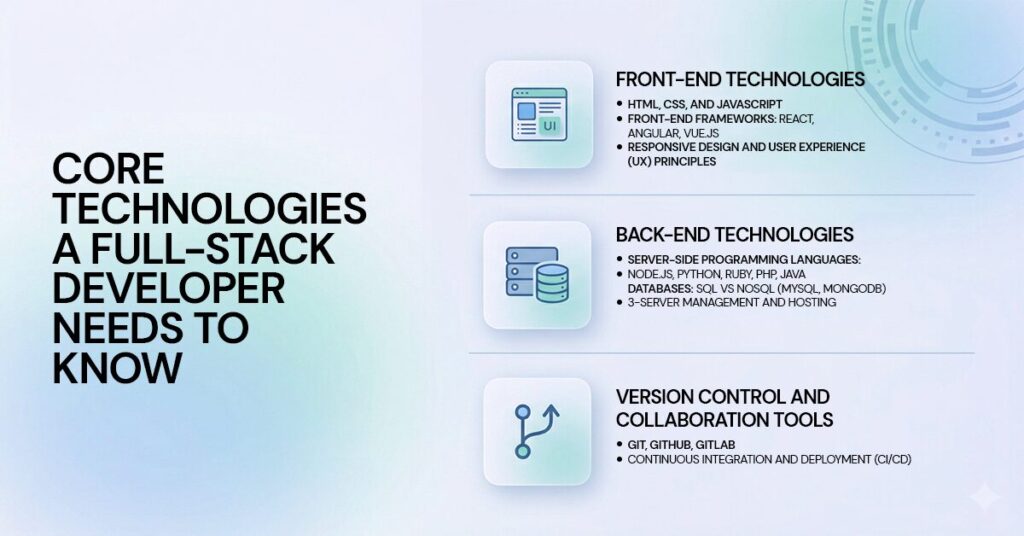
Front-End Technologies
HTML, CSS, and JavaScript
HTML structures content. CSS controls layout and visual style. JavaScript adds logic and interactivity. Together, they form the core of front-end development. Furthermore, understanding these basics ensures accessible and responsive interfaces. Additionally, clean front-end code improves performance and user satisfaction.
Front-end frameworks: React, Angular, Vue.js
Frameworks simplify UI development by promoting reusable components. They also improve state management and scalability. Furthermore, frameworks support large applications with consistent patterns. Additionally, they integrate well with modern tooling ecosystems.
Responsive design and user experience (UX) principles
Responsive design adapts layouts across devices. UX principles focus on clarity, usability, and accessibility. Furthermore, full-stack professionals must align technical decisions with user needs. Additionally, good UX reduces friction and improves engagement.
Back-End Technologies
Server-side programming languages: Node.js, Python, Ruby, PHP, Java
Server-side languages handle logic and integrations. They process requests, apply rules, and communicate with databases. Furthermore, choosing the right language depends on scalability and team expertise. Additionally, understanding multiple languages improves adaptability.
Databases: SQL vs NoSQL (MySQL, MongoDB)
Databases store and retrieve data efficiently. SQL systems offer structured schemas. NoSQL systems provide flexibility for evolving data. Furthermore, understanding trade-offs helps design reliable systems. Additionally, proper indexing and modeling improve performance.
Server management and hosting
Server management includes deployment, scaling, and monitoring. Hosting platforms support availability and reliability. Furthermore, knowledge of infrastructure reduces production risks. Additionally, automation simplifies maintenance.
Version Control and Collaboration Tools
Git, GitHub, GitLab
Version control tracks changes and enables collaboration. Git-based platforms support code reviews and issue tracking. Furthermore, they promote transparency and accountability. Additionally, they form the backbone of modern development workflows.
Continuous integration and deployment (CI/CD)
CI/CD automates testing and deployment. This reduces manual errors and speeds up releases. Furthermore, automation ensures consistent environments. Additionally, it supports rapid iteration.
The Full-Stack Developer’s Workflow
End-to-End Project Workflow
From idea to deployment: A full-stack perspective
A full-stack workflow begins with understanding requirements. It moves through design, development, testing, and release. Furthermore, seeing the entire flow helps anticipate risks early. Additionally, it supports better estimation and planning.
The role of a full-stack developer at each stage
At each stage, the developer contributes technical insight. During planning, they advise feasibility. During development, they implement features. Furthermore, during deployment, they ensure stability. Additionally, they support monitoring and iteration.
Development Stages
Planning and wireframing
Planning defines scope and priorities. Wireframing visualizes structure. Furthermore, early alignment prevents rework. Additionally, it clarifies technical dependencies.
Development and testing
Development turns designs into working systems. Testing ensures quality and reliability. Furthermore, automated tests reduce regressions. Additionally, continuous feedback improves outcomes.
Deployment and monitoring
Deployment releases features to users. Monitoring tracks performance and errors. Furthermore, observability supports rapid fixes. Additionally, it informs future improvements.
Common Challenges Faced by Full-Stack Developers
Balancing both front-end and back-end demands
Balancing depth across layers requires discipline. Furthermore, prioritization prevents overload. Additionally, strong fundamentals support flexibility.
Staying up to date with rapidly changing technologies
Technology evolves quickly. Continuous learning becomes essential. Furthermore, focusing on principles reduces churn. Additionally, selective adoption avoids burnout.
Is Full-Stack Development Right for You?
Who Should Become a Full-Stack Developer?
Ideal personality traits and skill set
Curiosity, adaptability, and problem-solving define successful candidates. Furthermore, comfort with ambiguity helps. Additionally, communication skills matter in cross-functional teams.
Career prospects and demand in the job market
Demand remains strong across industries. Furthermore, companies value versatility. Additionally, career paths offer flexibility and growth.
Full-Stack vs. Specialized Developers
Comparison between full-stack and front-end or back-end developers
Specialists focus deeply on a single domain, while full-stack developer meaning to cover multiple layers. Furthermore, both roles deliver value. Additionally, the right choice depends on project complexity, team structure, and career objectives.
Pros and cons of being a generalist vs. a specialist
Generalists offer flexibility across systems, while specialists provide deep expertise. Furthermore, teams benefit from both approaches. Additionally, professionals often shift between generalist and specialist roles as their careers progress.
How to Become a Full-Stack Developer
Education and Learning Paths
Traditional degree vs. bootcamp vs. self-learning
Degrees build strong fundamentals, bootcamps accelerate entry into the field, and self-learning offers flexibility. Furthermore, consistent effort determines outcomes. Additionally, real-world practice ultimately matters more than the learning path.
Online resources, certifications, and degree programs
Online resources enable continuous skill development, while certifications validate expertise. Furthermore, structured programs provide direction. Additionally, hands-on projects reinforce concepts and demonstrate practical ability to employers.
Building a Portfolio
Importance of showcasing real-world projects
Real-world projects demonstrate practical capability and problem-solving ability. Furthermore, they show execution skills clearly. Additionally, strong portfolios communicate value to employers, support interviews, and build trust with freelance clients.
Platforms to build and share your portfolio (GitHub, personal websites)
GitHub showcases source code and collaboration history, while personal websites present project stories. Furthermore, clear documentation strengthens credibility. Additionally, online visibility increases professional reach and attracts new career opportunities.
Networking and Gaining Experience
Participating in open-source projects
Open-source participation strengthens collaboration skills and exposes developers to real-world codebases. Furthermore, it builds professional credibility. Additionally, contributing publicly expands networks and demonstrates initiative to potential employers and peers.
Internships, freelance work, and contributing to tech communities
Internships and freelance work provide hands-on experience and confidence. Communities offer mentorship and shared learning. Furthermore, exposure accelerates growth. Additionally, strong relationships often lead to long-term career opportunities.
Explore More
Also Learn about Python Full Stack Developer Roadmap
Common Tools and Frameworks Used by Full-Stack Developers
Popular Front-End Tools
JavaScript libraries and tools: jQuery, React, Angular
JavaScript libraries simplify development by standardizing patterns and workflows. Furthermore, strong ecosystems provide long-term support. Additionally, choosing the right library depends on application scale, performance needs, and team expertise.
CSS frameworks: Bootstrap, Tailwind CSS
CSS frameworks accelerate styling and maintain visual consistency. Furthermore, utility-first approaches increase flexibility and control. Additionally, they simplify responsive design, reduce custom CSS, and speed up front-end development workflows.
Popular Back-End Tools
Node.js, Express, Django, Flask
Back-end frameworks structure server-side logic and improve scalability and security. Furthermore, built-in conventions reduce development complexity. Additionally, strong community support ensures long-term stability, documentation quality, and access to reusable solutions.
RESTful APIs and GraphQL
APIs enable structured communication between systems. REST provides simplicity and predictability, while GraphQL offers flexibility. Furthermore, choosing the right approach impacts performance. Additionally, thoughtful API design improves long-term maintainability.
Development Environments and IDEs
Visual Studio Code, WebStorm, Sublime Text
Modern IDEs improve developer productivity through debugging tools and rich extensions. Furthermore, customization enhances daily workflows. Additionally, choosing a comfortable environment reduces friction, supports focus, and improves long-term efficiency in development tasks.
Job Opportunities for Full-Stack Developers
Demand in Various Industries
Tech, finance, healthcare, e-commerce, and more
Every digitally driven industry relies on full-stack capabilities to build, scale, and maintain applications. Furthermore, ongoing modernization and digital transformation increase demand across sectors. Additionally, developers who combine technical skills with domain knowledge deliver greater business value.
Freelance vs. full-time employment
Freelance work provides flexibility, autonomy, and project variety, while full-time roles offer stability, benefits, and structured growth. Furthermore, both career paths remain sustainable. Additionally, the right choice depends on personal goals, risk tolerance, and preferred work style.
Salary and Career Growth
Full-stack developer salary trends
Full-stack developer salaries remain competitive across global markets due to sustained demand. Furthermore, increased experience and proven delivery significantly raise earning potential. Additionally, compensation varies by region, industry, company size, and the complexity of technologies used.
Career progression (junior, mid-level, senior, lead roles)
Career growth follows increasing responsibility, technical depth, and business impact. Furthermore, senior and lead roles introduce architectural and leadership duties. Additionally, mentoring junior developers and guiding teams becomes a key expectation at advanced stages.
Tools and Technologies Full-Stack Developers Should Learn in 2026
Emerging Technologies
Artificial intelligence, machine learning integration
Artificial intelligence enhances modern applications through automation, personalization, and predictive insights. Integration requires strong data understanding and clean pipelines. Furthermore, AI-driven workflows increase operational value. Additionally, responsible and ethical implementation remains essential to ensure transparency, fairness, and long-term trust.
Serverless architecture and microservices
Serverless architecture reduces infrastructure overhead and simplifies scaling, while microservices improve system modularity. Furthermore, distributed systems demand disciplined design, communication, and testing. Additionally, strong observability and monitoring are critical for maintaining reliability and performance at scale.
Future Trends
WebAssembly, Progressive Web Apps (PWAs), JAMstack
WebAssembly, Progressive Web Apps, and JAMstack architectures improve performance, security, and global reach. Furthermore, they blur boundaries between web and native experiences. Additionally, growing adoption reflects demand for faster load times, offline support, scalability, and modern deployment workflows.
The Pros and Cons of Being a Full-Stack Developer
| Category | Aspect | Explanation |
| Advantages | Flexibility and versatility | Versatility enables work across diverse projects. Furthermore, adaptability improves long-term resilience. Additionally, continuous learning keeps the role engaging and relevant. |
| Ability to work on entire project stacks | End-to-end ownership increases overall impact. Furthermore, full context improves technical and product decisions. Additionally, development and delivery cycles become faster. | |
| High demand in the job market | Strong demand ensures consistent job opportunities. Furthermore, skills remain transferable across industries. Additionally, long-term career growth remains stable. | |
| Challenges | Constant need to learn new technologies | Learning never stops in full-stack roles. Furthermore, focused learning prevents cognitive overload. Additionally, strong fundamentals help manage change effectively. |
| Juggling front-end and back-end responsibilities | Managing both sides requires careful planning. Furthermore, collaboration reduces pressure. Additionally, setting boundaries helps maintain quality and balance. |
Tools for Code Collaboration and Version Control
Importance of tools like Git, Bitbucket, and GitLab in team projects
Tools such as Git, Bitbucket, and GitLab play a critical role in collaborative development. They track code changes, manage versions, and prevent conflicts across teams. Furthermore, built-in review workflows support quality control and accountability. Additionally, these platforms enable distributed teams to work efficiently, maintain transparency, and deliver software reliably at scale.
Real-World Examples and Case Studies
Successful full-stack projects and companies leveraging full-stack teams
Startups (Product-led growth)
Companies like Airbnb and Stripe relied heavily on full-stack teams in their early stages. Engineers handled front-end flows, backend logic, and integrations together. This allowed rapid experimentation, fast MVP iterations, and tighter feedback loops between product and engineering.
Large tech companies (Scalable systems)
At Netflix, full-stack teams build internal dashboards, experimentation platforms, and customer-facing features. Developers work across UI, APIs, and data layers, which reduces dependencies and speeds feature rollout at scale.
Fintech and healthtech (Regulated environments)
Fintech companies like Square use full-stack teams to tightly control user experience, payment logic, and security layers. In healthtech, full-stack ownership helps teams align compliant backend systems with intuitive patient-facing interfaces.
Open-source and enterprise tools
Projects like GitLab are built by full-stack contributors who work across frontend and backend codebases. This model improves product consistency, reduces handoffs, and accelerates feature delivery.
These real-world examples show how full-stack teams enable speed, ownership, and scalable product development across industries.
Interview Preparation for Full-Stack Developers
Common Technical and Behavioral Questions
Full-stack interviews usually test both technical depth and practical thinking. Technical questions often cover front-end fundamentals, back-end logic, database design, APIs, and system workflows. Candidates may be asked to explain how data flows through an application or how they would design a simple feature end-to-end. Behavioral questions focus on problem-solving, teamwork, and ownership. Interviewers ask how you handled bugs, deadlines, or conflicting requirements. Furthermore, they assess communication and decision-making. Additionally, clear explanations matter as much as correct answers, especially for cross-functional roles.
How to Prepare for Full-Stack Developer Interviews
Preparation should focus on fundamentals and real-world scenarios. Revise core front-end, back-end, and database concepts. Practice explaining past projects clearly, including design choices and trade-offs. Furthermore, review system basics like APIs, authentication, and deployment flows. Additionally, prepare behavioral stories using real experiences. Mock interviews and coding practice help build confidence. Most importantly, show how you think, not just what tools you know.
Conclusion
Final Thoughts on Full-Stack Development
Recap of key points
This article clarified the full-stack developer meaning, responsibilities, tools, and career paths. Furthermore, it explained why versatility matters. Additionally, it highlighted future trends shaping the role.
The growing demand for full-stack developers in 2026 and beyond
Demand continues to rise as products grow more complex. Companies seek professionals who see the big picture. Furthermore, Techstack Digital emphasizes that understanding the full-stack developer meaning helps modern brands build faster, smarter, and more resilient digital solutions for the future.