
TL;DR- Quick Summary
- Core Difference: Full stack developers focus on breadth and end-to-end delivery, while software engineers emphasize depth, system design, and long-term scalability.
- Full Stack Developer Role: Works across front-end, back-end, databases, DevOps, and APIs to build complete features quickly.
- Software Engineer Role: Designs, optimizes, and maintains complex systems with a strong focus on architecture, algorithms, and performance.
- Work Environment: Full stack developers thrive in startups and agile teams; software engineers excel in enterprises and large-scale platforms.
- Skills Comparison: Full stack developers need versatility across technologies; software engineers require deep expertise in data structures, system design, and optimization.
- Career Growth: Full stack developers move into lead or product-focused roles; software engineers progress toward architect, principal engineer, or CTO positions.
- Salary Insight: Full stack developer vs software engineer salary varies by region, experience, and company scale, with specialization earning more at enterprise level.
- Challenges: Full stack developers face context switching and scalability limits; software engineers manage system complexity and legacy constraints.
- Future Outlook: Automation, AI, and cloud computing continue to expand demand for both roles across industries.
- Hiring Insight: Choosing between full stack developer vs software engineer depends on project scope, speed requirements, and system complexity.
Full Stack Developer vs Software Engineer: Roles, Skills, Salary Guide
Introduction
Modern digital products demand speed, scale, and reliability. Companies build web apps, platforms, and tools faster than ever before. This demand creates confusion around job titles and responsibilities. Many people ask whether development roles overlap or stay distinct. The debate often centers on scope versus specialization. Teams want professionals who can build, maintain, and evolve systems without friction. This is where the discussion around roles becomes relevant. Businesses want clarity before hiring. Developers want clarity before choosing a career.
Understanding the difference between full stack developer and software engineer helps both sides make better decisions. This guide explains what each role does, how they differ, and why the distinction matters in modern development teams.
If you plan to Hire full stack developer, this clarity becomes even more important.
What is a Full Stack Developer?
A full-stack developer works across the entire application stack. They handle user interfaces, server logic, databases, and deployment. This role focuses on building complete features from start to finish. A full-stack developer understands how the browser, server, and database interact. They move quickly between layers without handoffs. This flexibility makes them valuable in fast-moving teams.
Full-stack developers usually work on web-based products. They build interfaces, write APIs, manage data, and deploy applications. They often support startups and agile teams where speed matters. Their strength lies in breadth. They understand enough of everything to ship working products. They reduce dependency between teams and speed up delivery cycles.
What is a Software Engineer?
A software engineer focuses on designing and building reliable software systems. They apply engineering principles to solve complex problems. This role emphasizes correctness, scalability, and long-term maintainability. Software engineers think deeply about architecture and system behavior.
They often specialize in one area such as backend systems, infrastructure, or system-level programming. Software engineers work on performance, memory usage, and reliability. They design systems that handle scale and complexity. Many work on enterprise platforms, operating systems, or large distributed systems. Their value comes from depth, precision, and structured problem-solving.
Why is the Comparison Important?
The comparison matters because roles shape outcomes. Companies hire based on assumptions. Developers choose paths based on expectations. Confusion leads to mismatches. Teams either overhire generalists or underhire specialists.
Understanding software engineer vs full stack developer clarifies scope, cost, and workflow. It helps businesses assign responsibilities correctly. It helps professionals plan skills and growth. The comparison also affects salary expectations, hiring strategy, and team structure. Clear roles reduce friction and improve productivity across projects.
Core Responsibilities of Full Stack Developers
Front-End Development
Full stack developers build user-facing interfaces. They write clean HTML, CSS, and JavaScript. They ensure responsive layouts and smooth interactions. They translate designs into usable products.
They focus on usability and performance. They optimize load times and accessibility. Front-end work requires constant feedback and iteration. Full stack developers balance visual polish with functional clarity. They ensure users interact smoothly with the application.
Back-End Development
Full stack developers write server-side logic. They build APIs and handle requests. They manage authentication and authorization. They process data and enforce business rules.
They use backend frameworks to structure applications. They ensure secure data flow between systems. They handle errors and edge cases. This responsibility connects user actions to system outcomes.
Database Management
Full stack developers design and manage databases. They create schemas and relationships. They write efficient queries. They ensure data integrity.
They choose between relational and NoSQL databases. They manage migrations and backups. Database decisions affect performance and scalability. Full stack developers keep data structures aligned with application needs.
DevOps & Deployment
Full stack developers often manage deployment. They configure servers and pipelines. They automate builds and releases.
They monitor application health. They fix deployment issues quickly. This responsibility shortens feedback loops. It allows teams to ship faster with fewer blockers.
Integration of APIs and Third-Party Services
Full stack developers integrate external services. They connect payment gateways, analytics tools, and authentication providers.
They manage API contracts and data flow. They handle failures gracefully. These integrations extend application capabilities without rebuilding everything from scratch.

Core Responsibilities of Software Engineers
Software Design and Architecture
Software engineers design system architecture. They define modules and interfaces. They plan for scalability and resilience.
They evaluate trade-offs before implementation. Architecture decisions guide long-term success. Software engineers focus on stability over speed.
System-Level Programming
Many software engineers work close to the system. They manage memory and concurrency. They write efficient low-level code.
This work requires precision. Small mistakes cause large failures. System-level programming demands deep technical understanding.
Developing Algorithms
Software engineers design algorithms. They optimize time and space complexity. They solve computational problems efficiently.
Algorithms power search, recommendations, and analytics. Strong algorithmic thinking separates good systems from slow ones.
Optimizing Code
Software engineers optimize performance. They profile applications. They remove bottlenecks.
Optimization improves speed and reliability. It reduces infrastructure costs. This work requires patience and analytical skill.
Testing and Debugging Software
Software engineers write extensive tests. They validate edge cases. They debug complex failures.
Testing ensures long-term stability. Debugging requires structured thinking. These practices protect systems at scale.
Key Skills of Full Stack Developers
Knowledge of Front-End Technologies
Full stack developers master HTML, CSS, and JavaScript. They use frameworks like React. They focus on component design and state management. These skills ensure smooth user experiences.
Back-End Technologies
They work with Node.js, Ruby, or Python. They build APIs and services. Backend skills connect users to data and logic. They form the core of application behavior.
Explore More
Also Learn about Python Full Stack Developer Roadmap
Database Skills
Full stack developers understand SQL and NoSQL databases. They design schemas and indexes. Good database skills prevent performance issues. They keep applications responsive under load.
Version Control
They use Git for collaboration. They manage branches and merges. Version control supports teamwork and traceability. It reduces conflicts and errors.
Deployment Tools
They use Docker and Kubernetes to automate environments. Strong deployment skills reduce downtime, improve release consistency, and increase system reliability across frequent production updates.
Problem-Solving and Debugging
Full stack developers troubleshoot across application layers and resolve issues quickly. Their broad system visibility helps identify root causes faster and restore functionality efficiently.
Key Skills of Software Engineers
Understanding of Software Development Methodologies
Software engineers follow structured methodologies like Agile or Waterfall to improve predictability, coordination, delivery quality, and alignment across teams.
Proficiency in Programming Languages
They master languages such as Java, C++, and Python, enabling efficient logic, memory safety, performance optimization, and long-term maintainability.
Data Structures and Algorithms
Software engineers apply trees, graphs, and hashes to build efficient, scalable solutions for performance-critical and data-intensive systems.
Systems Design and Architecture
They design distributed systems, manage scaling challenges, and define how components communicate reliably under heavy traffic and operational load.
Software Testing and Quality Assurance
They prioritize automated testing to validate correctness, prevent regressions, and reduce costly failures in production environments.
Development Tools
They use IDEs, debuggers, and profilers to manage complexity, diagnose issues, and maintain efficiency in advanced development workflows.
Work Environment and Work Flow
Collaboration in Agile Teams
Both roles collaborate within Agile teams, participate in sprints and standups, and adapt quickly through continuous feedback and iteration.
Full Stack Developer’s Interaction with Designers and Stakeholders
Full stack developers collaborate with designers and stakeholders, translate ideas into features, explain trade-offs clearly, and accelerate product delivery.
Software Engineer’s Role in Large-Scale Systems
Software engineers maintain enterprise-scale systems, ensure stability, manage long-term performance, and support platforms serving large user bases.
Cross-Functional Team Dynamics
The full stack vs software engineer balance blends versatility with specialization, enabling teams to collaborate effectively and deliver scalable, reliable software.
Education and Training
Degree Requirements
Many roles prefer computer science degrees, but strong experience can substitute formal education and foundational academic knowledge.
Bootcamps vs Formal Education
Bootcamps emphasize practical skills for full stack developers, while formal education supports theoretical depth for software engineers.
Continuous Learning and Certifications
Both roles require continuous learning, with cloud and DevOps certifications supporting relevance in rapidly evolving technologies.
Software Engineering Academic Path
Software engineers often pursue advanced degrees to strengthen theoretical foundations and support complex system-level problem-solving.
Career Path and Job Opportunities
Career Growth for Full Stack Developers
Full stack developers advance into senior or lead roles, guide product direction, and leverage their versatility to enter technical leadership positions.
Career Growth for Software Engineers
Software engineers progress into architect, principal engineer, or CTO roles, where deep technical expertise supports long-term strategic decisions.
Industry Demand and Hiring Trends
Demand remains strong for both roles, with startups favoring full stack developers and enterprises prioritizing specialized software engineers.
Opportunities for Switching Between Roles
Many professionals successfully transition between roles due to overlapping skills, making career movement flexible and growth-oriented.
Salary Expectations
Full Stack Developer Salaries
Full stack developer vs software engineer salary varies by region. Additionally, full stack developers earn competitive salaries across startups, agencies, and product teams.
- Entry Level: $60,000 – $85,000/year
- Mid Level: $85,000 – $120,000/year
- Senior Level: $120,000 – $160,000+/year
- Freelance/Contract (global avg): $25 – $80/hour
Software Engineer Salaries
Software engineers earn higher compensation at scale. Furthermore, enterprise roles and specialized domains increase pay significantly.
- Entry Level: $70,000 – $100,000/year
- Mid Level: $100,000 – $140,000/year
- Senior Level: $140,000 – $200,000+/year
- Specialized Roles (AI, Cloud, Systems): $180,000 – $250,000+/year
Factors Affecting Salaries
Location, experience level, company size, and industry strongly impact earnings.
- USA / Europe: Highest salary bands globally
- Asia (incl. Pakistan/India): $8,000 – $40,000/year avg depending on skill level
- Remote Global Roles: $40,000 – $120,000/year
- High-demand skills (Kubernetes, AI, distributed systems): +20–50% premium
Salary Progression
Both roles show strong growth over time. Additionally, leadership and deep expertise increase long-term earnings.
- 0–2 Years: $60K – $90K
- 3–5 Years: $90K – $130K
- 5–10 Years: $130K – $180K+
- Lead/Architect Roles: $180K – $300K+
Challenges Faced by Full Stack Developers
Managing Multiple Responsibilities
- Handle front-end, back-end, databases, and deployment simultaneously
- Frequent context switching increases cognitive load
- Strong time management becomes essential to avoid burnout
Keeping Up with Technologies
- Track rapidly changing frameworks and tools
- Learn new languages and platforms continuously
- Balance learning with active project delivery
Balancing Roles in Small Teams
- Cover multiple responsibilities with limited support
- Manage higher pressure and tighter deadlines
- Prioritize tasks carefully to maintain productivity
Scalability Issues
- Face limitations when applications grow rapidly
- Require deeper architectural and performance expertise
- Shift from generalist work to more specialized solutions
Challenges Faced by Software Engineers
Balancing System Design and Optimization
Complex systems require careful architectural trade-offs between performance, scalability, and maintainability. Poor decisions increase technical debt, raise costs, and slow long-term development.
Working with Legacy Systems
Legacy systems resist change due to outdated design and dependencies. Refactoring becomes risky, time-consuming, and requires extensive testing to prevent breaking critical functionality.
Handling Large-Scale Infrastructure
Large-scale infrastructure introduces failure points, latency issues, and operational risks. Engineers plan redundancy, monitoring, and resilience to maintain reliability under constant load.
Navigating Complex Algorithms
Complex algorithmic problems rarely have clear solutions. Engineers apply deep analytical thinking, experimentation, and optimization to reach efficient and correct implementations.
Differences in Work Approach
Full Stack Developer’s Flexibility
Full stack developers manage end-to-end delivery across layers, enabling flexibility, faster iteration, and quicker feature releases in dynamic development environments.
Software Engineer’s Specialization
Software engineers focus deeply on specific domains, improving code quality, system reliability, performance optimization, and long-term architectural stability.
Collaboration vs Specialization
Successful teams balance collaboration and specialization, combining broad execution capabilities with deep expertise to achieve scalable and efficient software outcomes.
Impact on Delivery Time
Full stack development accelerates delivery timelines, while software engineering ensures durability, scalability, and long-term sustainability of systems.
Which Career Path is Right for You?
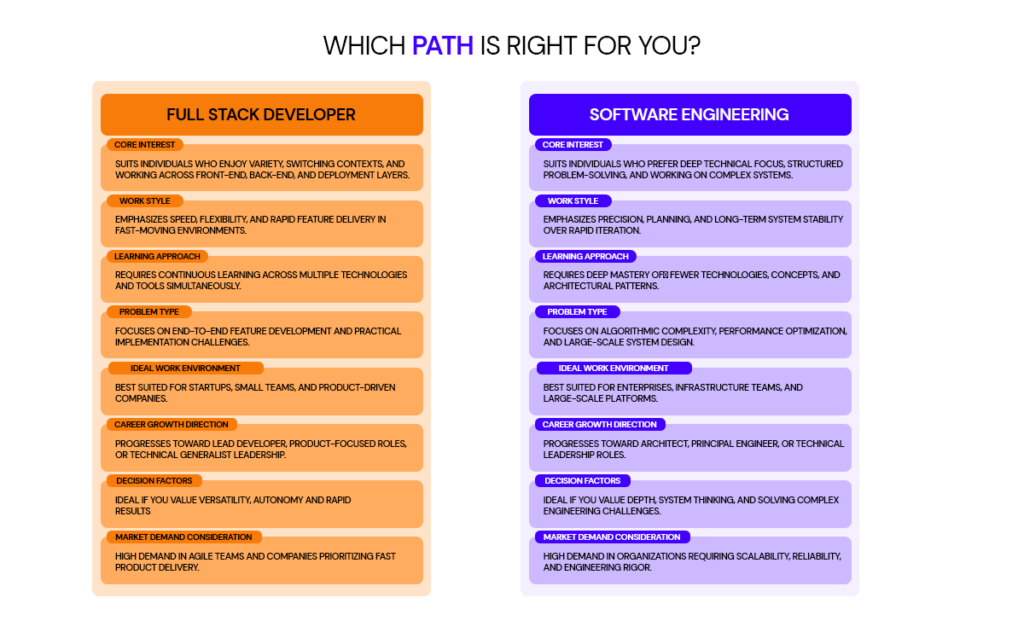
| Career Factor | Full Stack Development | Software Engineering |
| Core Interest | Suits individuals who enjoy variety, switching contexts, and working across front-end, back-end, and deployment layers. | Suits individuals who prefer deep technical focus, structured problem-solving, and working on complex systems. |
| Work Style | Emphasizes speed, flexibility, and rapid feature delivery in fast-moving environments. | Emphasizes precision, planning, and long-term system stability over rapid iteration. |
| Learning Approach | Requires continuous learning across multiple technologies and tools simultaneously. | Requires deep mastery of fewer technologies, concepts, and architectural patterns. |
| Problem Type | Focuses on end-to-end feature development and practical implementation challenges. | Focuses on algorithmic complexity, performance optimization, and large-scale system design. |
| Ideal Work Environment | Best suited for startups, small teams, and product-driven companies. | Best suited for enterprises, infrastructure teams, and large-scale platforms. |
| Career Growth Direction | Progresses toward lead developer, product-focused roles, or technical generalist leadership. | Progresses toward architect, principal engineer, or technical leadership roles. |
| Market Demand Consideration | High demand in agile teams and companies prioritizing fast product delivery. | High demand in organizations requiring scalability, reliability, and engineering rigor. |
| Decision Factors | Ideal if you value versatility, autonomy, and rapid results. | Ideal if you value depth, system thinking, and solving complex engineering challenges. |
Tools and Technologies for Full Stack Developers
Front-End Frameworks
React, Angular, and Vue power modern user interfaces by enabling component-based architecture, faster rendering, reusable UI elements, and responsive application experiences across devices.
Back-End Frameworks
Node.js, Django, and Flask support scalable APIs, simplify server-side logic, improve request handling, and enable secure, maintainable backend services for modern applications.
Database Systems
MySQL, PostgreSQL, and MongoDB remain widely used. Database choice depends on data structure, scalability needs, consistency requirements, and application performance goals.
Cloud Platforms
AWS, Azure, and Google Cloud dominate cloud computing by offering scalable infrastructure, managed services, global availability, and cost-efficient deployment options.
CI/CD Tools
Jenkins and CircleCI automate building, testing, and deployment pipelines, reducing manual errors, speeding releases, and ensuring consistent software delivery across environments.
Tools and Technologies for Software Engineers
IDEs and Environments
IDEs like Visual Studio and IntelliJ improve productivity by offering intelligent code completion, debugging tools, and error detection, helping engineers manage complex projects efficiently and reduce development friction.
Programming Languages
Languages such as Java, C++, Python, and Go dominate software engineering. Language choice directly influences performance, scalability, memory management, concurrency handling, and overall system behavior.
Development Frameworks
Frameworks like Spring and .NET support enterprise development by enforcing architectural patterns, improving code consistency, simplifying configuration, and enabling scalable, maintainable application structures across large teams.
Version Control Systems
Git remains the industry standard for version control. It enables collaboration, change tracking, branching strategies, and safe experimentation across distributed development teams and large codebases.
Software Testing Frameworks
Testing frameworks like JUnit and Selenium ensure application quality through automated testing, early defect detection, regression prevention, and consistent validation across development and release cycles.
Soft Skills for Both Roles
| Soft Skill | Full Stack Developers | Software Engineers |
| Communication and Collaboration | Communicate across design, backend, and deployment teams to prevent errors and ensure smooth feature delivery. | Collaborate with engineers and architects to maintain system integrity and alignment across large codebases. |
| Adaptability and Problem-Solving | Adapt quickly to changing requirements and solve issues across multiple layers of the application stack. | Tackle complex technical challenges with structured problem-solving and deep system-level analysis. |
| Time Management | Balance multitasking across front-end, back-end, and deployment responsibilities while meeting tight deadlines. | Manage focused work on specialized components, prioritizing depth, accuracy, and long-term system stability. |
Full Stack Developer vs Software Engineer in Startups vs Large Corporations
Role Adaptability in Startups
Startups need speed and flexibility. Full stack developers handle multiple layers, reduce dependencies, and ship features quickly, making them ideal for small teams and rapid iteration.
Role Specialization in Large Companies
Large companies manage complex systems at scale. Software engineers specialize deeply, focus on architecture and optimization, and ensure long-term stability across large, distributed enterprise platforms.
Future of Full Stack Development and Software Engineering
Trends in Automation and AI
AI automates testing, code suggestions, and monitoring. Developers focus more on logic, architecture, and decisions. Human judgment remains critical for ethics, system design, and complex problem-solving.
Impact of Cloud Computing
Cloud platforms simplify scaling, deployment, and infrastructure management. Developers build faster, more resilient systems. Both roles evolve by adopting cloud-native tools, distributed architectures, and continuous delivery practices.
The Evolution of These Roles
Historical Context
Software roles evolved with technology. Early systems demanded deep engineering and low-level control. Software engineering emerged to manage complex, large-scale systems. Web frameworks and cloud platforms later enabled full stack development. Today, both roles adapt to automation, AI, and cloud-driven architectures, keeping demand consistently strong.
FAQs
What is the main difference between a Full Stack Developer and a Software Engineer?
Scope versus specialization defines the difference in responsibilities, focus areas, and depth of technical expertise.
Can a Full Stack Developer become a Software Engineer?
Yes. Building deeper system design, algorithms, and architecture skills enables a successful role transition.
Is full stack developer and software engineer same?
No. Their responsibilities, problem scope, and specialization levels differ significantly in real-world projects.
What skills are required to become a Full Stack Developer?
Front-end development, back-end programming, database management, deployment processes, and cross-layer troubleshooting skills.
What skills are required to become a Software Engineer?
Strong algorithms, data structures, system design, optimization techniques, and engineering best practices are essential.
Which career is more in demand?
Demand varies based on company size, project complexity, industry type, and business growth stage.
Which is better, full stack developer vs software engineer?
The better choice depends on personal interests, problem-solving style, and long-term career goals.
Who gets paid more?
Pay depends on experience, specialization depth, geographic location, and the scale of systems managed.
Final Note
Both roles, full stack developer vs software engineer play a critical part in building modern software products. Full stack developers bring speed, flexibility, and end-to-end ownership, while software engineers provide depth, stability, and long-term system reliability. Choosing the right role improves product quality, delivery timelines, and team efficiency. Businesses that clearly understand these distinctions avoid skill mismatches and build balanced, high-performing teams. The right mix of versatility and specialization allows organizations to scale confidently while maintaining technical excellence. When companies align talent with project needs, they reduce risk and increase innovation. For organizations seeking reliable, future-ready development solutions, Techstack Digital delivers expertise across both domains with strategic precision.