
TL;DR – Quick Summary
Full Stack Developer vs Cloud Computing is an important comparison for anyone entering the tech industry. Additionally, both roles are in high demand and support modern digital systems. Full Stack Developers focus on building web applications using front-end development, back-end development, database management, and Full Stack frameworks. Furthermore, they manage the entire web application lifecycle, including design, development, and web application deployment.
Cloud Computing focuses on cloud infrastructure, scalability, and system performance. Additionally, Cloud Engineers work with Cloud platforms like AWS, Azure, and Google Cloud while using DevOps practices, CI/CD pipelines, and containerization (Docker, Kubernetes). They also handle microservices deployment, cloud security, and serverless computing.
Both roles share some overlap, but their focus differs. Career progression in tech depends on skills, IT certifications, and experience. Additionally, job market trends in IT show strong demand for both paths, especially hybrid cloud roles. Combining both skills creates more opportunities.
Full Stack Developer vs Cloud Computing: Career Guide 2026
Technology careers continue to evolve rapidly. Furthermore, businesses rely on both application development and scalable infrastructure to stay competitive. This makes comparing Full Stack Developer and Cloud Computing roles essential for career planning. Additionally, professionals must evaluate Cloud Engineer, DevOps Engineer, and Full Stack Developer paths based on long-term career progression in tech. At Techstack Digital, these roles are closely integrated to deliver scalable and efficient digital solutions.Learn more about DevOps Engineer vs Software Engineer.
Modern systems depend on web development, cloud infrastructure, and cloud-native applications. As a result, demand for skilled professionals grows across Cloud platforms and development environments. Technology stack comparison becomes critical when choosing a path. Furthermore, IT certifications and job market trends in IT influence decisions. Understanding these roles helps individuals align their skills with future opportunities and industry needs.
What is a Full Stack Developer?
Definition and Core Responsibilities
A Full Stack Developer builds complete applications from start to finish. Additionally, this role combines front-end development and back-end development into one workflow. Developers design interfaces, manage logic, and connect systems seamlessly.
They handle software architecture and ensure smooth web application lifecycle management. Furthermore, they use Full Stack frameworks to speed up development. Tasks include API integration, database management, and debugging systems.
Full Stack Developers also focus on performance and usability. Additionally, they ensure web application deployment works across environments. Many companies hire full stack developer talent to reduce dependency on multiple teams. This role plays a central part in modern product development and scalable application design.
Skills Required
A Full Stack Developer must learn multiple technologies. Additionally, they must understand both design and system logic. Key skills include front-end frameworks like React.js and Angular.
They also use back-end frameworks such as Node.js and Django. Furthermore, database management knowledge is essential using MySQL, MongoDB, or PostgreSQL. Developers work with programming languages (JavaScript, Python, Java) daily.
Understanding Agile software development improves collaboration. Additionally, basic DevOps practices and CI/CD pipelines help automate workflows. Developers also manage web application deployment and testing.
Strong problem-solving and debugging skills are necessary. Furthermore, they must adapt quickly to new tools. This broad skill set makes Full Stack Developers highly valuable across industries.
Explore More
Also Learn about Top Java Full Stack Developer Skills Employers Want in 2026
Common Tools and Frameworks
Full Stack Developers use a wide range of tools. Additionally, they combine multiple technologies into one workflow. Popular tools include React.js and Angular for front-end development.
On the back end, developers use Node.js, Django, or Spring Boot. Furthermore, databases like MongoDB and PostgreSQL support application data. These tools form the foundation of Full Stack frameworks.
Containerization tools like Docker and Kubernetes help manage environments. Additionally, DevOps practices improve deployment efficiency. Developers integrate CI/CD pipelines to automate builds and releases.
Version control systems like Git ensure collaboration. Furthermore, monitoring tools help track performance. These tools allow developers to build scalable, efficient, and maintainable applications.
What is Cloud Computing?
Definition and Key Concepts
Cloud Computing delivers computing services over the internet. Additionally, it allows businesses to use cloud infrastructure without managing physical servers.
There are three main models: IaaS, PaaS, and SaaS. Furthermore, these models provide flexibility for different use cases. Cloud systems support serverless computing and application scaling.
Cloud migration allows companies to move systems from local servers to cloud platforms. Additionally, this improves efficiency and reduces costs. Cloud-native applications are designed specifically for distributed environments.
This model enables high availability and scalability. Furthermore, organizations rely on cloud solutions for modern digital transformation. Cloud Computing plays a critical role in building resilient and flexible systems.Learm about our blog Offshore Cloud Services: Maximize Scalability & Efficiency
Popular Cloud Platforms
Several Cloud platforms dominate the industry. Additionally, companies rely on AWS, Azure, and Google Cloud for scalable solutions.
AWS provides a wide range of services for infrastructure and development. Furthermore, Azure integrates well with enterprise systems. Google Cloud focuses on data and AI-driven solutions.
These platforms support cloud-native applications and hybrid cloud environments. Additionally, businesses use them for storage, computing, and networking.
Cloud platforms also enable automation and global deployment. Furthermore, they support high-performance systems across regions. Choosing the right platform depends on business needs and technical requirements.
Essential Skills
Cloud professionals require specialized skills. Additionally, they must understand networking, security, and system design.
Knowledge of DevOps practices and CI/CD pipelines is essential. Furthermore, professionals work with microservices deployment and containerization (Docker, Kubernetes).
Cloud security plays a critical role in protecting systems. Additionally, engineers manage permissions, encryption, and compliance.
Understanding cloud infrastructure helps in designing scalable systems. Furthermore, professionals must monitor performance and optimize costs. These skills make Cloud Engineers essential in modern IT environments.
Key Differences Between Full Stack Development and Cloud Computing
Focus Areas
Full Stack Development focuses on building applications. Additionally, developers handle user interfaces and backend logic.
Cloud Computing focuses on infrastructure management. Furthermore, engineers design scalable systems and manage cloud infrastructure.
Full Stack Developers work on software architecture and web application deployment. Additionally, Cloud Engineers ensure systems run efficiently in distributed environments.
These roles complement each other. Furthermore, both are essential for modern application delivery.
Career Path Differences
Full Stack Developers often grow into Software Architects or Tech Leads. Additionally, they expand expertise in system design and development.
Cloud professionals advance into Cloud Solution Architects or DevOps Leaders. Furthermore, they focus on large-scale infrastructure systems.
Career progression in tech depends on experience and specialization. Additionally, IT certifications play a key role in advancement.
Both paths offer strong long-term opportunities. Furthermore, choosing the right path depends on individual interests.
Skills Overlap and Divergence
Both roles share some skills. Additionally, both use CI/CD pipelines and DevOps practices.
Full Stack focuses on programming languages, frameworks, and database management. Furthermore, Cloud Computing emphasizes cloud infrastructure and security.
Microservices deployment connects both fields. Additionally, containerization tools bridge development and operations.
However, the depth of knowledge differs. Furthermore, each role requires a unique specialization.
Job Roles and Responsibilities
Full Stack Developer Tasks
Full Stack Developers build complete applications. Additionally, they handle front-end development and back-end development.
They manage databases and integrate APIs. Furthermore, they optimize performance and ensure application scaling.
Developers oversee the entire web application lifecycle. Additionally, they handle testing and deployment processes.
This role requires versatility. Furthermore, developers must adapt to multiple technologies.
Cloud Engineer/Developer Tasks
Cloud Engineers design and manage systems. Additionally, they build cloud architecture and automate deployments.
They use Docker and Kubernetes for containerization. Furthermore, they manage CI/CD pipelines and ensure cloud security.
Engineers also monitor systems and optimize performance. Additionally, they support cloud-native applications and infrastructure.
This role focuses on scalability and reliability. Furthermore, it ensures systems run efficiently under load.
Hybrid Roles
Hybrid roles combine development and cloud expertise. Additionally, DevOps Engineers bridge the gap between teams.
These roles involve microservices deployment and application scaling. Furthermore, professionals manage hybrid cloud roles across systems.
Organizations increasingly demand these skills. Additionally, hybrid professionals bring flexibility and efficiency.
Learning Path and Career Progression
Full Stack Developer
Learning Full Stack Development requires hands-on practice. Additionally, developers must build projects using Full Stack frameworks.
Courses and bootcamps provide structured learning. Furthermore, Agile software development improves collaboration skills.
Developers must practice web application deployment. Additionally, they should learn multiple programming languages.
Continuous learning ensures growth. Furthermore, developers stay competitive in evolving markets.
Cloud Engineer
Cloud Engineers focus on infrastructure and platforms. Additionally, certifications validate expertise in Cloud platforms.
Hands-on labs improve practical skills. Furthermore, engineers build networks and deploy containers.
Experience with cloud infrastructure is essential. Additionally, professionals must understand system scalability.
This path requires technical depth. Furthermore, it offers strong career opportunities.
Recommended Certifications
Certifications improve career prospects. Additionally, IT certifications validate technical knowledge.
Popular certifications include AWS, Azure, and Google Cloud. Furthermore, Full Stack programs help developers build strong foundations.
These certifications support career progression in tech. Additionally, they improve job opportunities globally.
Salary and Market Demand
Global Salary Comparison
Full Stack Developer and Cloud Engineer salaries vary globally. Additionally, Cloud Computing roles often offer higher pay at scale.
Job market trends in IT show increasing demand for both roles. Furthermore, career progression in tech impacts earnings significantly.
Both roles offer strong financial growth. Additionally, specialization increases salary potential.
Regional Trends
Salary trends vary by region. Additionally, the US and Europe offer higher compensation.
India and the Middle East show growing demand. Furthermore, Cloud platforms drive hiring trends globally.
Demand for cloud-native applications continues to rise. Additionally, companies invest heavily in cloud technologies.
Future Job Market Predictions
Future demand favors hybrid roles. Additionally, application scaling and microservices deployment drive hiring.
Cloud Computing continues to expand rapidly. Furthermore, Full Stack Development remains essential for application building.
The job market will continue evolving. Additionally, professionals must adapt to new technologies.
Work Environment and Lifestyle
Typical Work Environment for Full Stack Developers
Full Stack Developers work in Agile teams. Additionally, they collaborate on web development projects.
They use front-end and back-end frameworks daily. Furthermore, they focus on delivering user-friendly applications.
This environment requires flexibility. Additionally, developers often handle multiple tasks.
Typical Work Environment for Cloud Engineers
Cloud Engineers work with infrastructure systems. Additionally, they manage deployments and automation.
They rely on DevOps practices and Cloud platforms. Furthermore, they monitor system performance continuously.
This role involves high responsibility. Additionally, engineers ensure system reliability.
Work-Life Balance Differences
Work-life balance varies by role. Additionally, Full Stack Developers may face tight deadlines.
Cloud Engineers handle system uptime and incidents. Furthermore, this may require on-call availability.
Both roles demand commitment. Additionally, experience improves balance over time.
Pros and Cons of Each Career Path
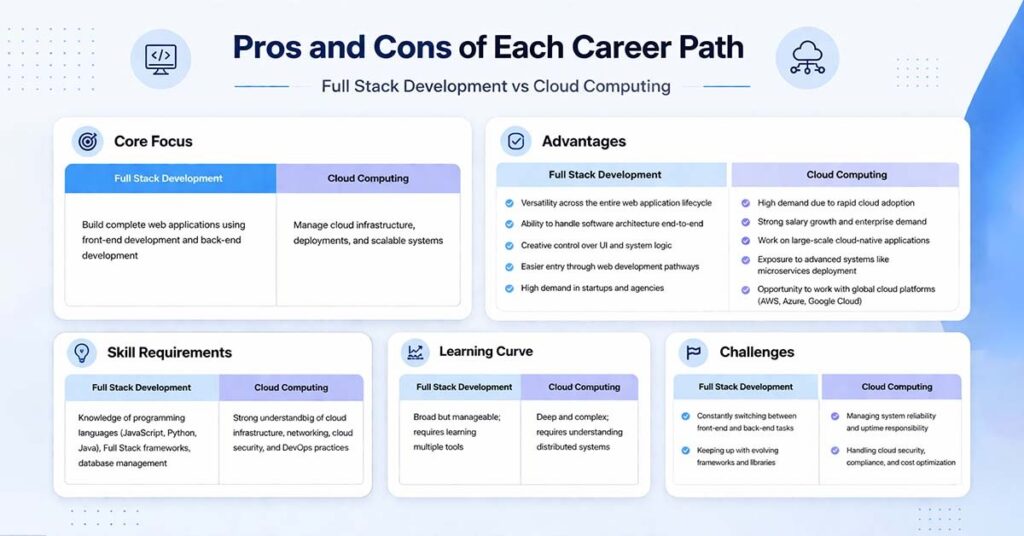
| Aspect | Full Stack Development | Cloud Computing |
| Core Focus | Build complete web applications using front-end development and back-end development | Manage cloud infrastructure, deployments, and scalable systems |
| Advantages | Versatility across the entire web application lifecycle | High demand due to rapid cloud adoption |
| Ability to handle software architecture end-to-end | Strong salary growth and enterprise demand | |
| Creative control over UI and system logic | Work on large-scale cloud-native applications | |
| Easier entry through web development pathways | Exposure to advanced systems like microservices deployment | |
| High demand in startups and agencies | Opportunity to work with global cloud platforms (AWS, Azure, Google Cloud) | |
| Skill Requirements | Knowledge of programming languages (JavaScript, Python, Java), Full Stack frameworks, database management | Strong understanding of cloud infrastructure, networking, cloud security, and DevOps practices |
| Learning Curve | Broad but manageable; requires learning multiple tools | Deep and complex; requires understanding distributed systems |
| Challenges | Constantly switching between front-end and back-end tasks | Managing system reliability and uptime responsibility |
| Keeping up with evolving frameworks and libraries | Handling cloud security, compliance, and cost optimization | |
| Debugging across multiple layers of the stack | Complex troubleshooting in distributed environments | |
| Work Pressure | Tight deadlines in Agile software development cycles | On-call duties and incident response in production systems |
| Career Growth | Can grow into Tech Lead or Software Architect roles | Can grow into Cloud Architect or DevOps Leader roles |
| Flexibility | High flexibility in project types and industries | High flexibility with remote and global cloud roles |
| Best For | Those who enjoy building products and coding across layers | Those who enjoy infrastructure, automation, and system scalability |
Project Types and Hands-On Experience
Full Stack Developer Projects
Projects include building web applications. Additionally, developers use programming languages and frameworks.
They focus on user experience and system performance. Furthermore, projects improve practical skills.
Cloud Projects
Cloud projects involve infrastructure setup. Additionally, engineers build CI/CD pipelines and deploy containers.
They work on microservices deployment and cloud-native applications. Furthermore, these projects improve scalability knowledge.
Open-Source Contributions and Portfolio Building
Open-source contributions improve credibility. Additionally, developers showcase skills on GitHub.
DevOps practices enhance project quality. Furthermore, portfolios demonstrate real-world experience.
Tools and Technologies Comparison
Development Frameworks vs Cloud Platforms
Development frameworks focus on application building. Additionally, Cloud platforms support infrastructure. This technology stack comparison highlights key differences. Furthermore, both are essential for modern systems.
CI/CD, Containerization, Orchestration Tools
Tools like Docker and Kubernetes manage containers. Additionally, CI/CD pipelines automate workflows. These tools connect development and operations. Furthermore, they improve efficiency and scalability.
Monitoring, Logging, and Security Tools
Monitoring tools track performance. Additionally, logging systems help debug issues. Cloud security ensures data protection. Furthermore, these tools maintain system stability.
Industry Applications
Sectors Hiring Full Stack Developers
Industries rely on web development solutions. Additionally, startups and agencies hire full stack developer talent. These roles support front-end and back-end development. Furthermore, they build scalable applications.
Sectors Hiring Cloud Engineers
Cloud Engineers work across industries. Additionally, companies adopt Cloud Computing for scalability. They manage cloud infrastructure and applications. Furthermore, demand continues to grow globally.
Overlapping Industries and Opportunities
Many industries require both roles. Additionally, hybrid cloud roles are increasing. Microservices deployment connects both fields. Furthermore, opportunities continue expanding.
Challenges and Common Pitfalls
Learning Curve Challenges
Both roles have steep learning curves. Additionally, mastering programming languages takes time. Cloud platforms require deep understanding. Furthermore, continuous practice is essential.
Keeping Up with Technology Updates
Technology evolves rapidly. Additionally, professionals must follow Agile software development trends. IT certifications help stay updated. Furthermore, DevOps practices improve adaptability.
Transitioning Between Roles
Transitioning requires effort. Additionally, developers must learn new skills. Hybrid cloud roles provide flexibility. Furthermore, experience helps smooth transitions.
Hybrid Roles: Combining Full Stack and Cloud
Full Stack Developer with Cloud Expertise
This role combines development and infrastructure. Additionally, professionals use Full Stack frameworks and cloud infrastructure. CI/CD pipelines improve deployment efficiency. Furthermore, this skill set is highly valuable.
DevOps Engineer Roles
DevOps Engineers connect teams. Additionally, they manage containerization and automation. They use CI/CD pipelines and DevOps practices. Furthermore, they improve system reliability.
Cloud-Native Full Stack Development
Cloud-native development focuses on scalability. Additionally, it uses microservices deployment and application scaling. This approach improves performance. Furthermore, it supports modern application needs.
Explore More
Also Learn about Full Stack Developer vs Data Analytics
FAQs
Is Full Stack Development better than Cloud Computing?
Both roles serve different purposes. Additionally, Full Stack focuses on web development while Cloud focuses on infrastructure.
Which career pays more?
Cloud roles often pay higher. Additionally, job market trends in IT influence salaries.
Can I transition from Full Stack to Cloud?
Yes, transition is possible. Additionally, career progression in tech supports hybrid roles.
How long does it take to become job-ready?
It depends on learning pace. Additionally, bootcamps and IT certifications help accelerate growth.
Which role is more in-demand?
Both roles are in demand. Additionally, Cloud Computing shows faster growth globally.
What certifications are essential?
Certifications from AWS, Azure, and Google Cloud are valuable. Additionally, IT certifications improve credibility.
Conclusion and Career Recommendations
Choosing between Full Stack Development and Cloud Computing depends on your career goals and long-term vision. Additionally, both roles offer strong growth, stability, and high demand across industries. Full Stack Developers focus on building complete applications, handling both front-end development and back-end development. Furthermore, they manage the entire web application lifecycle, from design to deployment.
On the other hand, Cloud Engineers focus on scalable cloud infrastructure, ensuring systems run efficiently and securely. Additionally, they work with cloud platforms, automation, and DevOps practices to support modern applications. Companies like Techstack Digital actively leverage both skill sets to build scalable, high-performance solutions for global clients. Furthermore, career progression in tech depends on specialization, hands-on experience, and continuous learning.
Both paths remain relevant as businesses adopt digital transformation. Additionally, combining Full Stack and Cloud skills creates hybrid opportunities, making professionals more versatile, valuable, and future-ready in a competitive technology landscape.