
TL;DR – Quick Summary
This guide compares PHP Developers and Software Engineers across responsibilities, skills, salaries, career paths, tools, and long-term opportunities. It explains how PHP Developers specialize in backend web development using PHP, Laravel, Symfony, MySQL, REST APIs, Composer, and PHPUnit, while Software Engineers design scalable software using Java, Python, Go, Docker, Kubernetes, AWS, Azure, GCP, CI/CD, and microservices.
The guide also covers programming languages, frameworks, software architecture, cloud computing, DevOps, AI-assisted development, Agile, Scrum, Git, SDLC, system design, and career progression. Additionally, it explores salary comparisons, job demand, educational requirements, startup hiring, future-proof skills, and transition paths between both roles.
Whether you’re choosing a career, hiring developers, or planning to upskill, this comparison provides the technical insights needed to understand each role and make an informed decision based on your goals and industry requirements.
PHP Developer vs Software Engineer: Salary, Skills & Career Guide 2026
Introduction
The technology industry offers countless career opportunities, but choosing the right path can be challenging. Two of the most common roles are PHP Developer and Software Engineer. Although both professionals write code and build software solutions, their responsibilities, technical expertise, and career paths differ significantly. Furthermore, employers often use these job titles interchangeably, creating confusion for aspiring developers. At Techstack Digital, we help businesses build high-performing development teams while empowering organizations with skilled PHP Developers and Software Engineers. Understanding these differences helps students, professionals, and businesses make informed decisions about career planning, hiring, and long-term growth in today’s rapidly evolving IT industry.
Direct Answer
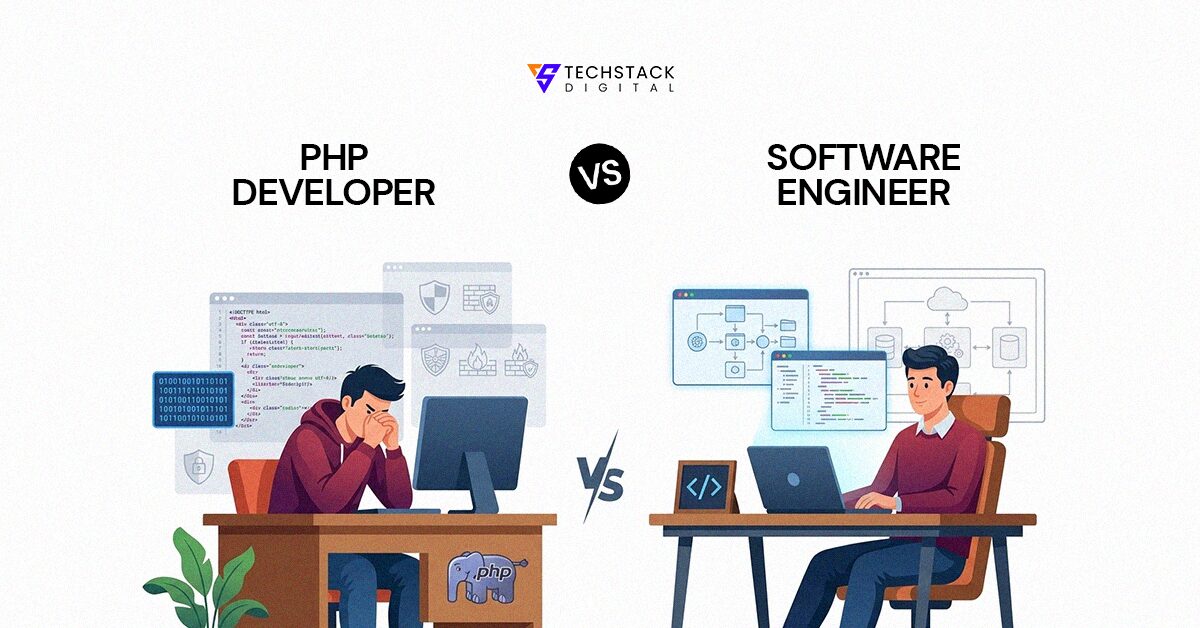
A PHP Developer primarily builds and maintains web applications using PHP and related technologies like Laravel and MySQL. In contrast, a Software Engineer designs, develops, tests, and maintains software systems across multiple platforms using engineering principles. While both roles overlap in coding, Software Engineers generally have a broader scope and wider career opportunities.
Why This Comparison Matters
Choosing between a PHP Developer and a Software Engineer influences your salary potential, career growth, and technical learning. Furthermore, each role demands different skills and responsibilities. PHP Developers primarily build backend web applications, while Software Engineers work across enterprise software, cloud platforms, AI, and mobile applications. Understanding these differences helps job seekers choose the right career path and enables businesses to hire professionals who best match their technical and project requirements.
Quick Comparison Table
| Feature | PHP Developer | Software Engineer |
| Definition | Specializes in PHP-based web development | Designs and develops software systems using engineering principles |
| Primary Focus | Websites, APIs, CMS, web applications | Software products, enterprise systems, mobile, cloud, AI |
| Programming Languages | PHP, SQL, JavaScript | Java, Python, C#, Go, Rust, JavaScript, PHP |
| Scope | Backend web development | Full software lifecycle |
| Typical Frameworks | Laravel, Symfony | Spring Boot, .NET, Django, Node.js, React, Angular |
| Architecture Responsibility | Limited | High |
| Average US Salary (2026) | $75,000–$125,000 | $95,000–$170,000+ |
| Career Growth | Backend Lead, Solution Architect | Staff Engineer, Principal Engineer, Engineering Manager |
| Industries | Web agencies, SaaS, eCommerce | Finance, Healthcare, AI, Cloud, Automotive, Enterprise |
| Best For | Web development specialists | Broad software engineering careers |
Who Should Read This Guide
This guide serves anyone considering a career in software development. Furthermore, it provides valuable insights for professionals planning to specialize or expand their technical expertise.
You should read this guide if you are:
- A student exploring developer roles and programming jobs
- A beginner learning PHP or software engineering
- A backend developer considering career growth
- A PHP Developer planning to become a Software Engineer
- A Software Engineer interested in PHP development
- A hiring manager comparing technical roles
- A business owner deciding which professional to hire
Additionally, experienced developers can use this comparison to evaluate future career opportunities, salary expectations, and specialization paths. Understanding both careers helps professionals make smarter long-term decisions in the rapidly changing IT profession.
What Is a PHP Developer?
A PHP Developer is a backend developer who builds dynamic websites, web applications, APIs, and content management systems using PHP. Furthermore, they commonly use frameworks like Laravel and Symfony alongside JavaScript, SQL, and Git to develop scalable solutions. Because PHP powers millions of websites, skilled PHP Developers remain in high demand across industries worldwide.
Explore More
Also Learn about What is a PHP Full Stack Developer
What Does a PHP Developer Do?
A PHP Developer designs, develops, tests, and maintains server-side web applications using PHP. Furthermore, they build APIs, authentication systems, and database-driven solutions while optimizing performance and security. Many specialize in Laravel or Symfony, whereas others develop CMS platforms like WordPress. Additionally, they collaborate with designers, frontend developers, QA engineers, and DevOps teams to deliver reliable, scalable applications.
Primary Responsibilities
The daily responsibilities of a PHP Developer extend beyond writing PHP code. Furthermore, businesses expect developers to build secure, scalable, and maintainable applications.
Common responsibilities include:
- Develop backend logic
- Build REST APIs
- Design database structures
- Optimize SQL queries
- Integrate payment gateways
- Implement authentication systems
- Maintain existing applications
- Debug production issues
- Write reusable code
- Collaborate with frontend teams
- Review code quality
- Improve application security
- Perform performance optimization
- Create technical documentation
Additionally, senior PHP Developers mentor junior developers and participate in software architecture discussions. They also recommend technical improvements that increase scalability and reduce maintenance costs.
Typical Technologies Used
PHP Developers work with a wide range of technologies that support modern web application development. Furthermore, mastering these tools increases employability and project efficiency.
Common technologies include:
Programming Languages
- PHP
- JavaScript
- SQL
- HTML
- CSS
Frameworks
- Laravel
- Symfony
- CodeIgniter
Databases
- MySQL
- PostgreSQL
- MariaDB
Development Tools
- Composer
- Git
- PHPUnit
- Docker
APIs
- REST APIs
- GraphQL
Additionally, many companies expect familiarity with Redis, Elasticsearch, RabbitMQ, Linux, Nginx, Apache, and cloud platforms like AWS. Learning these technologies enables PHP Developers to build enterprise-grade applications rather than simple websites.
Industries That Hire PHP Developers
PHP remains one of the world’s most widely used server-side languages. Consequently, organizations across multiple sectors continue hiring skilled PHP professionals.
Major industries include:
- SaaS companies
- E-commerce
- Healthcare
- Banking and Finance
- Education
- Logistics
- Manufacturing
- Digital agencies
- Government organizations
- Media companies
- Travel platforms
- Real estate
Furthermore, many startups choose Laravel because it accelerates MVP development and reduces development costs. Additionally, established enterprises maintain legacy PHP systems that require continuous enhancement and modernization.
The continued popularity of WordPress, Magento, and Laravel also creates strong demand for CMS developers and API developers who specialize in PHP technologies.
Daily Workflow
A PHP Developer’s workday combines coding, collaboration, testing, and maintenance. Furthermore, every task contributes to delivering stable and secure web applications.
A typical day may include:
- Attend the daily Agile stand-up
- Review Git pull requests
- Implement new backend features
- Develop REST APIs
- Optimize SQL queries
- Fix bugs reported by QA
- Test new functionality
- Deploy updates to staging
- Review application logs
- Update technical documentation
Additionally, developers regularly communicate with frontend teams to ensure seamless integration between user interfaces and backend services. They also participate in sprint planning, estimation sessions, and retrospectives to improve team productivity.
Although coding occupies most of the day, successful PHP Developers spend considerable time planning solutions, reviewing architecture, and ensuring software quality.
What Is a Software Engineer?
A Software Engineer designs, develops, tests, deploys, and maintains software systems using engineering principles. Furthermore, they build scalable, secure, and reliable applications across multiple technologies and industries. Software Engineers may specialize in cloud computing, mobile development, AI, enterprise software, or embedded systems, making them highly versatile professionals with strong global demand and long-term career opportunities.
Definition
A Software Engineer designs and builds software using engineering principles rather than focusing only on coding. Furthermore, they create scalable architectures, optimize performance, and ensure software reliability throughout the SDLC. Additionally, they collaborate with cross-functional teams, balance technical and business requirements, and develop secure, maintainable solutions that support long-term organizational goals.
What Is a Software Engineer?
Core Responsibilities
Software Engineers develop reliable software that solves complex business problems throughout the Software Development Life Cycle (SDLC). Furthermore, they design scalable architectures, write maintainable code, optimize performance, and implement secure solutions. Additionally, they collaborate with cross-functional teams, mentor junior developers, and ensure software remains scalable, efficient, and aligned with long-term business objectives.
Types of Software Engineers
Software Engineering offers numerous specialization paths. Furthermore, each specialization focuses on solving different technical challenges while following the same engineering principles.
Backend Engineer
Backend Engineers build server-side applications, APIs, databases, and authentication systems. Furthermore, they develop secure, scalable, and high-performing backend services using technologies like Java, Python, Go, PHP, Node.js, MySQL, PostgreSQL, Docker, and Kubernetes.
Frontend Engineer
Frontend Engineers develop responsive user interfaces that deliver excellent user experiences. Furthermore, they improve usability, accessibility, and performance using HTML, CSS, JavaScript, TypeScript, React, Angular, Vue.js, and Next.js to create modern web applications.
Full Stack Engineer
Full Stack Engineers develop both frontend and backend applications while managing databases, APIs, and deployment processes. Additionally, their broad technical expertise enables startups and businesses to build complete software products efficiently with smaller development teams.
Mobile Engineer
Mobile Engineers develop applications for smartphones and tablets.
They commonly work with:
- Swift
- Kotlin
- Flutter
- React Native
Furthermore, they optimize application performance, battery usage, offline functionality, and device compatibility.
DevOps Engineer
DevOps Engineers automate software delivery and infrastructure management. Additionally, they improve deployment speed, monitoring, security, and reliability.
Popular tools include:
- Docker
- Kubernetes
- Jenkins
- GitHub Actions
- Terraform
- AWS
- Azure
Their work enables organizations to release software faster with fewer production issues.
Cloud Engineer
Cloud Engineers design applications that run on cloud platforms. Furthermore, they manage:
- AWS
- Microsoft Azure
- Google Cloud Platform
- Serverless computing
- Cloud security
- Infrastructure automation
Cloud computing continues to be one of the fastest-growing engineering specialties.
AI/ML Engineer
Artificial Intelligence and Machine Learning Engineers build intelligent software that learns from data.
Additionally, they create:
- Recommendation systems
- Chatbots
- Predictive analytics
- Computer vision applications
- Natural language processing models
They frequently use Python, TensorFlow, PyTorch, and cloud AI services.
Embedded Systems Engineer
Embedded Systems Engineers develop software for hardware devices.
Typical industries include:
- Automotive
- Medical devices
- Consumer electronics
- Aerospace
- Industrial automation
- Robotics
Furthermore, they optimize software for limited memory, processing power, and energy consumption.
Typical Software Development Lifecycle
Software Engineers contribute throughout the Software Development Lifecycle (SDLC). Furthermore, every phase helps ensure software remains reliable, maintainable, and scalable.
A typical SDLC includes:
- Requirement gathering
- System analysis
- Software design
- Development
- Testing
- Deployment
- Monitoring
- Maintenance
- Continuous improvement
Additionally, Agile methodologies allow teams to repeat these stages in short development cycles called sprints. This iterative approach enables organizations to respond quickly to customer feedback while maintaining software quality.
PHP Developer vs Software Engineer: Quick Comparison
| Feature | PHP Developer | Software Engineer |
| Definition | Specializes in PHP web development | Designs software using engineering principles |
| Scope | Backend web applications | Complete software systems |
| Programming Languages | PHP, SQL, JavaScript | Java, Python, C#, Go, Rust, PHP, JavaScript |
| Responsibilities | APIs, websites, CMS, databases | Architecture, software design, cloud systems |
| Skills | Laravel, Symfony, MySQL | Algorithms, System Design, Cloud, DevOps |
| Average US Salary | $75k–$125k | $95k–$170k+ |
| Education | CS degree or equivalent | CS/Software Engineering or equivalent |
| Career Growth | Lead PHP Developer, Solution Architect | Staff, Principal, Engineering Manager |
| Demand | High for web applications | High across all industries |
| Work Environment | Agencies, SaaS, eCommerce | Enterprises, startups, cloud companies |
| Best For | Backend web specialization | Broad technology careers |
PHP Developer vs Software Engineer: Key Differences
Job Scope
The primary difference lies in the scope of work. PHP Developers mainly build backend web applications, APIs, and content management systems using PHP technologies. Furthermore, Software Engineers develop software across multiple platforms, including cloud, mobile, enterprise, and embedded systems. Their broader expertise allows them to solve more complex engineering challenges across diverse technologies.
Technical Expertise
PHP Developers become experts in backend web technologies.
Their expertise usually includes:
- PHP
- Laravel
- Symfony
- MySQL
- REST APIs
- Authentication
- CMS development
Software Engineers require broader technical knowledge.
They often study:
- Algorithms
- Data Structures
- System Design
- Networking
- Distributed Systems
- Cloud Computing
- Software Architecture
- DevOps
Furthermore, they apply engineering principles when making technical decisions instead of focusing only on implementation.
Programming Languages
Programming language requirements differ considerably between both careers.
PHP Developers primarily write:
- PHP
- SQL
- JavaScript
- HTML
- CSS
Software Engineers frequently work with several languages throughout their careers.
Common languages include:
- Java
- Python
- Go
- C#
- Rust
- JavaScript
- Kotlin
- Swift
- PHP
Additionally, experienced Software Engineers choose programming languages based on business requirements rather than personal preference.
Software Architecture Involvement
Software Engineers typically take greater responsibility for software architecture. Furthermore, they design scalable, secure, and reliable systems while evaluating infrastructure needs and performance. In contrast, PHP Developers usually implement and optimize existing architectures, focusing on backend functionality, maintainability, and application performance.
Project Ownership
PHP Developers typically own backend features, APIs, and database functionality. Furthermore, Software Engineers take ownership of complete software systems, including planning, architecture, deployment, monitoring, and maintenance. Their broader responsibilities often allow them to influence technical decisions, product strategy, and long-term system evolution.
Problem-Solving Complexity
PHP Developers primarily solve backend web application challenges such as API development, authentication, and database optimization. Furthermore, Software Engineers tackle more complex problems involving scalability, distributed systems, cloud infrastructure, performance, security, and reliability while balancing technical requirements with business objectives.
Business Impact
PHP Developers contribute by building reliable websites, APIs, and web applications that support business operations. Furthermore, Software Engineers create scalable software systems that improve efficiency, reduce operational costs, and support long-term business growth, making a broader impact on organizational strategy and competitive advantage.
PHP Developer vs Software Engineer: Similarities
Although PHP Developers and Software Engineers have different responsibilities, they share many core skills and work practices.
- Both write clean, maintainable, and efficient code.
- Both solve real-world business problems through software.
- Both follow Agile and Scrum development methodologies.
- Both use Git for version control and collaboration.
- Both participate in code reviews and software testing.
- Both work with cross-functional teams, including designers, QA engineers, and product managers.
- Both continuously learn new technologies and industry best practices.
- Both focus on software quality, security, and performance.
- Both contribute to the Software Development Life Cycle (SDLC).
- Both offer strong career growth and opportunities to transition into leadership roles.
Both Write Code
Both PHP Developers and Software Engineers write code to build software that meets business and user needs. Furthermore, PHP Developers focus on backend web applications, while Software Engineers work across multiple technologies and platforms. Both prioritize clean, maintainable code, follow coding standards, review code, and continuously optimize application performance and software quality.
Both Solve Business Problems
Both PHP Developers and Software Engineers solve real business problems through software. Furthermore, they analyze requirements, collaborate with stakeholders, and build solutions that improve efficiency, customer satisfaction, and business growth. Successful developers think beyond coding, using technology to achieve organizational goals and deliver measurable business value.
Both Work in Agile Teams
Modern software development rarely happens in isolation. Furthermore, both PHP Developers and Software Engineers usually work within Agile development teams.
Agile methodologies divide projects into smaller iterations called sprints. Additionally, teams hold regular meetings to plan work, discuss progress, and resolve technical challenges.
Common Agile ceremonies include:
- Sprint Planning
- Daily Stand-ups
- Sprint Reviews
- Sprint Retrospectives
- Backlog Grooming
These meetings improve communication, transparency, and team collaboration. Furthermore, PHP Developers and Software Engineers work closely with product managers, designers, QA engineers, DevOps teams, and stakeholders to deliver high-quality software quickly while responding effectively to changing customer and business requirements.
Both Use Git
Version control is an essential skill for every modern developer. Furthermore, Git enables teams to collaborate efficiently without overwriting each other’s work.
Both PHP Developers and Software Engineers use Git to:
- Track code changes
- Create feature branches
- Merge pull requests
- Review code
- Restore previous versions
- Manage releases
Additionally, platforms like GitHub, GitLab, and Bitbucket simplify collaboration across distributed teams.
Both Require Continuous Learning
Technology evolves rapidly, making continuous learning essential for every developer. Furthermore, PHP Developers stay current with Laravel, Symfony, and modern PHP features, while Software Engineers expand their knowledge in cloud computing, DevOps, AI, cybersecurity, and algorithms. Ongoing learning through courses, certifications, and practical projects strengthens technical expertise, career growth, and job security.
Both Collaborate with Cross-Functional Teams
Software development is a team effort. Furthermore, neither PHP Developers nor Software Engineers work independently throughout an entire project.
They frequently collaborate with:
- Product Managers
- Business Analysts
- UI/UX Designers
- QA Engineers
- DevOps Engineers
- Security Specialists
- Database Administrators
- Project Managers
Additionally, regular communication ensures everyone understands project goals, timelines, and technical constraints.
Strong collaboration reduces misunderstandings, improves software quality, and accelerates product delivery. Technical knowledge alone is not enough. Successful professionals also communicate effectively, share ideas openly, and support their teammates throughout the development process.
Duties and Responsibilities
The responsibilities of PHP Developers and Software Engineers overlap in some areas, but their primary focus differs significantly. Furthermore, PHP Developers concentrate on backend web development, while Software Engineers oversee broader software engineering activities.
Understanding these responsibilities helps businesses hire the right professionals and allows aspiring developers to choose a career aligned with their interests.
PHP Developer Responsibilities
PHP Developers specialize in building secure, scalable, and maintainable web applications. Furthermore, they manage the server-side functionality that powers websites and online platforms.
Backend Development
Backend development forms the core responsibility of every PHP Developer. They create business logic, manage user authentication, process requests, validate data, and communicate with databases.
Additionally, they optimize application performance to ensure websites load quickly and remain responsive under heavy traffic.
Laravel
Laravel is the most widely used PHP framework for modern web development.
PHP Developers use Laravel to:
- Build scalable applications
- Create RESTful APIs
- Manage authentication
- Handle routing
- Implement queues
- Improve security
- Write automated tests
Laravel significantly reduces development time while promoting clean, maintainable code.
Symfony
Many enterprise organizations choose Symfony for large-scale software projects. PHP Developers working with Symfony build highly modular applications using reusable components. Additionally, Symfony offers excellent flexibility for complex enterprise systems requiring long-term maintainability.
CMS Development
Many businesses depend on Content Management Systems. PHP Developers customize platforms such as:
- WordPress
- Drupal
- Magento
- Joomla
Their responsibilities include plugin development, theme customization, security improvements, and performance optimization.
APIs
Modern applications rely heavily on APIs. PHP Developers create and maintain REST APIs and GraphQL services that allow different applications to exchange data securely. Additionally, they integrate third-party payment gateways, CRM platforms, ERP systems, and external cloud services.
Database Management
Managing databases remains a critical responsibility.
PHP Developers:
- Design database schemas
- Write SQL queries
- Optimize indexes
- Improve query performance
- Maintain data integrity
Efficient database management directly impacts application speed and scalability.
Debugging
Software inevitably contains bugs. PHP Developers investigate production issues, analyze error logs, reproduce defects, and implement permanent fixes.
Website Maintenance
Launching a website is only the beginning.
PHP Developers continuously:
- Update dependencies
- Improve security
- Optimize performance
- Add new features
- Fix compatibility issues
- Monitor application health
Regular maintenance ensures long-term software reliability.
Software Engineer Responsibilities
Software Engineers manage broader engineering challenges that extend beyond application development.
Software Design
Software Engineers design systems before writing code.
They analyze requirements, define architecture, choose technologies, and create scalable technical solutions that support future business growth.
System Architecture
Architecture determines how software components interact. Software Engineers design:
- Microservices
- Distributed systems
- Event-driven architectures
- Cloud-native applications
Good architecture improves scalability, maintainability, and system reliability.
Scalable Applications
Software Engineers build applications capable of supporting increasing workloads. Additionally, they optimize:
- Performance
- Availability
- Fault tolerance
- Horizontal scaling
- Resource utilization
Scalability becomes essential as businesses grow.
Cloud Deployment
Cloud computing plays a central role in modern software engineering.
Software Engineers deploy applications using platforms like AWS, Azure, and Google Cloud while automating infrastructure and ensuring high availability.
Security
Security is integrated throughout software development.
Responsibilities include:
- Authentication
- Authorization
- Encryption
- Vulnerability management
- Secure coding practices
- Compliance requirements
Protecting user data remains a top engineering priority.
Performance Optimization
Performance directly affects user experience. Software Engineers continuously monitor applications, identify bottlenecks, optimize resource usage, and improve response times for large-scale systems.
Testing
Testing ensures software behaves as expected. Engineers develop:
- Unit tests
- Integration tests
- End-to-end tests
- Performance tests
- Automated testing pipelines
Comprehensive testing reduces production failures and improves software quality.
Automation
Automation increases development efficiency. Software Engineers automate:
- Software builds
- Testing
- Deployments
- Monitoring
- Infrastructure provisioning
Automation minimizes manual effort while improving reliability and deployment speed.
Skills Required
Success in either career requires strong technical and soft skills. Furthermore, PHP Developers specialize in backend web technologies, while Software Engineers need broader expertise in system design, cloud computing, and software architecture. Communication, teamwork, leadership, and continuous learning are equally essential for long-term career growth and success.
PHP Developer Skills
PHP Developers require a strong understanding of backend web development technologies. Furthermore, mastering modern frameworks and development tools significantly improves productivity and employability.
PHP
PHP is the primary programming language for every PHP Developer. Developers use it to build dynamic websites, REST APIs, business logic, authentication systems, and server-side applications.
Additionally, modern PHP versions introduce performance improvements, strict typing, attributes, enums, and enhanced security features that developers should understand.
Laravel
Laravel has become the industry’s preferred PHP framework.
Developers use Laravel for:
- Authentication
- Routing
- Database migrations
- Queues
- Scheduling
- Caching
- API development
- Automated testing
Laravel enables developers to build scalable applications while maintaining clean and organized code.
Symfony
Symfony is another enterprise-grade PHP framework widely used for large-scale applications.
PHP Developers working with Symfony build modular software using reusable components. Additionally, Symfony provides flexibility for organizations developing complex enterprise solutions that require long-term maintainability.
MySQL
Database management is an essential PHP skill. Developers should understand:
- Database normalization
- Relationships
- Indexing
- Query optimization
- Stored procedures
- Transactions
Efficient SQL queries improve application speed and reduce server resource consumption.
JavaScript
Modern backend development often requires frontend interaction.
PHP Developers use JavaScript to:
- Handle asynchronous requests
- Improve user experience
- Consume APIs
- Build interactive interfaces
Understanding JavaScript also improves collaboration with frontend developers.
HTML
HTML provides the structure of web pages.
Although frontend developers often manage interface development, PHP Developers frequently work with HTML templates when building Laravel Blade views, CMS themes, and server-rendered applications.
CSS
Basic CSS knowledge enables PHP Developers to make interface adjustments without depending entirely on frontend teams.
Additionally, understanding responsive design improves communication during collaborative development.
REST APIs
Nearly every modern application exchanges data through APIs.
PHP Developers should know how to:
- Design REST endpoints
- Authenticate requests
- Validate input
- Handle errors
- Document APIs
- Secure endpoints
API development remains one of the most valuable backend skills.
Composer
Composer is PHP’s dependency management tool.
Developers use Composer to:
- Install libraries
- Update packages
- Manage dependencies
- Implement autoloading
- Maintain project consistency
Mastering Composer improves workflow efficiency and project organization.
Software Engineer Skills
Software Engineers require broader technical expertise because they build systems across multiple platforms and technologies. Furthermore, engineering roles demand analytical thinking beyond language-specific development.
Data Structures
Data Structures form the foundation of efficient software. Engineers should understand:
- Arrays
- Linked Lists
- Trees
- Graphs
- Queues
- Stacks
- Hash Tables
- Heaps
Selecting the correct data structure significantly improves application performance.
Algorithms
Algorithms enable developers to solve problems efficiently.
Software Engineers regularly study:
- Searching
- Sorting
- Recursion
- Dynamic Programming
- Graph Algorithms
- Greedy Algorithms
Additionally, algorithmic thinking plays a major role during technical interviews.
Object-Oriented Programming (OOP)
OOP remains fundamental to software engineering. Developers should understand:
- Encapsulation
- Inheritance
- Polymorphism
- Abstraction
Applying these principles improves maintainability and code reuse.
System Design
System Design distinguishes senior engineers from junior developers. Key concepts include:
- Scalability
- Load balancing
- Microservices
- Distributed systems
- Caching
- Messaging systems
- Fault tolerance
System design interviews are common for mid-level and senior engineering roles.
Design Patterns
Design patterns provide proven solutions to recurring software challenges. Common patterns include:
- Singleton
- Factory
- Strategy
- Observer
- Repository
- Dependency Injection
Using appropriate design patterns improves software architecture and maintainability.
Cloud Computing
Cloud platforms dominate modern software development.
Software Engineers should understand:
- AWS
- Microsoft Azure
- Google Cloud Platform
- Serverless architecture
- Cloud storage
- Virtual machines
- Containers
Cloud expertise continues to increase hiring opportunities worldwide.
Docker
Docker enables developers to package applications into portable containers.
Benefits include:
- Consistent environments
- Faster deployments
- Easier testing
- Simplified dependency management
Containerization has become a standard engineering practice.
Kubernetes
Kubernetes automates container orchestration.
Software Engineers use Kubernetes to:
- Scale applications
- Manage deployments
- Recover failed services
- Balance workloads
- Maintain high availability
Large organizations commonly use Kubernetes for cloud-native applications.
CI/CD
Continuous Integration and Continuous Deployment automate software delivery.
Engineers build pipelines that:
- Run tests automatically
- Validate code quality
- Deploy applications
- Reduce deployment errors
- Accelerate releases
CI/CD improves software reliability while shortening release cycles.
Soft Skills
Technical expertise alone is insufficient for long-term success. Furthermore, employers increasingly prioritize professionals who communicate effectively and collaborate across departments.
Communication
Developers regularly explain technical concepts to managers, designers, clients, and stakeholders. Strong communication reduces misunderstandings and improves project outcomes.
Leadership
As professionals gain experience, leadership becomes increasingly important. Leadership includes:
- Mentoring junior developers
- Reviewing code
- Making technical decisions
- Managing projects
- Resolving conflicts
Strong leaders help engineering teams maintain productivity and technical quality.
Collaboration
Software development is highly collaborative. Developers work alongside:
- Product Managers
- Designers
- QA Engineers
- DevOps Engineers
- Security Teams
- Business Analysts
Effective collaboration accelerates software delivery and improves customer satisfaction.
Problem-Solving
Problem-solving remains the most valuable skill for every developer. Successful professionals:
- Analyze requirements
- Identify root causes
- Evaluate alternatives
- Optimize solutions
- Prevent recurring issues
Employers consistently value developers who solve business problems efficiently rather than simply writing code.
Educational Requirements
There is no single path into software development. Furthermore, employers value practical skills alongside formal education. Whether through degrees, bootcamps, self-learning, or certifications, continuous learning and hands-on experience remain essential for long-term career success.
Degree Requirements
Many employers prefer candidates with a bachelor’s degree in:
- Computer Science
- Software Engineering
- Information Technology
- Computer Engineering
These programs provide strong foundations in algorithms, databases, networking, operating systems, and software engineering principles.
However, a degree is no longer mandatory for many technology companies if candidates demonstrate strong practical skills.
Bootcamps
Coding bootcamps offer accelerated learning for career changers and beginners. Most programs focus on:
- PHP
- Laravel
- JavaScript
- React
- Databases
- Git
- API development
Additionally, bootcamps emphasize portfolio development and real-world projects that improve employability.
Self-Learning
Many successful developers are self-taught. Popular learning resources include:
- Official documentation
- Online coding platforms
- Technical blogs
- YouTube tutorials
- Open-source projects
- Personal applications
Self-learning requires discipline but provides flexibility and lower educational costs.
Professional Certifications
Certifications validate technical knowledge and demonstrate commitment to professional development.
Popular certifications include:
- AWS Certified Developer
- Microsoft Azure Developer Associate
- Google Professional Cloud Developer
- Docker Certified Associate
- Kubernetes Certifications
- Oracle Java Certifications
While certifications rarely replace practical experience, they strengthen resumes and improve credibility, particularly in cloud and enterprise engineering roles.
Experience Requirements
Experience expectations vary significantly depending on seniority. Furthermore, employers evaluate candidates based on technical ability, project complexity, business impact, and collaboration skills rather than years of experience alone.
Practical projects, internships, open-source contributions, and freelance work all strengthen a candidate’s profile and demonstrate real-world problem-solving abilities.
Entry-Level Expectations
Entry-level developers should demonstrate:
- Strong programming fundamentals
- Basic Git knowledge
- Database understanding
- API development skills
- Portfolio projects
- Willingness to learn
Internships and personal projects often compensate for limited professional experience.
Mid-Level Expectations
Mid-level professionals typically manage features independently. Employers expect them to:
- Write production-ready code
- Review pull requests
- Mentor junior developers
- Debug complex issues
- Collaborate across teams
- Deliver projects with minimal supervision
Additionally, they should understand software architecture and performance optimization.
Senior-Level Expectations
Senior professionals lead technical initiatives. Typical responsibilities include:
- System architecture
- Technical leadership
- Performance optimization
- Security improvements
- Code quality
- Team mentoring
- Technology selection
- Strategic planning
Senior developers also influence engineering standards across organizations.
Portfolio Requirements
A strong portfolio demonstrates practical experience regardless of education. Recommended projects include:
- Laravel web applications
- REST API projects
- Authentication systems
- E-commerce platforms
- Cloud deployments
- Open-source contributions
- Full-stack applications
Employers often value high-quality portfolio projects as much as formal qualifications, particularly for junior and self-taught developers.
Salary Comparison
Salary depends on experience, location, industry, and technical expertise. Furthermore, Software Engineers generally earn more because of their broader responsibilities. PHP Developers also enjoy strong earning potential, particularly with Laravel expertise, enterprise projects, and international freelance opportunities.
Average Salary
The table below compares average annual salaries in the United States for 2026.
| Experience | PHP Developer | Software Engineer |
| Average Salary | $75,000–$125,000 | $95,000–$170,000 |
| Top 10% | $140,000+ | $220,000+ |
Software Engineers generally receive higher compensation because they possess broader technical expertise and often contribute to software architecture, infrastructure, and product strategy.
Entry-Level Salary
Entry-level salaries remain competitive for both careers.
PHP Developer
Typical salary:
$60,000–$80,000 per year
Most junior PHP Developers work on:
- Laravel applications
- WordPress development
- REST APIs
- CMS customization
- Internal web applications
Additionally, developers with internship experience or strong portfolios often receive higher starting offers.
Software Engineer
Typical salary:
$75,000–$105,000 per year
Entry-level Software Engineers usually participate in:
- Backend development
- Mobile applications
- Enterprise software
- Cloud services
- Internal development platforms
Large technology companies frequently offer additional bonuses and stock compensation.
Mid-Level Salary
After gaining three to six years of experience, salaries increase significantly.
PHP Developer
Typical salary:
$90,000–$120,000 annually
Mid-level developers commonly lead backend modules, mentor junior developers, optimize application performance, and design APIs.
Software Engineer
Typical salary:
$120,000–$160,000 annually
Software Engineers at this level often contribute to architecture, cloud infrastructure, DevOps automation, and cross-functional technical leadership.
Senior Salary
Senior professionals receive the highest compensation because they solve complex engineering challenges and guide technical direction.
Senior PHP Developer
Typical salary:
$120,000–$160,000+ annually
Senior PHP Developers often become:
- Lead Developers
- Solution Architects
- Engineering Leads
- Technical Consultants
Senior Software Engineer
Typical salary:
$160,000–$220,000+ annually
Senior Software Engineers frequently lead enterprise architecture, distributed systems, cloud infrastructure, and high-scale applications.
Additionally, stock options and annual bonuses may significantly increase total compensation.
Freelance Earnings
Freelancing offers excellent earning potential for both careers. Typical international hourly rates:
| Role | Hourly Rate |
| PHP Developer | $30–$120/hour |
| Senior Laravel Developer | $60–$150/hour |
| Software Engineer | $60–$200+/hour |
Developers with expertise in cloud engineering, system architecture, DevOps, and enterprise software typically command the highest consulting rates.
Factors Affecting Salary
Several factors influence compensation.
These include:
- Years of experience
- Geographic location
- Industry
- Company size
- Cloud expertise
- Framework specialization
- System design knowledge
- Certifications
- Leadership responsibilities
- Communication skills
Additionally, professionals who continuously learn emerging technologies generally experience faster salary growth.

Job Outlook and Demand
Technology hiring continues to grow worldwide. Furthermore, businesses across nearly every industry depend on software to improve efficiency, customer experience, and digital transformation.
PHP Developers remain in demand because millions of websites and web applications continue to use PHP. Software Engineers enjoy even broader opportunities because every industry requires software engineering expertise.
Industry Demand
PHP Developers remain highly sought after across:
- SaaS
- E-commerce
- Healthcare
- Education
- Finance
- Media
- Government
Meanwhile, Software Engineers work across nearly every technology sector including:
- Artificial Intelligence
- Cloud Computing
- Cybersecurity
- Automotive
- FinTech
- Healthcare
- Robotics
- Aerospace
Demand remains strong for both careers.
Remote Opportunities
Remote work has expanded global hiring significantly. Many organizations now hire developers regardless of geographic location.
Popular remote roles include:
- Laravel Developer
- Backend Engineer
- Full Stack Developer
- Cloud Engineer
- DevOps Engineer
- Software Engineer
Additionally, freelancing platforms provide opportunities to work with international clients while earning competitive global rates.
Explore More
Also Learn about Full Stack Laravel Developer vs PHP Developer
Future Hiring Trends
Several trends continue shaping software careers. Organizations increasingly seek professionals skilled in:
- Cloud-native development
- API-first architecture
- Microservices
- Cybersecurity
- DevOps
- Automation
- Artificial Intelligence
Developers who understand these technologies will remain highly competitive throughout the coming decade.
AI’s Impact on Hiring
Artificial intelligence is changing software development rather than replacing developers. Tools like GitHub Copilot, ChatGPT, Claude, and Cursor help automate repetitive coding tasks and improve productivity.
However, companies still require experienced professionals to:
- Design systems
- Review AI-generated code
- Solve complex problems
- Maintain security
- Make architectural decisions
Developers who effectively use AI tools will likely become more productive and valuable.
Explore More
Also Learn about Will AI replace full stack developers?
Work Environment
Both PHP Developers and Software Engineers work across a variety of organizations. Furthermore, each environment offers different learning opportunities, responsibilities, and career growth.
Choosing the right workplace depends on personal interests, preferred work style, and long-term career goals.
Agencies
Digital agencies often manage multiple client projects simultaneously. PHP Developers commonly build:
- Business websites
- E-commerce platforms
- CMS solutions
- Marketing websites
Agency work provides exposure to diverse industries and rapid skill development.
Product Companies
Product companies focus on improving a single software product. Developers spend more time:
- Adding new features
- Improving scalability
- Optimizing performance
- Enhancing user experience
This environment encourages deeper technical specialization.
Startups
Startups require developers to wear multiple hats. Engineers often handle:
- Backend development
- Frontend implementation
- Cloud deployment
- Customer support
- Infrastructure
Additionally, startups provide rapid career growth and significant learning opportunities.
Enterprises
Large enterprises operate complex software ecosystems. Software Engineers typically work on:
- Distributed systems
- Enterprise platforms
- Internal business applications
- Cloud infrastructure
- Security
Enterprise environments emphasize engineering standards, documentation, and scalability.
Freelancing
Freelancing provides flexibility and global earning opportunities. Independent developers choose:
- Their clients
- Working hours
- Technologies
- Rates
However, freelancers must also manage contracts, marketing, communication, and client relationships.
Remote Work
Remote software development has become standard across the technology industry. Benefits include:
- Flexible schedules
- Global employment opportunities
- Better work-life balance
- Reduced commuting
- Higher earning potential
Successful remote developers require excellent communication, time management, and self-discipline.
Career Paths
Career progression differs slightly between PHP Developers and Software Engineers. Furthermore, both paths offer opportunities to move into technical leadership and management roles.
PHP Developer Career Path
Junior PHP Developer
↓
PHP Developer
↓
Senior PHP Developer
↓
Lead PHP Developer
↓
Solution Architect
↓
Engineering Manager
As developers gain experience, they transition from writing application features to designing scalable systems, mentoring teams, and making architectural decisions.
Software Engineer Career Path
Junior Software Engineer
↓
Software Engineer
↓
Senior Software Engineer
↓
Staff Engineer
↓
Principal Engineer
↓
Engineering Manager
Software Engineers may also specialize in cloud engineering, platform engineering, site reliability engineering, cybersecurity, artificial intelligence, or technical architecture before moving into executive leadership roles.
Which Career Is Better?
Choosing between a PHP Developer and a Software Engineer depends on your interests and career goals. PHP Developers specialize in backend web applications using technologies like Laravel, while Software Engineers work across cloud, enterprise, AI, and mobile systems. Both careers offer strong salaries, stability, and growth, but Software Engineering provides broader long-term flexibility.
Salary Potential
Software Engineers generally have higher earning potential. Average US salaries in 2026:
| Role | Average Salary |
| PHP Developer | $75,000–$125,000 |
| Software Engineer | $95,000–$170,000+ |
Furthermore, Software Engineers working at large technology companies often receive:
- Annual bonuses
- Stock options
- Performance incentives
- Signing bonuses
Senior engineers at major technology companies can earn total compensation exceeding $250,000 annually.
PHP Developers also earn excellent salaries, particularly when specializing in Laravel, enterprise backend systems, and API architecture.
Career Flexibility
Software Engineering offers greater flexibility. Software Engineers can transition into:
- Cloud Engineering
- DevOps
- Artificial Intelligence
- Machine Learning
- Mobile Development
- Cybersecurity
- Platform Engineering
- Site Reliability Engineering
Additionally, engineering principles transfer easily between programming languages and technology stacks.
PHP Developers usually remain within backend web development, although many successfully transition into software engineering, solution architecture, or technical leadership.
Job Stability
Both careers offer strong job stability. PHP Developers remain in demand for web applications and system maintenance, while Software Engineers enjoy broader opportunities across industries developing enterprise, cloud, mobile, and emerging software solutions.
Growing industries include:
- Healthcare
- Finance
- Manufacturing
- Logistics
- Education
- Government
- Artificial Intelligence
- Cloud Computing
Demand for skilled professionals continues to exceed supply in many regions.
Global Demand
Software Engineers generally have access to more international opportunities. Companies worldwide recruit engineers for:
- Cloud platforms
- Enterprise software
- AI products
- Mobile applications
- Infrastructure engineering
PHP Developers also enjoy strong international demand because Laravel and WordPress remain extremely popular across global markets.
Freelancing platforms consistently list thousands of PHP development opportunities serving clients from North America, Europe, Australia, and the Middle East.
Long-Term Growth
Long-term growth depends largely on continuous learning. PHP Developers who expand into:
- System Design
- Cloud Computing
- DevOps
- Software Architecture
- Distributed Systems
can reach senior engineering positions without abandoning PHP completely. Similarly, Software Engineers who continuously learn emerging technologies remain competitive throughout their careers. Overall, Software Engineering offers broader long-term opportunities, while PHP development provides deeper specialization in web technologies.
Can a PHP Developer Become a Software Engineer?
Yes. Many Software Engineers start as PHP Developers because backend development builds strong programming fundamentals. Furthermore, learning system design, algorithms, cloud computing, and software architecture enables PHP Developers to transition into broader engineering roles, typically within one to three years of focused learning and practical experience.
Skills to Learn
PHP Developers should gradually expand beyond framework-specific knowledge. Important skills include:
- Data Structures
- Algorithms
- Object-Oriented Design
- Networking
- Operating Systems
- Distributed Systems
- System Design
- Design Patterns
These subjects form the foundation of software engineering interviews and senior technical roles.
System Design
System Design becomes increasingly important at mid-level and senior engineering positions. Developers should learn:
- Scalability
- Load Balancing
- Microservices
- Event-Driven Architecture
- Message Queues
- Caching
- Database Sharding
- Fault Tolerance
Understanding these concepts prepares developers for enterprise software projects.
Algorithms
Algorithms improve problem-solving ability and technical interview performance. Focus on:
- Sorting
- Searching
- Trees
- Graphs
- Dynamic Programming
- Greedy Algorithms
- Time Complexity
- Space Complexity
Practicing algorithm problems regularly strengthens engineering fundamentals.
Cloud
Cloud computing has become an essential engineering skill. Developers should learn:
- AWS
- Azure
- Google Cloud Platform
- Docker
- Kubernetes
- Terraform
- Serverless Computing
Cloud knowledge significantly expands career opportunities.
DevOps
Understanding DevOps improves collaboration between development and operations teams. Learn:
- CI/CD
- Jenkins
- GitHub Actions
- Monitoring
- Infrastructure as Code
- Containerization
- Kubernetes
- Logging
Automation skills increase productivity and employability.
Recommended Roadmap
A practical transition roadmap looks like this:
- Master PHP fundamentals.
- Become proficient in Laravel or Symfony.
- Learn Data Structures and Algorithms.
- Study System Design.
- Learn Docker and Kubernetes.
- Build cloud-based applications.
- Understand distributed systems.
- Contribute to open-source projects.
- Practice engineering interview questions.
- Apply for Software Engineer positions.
Following this roadmap allows PHP Developers to transition naturally into broader engineering careers.
Can a Software Engineer Become a PHP Developer?
Yes. The transition is generally straightforward because Software Engineers already possess strong engineering fundamentals.
Learning PHP mainly involves understanding the language syntax, ecosystem, and popular frameworks rather than relearning programming concepts.
Many Software Engineers move into PHP development when joining companies that rely on Laravel, Symfony, or WordPress.
Transition Roadmap
Software Engineers can become productive PHP Developers by following these steps:
- Learn modern PHP syntax.
- Study Composer.
- Master Laravel.
- Learn Symfony basics.
- Build REST APIs.
- Work with MySQL and PostgreSQL.
- Learn Blade templates.
- Deploy Laravel applications.
- Build portfolio projects.
- Contribute to Laravel packages.
Most experienced engineers complete this transition within several months.
Frameworks to Learn
The most valuable PHP frameworks include:
- Laravel
- Symfony
- CodeIgniter
Developers should also understand popular PHP ecosystems such as:
- WordPress
- Magento
- Drupal
These platforms continue powering millions of business websites worldwide.
Common Challenges
Software Engineers transitioning into PHP may encounter several challenges. Common difficulties include:
- Learning Laravel conventions
- Understanding Composer dependency management
- Working with legacy PHP applications
- Understanding CMS ecosystems
- Adapting to existing enterprise codebases
Fortunately, strong engineering fundamentals make these challenges relatively easy to overcome.
Pros and Cons
Every technology career has advantages and limitations. Furthermore, understanding both sides helps aspiring developers make realistic career decisions.
PHP Developer
Pros
- High demand for web development
- Excellent Laravel ecosystem
- Strong freelance opportunities
- Fast development speed
- Large community support
- Lower entry barrier
- Wide CMS ecosystem
- Stable employment market
Cons
- Narrower specialization
- Lower average salary ceiling
- Limited exposure to broader engineering concepts
- Legacy PHP systems still exist
- Enterprise architecture opportunities are fewer
Software Engineer
Pros
- Higher salary potential
- Broad career flexibility
- Global demand
- Diverse technology choices
- Better leadership opportunities
- Strong long-term career growth
- High enterprise demand
- Easier specialization into emerging technologies
Cons
- Steeper learning curve
- More challenging interviews
- Requires stronger computer science fundamentals
- Continuous learning is essential
- Larger technical responsibility
Programming Languages Used
Programming languages differ according to each role’s responsibilities. PHP Developers specialize in backend web technologies, while Software Engineers use multiple languages depending on project requirements.
PHP Developer Languages
PHP
The primary language for backend web development.
SQL
Used for database design, queries, and optimization.
JavaScript
Supports frontend interactions and API communication.
HTML
Builds page structure and templates.
CSS
Styles user interfaces and responsive layouts.
Software Engineer Languages
Java
Widely used for enterprise applications.
Python
Popular for AI, automation, backend services, and data science.
C#
Common in enterprise software and Microsoft ecosystems.
Go
Preferred for cloud-native and distributed systems.
Rust
Used for high-performance and memory-safe applications.
JavaScript
Develops web applications and server-side services.
PHP
Many Software Engineers also work with PHP when building backend web applications.
Tools and Technologies Used
Both PHP Developers and Software Engineers use various tools to develop, test, deploy, and maintain software. Furthermore, these technologies improve collaboration, code quality, and productivity. PHP Developers primarily use backend frameworks, while Software Engineers work extensively with cloud platforms, containerization, automation, and DevOps tools.
PHP Developer
Laravel
Laravel is the most popular PHP framework for modern web development. Developers use Laravel to:
- Build scalable web applications
- Create REST APIs
- Manage authentication
- Handle database migrations
- Implement queues
- Schedule background jobs
- Perform automated testing
Laravel accelerates development while encouraging clean and maintainable code.
Symfony
Symfony is widely adopted for enterprise PHP development.Its reusable components allow developers to create modular applications that are flexible, secure, and easy to maintain.
Composer
Composer is PHP’s dependency manager. Developers use Composer to:
- Install packages
- Update dependencies
- Manage libraries
- Configure autoloading
- Maintain project consistency
Composer has become an essential part of every modern PHP project.
PHPUnit
Testing improves software quality. PHPUnit enables developers to create:
- Unit tests
- Integration tests
- Automated regression tests
Automated testing reduces production bugs and increases confidence during deployments.
MySQL
MySQL remains one of the most commonly used databases for PHP applications. Developers use MySQL for:
- Data storage
- Query optimization
- Index management
- Transaction handling
- Performance tuning
Strong database knowledge directly improves application performance.
Software Engineer
Docker
Docker packages applications into lightweight containers. Benefits include:
- Consistent environments
- Faster deployments
- Easier testing
- Simplified dependency management
Containerization has become a standard practice across modern software engineering teams.
Kubernetes
Kubernetes manages containerized applications at scale.nEngineers use Kubernetes to:
- Deploy applications
- Scale workloads
- Monitor services
- Balance traffic
- Recover failed containers
Large cloud-native applications commonly depend on Kubernetes.
Jenkins
Jenkins automates software delivery pipelines. Developers use Jenkins to:
- Build applications
- Execute automated tests
- Deploy software
- Monitor releases
Automation reduces manual work while improving deployment consistency.
GitHub Actions
GitHub Actions enables Continuous Integration and Continuous Deployment directly from GitHub repositories.
Typical workflows include:
- Running automated tests
- Checking code quality
- Building applications
- Deploying software
- Sending deployment notifications
CI/CD pipelines improve development efficiency and software reliability.
AWS
Amazon Web Services remains the world’s largest cloud platform. Software Engineers use AWS services including:
- EC2
- S3
- Lambda
- RDS
- ECS
- CloudFront
AWS skills continue to be highly valued across technology companies.
Azure
Microsoft Azure provides enterprise cloud services for organizations worldwide. Common Azure services include:
- Virtual Machines
- Azure SQL
- App Services
- Azure Kubernetes Service
- Azure Functions
Many enterprise organizations rely heavily on Microsoft’s cloud ecosystem.
Google Cloud Platform (GCP)
Google Cloud Platform offers scalable infrastructure for modern applications. Popular GCP services include:
- Compute Engine
- Cloud Run
- BigQuery
- Cloud Storage
- Kubernetes Engine
Knowledge of multiple cloud providers increases career flexibility.
Development Methodologies
Modern software teams use structured development methodologies to improve collaboration, software quality, and delivery speed. Furthermore, these frameworks help PHP Developers and Software Engineers build reliable software while adapting efficiently to changing business requirements.
Agile
Agile is the most widely adopted software development methodology. Its principles include:
- Frequent releases
- Customer collaboration
- Continuous feedback
- Iterative development
- Flexible planning
Agile enables teams to respond quickly to changing requirements while delivering working software throughout the project lifecycle.
Scrum
Scrum is one of the most popular Agile frameworks. Typical Scrum activities include:
- Sprint Planning
- Daily Stand-ups
- Sprint Reviews
- Sprint Retrospectives
- Backlog Refinement
Most software companies organize development work into two-week or three-week sprints.
DevOps
DevOps combines software development and IT operations. Its objectives include:
- Faster deployments
- Better collaboration
- Infrastructure automation
- Continuous monitoring
- Improved reliability
DevOps practices reduce deployment failures while increasing software delivery speed.
CI/CD
Continuous Integration and Continuous Deployment automate software releases. CI/CD pipelines perform tasks such as:
- Building applications
- Running tests
- Static code analysis
- Deploying applications
- Monitoring releases
Automation enables teams to release software frequently with minimal manual intervention.
Test-Driven Development (TDD)
Test-Driven Development encourages developers to write tests before implementing application logic.
The TDD cycle consists of:
- Write a failing test.
- Write code to pass the test.
- Refactor the code.
- Repeat the process.
TDD improves code quality, reduces defects, and simplifies long-term maintenance.
PHP Developer vs Software Engineer: Day-to-Day Work
PHP Developers primarily focus on building backend features and APIs, while Software Engineers balance coding with architecture, planning, and system optimization. Additionally, both collaborate with teams, review code, attend meetings, and debug applications throughout the development lifecycle.
Daily Routine Comparison
A typical PHP Developer’s day includes:
- Reviewing assigned tasks
- Building backend features
- Developing APIs
- Optimizing databases
- Fixing bugs
- Reviewing pull requests
A Software Engineer’s day often includes:
- Architecture discussions
- System design
- Feature development
- Performance optimization
- Infrastructure planning
- Technical mentoring
Engineering roles generally involve broader technical decision-making.
Meetings
Both professionals regularly attend:
- Daily stand-ups
- Sprint planning
- Sprint reviews
- Technical discussions
- Code review meetings
- Retrospectives
These meetings improve collaboration and project transparency.
Coding
Coding remains the primary responsibility in both careers.
PHP Developers mainly write:
- Backend services
- Laravel applications
- APIs
- Database queries
Software Engineers may develop:
- Distributed systems
- Cloud applications
- Mobile software
- Enterprise platforms
- Infrastructure services
Architecture Discussions
Software Engineers participate more frequently in architectural planning. Typical topics include:
- Scalability
- High availability
- Microservices
- Security
- Performance
- Infrastructure
Senior PHP Developers may also contribute to architecture, particularly for large Laravel applications.
Debugging
Debugging is part of every developer’s daily workflow. Common debugging tasks include:
- Fixing production bugs
- Reviewing logs
- Profiling performance
- Resolving API failures
- Optimizing database queries
Strong debugging skills significantly improve software quality.
PHP Developer vs Software Engineer for Startups
Startups have unique hiring priorities because they often operate with limited budgets, small teams, and aggressive product timelines. Furthermore, choosing the right technical talent can directly impact product success.
Both PHP Developers and Software Engineers provide value, but their contributions differ depending on the company’s growth stage.
Startup Hiring
Early-stage startups often hire PHP Developers to build web applications quickly and cost-effectively. As products scale, they increasingly recruit Software Engineers to design robust architectures, optimize infrastructure, and support long-term growth.
MVP Development
Building a Minimum Viable Product (MVP) requires speed and cost efficiency.
Laravel enables PHP Developers to rapidly develop:
- User authentication
- Dashboards
- APIs
- Payment systems
- Admin panels
This makes PHP an excellent choice for validating business ideas quickly
Scaling Products
As startups gain users, technical requirements become more complex.
Software Engineers help organizations:
- Scale infrastructure
- Improve architecture
- Implement cloud services
- Optimize databases
- Improve reliability
- Reduce operational costs
Many successful startups begin with PHP development and later expand their engineering teams as the product matures.
AI and Automation: How These Roles Are Changing
Artificial intelligence is reshaping software development by automating repetitive tasks and improving developer productivity rather than replacing professionals. Furthermore, AI tools help generate code, detect bugs, and speed up development. However, human expertise remains essential for system design, security, architecture, and solving complex business problems, making AI-assisted development an increasingly valuable skill.
GitHub Copilot
GitHub Copilot is one of the most widely adopted AI coding assistants.
It helps developers by:
- Suggesting code snippets
- Completing functions
- Generating boilerplate code
- Writing unit tests
- Explaining unfamiliar code
- Creating documentation
PHP Developers use Copilot to accelerate Laravel development, while Software Engineers use it across multiple programming languages and frameworks.
Although Copilot improves productivity, developers must carefully review every suggestion for correctness, performance, and security.
ChatGPT
ChatGPT has become a valuable development assistant.
Developers commonly use it to:
- Debug code
- Explain technical concepts
- Generate SQL queries
- Create API documentation
- Optimize algorithms
- Learn new technologies
- Refactor existing code
Additionally, ChatGPT helps developers understand unfamiliar frameworks more quickly, making it an effective learning tool for both beginners and experienced professionals.
However, developers should always validate AI-generated code before deploying it into production.
Claude
Claude assists developers with large codebases and technical documentation.
Its strengths include:
- Code explanation
- Documentation generation
- Architecture discussions
- Technical writing
- Refactoring suggestions
- Requirement analysis
Software Engineers frequently use Claude to review complex systems and understand enterprise-level projects with extensive documentation.
Cursor AI
Cursor AI is an AI-powered code editor that integrates directly into the development workflow.
It enables developers to:
- Edit code using natural language
- Refactor projects
- Generate functions
- Explain errors
- Navigate large repositories
Many engineering teams now integrate Cursor into their daily workflow to improve development speed and reduce repetitive coding tasks.
AI-Assisted Coding
AI-assisted coding has become a standard practice across modern software teams.
Developers use AI for:
- Boilerplate generation
- Test creation
- Code review assistance
- Documentation
- Refactoring
- Bug detection
- SQL generation
- Regular expression creation
Instead of replacing developers, AI allows them to focus on architecture, system design, optimization, and strategic problem-solving.
Future-Proof Skills
As AI adoption grows, developers should strengthen skills that machines cannot easily replace. Important future-proof skills include:
- System Design
- Software Architecture
- Distributed Systems
- Cloud Computing
- Cybersecurity
- Business Analysis
- Leadership
- Communication
- Critical Thinking
- Problem Solving
Professionals who combine technical expertise with these skills will remain highly competitive regardless of future technological changes.
Common Misconceptions
Many misconceptions surround PHP Developers and Software Engineers, leading to confusion among aspiring professionals. Furthermore, outdated assumptions often overlook how both roles have evolved. Understanding the facts helps candidates make informed career decisions based on current industry practices, required skills, and long-term opportunities rather than outdated stereotypes or job titles.
Is Every PHP Developer a Software Engineer?
Not always. PHP Developers primarily specialize in backend web development using PHP and related frameworks. However, experienced PHP Developers who apply engineering principles, design scalable architectures, and contribute to software design can also be considered Software Engineers. Ultimately, the distinction often depends on responsibilities rather than the job title.
Is Software Engineering Only About Coding?
No. Coding is only one part of Software Engineering. Furthermore, Software Engineers design architectures, analyze requirements, optimize performance, implement security, perform testing, review code, and collaborate with stakeholders. Their primary goal is to solve complex business problems by building reliable, scalable, and maintainable software systems rather than simply writing code.
Is PHP Outdated?
No. PHP remains one of the most widely used server-side programming languages for web development. Furthermore, modern PHP delivers improved performance, security, and language features. Frameworks like Laravel and Symfony continue to power enterprise applications, APIs, SaaS products, and millions of websites, ensuring PHP remains highly relevant today.
Expert Career Advice
Choosing between a PHP Developer and a Software Engineer depends on your interests, strengths, and career goals. Furthermore, both careers offer excellent opportunities, competitive salaries, and long-term growth. Focus on building strong programming fundamentals, gaining practical experience, and continuously learning new technologies to maximize your future career success.
Who Should Become a PHP Developer?
PHP development is an excellent choice for individuals who enjoy:
- Backend web development
- Building APIs
- Database management
- Laravel
- Symfony
- WordPress
- Fast application development
- Freelancing
It is particularly suitable for professionals who want to specialize in modern web technologies.
Who Should Become a Software Engineer?
Software Engineering suits individuals who enjoy:
- Solving complex problems
- Learning multiple programming languages
- Cloud Computing
- Artificial Intelligence
- Distributed Systems
- Mobile Development
- Enterprise Software
- Technical Architecture
It provides greater flexibility across industries and technologies.
Decision Framework
Choose PHP Developer if you:
- Prefer backend web development
- Want to specialize in Laravel
- Enjoy rapid application development
- Plan to freelance
- Want faster entry into the industry
Choose Software Engineer if you:
- Want broader career opportunities
- Enjoy computer science concepts
- Prefer system design
- Want higher long-term salary potential
- Plan to work on large-scale software systems
Frequently Asked Questions
Is a PHP Developer considered a Software Engineer?
Sometimes. Experienced PHP Developers who apply engineering principles, design scalable systems, and contribute to software architecture may also be considered Software Engineers.
Who earns more?
On average, Software Engineers earn more because they work across broader technologies and often handle larger engineering responsibilities.
Which role has better career growth?
Software Engineering generally provides broader long-term career opportunities, including cloud engineering, AI, DevOps, cybersecurity, and technical architecture.
Is PHP still worth learning?
Yes. PHP remains highly relevant, especially for Laravel development, API development, CMS platforms, SaaS applications, and enterprise web systems.
Which role is easier?
PHP development generally has a lower learning curve because it focuses on web technologies. Software Engineering requires broader computer science knowledge and engineering principles.
Which role has more remote jobs?
Both roles offer excellent remote opportunities. However, Software Engineers usually have access to a wider variety of international positions.
Can Software Engineers specialize in PHP?
Yes. Many Software Engineers specialize in backend web development using PHP, Laravel, and Symfony while applying broader engineering practices.
Is Laravel enough?
Laravel is an excellent starting point, but developers should also learn PHP fundamentals, SQL, APIs, Git, testing, cloud deployment, and software architecture.
Can I switch careers?
Absolutely. Many professionals transition successfully between PHP development and Software Engineering by expanding their technical knowledge and building practical projects.
Which role is better for freelancing?
PHP development offers abundant freelance opportunities because of the large number of websites and web applications built with PHP. Software Engineers also freelance successfully, particularly in cloud, DevOps, and enterprise consulting.
Key Takeaways
Major Differences
- PHP Developers specialize in backend web development.
- Software Engineers build software across multiple domains.
- Software Engineers typically earn higher salaries.
- PHP Developers focus heavily on Laravel, Symfony, APIs, and databases.
- Software Engineers work extensively with cloud computing, system design, distributed systems, and software architecture.
- Engineering roles generally involve greater technical scope and architectural responsibility.
Major Similarities
- Both write production-quality code.
- Both solve business problems.
- Both work in Agile teams.
- Both use Git and version control.
- Both collaborate with cross-functional teams.
- Both require continuous learning.
- Both offer excellent remote work opportunities.
- Both can progress into technical leadership and management positions.
Final Recommendation
Choose PHP Development if you enjoy backend web development, Laravel, APIs, and freelancing. Choose Software Engineering if you want broader technical exposure, higher earning potential, and opportunities in cloud, AI, and enterprise systems. Both careers offer excellent growth, and continuous learning ultimately determines your long-term success.
Conclusion
Choosing between a PHP Developer and a Software Engineer depends on your career goals and interests. PHP Developers specialize in backend web development, while Software Engineers work across broader software domains. Both careers offer competitive salaries, strong demand, and excellent growth opportunities. Whether you’re starting your journey or planning your next career move, Techstack Digital can help you build the right technical team or advance your software development initiatives. Continuous learning and practical experience remain the keys to long-term success.