

Quick Summary
Azure data engineering is a critical discipline for organizations building scalable, secure, and high-performance cloud data platforms on Microsoft Azure. This guide covers the complete skill set required for Azure Data Engineers, including cloud fundamentals, data storage, ETL pipelines, big data processing, streaming, data modeling, SQL optimization, security, governance, DevOps integration, and emerging trends like AI and multi-cloud. It explains key Azure services such as Synapse Analytics, Data Factory, Databricks, Cosmos DB, and Stream Analytics, while highlighting the importance of certifications, hands-on experience, and collaboration. Together, these skills enable Azure Data Engineers to design reliable, future-ready data systems that support analytics, automation, and business growth.
Introduction to Azure Data Engineering
Azure data engineering plays a critical role in how modern organizations manage, process, and analyze data at scale. As businesses move to cloud-first strategies, data pipelines must remain reliable, secure, and highly available. Furthermore, cloud-native platforms simplify complex data workflows while improving performance and governance.
Techstack Digital works closely with organizations that rely on scalable cloud data platforms to support analytics, automation, and business intelligence. Azure data engineering enables teams to turn raw data into actionable insights. Additionally, it supports structured and unstructured data across multiple sources.
As data volumes grow rapidly, organizations increasingly depend on skilled professionals who can design, optimize, and maintain Azure-based data systems efficiently.
Overview of Azure Data Engineering
Azure data engineering focuses on building systems that ingest, transform, store, and serve data using Microsoft Azure services. These systems handle batch and real-time workloads. Furthermore, they support analytics, reporting, and machine learning use cases.
Azure data engineering combines cloud architecture, data processing, and performance optimization. Engineers design pipelines that move data from multiple sources into centralized platforms. Additionally, they ensure reliability, scalability, and data quality.
This discipline sits at the core of modern data platforms. It connects operational systems with analytics tools. As a result, organizations gain better visibility into their data.
Importance of Azure Data Engineers in Modern Cloud-Based Data Infrastructure
Azure data engineers enable organizations to use cloud data efficiently. They design pipelines that reduce latency and improve availability. Furthermore, they manage storage systems that scale automatically.
Without proper data engineering, analytics teams struggle with incomplete or unreliable data. Azure data engineering ensures consistent data delivery across platforms. Additionally, it enforces governance, security, and compliance standards.
Modern cloud infrastructure relies heavily on automation. Azure data engineers implement infrastructure-as-code and monitoring systems. As a result, businesses maintain stable and cost-effective data platforms.
Growing Demand for Azure Data Engineers in the Industry
Demand for Azure data engineering continues to rise across industries. Companies adopt Azure to modernize legacy systems and improve analytics. Furthermore, data-driven decision-making increases the need for reliable pipelines.
Organizations seek professionals with strong cloud and data skills. Azure data engineers support analytics, AI, and reporting initiatives. Additionally, they help organizations migrate on-premise data to the cloud.
As data complexity grows, so does the value of these professionals. Azure data engineering skills now rank among the most in-demand cloud competencies.
Core Skills for Azure Data Engineers
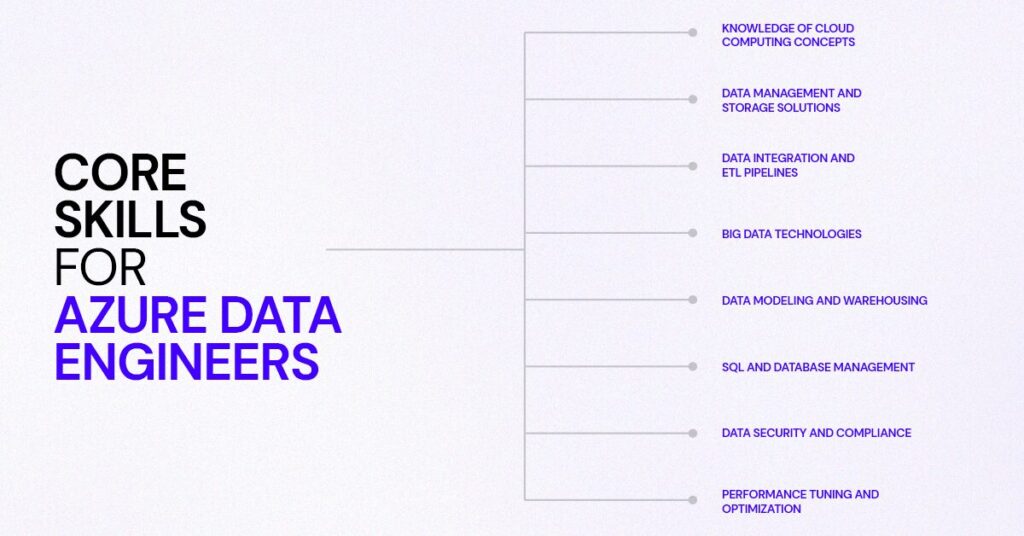
Knowledge of Cloud Computing Concepts
Fundamentals of Cloud Computing
Cloud computing knowledge forms the foundation of azure data engineering. Engineers must understand scalability, elasticity, and high availability. Furthermore, they must know shared responsibility models.
Cloud platforms reduce infrastructure overhead. Azure data engineering uses managed services to simplify deployment. Additionally, engineers optimize costs through resource planning and monitoring.
Understanding cloud fundamentals allows engineers to design resilient architectures. It also helps them choose the right service for each workload.
Understanding the Cloud Services and Architecture on Azure
Azure offers many services for data workloads. Engineers must understand how these services interact. Furthermore, architectural decisions impact performance and cost.
Azure data engineering requires knowledge of networking, identity, and security. Additionally, engineers design architectures that support fault tolerance.
Clear understanding of Azure architecture enables efficient pipeline design. It also simplifies troubleshooting and scaling.
Data Management and Storage Solutions
Azure Data Lake Storage
Azure Data Lake Storage supports large-scale analytics workloads. It stores structured and unstructured data efficiently. Furthermore, it integrates with analytics engines like Spark.
Azure data engineering relies on Data Lake for centralized storage. Additionally, it enables schema-on-read flexibility.
This storage model supports raw, processed, and curated data layers. It improves data organization and access control.
Azure Blob Storage
Azure Blob Storage stores unstructured data such as files and logs. It offers durability and cost efficiency. Furthermore, it supports tiered storage.
Azure data engineering uses Blob Storage for ingestion and archival. Additionally, it integrates with Azure Data Factory.
Engineers optimize storage costs by selecting appropriate tiers. This improves overall system efficiency.
Azure SQL Database
Azure SQL Database supports relational workloads. It offers managed scalability and security. Furthermore, it integrates with analytics tools.
Azure data engineering uses Azure SQL for transactional and reporting systems. Additionally, it supports high availability.
Engineers design schemas and indexes for performance. This ensures reliable query execution.
Azure Cosmos DB
Azure Cosmos DB supports globally distributed NoSQL workloads, delivering low latency, flexible schemas, and multiple APIs for modern applications.
In Azure data engineering, Cosmos DB powers real-time applications and event-driven systems while scaling automatically with demand.
Engineers carefully design partition keys to ensure efficient data access, balanced throughput, predictable performance, and cost control at scale.
Azure Synapse Analytics
Azure Synapse Analytics unifies data warehousing and analytics. It supports both SQL and Spark workloads. Furthermore, it integrates deeply with Azure services.
Azure data engineering relies on Synapse for enterprise analytics. Additionally, it enables large-scale data processing.
Engineers use Synapse to build analytical models and dashboards.
Data Integration and ETL Pipelines
Azure Data Factory (ADF)
Azure Data Factory orchestrates data movement and transformation, supporting both code-free and code-based pipelines, and integrating with numerous data sources.
In Azure data engineering, ADF automates workflows and reliably supports scheduling, dependency management, and end-to-end pipeline monitoring.
It enables scalable, repeatable data pipelines that improve reliability, governance, operational efficiency, and overall data platform performance consistently.
Creating and Managing ETL Pipelines
ETL pipelines extract, transform, and load data efficiently. Engineers design pipelines to handle failures gracefully and optimize performance.
Azure data engineering emphasizes reliability and reusability. Pipelines are modular, testable, and easier to maintain across environments.
Effective ETL design improves data availability, consistency, scalability, and trust for analytics and downstream applications across modern cloud platforms globally.
Data Transformation Tools in Azure
Azure offers multiple data transformation tools, including Data Flows, Databricks, and SQL engines, each serving specific workloads and scales.
Azure data engineering requires selecting the right tool while balancing performance, cost, scalability, and operational complexity across projects.
Proper transformation ensures clean, consistent, and trusted data for analytics, reporting, machine learning, and downstream applications at scale.
Big Data Technologies
Apache Spark on Azure (Azure Databricks)
Azure Databricks provides fully managed Spark clusters for large-scale data processing and analytics. It integrates seamlessly with Azure storage services.
Azure data engineering uses Databricks for advanced analytics, streaming workloads, and machine learning workflows requiring high performance.
Engineers write scalable Spark jobs efficiently, optimizing transformations, resource usage, and execution time across distributed environments.
Understanding and Working with Big Data Solutions
Big data solutions handle volume, velocity, and variety while engineers carefully manage distributed systems and optimize resource usage.
Azure data engineering includes batch and streaming workloads, where engineers also design for fault tolerance, scalability, and reliability.
This ensures stable big data platforms that deliver consistent performance, resilience, and trustworthy analytics at scale for enterprises globally.
Data Streaming and Processing (Azure Stream Analytics)
Azure Stream Analytics processes real-time data streams and supports event-driven architectures, integrating seamlessly with IoT Hub and Event Hubs.
Azure data engineering uses streaming solutions to deliver real-time insights, enabling faster responses and informed decision-making.
Engineers design low-latency pipelines focused on scalability, fault tolerance, and reliable processing of continuous data flows.
Data Modeling and Warehousing
Designing Data Models using Azure Synapse Analytics
Azure Stream Analytics processes real-time data streams and supports event-driven architectures, integrating seamlessly with IoT Hub and Event Hubs.
Azure data engineering uses streaming solutions to deliver real-time insights, enabling faster responses and informed decision-making.
Engineers design low-latency pipelines focused on scalability, fault tolerance, and reliable processing of continuous data flows.
Understanding Star and Snowflake Schema Design
Star and snowflake schemas support analytics workloads by simplifying querying and reporting while reducing overall data model complexity.
Azure data engineering applies these schemas widely to improve BI performance, consistency, and ease of data consumption.
Engineers choose schemas based on use cases, data volumes, query patterns, and reporting requirements.
Building and Managing Data Warehouses
Data warehouses store curated, structured data optimized for analytics. Engineers manage ingestion, indexing, and query optimization while ensuring high availability.
Azure data engineering uses managed warehouses like Synapse Analytics, supporting elasticity, scalability, and reduced operational overhead.
These warehouses power enterprise analytics, reporting, dashboards, and data-driven decision-making across organizations.
SQL and Database Management
Proficiency in SQL
SQL remains essential for data engineering, enabling engineers to write efficient queries and understand execution plans thoroughly.
Azure data engineering depends heavily on strong SQL skills to support analytics, transformations, and data validation tasks.
Well-optimized SQL improves system performance, reduces costs, and ensures reliable, scalable data processing across platforms.
Writing Complex SQL Queries
Complex SQL queries handle joins, aggregations, and window functions. Engineers optimize them carefully to reduce execution time and resource usage.
Azure data engineering requires advanced SQL logic for transformations, analytics, and data validation at scale.
Proper query optimization ensures reliability, predictable performance, cost efficiency, and stable data processing across large datasets.
Understanding Relational Databases (Azure SQL Database)
Relational databases support structured data by enforcing schemas, managing indexes, and maintaining strong data integrity guarantees.
Azure data engineering integrates relational systems efficiently, with Azure SQL simplifying provisioning, scaling, backups, and operational management.
This foundation supports transactional workloads, ensures consistency, and enables reliable processing for business-critical applications and services.
Data Security and Compliance
Security Measures in Azure Data Engineering
Security protects sensitive data. Engineers implement identity and access controls. Furthermore, they monitor activity.
Azure data engineering enforces security at every layer. Additionally, it supports encryption.
Security reduces risk.
Encryption Techniques
Encryption protects data at rest and in transit. Engineers configure keys, certificates, and access policies, while Azure manages encryption automatically.
Azure data engineering relies on built-in encryption features across storage and data services. This also supports regulatory compliance requirements.
Encryption ensures data confidentiality, reduces security risks, and protects sensitive information throughout the entire data lifecycle.
Role-Based Access Control (RBAC)
RBAC controls who can access Azure resources. Engineers assign roles carefully while following least privilege principles.
Azure data engineering uses RBAC extensively to enforce governance, accountability, and secure access across data platforms.
Proper access control prevents misuse, reduces security risks, and ensures only authorized users interact with sensitive data.
Compliance Frameworks (GDPR, HIPAA, etc.)
Compliance ensures legal and regulatory adherence. Engineers understand industry requirements and data protection standards. Azure provides built-in compliance tools.
Azure data engineering supports audits, monitoring, and reporting while simplifying compliance management across services and environments.
This approach builds trust, reduces risk, and ensures responsible handling of sensitive and regulated data.
Performance Tuning and Optimization
Query Optimization
Query optimization improves performance by reducing execution time and resource consumption. Engineers analyze execution plans and minimize unnecessary scans.
Azure data engineering emphasizes efficiency through optimized queries, indexing strategies, and proper data partitioning.
Well-optimized queries reduce operational costs and significantly improve system responsiveness and user experience.
Performance Tuning in Azure Databases
Performance tuning involves effective indexing, caching strategies, and continuous monitoring of system metrics. Azure also provides automated performance recommendations.
Azure data engineering uses built-in tuning features while engineers manually fine-tune queries, storage, and compute resources.
Proper tuning ensures platform stability, consistent performance, cost efficiency, and reliable data processing under varying workloads.
Data Partitioning and Indexing Strategies
Partitioning improves scalability by distributing data efficiently, while indexing speeds up queries and access patterns.
Azure data engineering applies partitioning widely across storage and analytics systems, and indexing further enhances performance.
Engineers balance design trade-offs carefully, as proper partitioning and indexing are critical for cost, speed, and reliability.
Azure-Specific Tools and Technologies
Azure Synapse Analytics
Azure Synapse Analytics is a unified analytics service combining data warehousing and big data analytics to run complex queries at scale efficiently.
Azure Data Factory (ADF)
Azure Data Factory is a cloud-based ETL service used to build, schedule, and orchestrate data integration pipelines across diverse data sources.
Azure Databricks
Azure Databricks is a managed Apache Spark platform enabling large-scale data processing, advanced analytics, streaming, and machine learning workloads on Azure.
Azure HDInsight
Azure HDInsight is a managed open-source analytics service supporting Hadoop, Spark, Hive, and Kafka for big data processing and distributed workloads.
Azure Stream Analytics
Azure Stream Analytics is a real-time event processing service used to analyze streaming data from IoT Hub, Event Hubs, and Kafka sources.
Programming Languages and Scripting Skills
SQL, Python, PowerShell, Bash, Scala
SQL, Python, PowerShell, Bash, and Scala are core languages for Azure data engineering. They support automation, data transformation, scripting, and analytics. These languages integrate deeply with Azure platforms, enabling efficient pipeline development, orchestration, and scalable processing across modern cloud data architectures.
Soft Skills and Communication
Problem-solving, teamwork, and communication are essential in Azure data engineering roles. Engineers collaborate closely with analysts, data scientists, and DevOps teams. Additionally, they translate complex technical concepts into clear, actionable insights, ensuring alignment between technical implementation, business goals, and stakeholder expectations across data-driven projects.
Certifications and Training for Azure Data Engineers
Microsoft certifications validate Azure Data Engineer skills and demonstrate practical knowledge of data services and architectures. They improve career prospects by increasing credibility and marketability. Skills required for Azure Data Engineer roles closely align with certification objectives, helping professionals prepare systematically while meeting industry expectations and employer requirements.
Practical Experience and Project Management
Hands-on experience builds confidence by exposing Azure Data Engineers to real-world data challenges and system behaviors. Practical work strengthens problem-solving, troubleshooting, and architectural decision-making skills. Additionally, agile project management improves delivery through iterative development, faster feedback, and better collaboration. Together, execution and planning skills enable Azure Data Engineers to deliver reliable, scalable solutions while aligning technical implementation with business goals and changing requirements.
Emerging Trends and Future Skills
AI, serverless architectures, and multi-cloud strategies are shaping the future of Azure data engineering. Data platforms increasingly integrate machine learning for automation, insights, and intelligent processing. Serverless services reduce infrastructure management while improving scalability and cost efficiency. Multi-cloud adoption requires interoperable designs and portable skills. As technologies evolve rapidly, adaptability, continuous learning, and strong architectural foundations remain critical for Azure Data Engineers to build resilient, future-ready data solutions.
Challenges in Azure Data Engineering
- Scalability requires careful resource planning to handle growing data volumes and variable workloads.
- Security involves managing access, encryption, and compliance across multiple Azure services.
- Data quality must be maintained through validation, monitoring, and reliable pipeline design.
- Unstructured data increases complexity in storage, processing, and transformation workflows.
Data Governance on Azure
Governance ensures data consistency, quality, and regulatory compliance across platforms. Azure data engineering supports data stewardship, access policies, and lineage tracking through built-in tools. These capabilities improve transparency, accountability, and trust by showing how data flows, changes, and is consumed across the entire data ecosystem.
Hybrid Cloud Skills for Azure Data Engineering
Hybrid environments combine on-premise and cloud systems to support flexible data architectures. Azure Data Engineers require strong integration skills to connect legacy systems with cloud services. They manage data movement, security, and consistency across environments while ensuring reliable performance, scalability, and governance in complex hybrid data platforms.
Azure Data Engineer’s Role in DevOps
Azure Data Engineers play a key role in DevOps by integrating data pipelines with CI/CD processes. DevOps practices improve deployment speed, reliability, and consistency. Azure data engineering uses automated testing, version control, and infrastructure as code to ensure smooth, repeatable, and scalable data platform deployments across environments.
Explore More
Also Learn about Data Engineer vs Software Engineer
FAQs
What are the key skills required for an Azure Data Engineer?
Key skills include data modeling, ETL design, SQL, Python, Azure services, performance tuning, and data security practices.
Is Azure certification necessary for data engineers?
Azure certification is not mandatory, but it strongly validates skills, improves credibility, and increases job opportunities.
What programming languages should an Azure Data Engineer know?
An Azure Data Engineer should know SQL, Python, Scala, and sometimes Spark-related APIs for data processing.
What tools should an Azure Data Engineer be familiar with?
Common tools include Azure Data Factory, Synapse Analytics, Databricks, Data Lake, SQL Database, and Azure Monitor.
What is the role of a Data Engineer in the Azure ecosystem?
The role focuses on designing, building, and maintaining scalable data pipelines and analytics solutions on Azure.
How important is knowledge of big data technologies in Azure?
Knowledge of big data technologies like Spark, Hadoop, and distributed processing is highly important in Azure environments.
How does an Azure Data Engineer ensure data security?
They ensure data security using encryption, role-based access control, private networking, and compliance best practices.
What are the challenges faced by Azure Data Engineers?
Common challenges include cost optimization, performance tuning, handling large-scale data, and managing complex pipelines.
How can Azure Data Engineers collaborate with other teams?
Azure Data Engineers collaborate with analysts, data scientists, and DevOps teams through shared pipelines and clear documentation.
Is it necessary to learn Azure DevOps for a Data Engineer?
Learning Azure DevOps is beneficial for CI/CD, pipeline automation, version control, and infrastructure management.
Can an Azure Data Engineer work in multi-cloud environments?
Yes, Azure Data Engineers can work in multi-cloud environments using portable tools and cloud-agnostic architectures.
What are the best practices for performance optimization in Azure Data Engineering?
Best practices include partitioning data, optimizing queries, using caching, scaling resources correctly, and monitoring workloads.
What role does AI and machine learning play in Azure Data Engineering?
AI and machine learning support advanced analytics, predictive modeling, and intelligent data processing within Azure platforms.
How can I keep up with the evolving technologies in Azure Data Engineering?
Staying updated requires continuous learning, following Azure documentation, blogs, certifications, and hands-on experimentation.
Conclusion
Azure data engineering enables modern organizations to unlock data value at scale. It combines cloud architecture, analytics, automation, and governance into one discipline. Furthermore, it supports faster decision-making and innovation.
Skills required for Azure Data Engineer roles continue to expand. Engineers must balance technical depth with collaboration. Additionally, continuous learning remains essential.
Techstack Digital helps organizations design and scale robust Azure data engineering platforms that align with business goals and future growth.