

TL;DR – Quick Summary
This guide explains the core differences and similarities between data engineer and software engineer, covering roles, responsibilities, skills, salaries, career paths, and market demand. It shows how data engineers focus on building reliable data systems, while software engineers build applications and products. Together, both roles support scalable, data-driven, and customer-focused digital solutions
Data Engineer vs Software Engineer: Differences, Skills, Salary, Careers
Techstack Digital works with modern brands that rely heavily on data, software systems, and scalable digital products. As companies grow, one common question keeps coming up. Should you hire a data engineer or a software engineer? The confusion is understandable. Both roles work with code. Both build systems. Yet their focus, tools, and daily responsibilities differ in meaningful ways.
This guide explains Data Engineer vs Software Engineer in a clear and practical way. It breaks down what each role does, how they overlap, and why the difference matters. Furthermore, it helps businesses and professionals make informed decisions. Whether you are building a data-driven platform or a customer-facing application, choosing the right role shapes long-term success.
What Is a Data Engineer?
A data engineer builds and maintains systems that collect, process, and store large volumes of data. Their work ensures data flows reliably from source systems to analytics and reporting tools. Additionally, they focus on data quality, performance, and scalability.
In the Data Engineer vs Software Engineer discussion, data engineers work closer to infrastructure and data platforms. They do not usually build user interfaces. Instead, they design pipelines that power dashboards, machine learning models, and business intelligence systems.
Core Responsibilities of a Data Engineer
A data engineer designs data pipelines that move data across systems. They ingest data from APIs, databases, logs, and third-party tools. Furthermore, they clean, transform, and validate data before storage.
They also manage data warehouses and lakes. Performance tuning remains a key responsibility. Additionally, they ensure data reliability through monitoring and testing. Security and access control also fall under their scope.
Types of Data Engineers (Big Data, Platform, Analytics)
Not all data engineers do the same work. Big data engineers handle massive datasets using distributed systems like Spark. Platform data engineers build shared data infrastructure for multiple teams. Analytics engineers focus on transforming data for reporting and dashboards.
Each type plays a role in data engineering vs software engineering discussions. The core difference lies in scale, tooling, and business use cases.
Industries That Hire Data Engineers
Data engineers work across industries. Tech companies rely on them for product analytics. Finance uses them for risk and fraud detection. Healthcare depends on clean data for insights. Additionally, e-commerce, media, and logistics companies hire heavily for this role.
What Is a Software Engineer?
A software engineer designs and builds applications that users interact with. These applications can be web apps, mobile apps, APIs, or embedded systems. Additionally, software engineers focus on functionality, performance, and user experience.
In the Data Engineer vs Software Engineer comparison, software engineers sit closer to product development. They translate business requirements into usable software systems.
Core Responsibilities of a Software Engineer
Software engineers write application logic. They design APIs, manage databases, and integrate third-party services. Furthermore, they handle debugging, testing, and deployment.
They also collaborate with designers and product managers. Code maintainability remains a key responsibility. Additionally, they ensure performance and security at the application level.
Types of Software Engineers (Backend, Frontend, Full Stack, Embedded)
Backend engineers focus on servers and APIs. Frontend engineers build user interfaces. Full stack engineers handle both. Embedded engineers work with hardware and low-level systems.
These roles highlight the difference between software engineer and data engineer in daily tasks and outputs.
Industries That Hire Software Engineers
Every industry needs software engineers. SaaS companies depend on them for products. Fintech builds secure applications. Healthcare platforms rely on compliant systems. Additionally, manufacturing, gaming, and IoT companies hire extensively.
Data Engineer vs Software Engineer: Key Differences
Understanding the difference between data engineer and software engineer requires looking beyond job titles. The distinction appears in daily work, system focus, and project ownership.
Day-to-Day Work Comparison
Data engineers spend time monitoring pipelines and fixing data issues. Software engineers spend time building features and fixing bugs. Furthermore, data engineers work with batch jobs and streaming systems. Software engineers work with requests, responses, and UI logic.
Both roles write code. However, the outputs differ significantly.
Focus: Data Pipelines vs Application Development
Data engineers focus on data movement and transformation. Software engineers focus on application behavior and usability. This contrast defines data engineering vs software engineering at a fundamental level.
Project Lifecycle Involvement
Data engineers often work early in analytics projects. Software engineers stay involved throughout product lifecycles. Additionally, data engineers support downstream teams. Software engineers deliver direct customer value.
Skills Required: Data Engineer vs Software Engineer
Skills form another clear line in the Data Engineer vs Software Engineer comparison. While overlap exists, priorities differ.
Programming Languages Compared
Data engineers commonly use Python, SQL, and Scala. Software engineers use JavaScript, Java, Python, or C++. Furthermore, language choice reflects system needs rather than preference.
Tools, Frameworks, and Technologies
Data engineers work with Spark, Airflow, Kafka, and dbt. Software engineers use frameworks like Django, Spring, React, or Node.js. Additionally, tooling reflects the nature of systems built.
Cloud Platforms and Infrastructure Skills
Both roles use cloud platforms. Data engineers focus on data services like BigQuery and Redshift. Software engineers focus on compute, APIs, and scaling services. This overlap fuels confusion in data engineering vs software engineering.
Soft Skills and Collaboration Requirements
Both roles require communication and collaboration. Data engineers work closely with analysts. Software engineers work closely with product teams. Additionally, documentation and clarity matter for both.
Educational Background and Qualifications
Education paths differ slightly but share common foundations.
Degrees and Formal Education
Most professionals hold computer science or engineering degrees. Mathematics and statistics benefit data engineers. Software engineers benefit from system design exposure.
Certifications and Online Learning Paths
Cloud certifications help both roles. Data engineers pursue data platform certifications. Software engineers pursue cloud architecture and development tracks.
Is a Computer Science Degree Mandatory?
A degree helps but is not mandatory. Practical skills matter more. This reality applies equally to the difference between software engineer and data engineer discussion.
Salary Comparison: Data Engineer vs Software Engineer
Compensation often influences career decisions.
Average Salaries by Country (US, India, Global)
| Role | US Average | India Average | Global Average |
| Data Engineer | $110,000 – $135,000 / year | ₹12,00,000 – ₹20,00,000 / year ($14k–$24k) | $90,000 – $120,000 / year |
| Software Engineer | $105,000 – $130,000 / year | ₹10,00,000 – ₹18,00,000 / year ($12k–$22k) | $80,000 – $115,000 / year |
Salaries overlap heavily. Market demand drives differences.
Salary by Experience Level
Entry-level salaries remain similar. Senior data engineers often earn more due to scarcity. However, senior software engineers can match or exceed this.
Factors That Influence Salary (Location, Industry, Skills)
Location, cloud skills, and system complexity matter. The difference between software engineer and data engineer narrows at senior levels.evels.
Career Path and Growth Opportunities
Both roles offer long-term growth.
Entry-Level to Senior Roles
Data engineers progress to senior and principal roles. Software engineers move toward staff and architect roles. Additionally, both tracks offer technical depth.
Leadership and Management Tracks
Both roles transition into engineering management. Leadership paths depend more on people skills than role type.
Transitioning Between Roles
Many professionals move between roles. Understanding Data Engineer vs Software Engineer helps plan these transitions realistically.
Job Demand and Market Outlook
Job demand remains strong as organizations depend on data platforms and software products to scale operations. Businesses across industries invest in engineering talent to support digital transformation, analytics, automation, and cloud adoption, keeping both roles consistently relevant in global technology markets.
Current Hiring Trends – Intuit
Companies like Intuit actively hire both roles to support data-driven products and scalable platforms. Data engineers enable analytics and insights, while software engineers drive feature development and customer-facing innovation. Additionally, increased reliance on real-time data and digital services continues to fuel steady hiring demand.
Future Outlook (AI, Big Data, Cloud Computing)
AI and big data significantly increase demand for data engineers who manage complex data systems. At the same time, cloud-native and SaaS growth sustains strong demand for software engineers. This balance will continue shaping the long-term evolution of data engineering vs software engineering.
Work Environment and Team Structure
Work environment and team structure influence collaboration style, priorities, communication flow, and day-to-day engineering responsibilities.
Typical Teams Data Engineers Work With
Data engineers work closely with data analysts, data scientists, and platform teams to enable reliable analytics, reporting, and machine learning workflows.
Typical Teams Software Engineers Work With
Software engineers collaborate with designers, QA engineers, and product managers to build, test, and deliver user-focused applications and features.
Data Engineer vs Software Engineer: Pros and Cons
Every role has trade-offs.
Advantages and Challenges of Being a Data Engineer
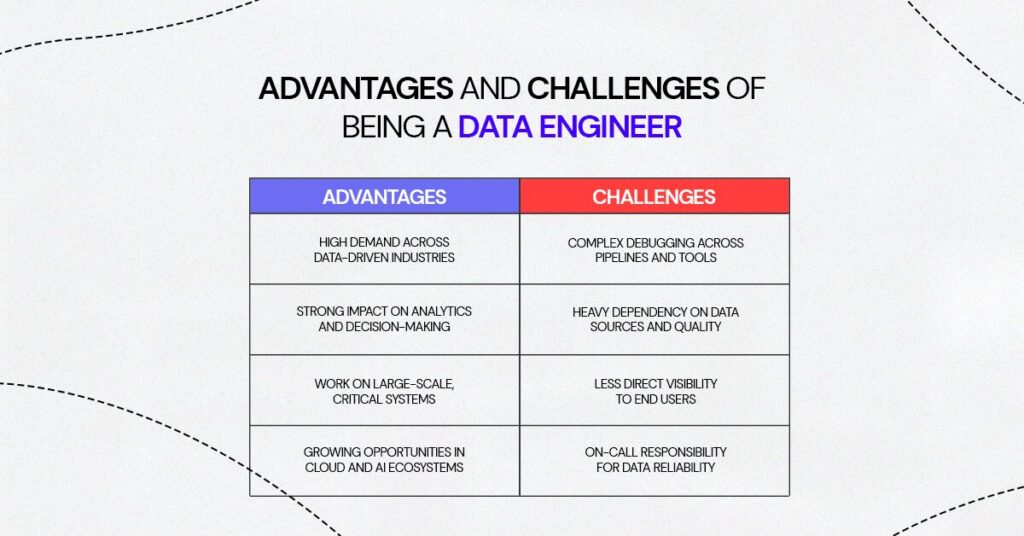
Advantages
- High demand across data-driven industries
- Strong impact on analytics and decision-making
- Work on large-scale, critical systems
- Growing opportunities in cloud and AI ecosystems
Challenges
- Complex debugging across pipelines and tools
- Heavy dependency on data sources and quality
- Less direct visibility to end users
- On-call responsibility for data reliability
Advantages and Challenges of Being a Software Engineer
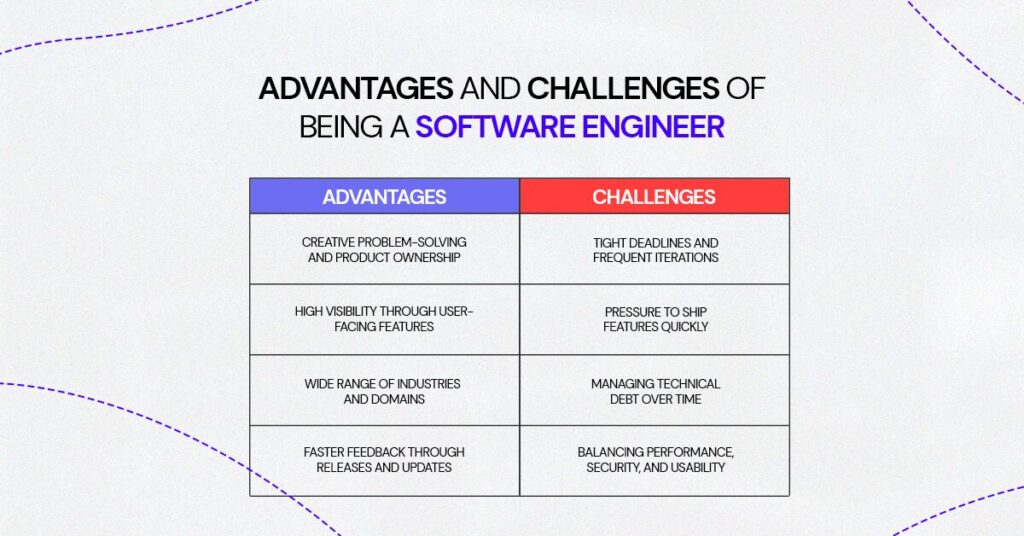
Advantages
- Creative problem-solving and product ownership
- High visibility through user-facing features
- Wide range of industries and domains
- Faster feedback through releases and updates
Challenges
- Tight deadlines and frequent iterations
- Pressure to ship features quickly
- Managing technical debt over time
- Balancing performance, security, and usability
Which Career Is Right for You?
Choosing between Data Engineer vs Software Engineer depends on preferences.
Based on Interests and Strengths
If you enjoy working with data flows, infrastructure, and large-scale systems, data engineering fits well. It suits people who like backend logic and optimization. If you enjoy building user-facing features and solving product problems, software engineering aligns better with creative and application-driven strengths.
Based on Long-Term Career Goals
Long-term growth depends on specialization, leadership ambitions, and industry focus. Data engineers often grow into platform or data leadership roles. Software engineers progress toward architecture or product leadership. Both paths offer strong demand, global opportunities, and long-term career stability.
Can One Role Replace the Other?
No single role can replace the other. Businesses need both to build reliable systems and extract value from data. Data engineers enable access and scale, while software engineers deliver functional products. Understanding the difference between software engineer and data engineer helps teams design balanced, scalable, and efficient technology organizations.
Explore More
Also Learn about Data Analyst vs Data Engineer
Frequently Asked Questions (FAQs)
Is Data Engineering Harder Than Software Engineering?
Both roles differ in complexity; difficulty depends on individual background, skills, learning curve, and interests.
Can a Software Engineer Become a Data Engineer?
Yes, many software engineers transition successfully by learning data pipelines, platforms, and distributed systems.
Which Role Pays More Long-Term?
Long-term pay remains strong in both roles, with market demand, skills, and location influencing outcomes.
Which Career Is More Future-Proof?
Both careers stay future-proof due to growing data volumes, cloud adoption, and ongoing software innovation.
Final Thoughts: Data Engineer vs Software Engineer
The Data Engineer vs Software Engineer comparison is not about superiority. It is about purpose. Modern brands need both roles to scale, innovate, and compete. Choosing correctly data engineer and software engineer improves efficiency and outcomes.
Techstack Digital helps companies align technical roles with business goals. Whether you work with an internal team or an offshore software development company, understanding these roles ensures smarter hiring and stronger systems. Both careers matter. The right choice depends on what you want to build.
.