

TL;DR–Quick Summary
- Core difference: Data analysts focus on insights, reporting, and business decisions, while data engineers build scalable systems that collect, process, and deliver reliable data.
- Primary responsibilities: Analysts analyze structured data, define KPIs, and create dashboards. Engineers design pipelines, manage infrastructure, and ensure data quality at scale.
- Skills comparison: Analysts rely on SQL, statistics, visualization, and business context. Engineers require programming, cloud platforms, data modeling, and system design skills.
- Tools used: Analysts use BI and visualization tools like SQL, Tableau, and Power BI. Engineers work with Spark, Kafka, Airflow, cloud warehouses, and orchestration tools.
- Workflows: Engineers ingest, transform, and store data. Analysts consume prepared data to generate insights and recommendations.
- Career paths: Analysts grow into senior analyst, analytics manager, or product roles. Engineers progress into senior engineer, platform lead, or data architect positions.
- Salary trends: Data engineers generally earn higher long-term salaries, especially at mid and senior levels, due to system ownership and scalability demands.
- Industries hiring: Analysts are common in marketing, finance, healthcare, and retail. Engineers are in high demand across SaaS, fintech, AI, and large enterprises.
- Learning curve: Analytics offers a smoother entry point. Data engineering requires deeper technical commitment and infrastructure knowledge.
- Future outlook: Both roles have strong demand, but data engineering demand grows faster as organizations scale cloud and big data platforms.
Data Analyst vs Data Engineer: Roles, Skills, Salary, and Career Paths
Introduction to Data Analyst vs Data Engineer
Data has become the backbone of modern businesses. Every decision, strategy, and product improvement relies on accurate information. However, data does not create value on its own. People and roles turn data into insights and systems. This is where the discussion of data analyst vs data engineer becomes important.
Furthermore, many companies confuse these roles or combine them incorrectly. As a result, teams struggle with slow reporting, unreliable dashboards, or broken pipelines. Understanding the difference between data analyst and data engineer helps businesses build efficient data teams.
At Techstack Digital, clarity around roles drives better outcomes. This guide explains responsibilities, skills, tools, salaries, and career paths so brands can make informed decisions.
What Is a Data Analyst?
A data analyst focuses on interpreting data to answer business questions. The role centers on insights, trends, and decision support. Analysts work closely with stakeholders to translate data into clear outcomes.
Additionally, a data analyst spends more time working with structured data. They analyze existing datasets instead of building systems. In the ongoing data analyst vs data engineer comparison, analysts sit closer to business teams.
Their value comes from understanding numbers and context together. They explain what happened, why it happened, and what actions to take next.
Roles and Responsibilities of a Data Analyst
Data analysts transform data into insights. They design reports, dashboards, and summaries that guide decisions. Furthermore, they validate data accuracy before analysis.
They also define metrics and KPIs. Analysts ensure teams measure the right things. Additionally, they answer ad-hoc questions from marketing, sales, and leadership.
In the analyst vs engineer comparison, analysts focus less on infrastructure. Instead, they prioritize interpretation, storytelling, and business alignment.
Daily Tasks of a Data Analyst
A typical day includes querying databases, updating dashboards, and reviewing trends. Analysts clean data, remove duplicates, and fix inconsistencies.
Additionally, they prepare reports for meetings. They explain results using charts and narratives. Furthermore, they collaborate with teams to refine metrics.
In data analyst vs data engineer, daily tasks remain less technical and more analytical. Analysts spend most of their time extracting value from prepared data.
Tools and Technologies Used by Data Analysts
Data analysts rely on visualization and querying tools. Common tools include:
- SQL databases
- Tableau or Power BI
- Excel or Google Sheets
- Looker and Metabase
Additionally, analysts use analytics platforms and BI tools. These tools allow fast exploration and reporting. Compared to analyst vs engineer, analysts use fewer backend systems and more front-facing tools.
Programming Languages for Data Analysts
SQL remains the most important language. Analysts use it daily for querying data.
Additionally, Python and R support deeper analysis. They help with statistics, forecasting, and automation. However, analysts rarely build production systems.
In data analyst vs data engineer, analysts write less code and focus more on results.
What Is a Data Engineer?
A data engineer builds the foundation of data systems. They design pipelines, manage infrastructure, and ensure reliable data flow.
Furthermore, data engineers handle scale. They process large datasets and support real-time systems. In the data analyst vs data engineer comparison, engineers work behind the scenes.
Their success depends on stability, performance, and automation. Without engineers, analysts cannot trust the data they analyze.
Roles and Responsibilities of a Data Engineer
Data engineers design and maintain data pipelines. They ingest data from multiple sources and deliver it to warehouses.
Additionally, they manage storage, compute, and orchestration. They also enforce data quality and monitoring.
In analyst vs engineer, engineers focus on systems, not insights. Their responsibility is to make data usable at scale.
Daily Tasks of a Data Engineer
A data engineer writes pipeline code. They monitor failures and optimize performance.
Furthermore, they handle schema changes and infrastructure updates. They also work on cost optimization and scalability.
In data analyst vs data engineer, engineers spend more time coding and debugging than analyzing trends.
Tools and Technologies Used by Data Engineers
Data engineers use backend and infrastructure tools such as:
- Apache Spark and Kafka
- Airflow, Dagster, Prefect
- Snowflake, BigQuery, Redshift
- Cloud platforms like AWS and GCP
These tools differ greatly from analyst toolsets.
Programming Languages for Data Engineers
Python remains the primary programming language for data engineers due to its flexibility and ecosystem. Engineers also use SQL extensively for querying and transforming data. Additionally, Scala and Java are common in big data systems like Spark. Bash scripting supports automation and system tasks, while infrastructure-as-code tools manage cloud resources. Compared to the analyst vs engineer role, data engineers consistently write production-grade, scalable, and maintainable code as part of daily responsibilities.
Key Differences Between Data Analyst and Data Engineer
Focus and Primary Objectives
The core data analyst vs data engineer difference lies in focus. Analysts answer business questions and measure outcomes. Engineers build reliable, scalable systems. Both roles support each other, but their primary objectives remain clearly distinct.
Data Handling and Workflow Differences
Analysts consume prepared data, while engineers produce it. In data analyst vs data engineer, workflows flow from ingestion to analysis. Engineers ingest, transform, and store data. Analysts query, interpret, and communicate insights.
Skill Set Comparison
Analysts rely on statistics, SQL, and business understanding. Engineers require software engineering, cloud platforms, and system design skills. The analyst vs engineer gap widens as data volume and system complexity increase.
Technical vs Analytical Mindset
Analysts think in trends, patterns, and narratives. Engineers think in pipelines, performance, and reliability. In data analyst vs data engineer, mindset often influences success more than specific tools or technologies.
Collaboration with Other Teams
Analysts collaborate closely with business, product, and leadership teams. Engineers work with DevOps, platform, and infrastructure teams. Both roles require strong communication, but each communicates in different directions.
Data Analyst vs Data Engineer: Skills Comparison
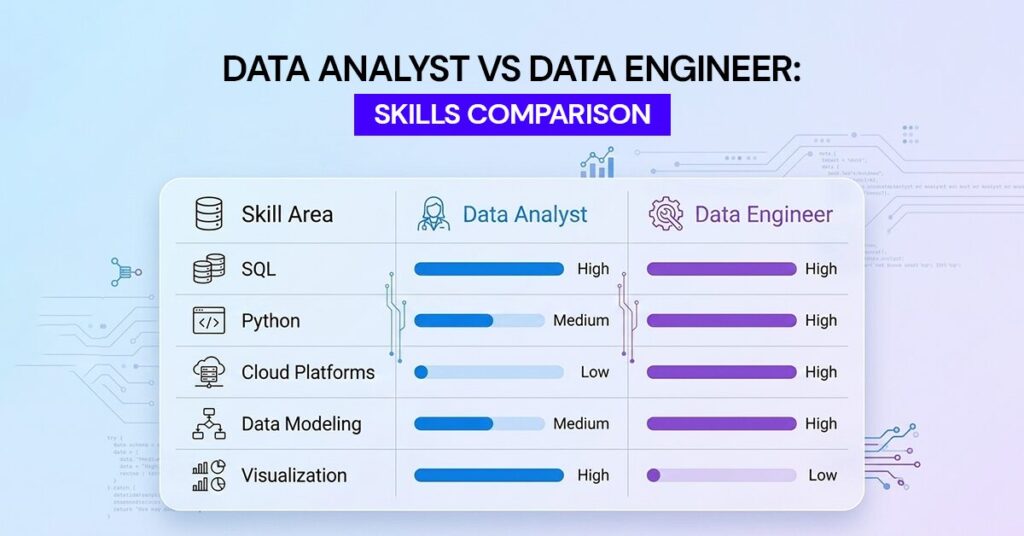
Hard Skills Required
| Skill Area | Data Analyst | Data Engineer |
| SQL | High | High |
| Python | Medium | High |
| Cloud Platforms | Low | High |
| Data Modeling | Medium | High |
| Visualization | High | Low |
This table highlights the difference between data analyst and data engineer skill depth.
Soft Skills Required
Analysts need storytelling and stakeholder communication. Engineers need problem-solving and system thinking.
Both roles benefit from collaboration and documentation skills.
Education Requirements and Background
Degrees and Academic Pathways
Both roles often begin with degrees in computer science, statistics, or engineering. However, in data analyst vs data engineer careers, practical skills, hands-on experience, and problem-solving ability matter more than formal degrees alone.
Certifications for Data Analysts
Popular certifications include:
- Google Data Analytics
- Microsoft Power BI
- Tableau certifications
These validate analytical skills.
Certifications for Data Engineers
Engineers often pursue:
- AWS Data Engineer
- Google Professional Data Engineer
- Databricks certifications
These focus on infrastructure and scalability.
Data Analyst vs Data Engineer: Salary Comparison
Entry-Level Salary Comparison
Entry-level data engineers usually earn slightly higher salaries, as engineering skills face stronger demand and require deeper technical expertise early.
Mid-Level Salary Comparison
At mid-level, the data analyst vs data engineer salary gap widens, with engineers earning more due to increased system responsibility and complexity.
Senior-Level Salary Comparison
Senior data engineers typically earn more because of platform ownership and scale, while senior analysts in leadership roles remain competitively compensated.
Salary by Geography
Salaries vary by geography. Tech hubs pay engineers more, while remote roles and global hiring help reduce regional salary gaps.
Career Path and Growth Opportunities
Career Progression for Data Analysts
Data analysts can grow into senior analyst, analytics manager, or product analyst roles, with some transitioning toward data science or strategy positions.
Career Progression for Data Engineers
Data engineers progress into senior engineer, platform lead, or data architect roles, with career growth closely tied to system ownership.
Transitioning Between Roles
Transitioning from analyst to engineer requires learning pipelines, cloud infrastructure, and system design. Many professionals move gradually within data analyst vs data engineer careers.
Job Market Demand and Industry Adoption
Industries Hiring Data Analysts
Marketing, finance, healthcare, and retail industries rely heavily on data analysts to support reporting, insights, forecasting, and data-driven decision-making.
Industries Hiring Data Engineers
SaaS, fintech, AI-driven companies, and large enterprises prioritize data engineers to build scalable systems and manage complex data infrastructure.
Future Demand and Job Outlook
Demand for both roles continues growing, but data engineering demand increases faster as organizations scale data platforms and adopt cloud technologies.
Work Environment and Team Structure
Typical Teams for Data Analysts
Data analysts usually work within business intelligence or product teams. They stay close to decision-makers, supporting strategy, reporting, and performance tracking across business functions.
Typical Teams for Data Engineers
Data engineers typically work in platform or data infrastructure teams. This structure reflects the analyst vs engineer divide, separating system building from business-facing analysis
Data Analyst vs Data Engineer: Pros and Cons
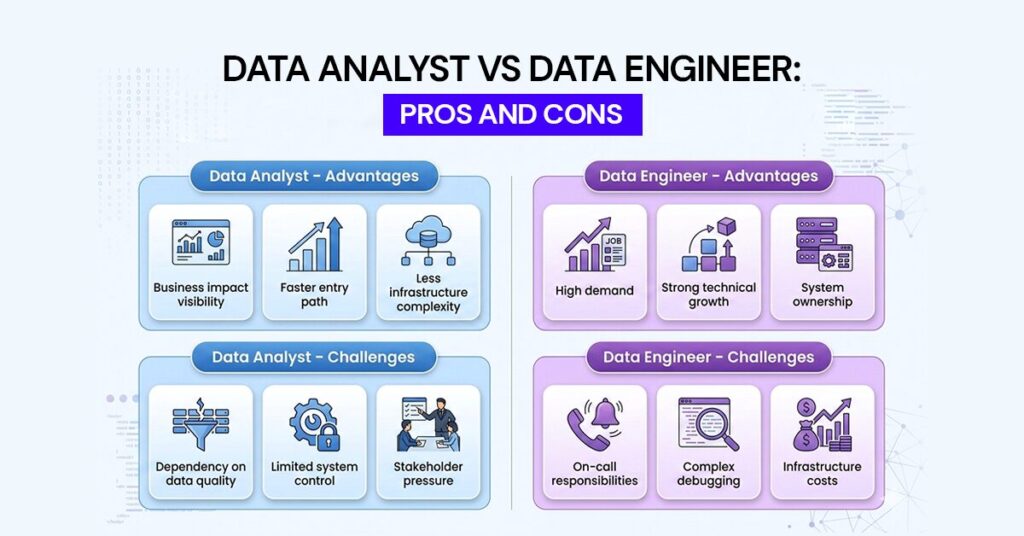
Advantages of Being a Data Analyst
- Business impact visibility
- Faster entry path
- Less infrastructure complexity
Challenges Faced by Data Analysts
- Dependency on data quality
- Limited system control
- Stakeholder pressure
Advantages of Being a Data Engineer
- High demand
- Strong technical growth
- System ownership
Challenges Faced by Data Engineers
- On-call responsibilities
- Complex debugging
- Infrastructure costs
Top 20 Data Engineering Tools and Software
Which Role Is Right for You?
Based on Skills and Interests
Choose a data analyst role if you enjoy finding insights and trends. Choose a data engineer role if you enjoy building scalable systems.
Based on Career Goals
Data engineering suits long-term technical growth and system ownership, while analytics fits business-focused careers involving decision-making and stakeholder collaboration.
Based on Learning Curve
Analytics offers a gentler learning curve, while data engineering requires deeper technical commitment, stronger programming skills, and infrastructure knowledge.
Data Analyst vs Data Engineer: Real-World Use Cases
The difference between data analyst vs data engineer becomes clearer in real-world projects. Both roles work with data, but at different stages. Engineers build systems. Analysts extract insights. Together, they support business decisions.
Business Intelligence Use Cases
In business intelligence, data engineers prepare the foundation. They ingest data from CRMs, marketing tools, product databases, and finance systems. Additionally, they build pipelines, data models, and schedules to keep dashboards reliable and up to date.
Data analysts then define KPIs, build dashboards, and analyze trends. They create reports for leadership, sales, and marketing teams. Furthermore, they explain performance changes and highlight growth opportunities. In this analyst vs engineer dynamic, engineers ensure accuracy and freshness, while analysts ensure clarity and business relevance.
Big Data and Cloud Use Cases
In big data environments, the data analyst vs data engineer difference becomes more technical. Data engineers design cloud-based pipelines using distributed systems like Spark, Kafka, and cloud warehouses. They manage scale, cost, and performance.
Data analysts use this infrastructure to run SQL queries, analyze large datasets, and support experiments. Additionally, they uncover user behavior patterns and business insights. Engineers make data usable at scale. Analysts turn that data into action.
Common Misconceptions About Data Analysts and Data Engineers
Many people assume data analysts do not code or that data engineers lack business understanding. Both assumptions are incorrect. In reality, data analyst vs data engineer roles often overlap in skills and collaboration. However, each role serves a distinct purpose within data teams, balancing insights with system reliability and scalability.
FAQs
Can a Data Analyst Become a Data Engineer?
Yes, many data analysts successfully transition by learning data pipelines, cloud platforms, programming, and system design fundamentals.
Which Role Pays More Long-Term?
Data engineers typically earn higher long-term salaries due to technical complexity, system ownership, and growing demand at scale.
Which Is Better for Beginners?
Data analyst roles are better for beginners because they have a gentler learning curve and require fewer advanced engineering skills.
Do Data Analysts Need Coding?
Yes, data analysts need coding skills, especially SQL for querying data, while Python helps with analysis and automation tasks.
Is Data Engineering Harder Than Data Analysis?
Data engineering is more technically demanding, while data analysis requires stronger business understanding and analytical thinking skills.
Which Role Has Better Future Scope?
Both roles have strong future scope, but data engineering demand grows faster as data systems scale globally.
Explore More
Also Learn about Data Scientist vs Data Engineer
Final Verdict
The data analyst vs data engineer decision depends on individual skills, interests, and long-term career goals. Data analysts focus on interpreting data, identifying patterns, and delivering insights that guide business decisions. In contrast, data engineers build and maintain the systems that collect, process, and deliver reliable data at scale. Both roles play equally important parts in modern data teams.
Analysts provide clarity and context, while engineers ensure data accuracy, availability, and performance. Strong organizations succeed when both perspectives work together seamlessly. At Techstack Digital, aligning the right role with the right problem helps businesses unlock measurable, data-driven outcomes.