
Preparing for a Meta Data Engineer interview requires more than technical knowledge. It demands structured thinking, clear communication, and strong product awareness. Furthermore, Meta evaluates how engineers solve problems at scale and communicate decisions. This guide explains the interview process in a simple and practical way. Additionally, it helps candidates understand expectations across technical, behavioral, and analytics rounds. Techstack Digital works closely with data professionals preparing for FAANG-level interviews, and this guide reflects real interview patterns. The goal is clarity, not intimidation. Each section breaks down what to expect and how to prepare effectively.
Introduction to the Meta Data Engineer Interview
What the Meta Data Engineer Role Involves
A meta data engineer works at the intersection of data infrastructure and product analytics. The role focuses on building reliable pipelines, designing scalable data models, and enabling decision-making through clean data. Furthermore, engineers collaborate with product, engineering, and analytics teams. They translate vague business questions into structured data solutions. Additionally, they optimize performance across large datasets. The role values ownership, impact, and clarity of thought. Communication matters as much as execution. Meta expects engineers to justify design choices and tradeoffs clearly.
Why Meta’s Interview Process Is Unique
Meta emphasizes signal over memorization. Interviewers focus on reasoning, not tricks. Furthermore, questions often simulate real work scenarios. Candidates must explain assumptions and constraints clearly. Additionally, Meta values speed balanced with correctness. Product context matters throughout the process. The interview tests how candidates think under ambiguity. Strong communication can outweigh minor mistakes. This approach differentiates the meta data engineer interview from many traditional hiring loops.
What This Interview Guide Covers
This guide covers every stage of the meta data engineer interview. It explains interview rounds, technical topics, behavioral expectations, and preparation strategies. Furthermore, it includes sample questions and common mistakes. Additionally, it highlights how Meta evaluates candidates internally. The goal is practical readiness. You will understand what matters and what does not.
Overview of the Meta Data Engineer Interview Process
Application and Resume Screening
Meta screens resumes for impact, not buzzwords. Clear ownership matters. Furthermore, measurable outcomes strengthen applications. Additionally, relevant scale experience improves chances. The screening stage filters for signals early. Resumes must show problem-solving depth.
Recruiter Phone Screen
The recruiter screen checks alignment and communication. Furthermore, recruiters assess motivation and role understanding. Additionally, they explain the interview structure clearly. Candidates should ask clarifying questions. This round sets expectations.
Technical Phone Interview
This round focuses on SQL and data reasoning. Furthermore, candidates must talk through logic clearly. Additionally, interviewers observe clarity and structure. Speed matters, but correctness matters more. This stage often decides onsite readiness.
Onsite / Virtual Onsite Interview Loop
The onsite includes multiple interviews. Furthermore, it tests technical, product, and behavioral skills. Additionally, interviewers evaluate consistency across rounds. Each round has clear objectives.
Hiring Committee and Offer Decision
The hiring committee reviews structured feedback. Furthermore, no single interviewer decides alone. Additionally, Meta values consensus and signal strength. Decisions focus on long-term success.
Meta Data Engineer Interview Rounds Explained
Initial Recruiter Call
This call confirms role fit and availability. Furthermore, recruiters explain expectations clearly. Additionally, they assess communication quality. Candidates should confirm level alignment early.
Technical Screening Round
This round focuses on SQL and modeling. Furthermore, candidates must explain choices clearly. Additionally, interviewers evaluate edge cases. Logical thinking matters most.
Onsite Interview Structure
The onsite includes SQL, data modeling, analytics, and behavioral rounds. Furthermore, each round has a dedicated focus. Additionally, interviewers do not overlap responsibilities.
Number of Interviews and Interviewers
Most loops include four to five interviews. Furthermore, each interviewer scores independently. Additionally, consistency across rounds matters. One weak round can be offset by strong signals elsewhere.
Meta Data Engineer Technical Interview Topics
SQL Interview Questions
SQL is critical in the meta data engineer interview. Candidates must write clean, correct queries. Furthermore, explanation matters as much as syntax. Interviewers assess logic step by step.
Joins, Subqueries, and Aggregations
Candidates must understand join behavior deeply. Furthermore, they should avoid unnecessary complexity. Additionally, aggregations must align with business intent. Clarity matters.
Window Functions
Window functions test advanced SQL understanding. Furthermore, candidates must explain partitions clearly. Additionally, use cases should feel practical. Overcomplication hurts performance.
Data Cleaning and Transformation
Cleaning data is a real-world skill. Furthermore, candidates must handle nulls and duplicates. Additionally, transformations should preserve meaning. Interviewers value practical thinking.
SQL Performance Optimization
Optimization shows maturity. Furthermore, candidates should discuss indexes and query plans. Additionally, tradeoffs must be explained clearly. Perfection is not required.
Data Modeling Interview Questions
OLTP vs OLAP Data Models
Candidates must explain differences clearly. Furthermore, they should discuss workload patterns. Additionally, examples help communication. This topic appears frequently.
Designing Scalable Data Schemas
Scalability matters at Meta. Furthermore, candidates must plan for growth. Additionally, normalization and denormalization tradeoffs should be clear.
Fact and Dimension Tables
Star schemas appear often. Furthermore, candidates should define grain correctly. Additionally, misuse of dimensions raises red flags.
Tradeoffs in Data Model Design
Every design has tradeoffs. Furthermore, candidates must explain constraints. Additionally, business context should guide decisions.
ETL and Data Pipelines
Batch vs Streaming Pipelines
Candidates must compare both clearly. Furthermore, latency and cost matter. Additionally, real examples strengthen answers.
Data Validation and Quality Checks
Quality is non-negotiable. Furthermore, candidates should discuss checks and alerts. Additionally, prevention matters more than fixes.
Pipeline Failure Handling
Failures happen. Furthermore, candidates must design recovery strategies. Additionally, idempotency is important.
Monitoring and Logging Pipelines
Monitoring ensures trust. Furthermore, candidates should mention metrics and alerts. Additionally, observability matters at scale.
Big Data and Distributed Systems
Working with Large-Scale Datasets
Scale changes everything. Furthermore, candidates must discuss partitioning. Additionally, memory limits matter.
MapReduce and Spark Concepts
Understanding Spark fundamentals is expected. Furthermore, transformations and actions must be clear. Additionally, lazy evaluation often appears.
Data Partitioning and Sharding
Partitioning improves performance. Furthermore, poor partitioning causes bottlenecks. Additionally, candidates must justify choices.
Performance Bottlenecks at Scale
Candidates must identify bottlenecks quickly. Furthermore, they should propose fixes. Additionally, tradeoffs matter.
Coding Interview for Meta Data Engineers
Python Coding Questions
Python evaluates problem-solving clarity rather than syntax mastery. Furthermore, interviewers focus on logical structure and explanation. Additionally, clean and readable solutions score higher. This round may include meta data engineer interview questions python to assess reasoning depth.
Data Manipulation Using Python
Candidates commonly work with arrays, dictionaries, or tabular data. Furthermore, pandas-style transformations may appear. Additionally, interviewers assess efficiency, correctness, and the ability to explain transformations clearly without overcomplicating the solution.
Algorithmic Thinking for Data Engineers
Candidates must decompose problems into simple, logical steps. Furthermore, handling edge cases demonstrates maturity. Additionally, clear reasoning and structured thinking consistently outperform overly clever or complex approaches during evaluation.
Common Coding Mistakes to Avoid
Rushing through solutions often introduces avoidable errors. Furthermore, ignoring constraints weakens performance. Additionally, failing to explain assumptions or logic clearly reduces interviewer confidence, even when the final answer appears technically correct.
Analytics and Product Sense Interviews
Understanding Meta Products (Facebook, Instagram, Ads)
Product knowledge is essential in Meta interviews. Furthermore, candidates must understand user behavior across platforms. Additionally, data analysis should always align metrics and insights with clear product goals and real user outcomes.
Metrics Definition and KPI Design
Strong metrics guide effective decisions. Furthermore, candidates must define success using measurable outcomes. Additionally, interviewers discourage vanity metrics and expect KPIs that directly reflect product health and user value.
Funnel Analysis and User Behavior
Funnels help identify where users drop off. Furthermore, candidates must analyze each stage logically. Additionally, forming clear hypotheses shows an ability to connect data patterns with underlying user behavior.
Experimentation and A/B Testing Concepts
Experiments validate product assumptions through data. Furthermore, candidates must explain statistical rigor clearly. Additionally, discussing sample size, bias, and real-world constraints demonstrates practical experimentation experience.
Behavioral Interview at Meta
Meta Core Values and Culture
Meta’s values guide daily decisions and long-term strategy. Furthermore, candidates must align their examples with measurable impact. Additionally, interviewers expect strong ownership, accountability, and a mindset focused on building systems that scale responsibly.
“Move Fast” and “Impact at Scale” Examples
Behavioral stories carry significant weight during interviews. Furthermore, candidates should quantify results and explain decisions clearly. Additionally, demonstrating how lessons were learned from mistakes shows adaptability and long-term thinking at scale.
Cross-Functional Collaboration Questions
Collaboration is central to Meta’s work culture. Furthermore, candidates must demonstrate empathy when working with diverse teams. Additionally, clear communication, expectation setting, and alignment across functions strongly influence interview evaluations.
Conflict Resolution and Ownership
Conflict is unavoidable in fast-moving environments. Furthermore, candidates must show maturity when handling disagreements. Additionally, taking responsibility, resolving issues constructively, and owning outcomes signals leadership readiness and trustworthiness.
Meta Data Engineer Onsite Interview Loop
Interview Day Structure
The interview day follows a clear and predictable schedule. Furthermore, planned breaks help candidates reset mentally. Additionally, managing energy, focus, and pacing throughout the day directly affects performance across multiple interview rounds.
Types of Interviewers You’ll Meet
Interviewers typically include data engineers, analysts, and product-focused partners. Furthermore, each interviewer evaluates a specific competency. Additionally, maintaining consistent reasoning and communication style across sessions improves overall interview outcomes.
Evaluation Criteria Used by Meta
Meta evaluates candidates on technical depth and clarity of thought. Furthermore, a strong signal outweighs minor mistakes. Additionally, clear communication, structured reasoning, and decision justification are critical to earning positive interview feedback.
Common Reasons Candidates Fail
Candidates often fail due to unclear explanations. Furthermore, ignoring product context weakens answers. Additionally, weak SQL fundamentals, poor reasoning structure, and limited communication significantly reduce overall interview performance.
Meta Data Engineer Interview Questions (Examples)
SQL Sample Questions
Expect joins, aggregations, and filtering logic. Furthermore, window functions appear frequently. Additionally, interviewers test edge cases, data accuracy, and the ability to explain query intent clearly.
Data Modeling Sample Questions
Candidates design schemas in real time. Furthermore, assumptions must be stated explicitly. Additionally, scalability, future growth, and tradeoffs influence how interviewers evaluate modeling decisions.
Product Analytics Sample Questions
These questions assess product thinking. Furthermore, metrics must align with business goals. Additionally, structured reasoning and clear interpretation of user behavior strongly affect evaluation outcomes.
Behavioral Sample Questions
Behavioral questions focus on real experiences. Furthermore, stories must demonstrate impact and ownership. Additionally, honest reflection and learning from past decisions improve interviewer confidence.
Meta Data Engineer Preparation Strategy
How Long to Prepare
Preparation depends on your current SQL and data experience. Use this as a practical baseline:
- Beginner (no real SQL / analytics work): 10–12 weeks
- Intermediate (basic SQL + some analytics): 6–8 weeks
- Experienced (daily SQL, production exposure): 3–4 weeks
Minimum effective schedule:
- Weekdays: 1.5–2.5 hours/day
- Weekends: 3–4 hours (deep practice + mocks)
If you cannot commit at least 10–12 focused hours/week, expect delays.
Study Plan for 30 / 60 / 90 Days
30-Day Plan (Fast Track – Only if fundamentals are solid)
Week 1 – SQL Core
- Joins (inner, left, multi-table)
- Group by + aggregates
- 30–40 problems (mostly medium)
Week 2 – Advanced SQL
- Window functions (ROW_NUMBER, RANK, LAG, LEAD)
- CTEs + subqueries
- Time-based queries
- 25–30 problems
Week 3 – Data Modeling + Product Metrics
- Fact vs dimension tables
- Star schema
- Metrics:
- DAU / MAU
- Retention
- Funnels
- DAU / MAU
Week 4 – Interview Mode
- 5–7 mocks
- Timed SQL (30 mins each)
- Practice explaining queries clearly
60-Day Plan (Recommended)
Weeks 1–2 – SQL Foundations
- 8–10 questions/day
- Focus:
- Join logic
- Aggregations
- Join logic
- Goal: zero hesitation on basic queries
Weeks 3–4 – Advanced SQL
- Window functions (heavy focus)
- CTE vs subquery usage
- Practice:
- Ranking problems
- Sessionization
- Event logs
- Ranking problems
Weeks 5–6 – Data Modeling + Analytics
- Design schemas for:
- E-commerce
- Ride-sharing
- Social apps
- E-commerce
- Metrics:
- Cohort retention
- Funnel conversion
- Growth metrics
- Cohort retention
Weeks 7–8 – Mock Interviews
- 8–10 mocks
- Track:
- Time taken
- Mistakes
- Communication gaps
- Time taken
90-Day Plan (Best for beginners)
Month 1 — SQL Depth
- 150–200 problems
- Focus:
- Multi-joins
- Filtering logic
- Clean query writing
- Multi-joins
Month 2 – Real-World Data Thinking
- Build 2–3 small projects:
- Retention analysis
- Funnel dashboard
- Retention analysis
- Learn:
- ETL basics
- Event tracking
- ETL basics
Month 3 – Interview Execution
- 15–20 mocks
- Practice:
- Whiteboard schema design
- Product analytics questions
- Whiteboard schema design
Mock Interviews and Practice Platforms
When to start: After ~2–3 weeks of prep
Minimum target:
- 10 mocks → acceptable readiness
- 15+ mocks → strong performance
Mock structure:
- 30 min SQL
- 15 min discussion (metrics/modeling)
What to evaluate:
- Query correctness
- Speed (target: <25 min)
- Communication clarity
Where to practice:
- LeetCode (SQL section)
- StrataScratch (closest to real interviews)
- DataLemur (product analytics focus)
How to Practice SQL the Right Way
Use this exact loop for every question:
1. Understand the data
- What are the tables?
- What is the relationship?
2. Plan before coding
- Required joins
- Aggregations needed
3. Write query (no shortcuts)
- Avoid trial-and-error typing
4. Explain aloud
- Why this join?
- Why this grouping?
- What about duplicates/nulls?
5. Optimize
- Remove unnecessary subqueries
- Simplify logic
6. Re-write clean version
- Clean formatting
- Readable aliases
Daily structure (2-hour model):
- 60 min → SQL problems
- 30 min → concepts (modeling / metrics)
- 20 min → explain 1–2 queries aloud
- 10 min → review mistakes
Focus on clarity + correctness, not clever queries. That is what interviewers evaluate.
Meta Data Engineer Salary and Leveling
| Level | Title | Experience | Scope | Base Salary (USD) | Total Comp (USD) |
| IC3 | Data Engineer | 0–2 yrs | Executes tasks, limited ownership | $120K – $150K | $150K – $190K |
| IC4 | Data Engineer II | 2–4 yrs | Owns features, writes production SQL/pipelines | $150K – $180K | $190K – $240K |
| IC5 | Senior Data Engineer | 4–7 yrs | Leads projects, designs systems | $180K – $210K | $250K – $320K |
| IC6 | Staff Data Engineer | 7–10 yrs | Cross-team ownership, architecture decisions | $210K – $240K | $320K – $420K |
| IC7 | Senior Staff / Principal | 10+ yrs | Org-level impact, strategy + infra direction | $240K – $280K | $400K – $600K+ |
Compensation Breakdown (Base, Bonus, RSUs)
IC3 (Entry Level)
- Base: $120K – $150K
- Bonus: 10% → $12K – $15K
- RSUs: $20K – $40K/year
IC4 (Mid-Level)
- Base: $150K – $180K
- Bonus: 10–15% → $15K – $27K
- RSUs: $40K – $70K/year
IC5 (Senior)
- Base: $180K – $210K
- Bonus: 15% → $27K – $32K
- RSUs: $70K – $120K/year
IC6 (Staff)
- Base: $210K – $240K
- Bonus: 15–20% → $32K – $48K
- RSUs: $120K – $180K/year
IC7 (Principal)
- Base: $240K – $280K
- Bonus: 20% → $48K – $56K
- RSUs: $200K – $350K/year
Key Notes (Reality Check)
- RSUs are the largest growth driver (often 40–60% of total comp at IC6+)
- Promotions typically increase comp by 20–40%
- Meta refreshes RSUs annually → strong long-term upside
- Offers vary based on:
- Location (US vs remote/global)
- Competing offers
- Interview performance
- Location (US vs remote/global)
These numbers reflect realistic Meta ranges, not generic market averages.
How Leveling Is Decided
Leveling depends on interview signals rather than resume history. Furthermore, Meta prioritizes demonstrated performance. Additionally, candidates who show clear impact, strong reasoning, and consistent execution are more likely to be leveled higher.
Negotiation Tips for Meta Offers
Negotiation is expected during the Meta offer stage. Furthermore, candidates should remain professional and respectful throughout discussions. Additionally, using market data, leveling benchmarks, and competing offers strengthens your position. Clear reasoning, calm communication, and flexibility help build trust while increasing the chances of securing better compensation terms.
Common Mistakes Candidates Make
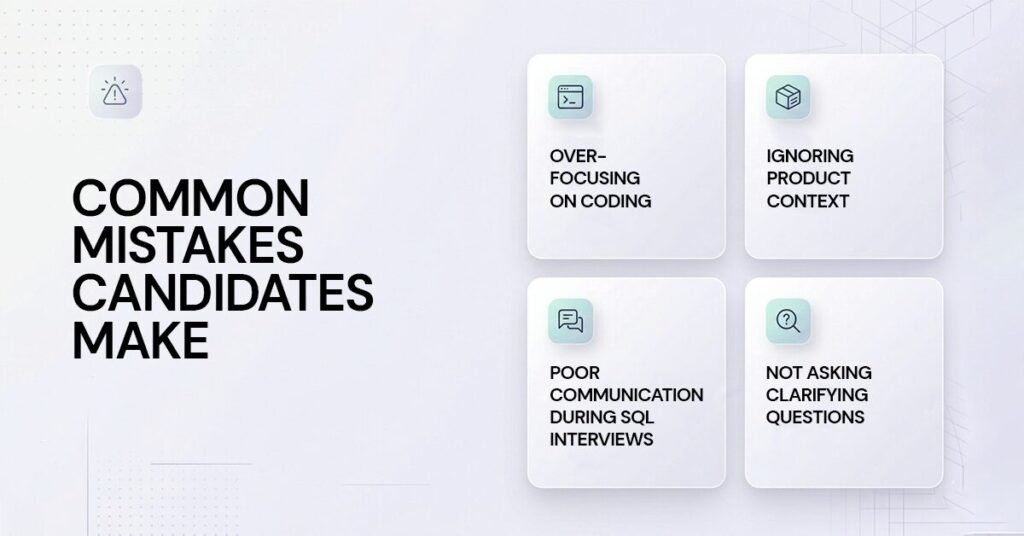
- Over-focusing on Coding
Coding alone is not enough to succeed. Furthermore, interviewers expect clear communication. Additionally, strong product thinking is critical for demonstrating real-world problem-solving ability. - Ignoring Product Context
Product context shapes effective solutions. Furthermore, ignoring it weakens otherwise correct answers. Additionally, Meta values relevance and alignment with real user and business needs. - Poor Communication During SQL Interviews
Staying silent hurts performance. Furthermore, thinking aloud helps interviewers follow logic. Additionally, clear explanations matter as much as writing correct SQL queries. - Not Asking Clarifying Questions
Clarifying assumptions is essential. Furthermore, asking questions shows maturity and structured thinking. Additionally, guessing without validation often leads to incorrect or misaligned solutions.
How Meta Evaluates Data Engineers
Technical Depth vs Business Impact
Both technical depth and business impact matter in evaluations. Furthermore, maintaining balance is essential. Additionally, Meta often prioritizes real-world impact and decision quality over unnecessary technical complexity.
Signal vs Noise in Interview Performance
Meta focuses on meaningful signal over isolated mistakes. Furthermore, consistent performance across interviews matters most. Additionally, minor errors are acceptable when overall reasoning and clarity remain strong.
What “Strong Hire” Really Means at Meta
A strong hire demonstrates clear thinking and ownership. Furthermore, they show ability to scale impact. Additionally, they communicate decisions effectively across technical and non-technical stakeholders.
Explore More
Also Learn about What skills are needed for Azure Data Engineering?
Meta Data Engineer vs Other FAANG Interviews
Meta vs Google Data Engineer Interviews
Google emphasizes theoretical depth and problem solving. Furthermore, Meta prioritizes real-world application. Additionally, Meta places a stronger focus on product sense and business-driven data decisions.
Meta vs Amazon Data Engineer Interviews
Amazon interviews heavily emphasize leadership principles. Furthermore, Meta focuses more on measurable impact. Additionally, Meta interviews feel less scripted and more discussion-driven overall.
Key Differences in Interview Style
Meta interviews feel conversational and practical. Furthermore, reasoning and explanation matter more than speed. Additionally, collaboration, clarity, and real-world thinking are consistently evaluated.
Resources to Prepare for Meta Data Engineer Interview
SQL Practice Resources
Core Platforms (closest to Meta-style questions):
- StrataScratch → Best match for product + analytics SQL
- DataLemur → Meta-style business problems
- LeetCode → Use SQL section (focus medium/hard)
Target Practice Volume:
- 150–250 SQL problems total
- At least:
- 40% joins
- 30% window functions
- 20% aggregation + filtering
- 10% edge cases
- 40% joins
Real Dataset Practice (critical):
- Kaggle datasets
- Google BigQuery public datasets
- Practice:
- event logs
- transaction data
- user activity tables
- event logs
Data Modeling Books and Courses
Books (high signal, not optional)
- The Data Warehouse Toolkit — MUST READ
- Fact vs dimension tables
- Star schema
- Real-world examples
- Fact vs dimension tables
- Designing Data-Intensive Applications
- Data pipelines
- Distributed systems
- Tradeoffs
- Data pipelines
- Fundamentals of Data Engineering
- Modern DE stack
- ETL/ELT thinking
- Practical architecture
- Modern DE stack
Courses (only high ROI ones)
- Data Engineering Zoomcamp
- End-to-end pipelines
- Hands-on projects
- End-to-end pipelines
- Mode SQL Tutorial
- Best for analytics SQL
- Covers real business cases
- Best for analytics SQL
- Coursera Data Warehousing for Business Intelligence
- Schema design
- Data modeling exercises
- Schema design
Mock Interview Platforms
Best Platforms:
- Interviewing.io → Anonymous FAANG interviewers
- Exponent → Structured Meta prep
- Pramp → Free but less consistent
Target:
- Minimum: 10 mocks
- Strong prep: 15–20 mocks
What to simulate:
- 30 min SQL
- 15 min discussion:
- metrics
- schema design
- tradeoffs
- metrics
Official Meta Preparation Resources
- Meta Platforms Careers Interview Guide
- Focus on:
- SQL + analytics
- product thinking
- communication clarity
- SQL + analytics
- Focus on:
- Meta Careers (site resources + prep pages)
What Actually Works (Execution Layer)
Weekly structure:
- 5 days → SQL (core)
- 2 days → modeling + mocks
Must-do practice:
- Explain every query verbally
- Redo failed questions after 48 hours
- Time yourself (target: 20–25 min/query set)
Key focus:
- Clean logic > clever queries
- Business understanding > syntax tricks
Frequently Asked Questions (FAQs)
Is Meta Data Engineer Interview Hard?
Yes, it is challenging but fair. Furthermore, structured preparation improves outcomes. Additionally, clear thinking and communication significantly increase success.
How Many SQL Questions Are Asked?
Usually multiple SQL questions appear. Furthermore, depth of understanding matters. Additionally, question complexity varies by interview round and difficulty.
Does Meta Ask LeetCode-Style Questions?
Rarely uses LeetCode-style problems. Furthermore, focus remains practical. Additionally, logical reasoning outweighs memorized algorithms.
Can I Interview Without Big Tech Experience?
Yes, big tech experience is not required. Furthermore, demonstrated impact matters more. Additionally, strong preparation bridges most experience gaps.
How Long Does the Hiring Process Take?
Typically four to eight weeks. Furthermore, scheduling availability affects timelines. Additionally, internal reviews can sometimes cause minor delays.
Final Tips to Crack the Meta Data Engineer Interview
What to Focus on the Week Before Interviews
Review core fundamentals calmly. Furthermore, prioritize rest and focus. Additionally, confidence and clarity improve overall interview performance.
Interview Day Best Practices
Stay calm and manage time well. Furthermore, communicate reasoning clearly. Additionally, ask clarifying questions whenever needed.
Post-Interview Follow-Up Advice
Send concise thank-you messages. Furthermore, reflect honestly on performance. Additionally, use feedback to improve future interview readiness
Conclusion
The meta data engineer interview evaluates more than technical ability. It tests clarity, reasoning, and product understanding. Furthermore, success depends on structured preparation and communication. This guide explained the process, expectations, and strategies in depth. Modern brands rely on strong data engineers to drive decisions at scale. Techstack digital helps professionals prepare for high-impact data roles through structured guidance and real-world practice. With the right approach, this interview becomes a solvable challenge rather than an obstacle.