
Quick Summary
- LAMP can be a strong MERN alternative when PHP, MySQL, relational data, server-side rendering, and established hosting fit the project.
- MERN fits React-heavy, JavaScript-first, interactive, real-time, and event-driven applications more naturally.
- MySQL suits structured relational data, while MongoDB suits flexible document-based data models.
- Neither stack is automatically faster or more scalable. Performance and scalability depend on architecture, workload, caching, databases, infrastructure, and optimization.
- LAMP can work well for ecommerce, SaaS, large applications, and existing PHP systems when its architecture matches the requirements.
- React can also work with a PHP backend, so teams do not always need to choose a rigid LAMP or MERN architecture.
- Choose based on architecture, data model, workload, infrastructure, developer expertise, and long-term maintenance rather than popularity.
LAMP vs MERN: Is LAMP a Good Alternative for Web Development in 2027?
LAMP can be a good alternative to MERN when it matches the application’s technical requirements. LAMP uses Linux, Apache, MySQL, and PHP, while MERN uses MongoDB, Express.js, React, and Node.js. Furthermore, LAMP may suit relational data, server-rendered websites, and established PHP infrastructure. MERN may fit React-focused, JavaScript-first, interactive, and event-driven applications. Additionally, Techstack Digital helps businesses evaluate architecture, database needs, frontend complexity, scalability, performance, team expertise, hosting, and maintenance before choosing the right stack.
Quick Answer: Is LAMP a Good Alternative to MERN?
Yes. LAMP can be a practical MERN alternative when a project benefits from PHP, MySQL, relational data, server-side application patterns, established hosting infrastructure, or an existing PHP codebase. However, MERN may fit React-heavy, JavaScript-first, highly interactive, real-time, and event-driven applications more naturally. The better choice depends on project requirements.
LAMP vs MERN at a Glance
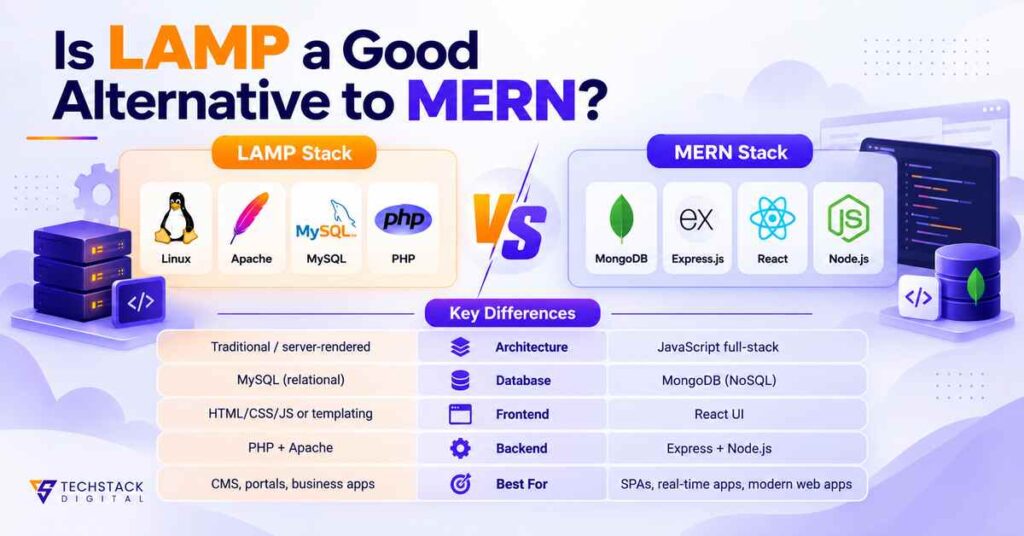
LAMP uses Linux, Apache, MySQL, and PHP, while MERN uses MongoDB, Express.js, React, and Node.js. Furthermore, LAMP often follows server-side request-response patterns, while MERN supports React-based interfaces and event-driven applications. Additionally, both stacks can scale and support modern applications when architecture and infrastructure match project requirements.
What Is the LAMP Stack?
LAMP combines Linux, Apache, MySQL, and PHP. Linux provides the operating system, Apache handles web requests, MySQL stores relational data, and PHP manages backend logic. Furthermore, LAMP supports APIs, server-rendered applications, and modern frameworks. Additionally, its mature ecosystem and broad hosting support keep it relevant for web development.
What Is the MERN Stack?
MERN combines MongoDB, Express.js, React, and Node.js. MongoDB stores document-based data, Express.js handles backend routing, React builds interfaces, and Node.js runs server-side JavaScript. Furthermore, MERN supports JavaScript across frontend and backend development. Additionally, it fits interactive, API-driven, and event-driven web applications well.
How Is LAMP Different From MERN?
The main difference between LAMP and MERN does not come from comparing four technologies against another four technologies. The deeper difference involves application architecture.
LAMP traditionally uses PHP for backend processing, MySQL for relational data, Apache for web serving, and server-generated pages. MERN commonly uses Node.js and Express.js for APIs, MongoDB for document storage, and React for client-side interfaces.
Furthermore, their request-handling models differ. PHP commonly handles individual web requests through server-side execution. Node.js uses an event loop and asynchronous I/O model.
Their database architectures also differ significantly. MySQL organizes data through structured relational tables. MongoDB organizes data through documents and collections.
Additionally, MERN directly defines a frontend technology through React, while LAMP does not prescribe a frontend framework.
Hosting, deployment practices, available developer expertise, existing infrastructure, application structure, and maintenance requirements can therefore make one stack more suitable than the other.
Explore More
Also Learn about MERN stack alternatives
PHP vs Node.js for Backend Development
PHP and Node.js can both power modern backend applications, APIs, authentication systems, business logic, and database operations. However, they use different execution models.
PHP typically processes requests through server-side scripts or frameworks such as Laravel and Symfony. A request enters the application, PHP executes the required logic, produces a response, and completes the request lifecycle.
Node.js uses an event-driven architecture. It handles asynchronous operations through an event loop. Furthermore, this model can work well for applications that process many concurrent I/O operations, persistent connections, and frequent asynchronous events.
However, asking whether Node.js or PHP is simply “faster” oversimplifies backend performance. Database queries, caching, application logic, infrastructure, framework overhead, network latency, and code quality can affect performance significantly.
Additionally, developer expertise matters. A strong PHP team may build a better application with PHP than an inexperienced team using Node.js. Workload and architecture should guide the backend decision.
MySQL vs MongoDB for Data Storage
MySQL and MongoDB represent one of the most important differences between LAMP and MERN.
MySQL uses a relational database model. Developers organize information into tables, rows, columns, relationships, indexes, and constraints. This model fits applications with structured records, strong relationships, complex SQL queries, and transactional requirements.
MongoDB uses a document-oriented model. It stores records as flexible documents inside collections. Furthermore, related information can sometimes remain within the same document, which can reduce the need for traditional relational joins.
Flexible schemas can also support applications where data structures evolve frequently. However, flexibility does not remove the need for careful data modeling.
Additionally, both databases support transactions and sophisticated query capabilities, although they approach data organization differently.
Developers should therefore choose based on the application’s data model. If relationships and structured transactions dominate, MySQL may fit naturally. If document-oriented structures fit the domain better, MongoDB may provide a strong option.
Server-Rendered Applications vs React-Based Interfaces
Traditional LAMP applications often generate HTML on the server. PHP processes the request, retrieves data, renders a template, and returns the completed page to the browser.
MERN directly includes React, which commonly builds interactive user interfaces in the browser. React manages components, state, events, client-side navigation, and dynamic updates. Furthermore, React can support single-page applications and complex dashboards where users interact with application state frequently.
However, LAMP does not prevent developers from using React.
Developers can build a React frontend that sends requests to a PHP API. PHP can handle authentication, business logic, integrations, and database operations, while MySQL manages data storage.
Additionally, modern PHP applications can use REST APIs, GraphQL, server-side rendering approaches, and frontend frameworks.
Therefore, comparing LAMP with MERN should not imply that LAMP forces developers to build traditional interfaces. The distinction concerns default architecture and ecosystem preferences rather than rigid technical limitations.
LAMP vs MERN: Which Performs Better?
| Factor | LAMP | MERN |
| Performance model | Strong for traditional request-response workloads | Strong for asynchronous and I/O-heavy workloads |
| Backend execution | PHP commonly processes requests synchronously | Node.js uses a non-blocking, event-driven model |
| Concurrent connections | Can handle high traffic with proper scaling and configuration | Often well suited for many simultaneous connections |
| Database performance | Depends heavily on MySQL queries, indexes, and schema design | Depends heavily on MongoDB queries, indexes, and document design |
| Caching | Supports application, database, CDN, and server-side caching | Supports application, database, CDN, and distributed caching |
| Real-time workloads | Can support them with additional tools and architecture | Often a natural fit for chat, notifications, and live updates |
| Frontend impact | Depends on frontend implementation and rendering strategy | React performance depends on rendering, state management, and code quality |
| Infrastructure | Performance improves with load balancing, CDN, caching, and tuned servers | Performance improves with clustering, load balancing, caching, and optimized infrastructure |
| Main consideration | PHP itself does not make LAMP slow | Node.js itself does not make MERN fast |
| Overall | Can perform very well with proper optimization | Can perform very well with proper optimization |
Is LAMP as Scalable as MERN?
Yes. LAMP applications can scale significantly when developers design them appropriately. MERN does not automatically provide scalability, and LAMP does not inherently prevent it.
Scalability refers to an application’s ability to handle increasing users, traffic, data volume, requests, and computational demand while maintaining acceptable performance.
Developers can scale LAMP applications vertically by increasing server resources. Furthermore, they can scale horizontally by running multiple application servers behind load balancers.
Caching layers can reduce repeated database and application work. Stateless application designs can make horizontal scaling easier. Database replication, partitioning, read replicas, and infrastructure changes can address growing data workloads.
MERN applications use many of the same scaling principles. Node.js services can run across multiple instances, while MongoDB provides replication and sharding options.
Additionally, infrastructure matters more as traffic increases.
The application architecture, workload, database strategy, caching model, deployment platform, and engineering practices ultimately determine scalability more than the stack acronym.
LAMP vs MERN for Security and Maintenance
Neither LAMP nor MERN is inherently secure simply because developers choose the stack. Security depends on implementation, configuration, authentication, authorization, patching, dependency management, database security, infrastructure, and development practices.
PHP applications require teams to maintain the PHP runtime, frameworks, packages, Apache configuration, database permissions, server security, and operating system updates.
MERN applications require similar attention. Developers need to maintain Node.js versions, npm packages, Express.js middleware, React dependencies, MongoDB configuration, and infrastructure.
Furthermore, both ecosystems receive security patches and package updates. Teams must review dependencies, remove unsupported software, configure secure headers, protect credentials, validate input, manage sessions or tokens correctly, and control database access.
Maintenance also involves developer availability and ecosystem stability. Mature PHP applications can remain maintainable for many years. Node.js applications can also provide long-term maintainability when teams manage dependencies carefully.
Additionally, architecture quality often influences maintenance more than language choice. Clear boundaries, testing, documentation, monitoring, and consistent development practices benefit both stacks.
When Is LAMP a Good Alternative to MERN?
LAMP becomes a strong MERN alternative when its technologies fit the application’s architecture instead of forcing the project into a different technical model.
Projects with relational data, established PHP systems, server-side rendering, mature hosting environments, or strong PHP development teams may gain little from adopting MERN simply because React and Node.js are popular.
Furthermore, MySQL can provide a natural foundation for applications with clearly defined relationships, transactions, reporting requirements, and structured business data.
Existing infrastructure also matters. Organizations may already maintain deployment pipelines, monitoring, hosting, databases, PHP frameworks, development standards, and experienced engineering teams around LAMP technologies.
Additionally, replacing these systems with MERN can introduce migration work without creating equivalent technical value.
LAMP therefore works best as a MERN alternative when the decision comes from architecture, data, infrastructure, and team requirements. It should not serve as a default replacement in every application category.
Content-Heavy and Server-Rendered Websites
LAMP can fit content-heavy and server-rendered applications particularly well. PHP can retrieve data, process application logic, render templates, and return complete HTML responses through a conventional request-response workflow.
This architecture can keep application structure straightforward when most pages depend on server-generated content rather than complex client-side state.
Furthermore, developers can add caching, CDNs, reverse proxies, and optimized database queries to improve performance for high-traffic content.
Compared with a MERN architecture, a LAMP application may require fewer client-side application layers when extensive React functionality provides little benefit.
However, this does not mean MERN cannot support content-heavy websites. React frameworks and Node.js environments can also provide server rendering and static generation.
Additionally, LAMP applications can add JavaScript progressively when users need interactive components.
Therefore, LAMP becomes attractive when conventional server-side workflows fit the product naturally and a full React-oriented architecture would add unnecessary complexity.
Applications With Structured Relational Data
LAMP can make strong architectural sense when structured relational data forms the center of an application.
MySQL allows developers to define tables, keys, constraints, indexes, and relationships between entities. Applications involving customers, orders, invoices, accounts, permissions, inventory, payments, or other interconnected records often benefit from relational modeling.
Furthermore, SQL provides powerful tools for joining related information, aggregating records, filtering complex datasets, and producing reports.
Transactions also support workflows where several database changes must complete together correctly.
MongoDB provides different strengths. Its document model can work well when information naturally forms self-contained records or when data structures vary frequently.
Additionally, MongoDB can still model relationships, while MySQL can store JSON data when appropriate.
The decision should therefore follow the data model rather than an assumed stack preference. If the application’s domain contains strong relational structures and complex transactional workflows, MySQL can make LAMP a practical MERN alternative.
Existing PHP and LAMP Applications
An existing PHP application can make LAMP the most practical option regardless of MERN’s popularity.
Organizations may already employ PHP developers, maintain mature codebases, operate MySQL databases, use tested deployment pipelines, and understand their hosting environment well.
Replacing that environment with MERN introduces significant work. Developers may need to rewrite application logic, redesign APIs, migrate data, replace deployment systems, retrain teams, and rebuild monitoring or operational procedures.
Furthermore, rewrites can introduce new defects while removing years of accumulated application knowledge.
A migration can still make sense when the existing architecture creates measurable limitations. However, the project should identify those limitations clearly.
Additionally, teams should compare the cost of targeted modernization against a complete technology replacement.
If a PHP application works well, scales adequately, remains maintainable, and supports the product roadmap, keeping LAMP may reduce technical and business risk.
Projects Using Established Web Hosting Infrastructure
LAMP benefits from broad hosting and infrastructure support. Many shared hosting providers, managed servers, virtual machines, control panels, and enterprise environments support PHP, Apache, and MySQL directly.
This availability can simplify deployment for conventional web applications.
Furthermore, organizations may already maintain server administration processes, database backups, monitoring tools, SSL configuration, domain management, and disaster recovery around LAMP infrastructure.
Moving to MERN can require different runtime management, application processes, reverse proxies, deployment tools, container systems, or hosting services.
However, modern Node.js hosting has also become widely available. Cloud platforms can deploy both PHP and Node.js applications effectively.
Additionally, containerization reduces some differences between hosting environments.
Infrastructure should therefore influence rather than dictate technology selection. When an existing hosting environment already supports PHP applications efficiently, LAMP may offer lower operational complexity than introducing a new Node.js deployment model without a clear requirement.
When Is LAMP Not the Best MERN Alternative?
LAMP does not provide the most natural development path for every project.
Applications that center heavily on complex React interfaces, event-driven behavior, persistent real-time connections, or JavaScript-first development teams may align more naturally with MERN.
Furthermore, using a single JavaScript or TypeScript ecosystem across frontend and backend development can simplify knowledge sharing for some teams.
React also integrates directly into the MERN definition, which makes the stack a straightforward option when the product requires an application-like browser experience.
However, these advantages do not make LAMP incapable of supporting similar products.
A PHP API can serve React applications. WebSocket services can complement a PHP backend. Teams can also combine multiple technologies when one stack alone does not address every requirement.
Additionally, architecture should remain flexible. The best solution may use selected parts of LAMP and selected JavaScript technologies rather than following either acronym rigidly.
Explore More
Also Learn about Can Next.js replace the MERN stack?
Highly Interactive Single-Page Applications
MERN can provide a natural architecture for highly interactive single-page applications because React already forms part of the stack.
React manages dynamic components, client-side state, navigation, forms, user interactions, and frequently changing interface data. Furthermore, React applications commonly communicate with APIs provided by Express.js and Node.js.
This architecture can fit dashboards, collaboration platforms, management interfaces, customer portals, and applications where users interact with data continuously.
LAMP does not prevent this architecture. Developers can build the same React frontend while PHP exposes REST or GraphQL APIs and MySQL stores application data.
However, teams must then work across separate JavaScript and PHP ecosystems.
Additionally, MERN may reduce that language divide for JavaScript-focused teams.
The decision therefore depends on frontend complexity, team expertise, backend requirements, and data architecture. If React dominates product development, MERN may provide a more unified development experience.
Real-Time and Event-Driven Applications
MERN can be attractive when real-time and event-driven behavior forms a major part of the application.
Node.js uses an event-driven, non-blocking architecture. This model works well with workloads that manage many simultaneous connections or frequent asynchronous events.
Examples include live chat, collaborative editing, multiplayer experiences, monitoring dashboards, live notifications, location tracking, and continuously updating interfaces.
Furthermore, technologies such as WebSockets integrate naturally with Node.js environments.
However, developers should not assume that LAMP makes real-time functionality impossible.
A PHP-based application can communicate with dedicated WebSocket servers, message queues, event brokers, server-sent events, or external real-time services.
Additionally, modern architectures often combine multiple specialized services rather than forcing every feature into a single runtime.
Node.js may therefore provide a cleaner path when real-time connections dominate the application. LAMP can still support those capabilities when developers design the supporting architecture appropriately.
JavaScript-First Development Teams
MERN provides a clear advantage when a development team already works primarily with JavaScript or TypeScript.
Developers can build React interfaces, Node.js services, Express.js APIs, shared validation logic, utility packages, and development tooling within the broader JavaScript ecosystem.
Furthermore, teams can transfer knowledge between frontend and backend development more easily when both environments use related languages and tooling.
This does not mean every MERN component behaves identically. MongoDB uses its own data concepts and query APIs. React has a specialized component model. Node.js introduces backend concerns that frontend developers still need to learn.
However, language consistency can reduce context switching.
A LAMP architecture introduces PHP for server-side development and SQL for relational database interaction. For PHP-focused teams, this creates no disadvantage.
Additionally, existing expertise often matters more than theoretical stack simplicity. Teams should choose technologies that match their strongest engineering capabilities and long-term hiring requirements.
LAMP vs MERN for Different Types of Web Applications
Application type can influence the decision between LAMP and MERN, but no category automatically requires one stack.
Ecommerce systems may benefit from relational transactions. SaaS products may require complex dashboards and APIs. Large applications may need horizontal scaling, caching, queues, distributed services, and sophisticated databases. Real-time products may require persistent event-driven connections.
Furthermore, each of these requirements can exist independently.
A SaaS application can use PHP and React. An ecommerce platform can use Node.js and MySQL. A large system can combine multiple languages and databases.
Additionally, modern software architecture increasingly separates frontend interfaces, backend services, databases, queues, search systems, and infrastructure rather than following one fixed stack.
Developers should therefore use application categories only as a starting point. Detailed requirements such as data relationships, concurrency, user experience, integration needs, existing infrastructure, and team expertise provide better guidance.
LAMP vs MERN for Ecommerce
Both LAMP and MERN can support ecommerce applications.
LAMP can fit ecommerce systems where structured product data, customers, orders, payments, inventory, and transactional workflows play central roles. MySQL handles relational data naturally, while PHP has a mature ecommerce ecosystem.
Furthermore, many established ecommerce platforms already rely on PHP and relational databases. Existing integrations, plugins, hosting, and operational knowledge can make LAMP practical.
MERN can work well when the storefront requires highly interactive interfaces, custom product experiences, dynamic filtering, real-time inventory updates, or an application-like user experience.
MongoDB can also support catalog structures where product attributes vary significantly.
Additionally, developers can mix architectures. React can provide the storefront while PHP and MySQL manage backend operations.
The ecommerce decision should therefore consider checkout reliability, data relationships, product complexity, integrations, frontend interactivity, existing platforms, operational infrastructure, and expected scale rather than choosing one acronym automatically.
LAMP vs MERN for SaaS Applications
Both stacks can support SaaS applications effectively.
A SaaS product may require authentication, account management, dashboards, APIs, subscriptions, reporting, permissions, integrations, background jobs, and multi-user workflows.
LAMP can fit applications where relational data and structured business processes dominate. MySQL can manage accounts, subscriptions, roles, transactions, and related records. PHP frameworks can provide APIs, authentication, queues, and background processing.
MERN may fit products with complex React dashboards, frequent client-side updates, real-time features, and JavaScript-heavy engineering teams.
Furthermore, Node.js works naturally with API-oriented and event-driven services.
However, SaaS architecture often matters more than the selected stack. Tenant isolation, database design, authorization, observability, queues, caching, billing integrations, and deployment processes strongly influence long-term reliability.
Additionally, teams can use React with PHP or relational databases with Node.js.
The SaaS product’s technical requirements should therefore determine the architecture.
LAMP vs MERN for Large-Scale Applications
Application size alone does not determine whether LAMP or MERN provides the better architecture.
Large-scale applications must handle specific technical workloads. These may include high traffic, many concurrent connections, complex database queries, large datasets, background processing, integrations, caching, analytics, search, and distributed infrastructure.
Furthermore, both PHP and Node.js can run across multiple servers. MySQL and MongoDB both provide scaling strategies. Load balancers, queues, caching layers, CDNs, containers, orchestration platforms, and managed cloud services can support either ecosystem.
The more important questions involve workload characteristics.
How many concurrent connections exist? How relational is the data? Which queries create bottlenecks? Can application servers remain stateless? What caching strategy does the system use?
Additionally, team expertise influences large-scale reliability because developers must operate and troubleshoot the system effectively.
Therefore, a “big application” does not automatically require MERN or exclude LAMP. Architecture and infrastructure remain the decisive factors.
LAMP vs MERN for Real-Time Applications
MERN can offer a natural development path for real-time applications because Node.js handles asynchronous and event-driven workloads efficiently.
Applications such as live chat, collaborative tools, real-time dashboards, live notifications, and streaming updates often maintain many concurrent connections. Node.js can manage these connections through its non-blocking event model.
Furthermore, WebSocket libraries and real-time JavaScript ecosystems integrate well with Node.js.
However, LAMP-based architectures can still implement real-time features.
Developers can add WebSocket servers, message brokers, queue systems, server-sent events, managed real-time platforms, or specialized microservices alongside PHP applications.
Additionally, many production systems already use more than one runtime.
Therefore, Node.js can provide a more direct fit when persistent event-driven communication forms the core workload. LAMP remains viable when real-time functionality represents only one part of a broader server-side application.
Should You Migrate From MERN to LAMP?
Teams should migrate from MERN to LAMP only when the change solves a clear technical or business problem.
A migration affects much more than application code. Developers may need to replace Node.js services, rewrite APIs, redesign frontend integration, convert MongoDB data into relational structures, change hosting infrastructure, retrain engineers, rebuild deployment pipelines, and retest the entire application.
Furthermore, database migration can become particularly complex because MongoDB documents do not map directly to normalized relational tables in every case.
Teams should evaluate current performance bottlenecks, maintenance costs, developer availability, infrastructure constraints, data requirements, product roadmap, and required features.
Additionally, they should compare a complete rewrite against targeted improvements to the existing MERN application.
If the existing system meets technical and business requirements, migration may add cost without creating enough value.
A stack migration therefore needs measurable objectives such as reduced operational cost, better data modeling, easier maintenance, infrastructure consolidation, or access to required expertise.
How to Choose Between LAMP and MERN
Choosing between LAMP and MERN requires a requirement-driven process.
Start with the application architecture. Determine whether the product centers on server-side rendering, API-driven interfaces, single-page applications, real-time communication, or a combination of these patterns.
Next, evaluate the data model. Strong entity relationships, structured records, reporting, and transactional requirements may point toward MySQL. Document-oriented structures may point toward MongoDB.
Furthermore, examine the workload. Consider concurrent connections, background jobs, request patterns, database operations, integrations, and caching requirements.
Team expertise also matters. Developers who already understand PHP and MySQL may deliver more reliable software with LAMP. JavaScript-focused teams may move faster with MERN.
Additionally, consider existing hosting, deployment infrastructure, monitoring, security processes, hiring availability, and maintenance costs.
Technology selection works best when every major choice connects to a concrete project requirement.
Choose LAMP When…
Choose LAMP when the application naturally fits PHP-based server-side development and relational data requirements.
LAMP can make sense when your team already has strong PHP expertise and can maintain the application efficiently. Furthermore, MySQL can provide a strong foundation when relationships, structured records, SQL reporting, and transactions form an important part of the system.
Existing infrastructure can also influence the decision. Organizations that already maintain PHP applications, MySQL databases, Apache servers, deployment pipelines, and monitoring systems may avoid unnecessary migration work by staying within the LAMP ecosystem.
Additionally, conventional request-response applications may not need the architectural complexity of a separate React and Node.js environment.
LAMP can therefore be a good MERN alternative when:
- PHP fits the backend.
- Relational data matters.
- A LAMP codebase already exists.
- Hosting favors PHP.
- Server-side patterns fit the product.
- MERN would add complexity without solving a specific requirement.
Choose MERN When…
Choose MERN when React and JavaScript form central parts of the application’s architecture.
React can provide a strong foundation for interactive interfaces, dashboards, single-page applications, complex client-side state, and reusable UI components.
Furthermore, Node.js can suit applications with substantial asynchronous processing, event-driven workflows, persistent connections, and real-time communication.
MERN can also make sense when developers already specialize in JavaScript or TypeScript. Using related languages across frontend and backend layers can simplify collaboration and reduce context switching.
MongoDB may fit when the application’s data naturally maps to documents or requires flexible structures.
Additionally, existing Node.js infrastructure can make MERN easier to maintain.
MERN may therefore fit when:
- React dominates frontend development.
- JavaScript expertise already exists.
- Interfaces require high interactivity.
- Real-time behavior matters.
- Event-driven workloads are common.
- MongoDB matches the data model.
- Node.js already supports the architecture.
Don’t Choose Based on Stack Popularity Alone
Technology popularity should not determine architecture.
Popular stacks receive more tutorials, discussions, hiring attention, and community activity. However, those advantages do not guarantee that the technology fits a specific application.
A project with complex relational data may gain more from MySQL than from adopting MongoDB because MERN appears modern. Similarly, a highly interactive React application may gain little from replacing Node.js with PHP simply because LAMP offers mature hosting.
Furthermore, changing stacks introduces cost. Teams must rewrite code, migrate databases, change deployment infrastructure, retrain engineers, and maintain new dependencies.
Additionally, technology trends change faster than long-lived production systems.
A stronger decision framework evaluates:
application architecture + data model + workload + existing infrastructure + developer expertise + maintenance requirements.
When each technology choice solves a real technical need, stack selection becomes easier to defend and maintain over time.
Frequently Asked Questions About LAMP vs MERN
Is LAMP still a good alternative to MERN?
Yes. LAMP remains a good MERN alternative for PHP-based applications, relational data, established hosting, and existing infrastructure. MERN may fit JavaScript-first, React-heavy, interactive, and event-driven applications more naturally today.
Can LAMP do everything MERN can do?
LAMP can support most capabilities MERN handles, including APIs, authentication, dashboards, payments, integrations, and scalable applications. However, MERN may provide a simpler path for JavaScript-first and real-time application architectures.
Is LAMP or MERN better for large applications?
Both LAMP and MERN can support large applications. The better choice depends on traffic, database workload, concurrency, caching, infrastructure, architecture, and team expertise rather than application size alone today.
Is LAMP more scalable than MERN?
Neither LAMP nor MERN is universally more scalable. Both support load balancing, caching, horizontal scaling, cloud infrastructure, and database optimization. Scalability depends mainly on architecture, workload, and implementation quality overall.
Which is faster, LAMP or MERN?
Neither stack is always faster. MERN may perform well for asynchronous, high-concurrency workloads, while LAMP can perform strongly for optimized request-response applications. Real performance depends on architecture, infrastructure, and code.
Is LAMP better than MERN for ecommerce?
LAMP can suit ecommerce systems with structured relational data, transactions, and mature PHP platforms. MERN may fit highly interactive storefronts, real-time updates, and JavaScript-heavy experiences. Requirements should guide final selection.
Can React be used with LAMP?
Yes. React can work with LAMP as the frontend while PHP handles backend logic and MySQL stores data. This hybrid approach lets teams modernize interfaces without replacing existing backend infrastructure.
Is MySQL better than MongoDB?
Neither database is universally better. MySQL suits structured relational data, joins, reporting, and transactions. MongoDB suits flexible document models and changing schemas. Choose according to data relationships and query needs.
Should I migrate an existing LAMP application to MERN?
Migrate only when MERN solves a clear technical or business problem. Rewriting can add cost, risk, and complexity. If LAMP still meets requirements, targeted modernization may be safer and cheaper.
Is MERN replacing LAMP?
No. MERN is not replacing LAMP. They are different technology combinations for different architectures. Modern teams often mix technologies, so stack choice depends on workload, data model, infrastructure, and expertise.
Final Answer: Is LAMP Really a Good Alternative to MERN?
Yes, LAMP can be a good alternative to MERN when it matches the application’s technical requirements. LAMP suits PHP-based applications, relational data, transactional workloads, established hosting, and existing PHP systems. Furthermore, teams with strong PHP expertise and MySQL infrastructure may avoid unnecessary migration costs by staying with LAMP. MERN can fit React-focused, JavaScript-first, highly interactive, real-time, and event-driven applications more naturally.
Additionally, both stacks allow flexible technology combinations. React can work with PHP, while Node.js can work with MySQL. Techstack Digital helps businesses evaluate these technology choices based on their specific application requirements. Therefore, choose between LAMP and MERN based on architecture, data model, workload, team expertise, infrastructure, scalability, and maintenance requirements.