
Quick Summary
Choosing between a Full Stack Laravel Developer and a PHP Developer depends on your project goals, budget, and technical requirements. PHP developers specialize in backend development, custom server-side programming, and maintaining legacy applications. In contrast, Full Stack Laravel Developers manage frontend development, backend systems, APIs, databases, deployment, and scalability. Laravel’s modern ecosystem, built-in security features, and rapid development capabilities make it ideal for SaaS platforms, startup MVPs, and enterprise applications. This guide compares responsibilities, skills, costs, performance, career opportunities, and business use cases to help organizations select the right development expertise for long-term success and growth.
Full Stack Laravel Developer vs PHP Developer: Complete 2026 Guide
Businesses today rely heavily on web applications to serve customers, automate operations, and drive growth. As digital transformation accelerates, choosing the right development talent becomes increasingly important. Many organizations compare a Full Stack Laravel Developer and a PHP Developer when planning new software projects. While both professionals work within the PHP ecosystem, their responsibilities, skill sets, and project capabilities differ significantly. At Techstack Digital, we have seen how selecting the right development expertise can directly impact project success, scalability, and long-term business growth.
Understanding these differences helps companies align hiring decisions with business objectives. Furthermore, selecting the right developer can influence project timelines, maintenance costs, scalability, and long-term success. This guide explores both roles in detail, compares their strengths and limitations, and explains which option best suits different project requirements.
What Is PHP?
PHP is a server-side scripting language designed specifically for web development. Since its introduction, it has become one of the most widely used programming languages for building websites and web applications. Furthermore, PHP offers flexibility, simplicity, and extensive community support.
Developers use PHP to process user requests, manage databases, handle authentication, and generate dynamic content. Additionally, PHP integrates easily with various databases, servers, and third-party tools. The language remains a core technology behind millions of websites worldwide.
Explore More
Also Learn about What is PHP full-stack developer?
History and Evolution of PHP
PHP began in 1994 as a simple collection of scripts created by Rasmus Lerdorf. Over time, it evolved into a powerful programming language capable of supporting complex applications.
Furthermore, each major PHP release introduced performance improvements, modern programming features, and enhanced security. PHP 7 and PHP 8 significantly increased execution speed and developer productivity. Additionally, modern PHP supports object-oriented programming, dependency management, type declarations, and advanced development practices.
The language continues evolving to meet modern software development requirements while maintaining backward compatibility for existing applications.
Why PHP Still Powers a Large Portion of the Web
Despite the popularity of newer programming languages, PHP continues to dominate web development. Furthermore, many businesses rely on PHP because of its maturity, stability, and cost-effectiveness.
PHP powers content management systems, e-commerce platforms, SaaS products, and enterprise applications. Additionally, hosting providers universally support PHP, making deployment straightforward and affordable.
The large developer community also contributes thousands of libraries, frameworks, and educational resources. As a result, businesses can find skilled developers relatively easily compared to niche technologies.
Popular Websites Built with PHP
Many well-known platforms use PHP within their technology stack. Furthermore, large organizations continue investing in PHP-based solutions because of their proven reliability.
Examples include Facebook’s early infrastructure, WordPress, Wikipedia, Slack’s backend services, Etsy, and Mailchimp. Additionally, countless enterprise applications operate successfully on PHP.
These examples demonstrate that PHP remains capable of supporting both startup projects and large-scale platforms serving millions of users worldwide.
What Is Laravel?
Laravel is an open-source PHP framework designed to simplify modern application development. Rather than writing every component manually, developers use Laravel’s built-in tools and architecture to accelerate development.
Furthermore, Laravel follows modern software engineering principles that improve code organization and maintainability. Additionally, it provides integrated solutions for authentication, routing, caching, database management, testing, and deployment.
Today, Laravel has become the most popular PHP framework in the world.
Overview of the Laravel Framework
Laravel provides a structured foundation for building scalable web applications. Furthermore, it eliminates repetitive coding tasks by offering reusable components and built-in functionality.
Developers can quickly create APIs, dashboards, SaaS products, enterprise platforms, and e-commerce solutions using Laravel. Additionally, the framework encourages clean coding standards and maintainable architecture.
This structured approach improves developer productivity while reducing technical debt over the lifetime of a project.
Key Features That Make Laravel Popular
Laravel includes numerous features that simplify application development. Furthermore, these features reduce development time and improve software quality.
Some of the most important features include:
- MVC architecture
- Eloquent ORM
- Blade templating engine
- Authentication systems
- Middleware support
- Queue management
- Task scheduling
- API development tools
- Testing utilities
- Caching mechanisms
Additionally, Laravel offers excellent documentation and a strong open-source community that continuously improves the framework.
Laravel’s Position in Modern Web Development
Laravel occupies a leading position within modern PHP development. Furthermore, startups and enterprises increasingly adopt Laravel for new application development.
Its rapid development capabilities make it attractive for MVP creation and SaaS platforms. Additionally, Laravel integrates effectively with Vue.js, React, Docker, Kubernetes, cloud services, and modern DevOps workflows.
As businesses prioritize speed and scalability, Laravel continues gaining popularity among development teams worldwide.
What Is a PHP Developer?
A PHP Developer specializes in building and maintaining applications using the PHP programming language. Depending on project requirements, they may work with Core PHP or PHP frameworks.
Furthermore, PHP developers primarily focus on backend development tasks. Additionally, they manage databases, business logic, server-side functionality, and application maintenance.
Many organizations hire PHP developers to support legacy systems, custom applications, and internal business tools.
Core Responsibilities of a PHP Developer
A PHP developer handles various server-side development activities. Furthermore, they create application logic that powers websites and web applications.
Typical responsibilities include:
- Writing backend code
- Managing databases
- Creating custom functionality
- Debugging applications
- Integrating third-party services
- Maintaining existing systems
- Optimizing application performance
Additionally, PHP developers collaborate with designers, frontend developers, project managers, and stakeholders throughout the software development lifecycle.
Typical Tech Stack Used by PHP Developers
The technology stack of a PHP developer often varies based on project requirements. Furthermore, developers frequently work with several complementary technologies.
Common tools include:
- PHP
- MySQL
- PostgreSQL
- Apache
- Nginx
- Git
- JavaScript
- HTML
- CSS
Additionally, many developers work with Composer for dependency management and PHPUnit for testing.
Skills Required to Become a PHP Developer
Successful PHP developers require both technical and problem-solving skills. Furthermore, strong backend knowledge forms the foundation of their expertise.
Key skills include:
- PHP programming
- Object-oriented PHP
- SQL databases
- API development
- Debugging
- Security best practices
- Version control
- Performance optimization
Additionally, understanding software architecture improves long-term career growth opportunities.
What Is a Full Stack Laravel Developer?
A Full Stack Laravel Developer combines backend Laravel expertise with frontend development capabilities. Unlike traditional PHP developers, they can build complete applications from user interface to database infrastructure.
Furthermore, they manage both client-side and server-side development tasks. Additionally, they often take ownership of entire application workflows and business features.
This broad skill set makes them highly valuable for startups, SaaS companies, and agile development teams.
Core Responsibilities of a Full Stack Laravel Developer
Full stack developers oversee complete application development. Furthermore, they connect frontend interfaces with backend systems and databases.
Their responsibilities typically include:
- Frontend development
- Backend development
- API integration
- Database management
- Authentication implementation
- Testing
- Deployment
- Performance optimization
Additionally, they often participate in architecture planning and product development discussions.
Frontend Technologies Commonly Used
Modern Laravel developers frequently work with frontend frameworks and libraries. Furthermore, businesses increasingly expect full stack developers to deliver complete user experiences.
HTML, CSS, JavaScript
These technologies form the foundation of frontend development. Furthermore, developers use them to create responsive web design and interactive user interfaces.
Additionally, strong frontend skills improve usability, accessibility, and customer satisfaction.
Vue.js, React, and Alpine.js
Laravel integrates naturally with modern JavaScript frameworks. Furthermore, Vue.js remains one of the most popular frontend choices within the Laravel ecosystem.
React supports highly interactive applications and large-scale interfaces. Additionally, Alpine.js provides lightweight interactivity without introducing significant complexity.
Backend Technologies and Laravel Ecosystem
Laravel developers leverage a rich ecosystem of tools that accelerate development. Furthermore, these tools simplify common software engineering challenges.
Examples include:
- Laravel Artisan
- Laravel Sanctum
- Laravel Passport
- Laravel Horizon
- Laravel Forge
- Laravel Vapor
- Laravel Nova
Additionally, these tools support deployment, monitoring, authentication, and scalability.
Database Management Skills
Database management remains a critical responsibility for full stack developers. Furthermore, modern applications depend on efficient data storage and retrieval.
Full stack Laravel developers work extensively with MySQL, PostgreSQL, database optimization, migrations, indexing, and Eloquent ORM. Additionally, they design schemas that support scalability and long-term maintenance.
Strong database management skills directly impact application performance and business success.
Full Stack Laravel Developer vs PHP Developer: Key Differences
Although both professionals work within the PHP ecosystem, their responsibilities differ significantly. A PHP developer typically focuses on backend development and server-side functionality. In contrast, a Full Stack Laravel Developer manages frontend interfaces, backend systems, APIs, databases, deployment, and application workflows.
Furthermore, businesses increasingly prefer developers who can handle multiple aspects of a project. Additionally, full stack expertise reduces communication gaps between frontend and backend teams. However, PHP developers remain valuable for specialized backend projects and legacy application maintenance.
The choice depends on project complexity, business objectives, and available resources. Organizations building modern web applications often benefit from full stack capabilities. Meanwhile, companies maintaining existing systems may find PHP specialists more suitable. Understanding these differences helps businesses make informed hiring decisions.
Scope of Responsibilities
The scope of work represents one of the largest differences between both roles. PHP developers primarily focus on backend programming, database operations, and application logic. Furthermore, they typically rely on separate frontend developers for user interface implementation.
Full Stack Laravel Developers handle both frontend and backend responsibilities. Additionally, they integrate APIs, manage databases, optimize performance, and deploy applications.
This broader scope allows them to build complete features independently. As a result, project coordination becomes simpler and development cycles often become faster. However, specialized PHP developers may possess deeper expertise in backend architecture and optimization.
The ideal choice depends on whether a project requires specialized backend knowledge or complete end-to-end development capabilities.
Frontend Development Capabilities
Frontend development represents a major differentiator between these roles. PHP developers generally possess limited frontend expertise and focus primarily on server-side development.
In contrast, Full Stack Laravel Developers build responsive interfaces using HTML, CSS, JavaScript, Vue.js, React, and other frontend technologies. Furthermore, they understand user interface design principles and user experience considerations.
This capability enables them to connect frontend components directly with backend services. Additionally, businesses benefit from faster implementation and fewer development handoffs.
Modern web applications increasingly require rich interactive interfaces. Therefore, frontend expertise has become a valuable skill for developers working on customer-facing platforms.
Backend Development Expertise
Both roles possess backend development knowledge, but their approaches differ. PHP developers often focus deeply on server-side architecture, custom PHP development, and backend optimization.
Furthermore, they frequently work with legacy systems, custom frameworks, and specialized backend services. Their expertise often extends to debugging complex applications and optimizing database-intensive systems.
Full Stack Laravel Developers also perform backend development but usually leverage Laravel’s framework capabilities. Additionally, they use built-in tools for authentication, middleware, routing, queues, and database management.
While PHP developers may offer deeper backend specialization, Laravel developers typically achieve faster development cycles through framework-driven workflows.
Database and API Management
Database management plays an essential role in both careers. PHP developers frequently write raw SQL queries and manage database architecture manually.
Full Stack Laravel Developers often use Eloquent ORM, migrations, seeders, and Laravel’s database tools. Furthermore, they build and integrate APIs for web applications, mobile apps, and third-party services.
Additionally, Laravel simplifies common database operations while maintaining flexibility. API integration has become increasingly important as businesses connect multiple systems and services.
Strong database management and API development skills remain valuable regardless of the chosen role.
Project Ownership and End-to-End Development
Project ownership often determines the value organizations receive from developers. PHP developers usually contribute to specific backend portions of a project.
Meanwhile, Full Stack Laravel Developers frequently take ownership of complete features from planning to deployment. Furthermore, they understand how frontend, backend, databases, APIs, and infrastructure interact.
This broader perspective improves collaboration and reduces implementation bottlenecks. Additionally, full stack developers can make informed architectural decisions across the entire technology stack.
For startups and agile teams, end-to-end development capabilities often provide substantial operational advantages.
Learning Curve Comparison
Learning PHP typically requires mastering programming fundamentals, object-oriented programming, databases, and backend development concepts. Furthermore, developers can begin building applications relatively quickly.
The Full Stack Laravel Developer path involves a steeper learning curve. Additionally, developers must understand frontend frameworks, Laravel architecture, APIs, databases, testing, DevOps practices, and cloud deployment.
Although the learning journey requires more effort, it also opens broader career opportunities. Modern businesses increasingly seek developers who can contribute across multiple areas of software development.
Productivity and Development Speed
Development speed significantly impacts project success. PHP developers may spend additional time creating functionality manually, particularly when working without frameworks.
Laravel accelerates development through built-in tools, reusable components, and established architectural patterns. Furthermore, developers spend less time solving common infrastructure problems.
Features such as authentication, routing, middleware, validation, and ORM functionality reduce repetitive coding tasks. Additionally, Laravel’s ecosystem improves overall developer productivity.
As a result, many organizations choose Laravel when rapid application development and faster time-to-market are critical business objectives.
Laravel vs PHP: Understanding the Relationship
Many people incorrectly compare Laravel and PHP as competing technologies. In reality, Laravel is built on top of PHP and depends entirely on the PHP programming language.
Furthermore, understanding this relationship helps businesses make better technology decisions. Additionally, it clarifies why Laravel developers still require strong PHP knowledge.
Rather than replacing PHP, Laravel enhances PHP development by providing structure, tools, and modern development practices. Organizations should view Laravel as a productivity layer that simplifies application development.
Is Laravel Better Than PHP?
Laravel is not inherently better than PHP because both serve different purposes. PHP functions as a programming language, while Laravel serves as a framework built using PHP.
Furthermore, Laravel simplifies many common development tasks and promotes maintainable code structures. Additionally, it includes tools that reduce development effort significantly.
For many modern web applications, Laravel provides a more efficient development experience. However, some projects may benefit from lightweight Core PHP implementations.
The appropriate choice depends on project requirements, development timelines, and long-term maintenance considerations.
Can Laravel Exist Without PHP?
Laravel cannot function without PHP. Every Laravel application ultimately executes PHP code on the server.
Furthermore, Laravel relies on PHP’s language features, runtime environment, and ecosystem. Additionally, developers must understand PHP fundamentals to work effectively with Laravel.
Strong PHP knowledge remains essential even when using advanced frameworks. Developers who understand both technologies typically produce more maintainable and scalable applications.
When Raw PHP Makes More Sense
Core PHP remains useful in specific situations. Furthermore, lightweight applications may not require the overhead associated with a full framework.
Examples include:
- Small utility applications
- Legacy system maintenance
- Simple internal tools
- Highly customized architectures
- Resource-constrained environments
Additionally, experienced PHP developers may prefer raw PHP when complete control over application architecture becomes necessary.
When Laravel Is the Better Choice
Laravel excels when projects require scalability, maintainability, and rapid development. Furthermore, its ecosystem reduces development complexity significantly.
Laravel works particularly well for:
- SaaS applications
- Startup MVPs
- Enterprise software
- Customer portals
- E-commerce platforms
- API-driven applications
Additionally, Laravel’s security features, testing tools, and deployment ecosystem support long-term business growth effectively.
Skills Comparison Table
| Skill Area | PHP Developer | Full Stack Laravel Developer |
| Core PHP | High | High |
| Frontend Development | Limited | Advanced |
| Laravel Framework | Moderate | Advanced |
| API Development | High | High |
| Database Management | High | High |
| Vue.js / React | Limited | Advanced |
| DevOps Knowledge | Moderate | Moderate to High |
| Cloud Deployment | Limited | Moderate to High |
| UI/UX Understanding | Low | Moderate |
| End-to-End Development | Limited | High |
Salary Comparison in Different Markets
Compensation varies according to region, experience, technical expertise, and project complexity. Furthermore, developers with broader skill sets generally command higher salaries because they can contribute across multiple areas of software development. Additionally, remote hiring has expanded opportunities for both PHP Developers and Full Stack Laravel Developers worldwide.
United States
The United States offers some of the highest salaries for software developers globally. Furthermore, companies often pay a premium for Full Stack Laravel Developers because they can manage frontend and backend development independently.
| Experience Level | PHP Developer | Full Stack Laravel Developer |
| Junior | $60,000–$85,000 | $70,000–$95,000 |
| Mid-Level | $85,000–$120,000 | $100,000–$135,000 |
| Senior | $110,000–$150,000 | $120,000–$170,000+ |
Additionally, startups frequently hire full stack professionals to reduce overall development team costs.
Europe
European demand for Laravel development continues growing across countries such as Germany, the Netherlands, and the United Kingdom. Furthermore, organizations increasingly hire remote developers to balance quality and budget considerations.
| Experience Level | PHP Developer | Full Stack Laravel Developer |
| Junior | €35,000–€50,000 | €40,000–€60,000 |
| Mid-Level | €50,000–€75,000 | €60,000–€90,000 |
| Senior | €75,000–€110,000 | €90,000–€130,000+ |
Additionally, Western European companies often offer higher compensation for developers with cloud, DevOps, and SaaS development experience.
Asia
Asia remains a major software outsourcing hub. Furthermore, countries such as Pakistan, India, and the Philippines provide access to highly skilled development talent at competitive rates.
| Experience Level | PHP Developer | Full Stack Laravel Developer |
| Junior | $6,000–$15,000 | $8,000–$18,000 |
| Mid-Level | $15,000–$30,000 | $20,000–$40,000 |
| Senior | $30,000–$60,000+ | $40,000–$80,000+ |
Additionally, developers working directly with international clients often earn significantly more than local market averages.
Remote Global Market
Remote work has reshaped the software development industry. Furthermore, many companies now hire based on skills rather than geography. As a result, developers can access opportunities from higher-paying international markets.
| Experience Level | PHP Developer | Full Stack Laravel Developer |
| Junior | $20,000–$40,000 | $25,000–$50,000 |
| Mid-Level | $40,000–$80,000 | $50,000–$100,000 |
| Senior | $80,000–$140,000 | $100,000–$180,000+ |
Additionally, Full Stack Laravel Developers often command higher rates in the remote market because they can handle frontend development, backend architecture, API integration, database management, deployment, and cloud infrastructure without requiring multiple specialists.
Hiring a PHP Developer: Pros and Cons
Advantages
PHP developers offer deep backend expertise and strong server-side development skills. Furthermore, they often possess extensive experience maintaining large legacy systems.
Additional advantages include:
- Strong backend specialization
- Lower hiring costs in some markets
- Extensive experience with legacy applications
- Deep database expertise
- Flexible architecture approaches
Limitations
Despite their strengths, PHP developers may require additional team members for frontend implementation.
Common limitations include:
- Limited frontend expertise
- Reduced end-to-end ownership
- Increased coordination requirements
- Potentially slower feature delivery
Hiring a Full Stack Laravel Developer: Pros and Cons
Advantages
Full Stack Laravel Developers provide broad technical capabilities that support modern development workflows. Furthermore, they can independently build complete features from frontend to backend.
Additional benefits include:
- End-to-end development capabilities
- Faster development cycles
- Improved developer productivity
- Reduced team dependencies
- Strong Laravel ecosystem expertise
Limitations
The broader skill set often results in higher compensation expectations. Furthermore, some full stack developers may not possess deep specialization in every technology area.
However, for many startups and growing businesses, the benefits often outweigh these limitations.
Explore More
Also Learn about Full Stack Laravel Developer Roadmap
Which Developer Is Best for Different Project Types?
Small Business Websites
Small business websites can succeed with either option. However, Full Stack Laravel Developers often provide greater flexibility when custom functionality becomes necessary.
SaaS Applications
SaaS development strongly favors Full Stack Laravel Developers. Furthermore, SaaS platforms require frontend interfaces, APIs, databases, authentication systems, and scalable architecture.
Enterprise Applications
Enterprise software depends on security, scalability, and long-term maintenance. Additionally, Laravel’s structured architecture supports enterprise development effectively.
E-commerce Platforms
Modern e-commerce systems require frontend experiences, payment integrations, APIs, and inventory management. Therefore, full stack capabilities provide significant advantages.
Startup MVP Development
Startups often prioritize speed and resource efficiency. Furthermore, Full Stack Laravel Developers can rapidly build MVPs without requiring large development teams.
Legacy PHP System Maintenance
Legacy applications frequently benefit from dedicated PHP developers. Additionally, specialists often understand older architectures and custom implementations more effectively.
Performance Comparison: Laravel Applications vs Core PHP Applications
Performance remains a major consideration when selecting a development approach. Both Laravel and Core PHP can deliver excellent results when implemented correctly. However, their performance characteristics differ because Laravel includes additional framework layers.
Furthermore, businesses should evaluate performance alongside maintainability, security, and development speed. Additionally, raw execution speed alone rarely determines project success.
Modern infrastructure, caching systems, cloud hosting, database optimization, and application architecture often have a greater impact on performance than the underlying framework itself. Understanding these factors helps organizations make informed technology decisions.
Speed and Resource Usage
Core PHP applications generally execute faster because they contain fewer framework components. Furthermore, developers maintain complete control over resource usage and execution paths.
Laravel introduces additional abstraction layers such as middleware, service containers, routing systems, and ORM functionality. Additionally, these features consume extra resources during request processing.
However, modern server infrastructure minimizes many of these differences. Most business applications experience negligible performance impacts when Laravel is properly optimized.
For projects requiring extreme performance optimization, custom PHP solutions may offer advantages. Meanwhile, Laravel provides better productivity and maintainability for most commercial applications.
Scalability Considerations
Scalability determines how effectively applications handle increasing traffic and workloads. Furthermore, modern businesses require systems capable of supporting future growth.
Laravel provides built-in support for queues, caching, job processing, database optimization, and load balancing. Additionally, it integrates seamlessly with cloud hosting providers and containerized environments.
Core PHP applications can also scale effectively. However, developers often implement scalability features manually.
As a result, Laravel frequently enables faster scaling while reducing development complexity. This advantage becomes particularly important for SaaS development and enterprise applications.
Security Features
Security remains a critical requirement for modern web applications. Furthermore, data breaches can result in significant financial and reputational damage.
Laravel includes built-in protections against common vulnerabilities. Additionally, developers benefit from CSRF protection, authentication systems, middleware security, password hashing, and secure session management.
Core PHP applications require developers to implement many of these protections manually. Therefore, security quality depends heavily on developer expertise.
Organizations prioritizing rapid development and secure implementation often find Laravel’s security ecosystem highly beneficial.
Long-Term Maintenance
Long-term maintenance directly affects software costs and sustainability. Furthermore, maintainable applications reduce technical debt and operational risks.
Laravel promotes clean architecture, standardized development practices, and structured code organization. Additionally, extensive documentation simplifies onboarding for new developers.
Core PHP applications can become difficult to maintain when coding standards vary across teams. As a result, maintenance costs often increase over time.
For long-term projects, Laravel frequently provides advantages in maintainability, scalability, and team collaboration.
Development Cost Comparison
Development costs extend beyond initial implementation. Furthermore, businesses must consider maintenance, scaling, staffing, and future upgrades. Additionally, the cheapest option at the beginning does not always deliver the lowest total cost of ownership.
Initial Development Costs
Core PHP development may appear less expensive initially because developers can create lightweight applications without framework dependencies. However, Laravel accelerates development through built-in authentication, routing, validation, queues, caching, and ORM functionality.
Furthermore, studies from Google DORA show that high-performing teams deploy changes multiple times per day and reduce lead times significantly through standardized workflows. Laravel’s conventions and reusable components support faster delivery and improved developer productivity. Consequently, many organizations reduce development effort and shorten release cycles. Faster time-to-market helps startups capture customers earlier and generate revenue sooner.
Maintenance Costs
Maintenance often becomes the largest expense throughout a software system’s lifecycle. Research indicates that software maintenance accounts for 50–80% of total ownership costs, while some studies estimate figures as high as 90%. Additionally, companies typically spend 15–25% of the original development budget annually on maintenance.
Laravel promotes MVC architecture, code organization, and standardized practices. Furthermore, developers can troubleshoot and extend applications more efficiently. Custom Core PHP applications vary widely depending on coding practices. Consequently, inconsistent architectures frequently increase technical debt and support expenses.
According to O’Reilly’s 60/60 rule, roughly 60% of software lifecycle costs come from maintenance, and 60% of maintenance spending focuses on enhancements rather than bug fixes. Therefore, maintainability directly affects long-term profitability.
Team Expansion Costs
Growing applications require additional developers. Furthermore, onboarding speed directly affects project costs and productivity.
Laravel follows established conventions and provides extensive documentation and community support. As a result, new developers can understand projects faster and become productive sooner. Additionally, Laravel’s ecosystem includes more than 700 million Composer package downloads and one of the largest PHP communities, reducing training overhead.
Custom Core PHP projects often rely heavily on internal coding styles and undocumented patterns. Consequently, onboarding may require weeks instead of days. Organizations planning future growth generally benefit from Laravel’s standardized ecosystem because developer replacement and scaling become easier.
Time-to-Market Analysis
Time-to-market directly influences competitive advantage. Furthermore, delayed launches can increase customer acquisition costs and reduce revenue opportunities.
Laravel provides ready-made features, including authentication, queues, scheduling, API resources, and database migrations. Consequently, developers focus more on business logic rather than rebuilding common functionality.
According to DORA research, elite-performing teams deploy multiple times per day, maintain change failure rates near 5%, and recover from failures in less than one hour. These capabilities enable faster product iterations and shorter release cycles. Startups and SaaS companies frequently prioritize rapid delivery because early market entry can determine long-term success. Therefore, Laravel often provides lower overall development costs despite requiring framework expertise.
Laravel Ecosystem Advantages for Modern Businesses
One of Laravel’s strongest advantages is its ecosystem. Furthermore, Laravel offers numerous tools that simplify development, deployment, monitoring, and maintenance.
Additionally, these tools reduce operational complexity while improving developer productivity.
Laravel Forge
Laravel Forge simplifies server provisioning and deployment management. Furthermore, developers can configure production environments without extensive system administration expertise.
Forge supports multiple cloud providers and automates common deployment tasks. Additionally, businesses reduce infrastructure management overhead.
Laravel Vapor
Laravel Vapor enables serverless deployment on AWS infrastructure. Furthermore, applications scale automatically according to demand.
Businesses benefit from reduced operational management while maintaining high availability. Additionally, serverless architecture supports modern cloud-native development strategies.
Laravel Nova
Laravel Nova provides an elegant administrative dashboard solution. Furthermore, developers create powerful administration interfaces quickly.
This capability reduces development effort for internal tools, reporting systems, and business management platforms. Additionally, Nova improves operational efficiency significantly.
Laravel Horizon
Laravel Horizon simplifies queue monitoring and management. Furthermore, developers gain visibility into background processing workloads.
Real-time monitoring improves reliability and helps identify performance bottlenecks quickly. Additionally, Horizon supports scalable application architectures.
Laravel Sanctum and Passport
Modern applications require secure authentication systems. Furthermore, APIs, mobile applications, and SaaS platforms depend on effective access control.
Sanctum simplifies token-based authentication for modern applications. Additionally, Passport provides enterprise-grade OAuth implementation capabilities.
Together, these tools strengthen security while accelerating development.
Career Path Comparison
Both PHP developers and Full Stack Laravel Developers enjoy strong career opportunities. However, their career trajectories often differ based on specialization and market demand.
Furthermore, businesses increasingly seek professionals capable of contributing across multiple areas of software development.
Career Growth for PHP Developers
PHP developers often begin with backend development roles and gradually expand their expertise. Furthermore, experienced professionals frequently specialize in architecture, performance optimization, or enterprise systems.
Potential career paths include:
- PHP Developer
- Senior PHP Developer
- Backend Engineer
- Software Architect
- Technical Lead
Additionally, expertise in legacy modernization creates valuable consulting opportunities.
Career Growth for Full Stack Laravel Developers
Full Stack Laravel Developers often experience broader career progression opportunities. Furthermore, their cross-functional expertise supports leadership and product-focused roles.
Common career paths include:
- Laravel Developer
- Full Stack Developer
- Senior Full Stack Engineer
- Lead Developer
- Engineering Manager
- Solutions Architect
Additionally, full stack experience often aligns closely with startup leadership positions.
Future-Proofing Your Skill Set
Technology continues evolving rapidly. Furthermore, developers must continuously adapt to remain competitive.
Full stack capabilities provide flexibility across frontend, backend, APIs, databases, DevOps, and cloud technologies. Additionally, broader technical knowledge supports long-term career resilience.
PHP specialists also remain valuable, particularly in enterprise environments and legacy modernization initiatives.
Market Demand and Job Opportunities in 2026
Demand for PHP and Laravel professionals remains strong in 2026. Furthermore, organizations continue investing heavily in web applications, SaaS platforms, and digital transformation initiatives.
Additionally, remote work has expanded global employment opportunities significantly.
Current Hiring Trends
Employers increasingly seek developers who can contribute across multiple disciplines. Furthermore, startups often prioritize versatility when building small development teams.
Laravel continues experiencing strong adoption across SaaS, e-commerce, healthcare, education, and enterprise software markets.
Consequently, Full Stack Laravel Developers remain highly attractive candidates.
Freelancing Opportunities
Freelancing offers substantial opportunities for both developer types. Furthermore, many businesses hire contractors for application development, maintenance, and modernization projects.
Laravel projects frequently command higher rates because they often involve complete product development responsibilities. Additionally, freelancers benefit from Laravel’s rapid development capabilities.
Remote Work Opportunities
Remote development continues growing worldwide. Furthermore, companies increasingly hire based on skills rather than geographic location.
Full Stack Laravel Developers often access broader opportunities because they can manage complete development workflows independently. Additionally, remote-first startups frequently prefer versatile full stack professionals.
As global hiring expands, demand for Laravel expertise is expected to remain strong throughout 2026 and beyond.
AI and Modern Development: How the Roles Are Changing
Artificial intelligence is transforming software development workflows across every industry. Furthermore, developers now use AI-powered tools to accelerate coding, testing, documentation, and debugging activities. Additionally, businesses expect development teams to deliver software faster while maintaining quality and security.
Both PHP developers and Full Stack Laravel Developers benefit from AI-assisted development. However, full stack professionals often gain greater advantages because they work across multiple areas of the software development lifecycle. Furthermore, AI tools can generate frontend components, backend APIs, database queries, and deployment scripts.
As development practices continue evolving, adaptability becomes increasingly important. Developers who combine technical expertise with AI-assisted workflows can improve productivity significantly. Additionally, organizations benefit from shorter development cycles and reduced operational costs.
AI-Assisted Coding Tools
AI coding assistants have become common development companions. Furthermore, these tools help developers generate code, identify bugs, write tests, and improve documentation.
Popular tools include:
- GitHub Copilot
- ChatGPT
- Cursor
- Claude
- Amazon CodeWhisperer
Additionally, AI accelerates repetitive development tasks while allowing developers to focus on business logic and architectural decisions.
However, developers must still review generated code carefully. Human expertise remains essential for security, maintainability, and performance optimization.
Laravel’s Advantage in Rapid Development
Laravel aligns particularly well with AI-assisted development. Furthermore, its structured architecture makes code generation more predictable and maintainable.
AI tools can quickly generate:
- Controllers
- Models
- Migrations
- APIs
- Authentication systems
- CRUD operations
Additionally, Laravel’s conventions help developers implement features consistently across projects.
As a result, Laravel often enables faster development workflows compared to custom PHP implementations.
Why Full Stack Skills Are Becoming More Valuable
Modern businesses increasingly seek developers who understand complete application workflows. Furthermore, projects now require collaboration across frontend development, backend systems, databases, APIs, cloud infrastructure, and security.
Full stack professionals can bridge these areas effectively. Additionally, they reduce communication overhead and improve development efficiency.
As software ecosystems become increasingly interconnected, broad technical knowledge continues growing in value.
Common Misconceptions About Laravel and PHP
Many misconceptions surround PHP and Laravel development. Furthermore, these misunderstandings often influence hiring decisions and technology selection.
Clarifying these myths helps businesses evaluate technologies objectively and make informed decisions.
“Laravel Replaces PHP”
This statement is incorrect. Laravel does not replace PHP because Laravel itself is built using PHP.
Furthermore, every Laravel application ultimately executes PHP code on the server. Additionally, developers must understand PHP fundamentals to work effectively with Laravel.
Laravel enhances PHP development rather than replacing it.
“PHP Is Outdated”
PHP remains one of the most widely used programming languages in the world. Furthermore, modern PHP versions deliver strong performance, security improvements, and modern programming capabilities.
Major platforms continue relying on PHP for mission-critical applications. Additionally, the PHP ecosystem remains active and continuously evolving.
The idea that PHP is obsolete simply does not reflect current industry reality.
“Full Stack Developers Know Everything”
Full stack developers possess broad technical knowledge across multiple domains. However, no developer can master every technology perfectly.
Furthermore, full stack expertise focuses on versatility rather than absolute specialization. Additionally, experienced full stack developers understand when specialized expertise becomes necessary.
Businesses should view full stack developers as highly adaptable professionals rather than universal experts.
Decision Framework: Should You Hire a Full Stack Laravel Developer or a PHP Developer?
Choosing the right developer depends on project goals, budget, complexity, and timeline requirements. Furthermore, there is no universal answer that applies to every organization.
The following framework can simplify decision-making.
Budget-Based Decision
Budget constraints often influence hiring strategies. Furthermore, startups and small businesses frequently seek maximum value from limited resources.
A Full Stack Laravel Developer may reduce overall staffing requirements because one person can manage frontend and backend development. Additionally, this approach can lower coordination costs.
However, organizations maintaining backend-heavy systems may benefit from specialized PHP developers.
Timeline-Based Decision
Projects with aggressive deadlines often benefit from Laravel’s rapid development capabilities. Furthermore, built-in tools accelerate implementation significantly.
Full Stack Laravel Developers can typically deliver complete features faster because they manage both frontend and backend workflows. Additionally, fewer development handoffs improve efficiency.
For rapid MVP development, Laravel frequently offers substantial advantages.
Project Complexity Decision
Complex enterprise systems require careful evaluation. Furthermore, some projects benefit from specialized expertise while others require broad technical capabilities.
Full Stack Laravel Developers often excel in SaaS products, startup platforms, and modern web applications. Additionally, PHP specialists remain valuable for highly customized backend systems and legacy modernization initiatives.
Project architecture should guide the decision-making process.
Team Structure Decision
Existing team composition also matters. Furthermore, organizations with dedicated frontend teams may only require backend specialists.
Meanwhile, smaller teams often benefit from versatile full stack developers who can contribute across multiple disciplines. Additionally, startups frequently prioritize flexibility during early growth stages.
Aligning developer capabilities with team structure improves overall project outcomes.
Real-World Case Studies
Real-world examples demonstrate how different developer types contribute to business success. Furthermore, these scenarios highlight practical decision-making considerations.
Startup MVP Built by a Full Stack Laravel Developer
A technology startup needed to validate a SaaS concept quickly. Furthermore, limited funding prevented hiring multiple specialists.
A Full Stack Laravel Developer built:
- Customer dashboard
- Authentication system
- Subscription management
- REST APIs
- Database architecture
- Deployment pipeline
Additionally, the MVP launched within a few months and collected valuable customer feedback.
The company’s ability to move quickly helped secure additional investment and accelerate growth.
Legacy Enterprise System Maintained by PHP Developers
An enterprise organization relied on a large PHP application built over many years. Furthermore, the system contained extensive custom business logic and internal integrations.
Experienced PHP developers maintained and optimized the platform while gradually modernizing components. Additionally, their deep backend expertise minimized operational disruptions.
In this scenario, specialized PHP knowledge delivered greater value than broad full stack capabilities.
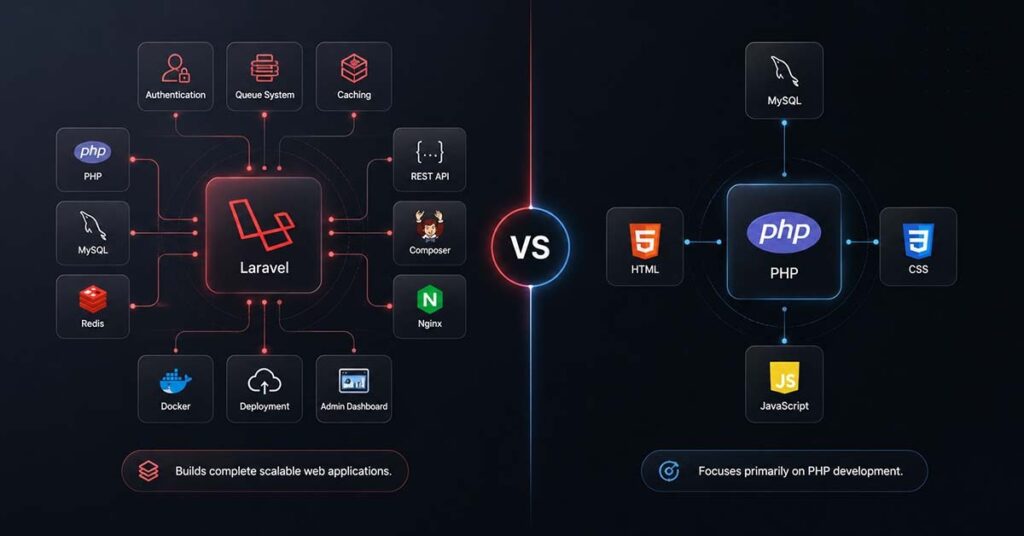
Full Stack Laravel Developer vs PHP Developer: Side-by-Side Comparison Table
| Category | PHP Developer | Full Stack Laravel Developer |
| Backend Development | Excellent | Excellent |
| Frontend Development | Limited | Strong |
| Laravel Expertise | Moderate | Advanced |
| API Development | Strong | Strong |
| Database Management | Strong | Strong |
| UI/UX Knowledge | Limited | Moderate |
| DevOps Awareness | Moderate | Moderate to High |
| Cloud Deployment | Limited | Moderate |
| Project Ownership | Partial | End-to-End |
| Startup Suitability | Moderate | Excellent |
| SaaS Development | Good | Excellent |
| Legacy System Support | Excellent | Good |
| Development Speed | Moderate | High |
| Team Dependency | Higher | Lower |
| Hiring Cost | Moderate | Higher |
Frequently Asked Questions
Is Laravel replacing PHP?
No. Laravel is a PHP framework and depends entirely on PHP. Laravel simplifies development but does not replace the underlying programming language.
Can a PHP developer become a Laravel developer?
Yes. Many Laravel developers begin their careers as PHP developers. Furthermore, strong PHP knowledge creates an excellent foundation for learning Laravel.
Which role earns a higher salary?
In most markets, Full Stack Laravel Developers earn higher salaries because they contribute across frontend and backend development. However, highly specialized PHP architects can also command premium compensation.
Is Laravel good for enterprise applications?
Yes. Laravel supports enterprise-grade applications through features such as authentication, authorization, queues, caching, APIs, cloud deployment, and scalable architecture.
Which role is easier to hire?
PHP developers generally have a larger talent pool because PHP has existed for decades. However, experienced Full Stack Laravel Developers remain widely available in global hiring markets.
Which option is best for startups?
Startups often benefit from Full Stack Laravel Developers because they can build complete products quickly while reducing team size and development costs.
Conclusion
The choice between a Full Stack Laravel Developer and a PHP Developer depends entirely on project requirements. Furthermore, both roles provide valuable expertise within the modern software development ecosystem. PHP developers excel in backend development, custom architectures, and legacy application maintenance. Additionally, they offer deep specialization for organizations with complex server-side requirements. Full Stack Laravel Developers bring broader capabilities that span frontend development, backend systems, APIs, databases, cloud deployment, and application architecture. Their ability to manage end-to-end development often makes them ideal for startups, SaaS products, and modern web applications. At Techstack Digital, we recognize that every project has unique technical and business requirements. Ultimately, businesses should evaluate project complexity, team structure, budget, scalability requirements, and long-term objectives before making a hiring decision. Selecting the right professional ensures better productivity, faster delivery, and stronger business outcomes.