
TL;DR – Quick Summary
Full stack development outsourcing helps businesses build applications faster and more efficiently. It reduces costs, improves scalability, and provides access to global talent. Companies can outsource frontend, backend, and database development while focusing on core operations. This guide explains outsourcing models, benefits, challenges, and selection strategies. It also covers cost factors, technologies, and best outsourcing destinations. Additionally, it highlights processes, KPIs, and common mistakes to avoid. Businesses use outsourcing to accelerate digital transformation and stay competitive. With the right strategy and partner, outsourcing becomes a reliable approach for delivering high-quality software solutions at scale.
Full stack development outsourcing is reshaping how companies build software. Businesses no longer rely only on in-house teams. Instead, they collaborate with global experts to deliver faster and smarter solutions. Furthermore, outsourcing helps reduce cost, improve scalability, and access specialized skills. Additionally, modern tools enable seamless communication across remote teams. Therefore, outsourcing becomes a strategic decision rather than a cost-saving tactic. This guide explains full stack development outsourcing in detail. It covers benefits, challenges, models, and processes. Additionally, companies like Techstack Digital help businesses understand when and how to outsource effectively.
Introduction to Full Stack Development Outsourcing (Global Software Development Trends)
What is Full Stack Development Outsourcing? (End-to-End Web Development Services)
Full stack development outsourcing refers to hiring external teams to handle complete web or software development. Furthermore, it includes frontend, backend, and database development. Additionally, outsourced developers manage deployment, testing, and maintenance.
Businesses use this model to access full-stack services without building internal teams. Moreover, it supports web app development across industries. Therefore, companies can focus on strategy while experts handle execution.
Outsourced developers work remotely or through offshore software development company. Additionally, they use collaboration tools to stay aligned. This approach ensures flexibility and efficiency in development cycles.
Why Businesses Are Choosing Outsourcing (Digital Transformation, Cost Optimization)
Businesses choose outsourcing to reduce development cost and improve efficiency. Furthermore, it allows access to global talent without geographic limitations. Additionally, companies scale teams based on project needs.
Digital transformation increases demand for faster delivery. Therefore, outsourcing supports agile workflows and rapid development. Moreover, organizations avoid hiring delays and infrastructure costs.
Additionally, outsourcing enables innovation by integrating new technologies quickly. Companies leverage expertise in AI, cloud computing, and DevOps. Therefore, outsourcing becomes a competitive advantage in modern markets.
What is Full Stack Development? (Frontend, Backend, Database Explained)
Frontend Development (UI/UX, Client-Side Technologies like React, Angular)
Frontend development focuses on user interface and experience. Furthermore, developers create layouts, navigation, and interactions. Additionally, they ensure responsiveness across devices.
Technologies like React and Angular simplify UI development. Moreover, they support reusable components and faster rendering. Therefore, frontend becomes more dynamic and interactive.
Additionally, frontend developers optimize performance and accessibility. They ensure smooth user experience and consistent design.
Backend Development (Server-Side Technologies like Node.js, PHP, Python)
Backend development handles server-side logic and data processing. Furthermore, it manages APIs, authentication, and business logic.
Technologies like Node.js, PHP, and Python support scalable applications. Additionally, they enable integration with multiple systems.
Moreover, backend ensures data security and system stability. Therefore, it forms the core of any application architecture.
Database Layer (MySQL, MongoDB, PostgreSQL)
The database layer stores and manages application data. Furthermore, it ensures data consistency and retrieval efficiency.
MySQL and PostgreSQL handle structured data effectively. Additionally, MongoDB supports flexible NoSQL storage.
Moreover, database optimization improves performance and scalability. Therefore, it plays a critical role in system reliability.
Full Stack Architecture (MEAN Stack, MERN Stack, LAMP Stack)
Full stack architecture combines frontend, backend, and database layers. Furthermore, it ensures seamless communication between components.
Stacks like MEAN, MERN, and LAMP define technology combinations. Additionally, they streamline development processes.
Therefore, full stack development enables complete application building from a single ecosystem.
Types of Full Stack Development Outsourcing Models (Engagement Models)
Offshore Outsourcing (Global Talent, Cost Efficiency)
Offshore outsourcing involves hiring teams from distant countries. Furthermore, it reduces operational costs significantly. Additionally, companies access a large global talent pool. Time zone differences may affect communication. Therefore, proper management becomes essential.
Nearshore Outsourcing (Time Zone Alignment, Regional Teams)
Nearshore outsourcing involves working with teams in nearby regions. Furthermore, it improves collaboration due to similar time zones. Cultural alignment enhances communication. Therefore, it balances cost and efficiency effectively.
Onshore Outsourcing (Local Development Teams)
Onshore outsourcing involves hiring teams within the same country. Furthermore, it ensures better communication and legal compliance. Costs are higher compared to offshore models. Therefore, it suits projects requiring strict coordination.
Dedicated Development Team Model (Long-Term Collaboration)
This model provides a full team dedicated to one project. Furthermore, it ensures consistency and long-term collaboration. Additionally, teams align closely with business goals. It suits ongoing development needs.
Staff Augmentation (Flexible Resource Hiring)
Staff augmentation allows companies to add developers temporarily. Furthermore, it fills skill gaps quickly. Businesses maintain control over projects. Therefore, it offers flexibility and scalability.
Project-Based Outsourcing (Fixed Scope Projects)
Project-based outsourcing focuses on defined deliverables. Furthermore, it suits short-term projects with clear scope. Additionally, pricing remains predictable. Therefore, it reduces management overhead.
Key Benefits of Full Stack Development Outsourcing (Business Growth & Efficiency)
Cost Savings and Budget Control (Affordable Development Services)
Outsourcing reduces hiring, infrastructure, and operational costs. Companies pay only for required resources. It removes overhead expenses. Clear budgets improve control. Flexible contracts help optimize spending and reduce financial risk.
Access to Global Talent Pool (Skilled Developers Worldwide)
Outsourcing provides access to global developers with diverse expertise. Companies hire specialists for specific technologies. It improves innovation and quality. Broader talent selection strengthens teams and enhances project outcomes.
Faster Time to Market (Agile Development, Rapid Delivery)
Outsourced teams follow agile practices and iterative delivery. They accelerate development cycles. Parallel workflows increase efficiency. Faster releases improve competitiveness. Quick deployment helps capture market opportunities and user feedback early.
Scalability and Flexibility (Team Expansion, On-Demand Resources)
Outsourcing enables rapid team scaling based on project needs. Resources adjust on demand. It supports changing requirements. Flexible engagement models reduce delays. Teams expand or shrink without long hiring cycles.
Focus on Core Business Activities (Operational Efficiency)
Outsourcing frees internal teams from technical execution. Businesses focus on strategy, sales, and growth. It improves efficiency. Leadership prioritizes core functions. Reduced workload increases productivity and better decision-making across departments.
Latest Technology Access (AI, Cloud, DevOps Tools)
Outsourcing provides access to modern technologies and practices. Teams implement Artificial Intelligence, Cloud Computing, and DevOps solutions. Experts follow best practices. It improves performance, scalability, and innovation across projects.
Challenges of Full Stack Development Outsourcing (Risks & Limitations)
Communication Barriers (Time Zones, Language Differences)
Communication gaps occur in distributed teams. Time zone differences delay responses and decisions. Language barriers reduce clarity. Misalignment increases rework. Clear protocols, overlap hours, and documented updates improve coordination.
Quality Control Issues (Code Quality, Testing)
Maintaining consistent quality is challenging across vendors. Teams follow different standards and practices. Inadequate testing affects stability. Enforce code reviews, linting, and automated tests. Define QA benchmarks to ensure reliability.
Data Security and Privacy Risks (GDPR, Cybersecurity)
Data security is a major concern in outsourcing. Sensitive information gets shared across systems. Compliance with GDPR is required. Apply encryption, access controls, and audits. Use secure environments and strict policies.
Project Management Challenges (Coordination, Deadlines)
Remote projects require strong coordination and ownership. Unclear requirements cause delays and scope confusion. Lack of tracking tools affects timelines. Use structured workflows, sprint planning, and dashboards to maintain visibility.
Hidden Costs and Scope Creep (Budget Risks)
Unexpected costs arise from unclear scope and changes. Frequent requirement shifts increase budgets. Poor estimation drives overruns. Define scope, change control, and milestones. Use fixed deliverables and approvals to limit creep.
How to Choose the Right Full Stack Development Outsourcing Company (Vendor Selection Guide)
Evaluate Technical Expertise (Tech Stack: React, Laravel, Node.js)
Technical expertise defines project success. Teams must assess skills in modern stacks. Experience with frameworks ensures quality delivery. Strong engineers build scalable systems. Proper evaluation reduces risk and improves outcomes.
Check Portfolio and Case Studies (Past Projects)
A portfolio shows real-world experience. Case studies highlight problem-solving ability and delivery quality. Past projects reflect domain expertise. Strong examples indicate reliability. Reviewing work helps validate capabilities and fit.
Client Reviews and Testimonials (Clutch, GoodFirms)
Client reviews provide insights into reliability and consistency. Platforms like Clutch and GoodFirms validate credibility. Testimonials reveal communication quality and results. Verified feedback helps compare vendors and reduce selection risk.
Communication and Collaboration Skills (Agile, Scrum)
Strong communication ensures smooth execution. Agile and Scrum structure workflows and iterations. Regular updates keep teams aligned. Clear documentation improves clarity. Effective collaboration reduces delays and supports predictable delivery.
Pricing Models and Transparency (Hourly vs Fixed Pricing)
Clear pricing prevents misunderstandings and disputes. Companies should understand hourly and fixed models. Transparent estimates build trust. Defined scopes reduce overruns. Cost visibility supports better planning and budget control.
Security Standards and Compliance (ISO, NDA Agreements)
Security standards protect data and systems. ISO certifications indicate compliance and process maturity. NDAs safeguard confidentiality. Access controls limit exposure. Strong security practices reduce risk and ensure regulatory alignment.
Full Stack Development Outsourcing Process (Step-by-Step Guide)
Requirement Analysis and Project Planning (Scope Definition)
Projects begin with requirement analysis and detailed planning. Furthermore, teams define clear goals, scope, and deliverables. Additionally, proper planning ensures alignment. Therefore, it minimizes risks and prevents future development issues.
Vendor Selection and Contract Signing (SLA, NDA)
Selecting the right vendor is crucial for success. Furthermore, contracts define scope, roles, and responsibilities. Additionally, SLAs and NDAs protect interests. Therefore, clear agreements ensure accountability and reduce potential disputes.
Design and Development Phase (UI/UX + Backend Development)
Development begins after planning approval. Furthermore, teams build frontend and backend systems simultaneously. Additionally, UI/UX design improves usability. Therefore, structured development ensures efficient workflows and better overall product performance.
Testing and Quality Assurance (QA, Automation Testing)
Testing ensures application functionality and reliability. Furthermore, QA processes identify bugs early. Additionally, automation testing speeds up validation and consistency. Therefore, strong testing practices ensure stable and high-quality software delivery.
Deployment and Maintenance (Cloud Hosting, CI/CD)
Deployment releases the application into production environments. Furthermore, CI/CD pipelines automate updates and integrations. Additionally, maintenance ensures performance and stability. Therefore, continuous monitoring and updates keep systems secure and efficient.
Cost of Full Stack Development Outsourcing (Price Breakdown)
Full stack development outsourcing costs vary by scope, technology, and developer location. Here is the price breakdown of full stack development outsourcing.
Factors Affecting Cost (Project Complexity, Tech Stack, Location)
Costs depend heavily on project complexity, required features, and development timelines. Furthermore, advanced integrations like AI, real-time systems, and payment gateways can increase development costs by 30–50%. Additionally, complex tech stacks and senior-level developers raise hourly rates. Therefore, proper planning and MVP-focused development help businesses reduce unnecessary spending and control long-term operational costs effectively.
Average Outsourcing Rates by Region (USA, Europe, Asia)
Outsourcing rates vary significantly across global regions. Furthermore, developers in the United States commonly charge between $100–$200 per hour for full stack development services. Additionally, Eastern Europe averages around $40–$90 per hour, while Asian markets often range between $20–$50 per hour. Therefore, many startups and enterprises outsource to Asia for cost efficiency while maintaining scalable development workflows and competitive delivery speed.
Cost Comparison: In-House vs Outsourcing (ROI Analysis)
In-house development teams require major investments in salaries, recruitment, office infrastructure, software licenses, and employee benefits. Furthermore, hiring a senior mobile engineer in the US may exceed $120,000 annually excluding operational costs. Additionally, outsourcing can reduce overall development expenses by nearly 40–60% depending on project scope and location. Therefore, outsourcing improves ROI through flexible scaling, lower overhead costs, faster onboarding, and reduced infrastructure management responsibilities.
Best Countries for Full Stack Development Outsourcing (Global IT Hubs)
India (Cost-Effective Development Services)
India offers large talent pools and skilled developers. Furthermore, it provides affordable development services. Additionally, strong IT infrastructure and experience support growth. Therefore, it remains a top outsourcing destination.
Ukraine (Skilled Engineering Talent)
Ukraine provides highly skilled developers and strong technical expertise. Furthermore, it focuses on high-quality engineering standards. Additionally, competitive pricing attracts global businesses. Therefore, it remains a reliable outsourcing hub.
Pakistan (Growing IT Industry, Affordable Rates)
Pakistan’s IT industry is growing rapidly with increasing global demand. Furthermore, it offers cost-effective development services. Additionally, skilled developers support international projects. Therefore, it continues gaining outsourcing popularity.
Philippines (Strong English Communication)
The Philippines excels in communication and collaboration. Furthermore, strong English proficiency improves clarity with global clients. Additionally, outsourcing services are well-established. Therefore, it remains a preferred destination for remote teams.
Technologies Used in Full Stack Development Outsourcing (Modern Tech Stack)
Frontend Technologies (React, Vue.js, Angular)
Frontend tools build interactive interfaces. Furthermore, React and Vue.js improve performance and responsiveness. Additionally, Angular supports structured applications. Therefore, frontend development remains dynamic, scalable, and user-focused.
Backend Technologies (Node.js, Django, Laravel)
Backend frameworks manage logic and server operations. Furthermore, Django supports secure development. Additionally, Node.js handles real-time applications efficiently. Therefore, backend systems ensure scalability, performance, and reliability.
Databases (MySQL, MongoDB, Firebase)
Databases store and manage application data. Furthermore, Firebase enables real-time synchronization. Additionally, MongoDB supports flexible schemas. Therefore, choosing the right database ensures scalability, speed, and efficient data handling.
Cloud Platforms (AWS, Microsoft Azure, Google Cloud)
Cloud platforms host and scale applications globally. Furthermore, AWS and Azure provide reliable infrastructure. Additionally, Google Cloud offers advanced analytics. Therefore, cloud adoption ensures flexibility, performance, and business continuity.
When Should You Outsource Full Stack Development? (Decision Guide)
Startups with Limited Budget (Cost Optimization Strategy)
Startups often lack resources and capital. Furthermore, outsourcing reduces hiring, infrastructure, and operational costs. Additionally, it enables faster product development and market entry. Therefore, startups achieve growth efficiently with limited budgets.
Enterprises Scaling Quickly (Rapid Expansion Needs)
Enterprises require rapid scaling to meet market demand. Furthermore, outsourcing provides additional skilled resources instantly. Additionally, it supports large, complex projects efficiently. Therefore, businesses expand operations quickly without overburdening internal teams.
Lack of In-House Expertise (Skill Gap Solution)
Skill gaps limit development capabilities and slow progress. Furthermore, outsourcing provides access to experienced professionals. Additionally, it fills technical gaps quickly with specialized knowledge. Therefore, businesses improve efficiency and deliver high-quality solutions.
In-House vs Outsourcing vs Freelancers (Detailed Comparison)
| Factor | In-House Team | Outsourcing Agency | Freelancers |
| Control | Full control over team and processes. Furthermore, direct supervision ensures alignment. | Moderate control with defined contracts. Additionally, agencies follow structured workflows. | Limited control. Furthermore, depends on individual reliability and availability. |
| Cost | High cost due to salaries, benefits, and infrastructure. Additionally, long-term expenses increase. | Cost-effective for most projects. Furthermore, flexible pricing models reduce overhead. | Low upfront cost. Additionally, may increase with revisions or delays. |
| Scalability | Limited scalability. Furthermore, hiring takes time and resources. | Highly scalable. Additionally, teams expand based on project needs. | Limited scalability. Furthermore, depends on individual capacity. |
| Expertise | Depends on internal hiring. Furthermore, skill gaps may exist. | Access to diverse expertise. Additionally, agencies provide specialized teams. | Specialized but narrow expertise. Furthermore, lacks team support. |
| Project Speed | Slower due to hiring and onboarding. Additionally, internal processes may delay work. | Faster delivery using experienced teams. Furthermore, parallel workflows improve speed. | Moderate speed. Additionally, delays may occur due to multitasking. |
| Communication | Direct and seamless communication. Furthermore, cultural alignment improves clarity. | Structured communication using tools. Additionally, time zones may impact response. | Communication varies. Furthermore, may lack consistency. |
| Reliability | High reliability with long-term commitment. Additionally, team stability is strong. | Reliable with contracts and SLAs. Furthermore, agencies ensure continuity. | Less reliable. Additionally, availability may fluctuate. |
| Best For | Long-term projects and core business operations. Furthermore, suits stable workflows. | Medium to large projects requiring scalability. Additionally, ideal for growth-focused businesses. | Small tasks or short-term projects. Furthermore, suitable for quick fixes or limited scope. |

Legal Considerations in Outsourcing (Contracts, IP Protection)
Legal considerations play a critical role in outsourcing success. Furthermore, well-defined contracts establish scope, responsibilities, timelines, and payment terms clearly. Additionally, agreements reduce disputes and ensure accountability between both parties.
Intellectual property protection is equally important. Furthermore, businesses must secure ownership rights for code, designs, and data. Additionally, using NDAs and clear IP clauses prevents misuse or unauthorized sharing.
Compliance with regulations and data protection laws must also be ensured. Furthermore, companies should verify vendor adherence to legal standards. Therefore, strong legal frameworks safeguard business interests and minimize risks in outsourcing partnerships.
Managing Remote Development Teams (Tools like Slack, Jira)
Managing remote development teams requires clear structure and consistent communication. Furthermore, tools like Slack enable real-time messaging and quick collaboration. Additionally, Jira helps track tasks, manage sprints, and monitor progress efficiently.
Define roles and responsibilities early. Furthermore, set clear expectations and timelines for each task. Additionally, use Agile practices to maintain flexibility and continuous improvement. Regular standups and updates ensure alignment across distributed teams.
Moreover, documentation plays a critical role. Keep workflows, decisions, and processes well-documented. Additionally, use performance metrics to track productivity and outcomes. Therefore, structured management ensures remote teams remain efficient, accountable, and aligned with business goals.
Explore More
Also Learn about Top 10+ Full Stack Development Companies
KPIs to Measure Outsourcing Success (Performance Metrics)
KPIs help evaluate the effectiveness of outsourcing projects. Furthermore, project delivery time measures how efficiently teams meet deadlines and maintain schedules. Additionally, cost variance tracks budget control and identifies financial risks. Code quality metrics assess bugs, errors, and maintainability, ensuring system performance. Productivity rate reflects team efficiency by measuring output per developer. Customer satisfaction scores indicate service quality and overall experience.
Furthermore, SLA compliance ensures that agreed service levels are consistently met. Therefore, tracking these metrics provides clear visibility into performance and supports better decision-making.
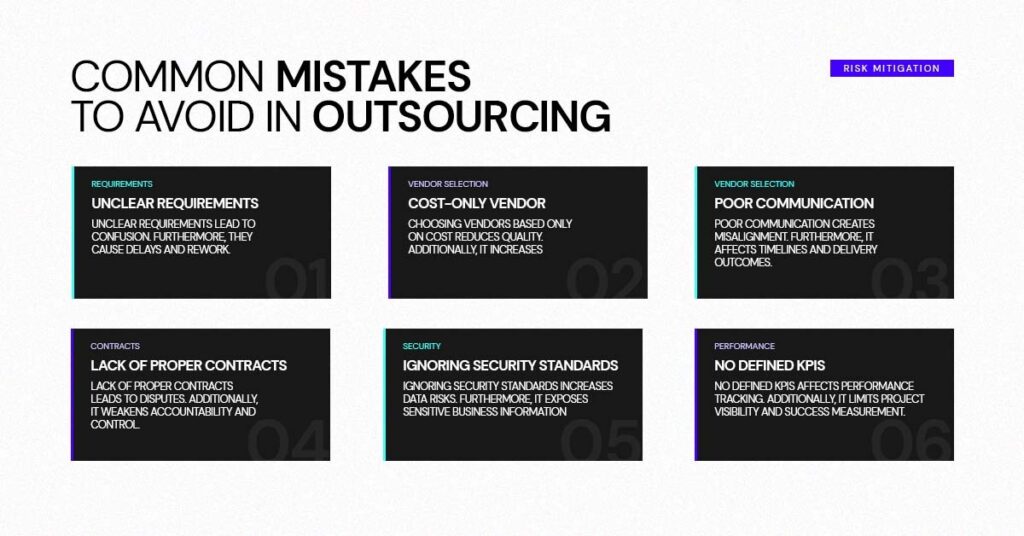
Common Mistakes to Avoid in Outsourcing (Risk Mitigation)
Businesses often make mistakes in outsourcing.
- Unclear requirements lead to confusion. Furthermore, they cause delays and rework.
- Choosing vendors based only on cost reduces quality. Additionally, it increases long-term risks.
- Poor communication creates misalignment. Furthermore, it affects timelines and delivery outcomes.
- Lack of proper contracts leads to disputes. Additionally, it weakens accountability and control.
- Ignoring security standards increases data risks. Furthermore, it exposes sensitive business information.
- No defined KPIs affects performance tracking. Additionally, it limits project visibility and success measurement.
Real-World Use Cases of Full Stack Development Outsourcing (Case Studies)
E-commerce Platforms (Shopify, Magento)
E-commerce platforms require scalable systems. Furthermore, outsourcing supports development of Shopify and Magento stores. Additionally, it enables integrations, payment gateways, and automation. Therefore, businesses expand operations, improve user experience, and increase revenue.
SaaS Applications (Cloud-Based Platforms)
SaaS applications rely on cloud infrastructure. Furthermore, outsourcing supports rapid development and deployment. Additionally, it ensures scalability, security, and continuous updates. Therefore, SaaS companies deliver reliable services and adapt quickly to market demands.
Enterprise Software Solutions (Custom Systems)
Enterprises need custom solutions for complex operations. Furthermore, outsourcing supports development of large-scale systems. Additionally, it ensures flexibility, integration, and performance optimization. Therefore, enterprise applications improve efficiency, streamline workflows, and support business growth.
FAQs
Is outsourcing full stack development cost-effective?
Yes. It reduces hire full stack developer, infrastructure, and operational costs while improving scalability, delivery speed, and overall project ROI.
How do I ensure quality in outsourcing?
Set clear requirements, use QA testing, review code regularly, and track progress through agile project management tools.
What is the best country for outsourcing?
The best country depends on budget, skills, communication needs, and project type. India, Ukraine, and Pakistan are strong options.
Is outsourcing safe for sensitive data?
Yes, if you use NDAs, secure contracts, access controls, compliance standards, and trusted development partners.
How long does a project take?
Most projects take weeks to months, depending on features, complexity, team size, revisions, and technology requirements.
What tech stack should I choose?
Choose a stack based on scalability, performance, project goals, budget, developer availability, and long-term maintenance needs.
Conclusion
Full stack development outsourcing has become essential for modern businesses. Furthermore, it enables faster development, cost efficiency, and access to global talent. Additionally, it supports scalability and innovation through advanced technologies. However, companies must address challenges like communication and security. Therefore, choosing the right outsourcing partner is critical. A structured approach ensures better results and long-term success. Additionally, businesses should focus on clear requirements and strong collaboration. Outsourcing is not just a cost-saving method. Instead, it is a strategic move for growth and digital transformation.