
TL;DR-Quick Summary
- Web development focuses on building websites using front-end or back-end layers, while full stack covers complete system development end-to-end.
- A Web Developer specializes in one domain, whereas a Full Stack Developer handles UI, backend, database, and deployment together.
- Web development includes front-end (HTML, CSS, JavaScript) and back-end (Node.js, servers, APIs) working through structured integration.
- Full stack development manages the full development lifecycle, including UI/UX design, backend logic, database management, and cloud deployment.
- Web developers offer deep expertise in specific areas, while full stack developers provide versatility across multiple technologies and tools.
- Full stack developers suit startups and complex systems, while web developers fit structured teams and specialized enterprise environments.
- Full stack roles often have higher salaries and broader opportunities, while web developers grow through specialization and niche expertise.
- Tools include React, Angular, Node.js, databases, and cloud platforms, with full stack developers using a wider technology ecosystem.
- Hybrid models and emerging technologies like AI, automation, and low-code platforms are shaping development trends in 2026.
- Choosing between paths depends on goals, project complexity, budget, and learning curve, with both roles remaining highly relevant.
Full Stack Development vs Web Development: Key Differences Guide
Web development refers to building websites and web applications that users access through browsers. A Web Developer typically focuses on either front-end interfaces or back-end systems. In contrast, a Full Stack Developer handles both layers along with databases and deployment. Furthermore, full stack development connects the entire system from UI to server.
This comparison matters in 2026 because modern web careers demand flexibility. Additionally, companies, including any offshore software development company, prefer developers who understand front-end vs back-end vs full stack roles. Understanding the web development definition and full stack development definition helps you choose the right path. Moreover, it aligns your skills with real market demand and growth opportunities.
What is Web Development?
Definition and Scope
Web development involves building websites and web application development systems. It includes both front-end development and back-end development. Additionally, it focuses on creating functional, responsive, and user-friendly platforms.
Front-end development handles UI/UX design and user interaction. Furthermore, back-end development manages logic, servers, and databases. A Web Developer may specialize in one area instead of handling everything.
Web development plays a critical role in digital businesses. Additionally, companies rely on it for customer engagement and product delivery. It supports e-commerce, SaaS platforms, and enterprise systems. Therefore, it remains one of the most in-demand skills in modern web careers.
Components of Web Development
Web development consists of two primary components:
Front-End Development
Front-end developers build user interfaces using HTML, CSS, and JavaScript. Additionally, they use frameworks like React.js and Angular to create dynamic interfaces. They ensure responsive design and smooth user experience.
Back-End Development
Back-end developers manage server-side logic and database interaction. Furthermore, they use technologies like Node.js to handle requests and APIs. They ensure security, scalability, and performance.
Both layers must work together. Additionally, they communicate through APIs and server-side logic. Therefore, web development requires coordination between design and functionality.
What is Full Stack Development?
Definition and Scope
Full stack development refers to end-to-end web development. It includes front-end, back-end, database management, and deployment. Additionally, it covers the full development lifecycle from idea to production.
A Full Stack Developer builds complete systems instead of focusing on one layer. Furthermore, they handle UI, backend logic, and infrastructure. This makes full stack web development highly versatile.
Full stack developers often work in startups and agile teams. Additionally, they contribute to multiple stages of product development. Therefore, they play a key role in modern software ecosystems.
Core Responsibilities of a Full Stack Developer
A Full Stack Developer handles multiple responsibilities:
- UI & UX Design
Build interactive interfaces and improve user experience. - Backend Logic
Implement APIs and business logic using frameworks like Django and Ruby on Rails. - Database Management
Handle data storage, queries, and optimization using Database Management systems.
Additionally, full stack developers work with API integration and DevOps basics. Furthermore, they manage cloud deployment and scaling. This makes them responsible for delivering complete applications.
Side-by-Side Comparison: Web Development vs Full Stack
Skill Set Comparison
| Aspet | Web Developer | Full Stack Developer |
| Skills | Specialized | Broad |
| Focus | Front-end or back-end | Both + database + deployment |
| Tools | Limited stack | Full stack tools |
Web developers focus on front-end skills or back-end skills. Additionally, they specialize deeply in one area. Full stack developers require full stack skills across multiple layers. Therefore, they use more software development tools.
Responsibilities Comparison
| Area | Web Developer | Full Stack Developer |
| UI Tasks | Yes | Yes |
| Server Logic | Sometimes | Yes |
| Database | Limited | Full control |
Web developers handle UI or server-side languages. Additionally, they may not manage databases. Full stack developers handle the full process including database technologies and deployment.
Project Suitability
- Web development suits smaller projects or specialized roles.
- Full stack development suits complex systems and startups.
Additionally, companies choose based on project needs. Therefore, scalability often determines the choice.
Career Growth & Salary
Full stack developers often earn higher salaries. Additionally, they have broader job opportunities. Web developers may specialize and grow into experts.
| Role | Average Salary Trend |
|---|---|
| Web Developer | Moderate |
| Full Stack Developer | Higher |
Furthermore, job market demand favors full stack roles. However, specialized developers remain valuable in large teams.
Tools and Technologies Used
Front-End Tools
Front-end developers use HTML, CSS, and JavaScript. Additionally, they rely on frameworks like React, Angular, and Vue.js.
These tools support responsive design and modern frameworks. Furthermore, they improve performance and maintainability.
Back-End Tools
Back-end development uses technologies like Node, Python, Java, Ruby, and PHP. Additionally, frameworks simplify server-side development.
These tools handle APIs, authentication, and server logic. Therefore, they are essential for scalable applications.
Databases
Common databases include MySQL, PostgreSQL, and MongoDB. Additionally, developers use them for structured and unstructured data.
Database Management ensures efficient storage and retrieval. Furthermore, it supports application performance and scalability.
DevOps & Deployment Tools
DevOps tools include Docker, AWS, and Azure. Additionally, they enable Cloud Deployment and automation.
These tools support cloud servers and continuous deployment. Furthermore, they improve reliability and scalability.
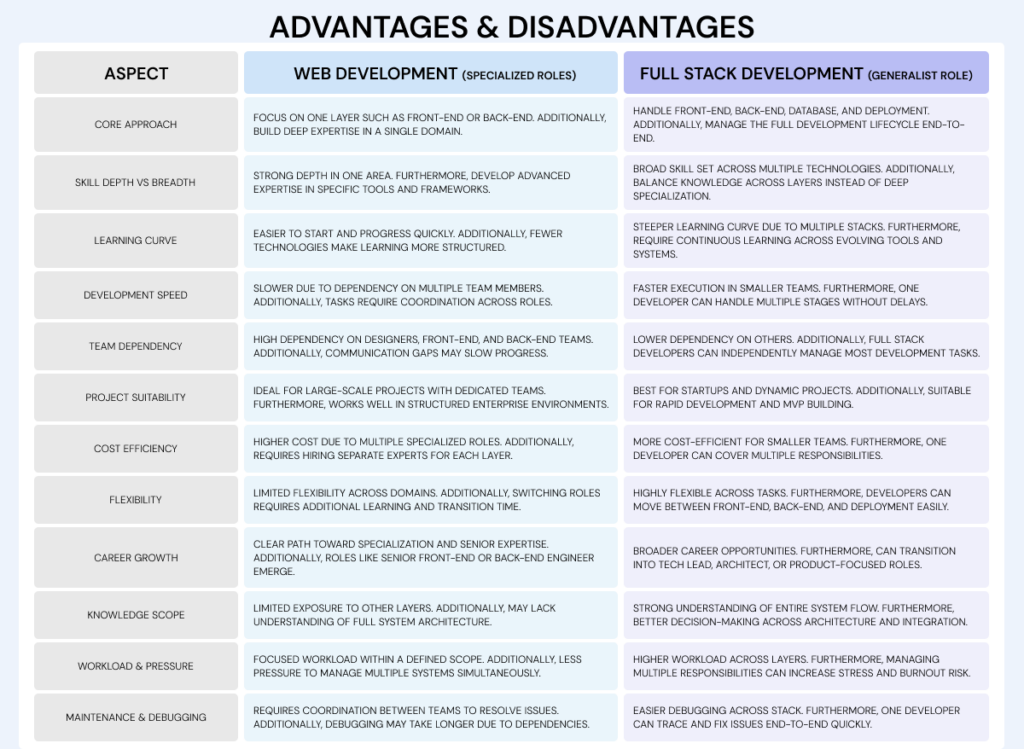
Advantages & Disadvantages
| Aspect | Web Development (Specialized Roles) | Full Stack Development (Generalist Role) |
| Core Approach | Focus on one layer such as front-end or back-end. Additionally, build deep expertise in a single domain. | Handle front-end, back-end, database, and deployment. Additionally, manage the full development lifecycle end-to-end. |
| Skill Depth vs Breadth | Strong depth in one area. Furthermore, develop advanced expertise in specific tools and frameworks. | Broad skill set across multiple technologies. Additionally, balance knowledge across layers instead of deep specialization. |
| Learning Curve | Easier to start and progress quickly. Additionally, fewer technologies make learning more structured. | Steeper learning curve due to multiple stacks. Furthermore, require continuous learning across evolving tools and systems. |
| Development Speed | Slower due to dependency on multiple team members. Additionally, tasks require coordination across roles. | Faster execution in smaller teams. Furthermore, one developer can handle multiple stages without delays. |
| Team Dependency | High dependency on designers, front-end, and back-end teams. Additionally, communication gaps may slow progress. | Lower dependency on others. Additionally, full stack developers can independently manage most development tasks. |
| Project Suitability | Ideal for large-scale projects with dedicated teams. Furthermore, works well in structured enterprise environments. | Best for startups and dynamic projects. Additionally, suitable for rapid development and MVP building. |
| Cost Efficiency | Higher cost due to multiple specialized roles. Additionally, requires hiring separate experts for each layer. | More cost-efficient for smaller teams. Furthermore, one developer can cover multiple responsibilities. |
| Flexibility | Limited flexibility across domains. Additionally, switching roles requires additional learning and transition time. | Highly flexible across tasks. Furthermore, developers can move between front-end, back-end, and deployment easily. |
| Career Growth | Clear path toward specialization and senior expertise. Additionally, roles like senior front-end or back-end engineer emerge. | Broader career opportunities. Furthermore, can transition into tech lead, architect, or product-focused roles. |
| Knowledge Scope | Limited exposure to other layers. Additionally, may lack understanding of full system architecture. | Strong understanding of entire system flow. Furthermore, better decision-making across architecture and integration. |
| Workload & Pressure | Focused workload within a defined scope. Additionally, less pressure to manage multiple systems simultaneously. | Higher workload across layers. Furthermore, managing multiple responsibilities can increase stress and burnout risk. |
| Maintenance & Debugging | Requires coordination between teams to resolve issues. Additionally, debugging may take longer due to dependencies. | Easier debugging across stack. Furthermore, one developer can trace and fix issues end-to-end quickly. |
When Should You Choose Each Path?
Choosing a web development or full stack path depends on several factors:
- Project Complexity: Choose full stack development for complex systems with multiple integrations. Choose web development for smaller, focused, or single-layer projects.
- Career Goals: Choose web development if you want deep expertise in one domain. Choose full stack if you prefer versatility and broader technical exposure.
- Budget Considerations: Full stack developers reduce hiring costs by handling multiple roles. Additionally, web development teams may require separate front-end and back-end specialists.
- Team Structure: Choose web development in large teams with defined roles. Furthermore, choose full stack for startups or small teams needing flexibility.
- Learning Curve & Time Investment: Web development is easier to start and faster to learn. Additionally, full stack requires more time due to broader technologies.
- Job Market Demand: Full stack roles often have higher demand across startups. Furthermore, web developers remain essential in specialized enterprise environments.
- Long-Term Growth: Full stack offers wider career opportunities and adaptability. Additionally, web development allows deeper mastery and niche specialization.
Furthermore, the choice depends on specialization vs generalization. Therefore, evaluate your long-term goals carefully.
Explore More
Also Learn about Full Stack Developer vs Cloud Computing
Future Trends
Hybrid Development Models
Hybrid development models combine specialized Web Developers with versatile Full Stack Developers in the same team. Additionally, companies like Techstack Digital structure teams so each role focuses on what it does best.
Front-end specialists handle UI/UX Design and performance. Furthermore, back-end specialists manage APIs and server-side logic. Full stack developers connect both sides and handle integration across the full development lifecycle.
This model improves efficiency because tasks move faster without bottlenecks. Additionally, it reduces dependency on a single role. Companies gain flexibility by scaling teams based on project needs. Therefore, hybrid models balance specialization with adaptability, especially in large or fast-growing products.
Emerging Technologies
Modern development is shifting due to AI/ML, automation, and low-code platforms. Additionally, these technologies change how developers build and deploy applications.
AI assists in code generation, debugging, and testing. Furthermore, it speeds up web application development and reduces repetitive work. Low-code platforms allow faster prototyping with minimal coding effort.
Automation tools improve Cloud Deployment and DevOps for developers. Additionally, they streamline CI/CD pipelines and infrastructure management. This reduces manual errors and improves scalability.
These trends shape web development trends 2026 by increasing speed and efficiency. Furthermore, full stack developers benefit the most because they can integrate AI, automation, and deployment into one workflow.
Conclusion
Web development and full stack development serve different purposes. A Web Developer focuses on specific layers. A Full Stack Developer manages the entire system.
Furthermore, full stack roles offer versatility and higher salary potential. Additionally, web development provides deep specialization and clarity, as seen in teams like Techstack Digital.
Choosing the best career path depends on your goals. Therefore, consider your interests, learning capacity, and market demand. Both paths remain relevant and valuable in modern tech ecosystems.
Frequently Asked Questions
What is the difference between full stack development and web development?
Web development focuses on specific layers like front-end or back-end, while full stack covers complete application development end-to-end.
Is full stack development harder than web development?
Yes. Full stack development requires learning multiple technologies and managing the entire development lifecycle, making it more complex overall.
Which is better: full stack developer or web developer?
It depends on your goals. Full stack offers versatility and flexibility, while web development allows deeper specialization in one area.
What are the main skills needed for full stack development?
Key skills include HTML, CSS, JavaScript, front-end frameworks, back-end languages, database management, APIs, and deployment tools knowledge.
What languages should I learn for web development vs full stack development?
Web development focuses on HTML, CSS, JavaScript, while full stack includes JavaScript, Python, Node.js, and SQL for broader capabilities.
Can I become a full stack developer without learning back-end development?
No. A full stack developer must understand both front-end and back-end systems to build and manage complete applications.
How long does it take to learn full stack development?
Basic understanding takes around six to twelve months, while proficiency may require one to three years with consistent practice.
Do full stack developers get paid more than web developers?
Generally, full stack developers earn higher salaries due to broader skill sets and ability to handle multiple development responsibilities.
What are the job opportunities for web developers vs full stack developers?
Both roles are in demand, but full stack developers often access more diverse roles across startups and enterprise projects.
Can a web developer become a full stack developer?
Yes. Many developers start with front-end or back-end roles and gradually expand skills to become full stack professionals.
What is front-end, back-end, and full stack development?
Front-end manages user interfaces, back-end handles logic and servers, while full stack combines both for complete application development.
What technologies are used by full stack developers?
Full stack developers use MERN, MEAN, or LAMP stacks, along with databases, APIs, and cloud deployment tools.
Is full stack development future-proof?
Yes. Full stack skills remain valuable as businesses prefer developers who can handle multiple aspects of application development.
What is the best path for beginners — web development or full stack?
Beginners should start with web development fundamentals, then gradually move into full stack by learning back-end and deployment.
Will AI replace web developers or full stack developers?
No. AI supports development tasks, but human creativity, problem-solving, and decision-making remain essential in software development.