
Quick Summary
Full stack game development combines frontend gameplay programming, backend infrastructure, multiplayer networking, cloud services, databases, APIs, and deployment workflows to build complete gaming experiences. A full stack game developer works across Unity, Unreal Engine, and modern backend technologies to create scalable games for mobile, PC, console, cloud, and online platforms. Key skills include C++, C#, JavaScript, server-side programming, Git, mathematics, physics simulation, testing, optimization, CI/CD, and cloud infrastructure. Career opportunities exist in AAA studios, indie development, freelancing, and remote work. As multiplayer gaming, cloud gaming, AI, and live-service models continue growing, demand for full stack game developers remains strong.
Full Stack Game Developer: Skills, Salary & Career Path
The gaming industry continues to grow across mobile, PC, console, cloud, and online platforms. Furthermore, modern games require complex systems that combine user interfaces, gameplay mechanics, backend services, networking, databases, and cloud infrastructure. Therefore, companies increasingly seek professionals who can handle multiple areas of development. A full stack game developer works across both frontend and backend systems to build complete gaming experiences. Additionally, these developers help studios reduce development bottlenecks and improve collaboration between teams. Whether creating mobile games, multiplayer platforms, or large-scale online experiences, full stack game development offers exciting opportunities for developers who want to build complete video game solutions.
What Is a Full Stack Game Developer in Video Game Development?
A full stack game developer is a professional who works on both the client-side and server-side components of a game. In modern video game development, these developers build gameplay systems, networking features, databases, APIs, and cloud infrastructure. Therefore, studios value professionals who understand the complete production pipeline. Unlike specialists who focus on a single area, full stack developers contribute across multiple disciplines, improving collaboration and development efficiency. Furthermore, the global gaming industry generates more than $250 billion annually, increasing demand for versatile technical talent. Additionally, multiplayer gaming, live-service models, and cloud technologies continue driving opportunities for developers with broad expertise.
Difference Between a Game Developer and a Full Stack Game Developer
A game developer typically specializes in a specific area such as gameplay programming, graphics, AI, or backend services. Therefore, their responsibilities often focus on a single technical domain. In contrast, a full stack developer for games works across frontend systems, backend infrastructure, APIs, databases, and deployment pipelines. Furthermore, they understand how all components interact throughout the game lifecycle. This versatility makes them especially valuable to startups and smaller studios, where one developer may handle multiple responsibilities. Additionally, industry surveys indicate that full stack professionals often earn higher salaries due to their broader skill sets and ability to accelerate development cycles. As a result, companies benefit from improved efficiency, flexibility, and cross-functional collaboration.
How Frontend and Backend Development Work in Games
Frontend development focuses on the features players directly interact with, including menus, HUDs, controls, animations, and visual effects. Therefore, it plays a critical role in shaping user experience and engagement. Backend development manages player accounts, matchmaking, leaderboards, cloud saves, analytics, and multiplayer communication. Furthermore, backend systems process and synchronize data securely across devices and servers. Online gaming systems depend on constant interaction between these layers to deliver smooth gameplay. Additionally, modern multiplayer titles can support millions of active users, requiring highly scalable backend infrastructure. Together, frontend and backend technologies create seamless, responsive, and reliable gaming experiences for players worldwide.
Why AAA Game Studios Hire Full Stack Developers
Modern AAA game studios manage increasingly complex projects that include multiplayer systems, live-service features, cloud infrastructure, cross-platform support, and large-scale backend services. Therefore, they actively seek developers with broad technical expertise. Full stack developers help connect frontend and backend teams, reducing communication barriers and accelerating feature delivery. Furthermore, their ability to work across multiple systems improves development efficiency and problem-solving capabilities. Many gaming industry roles now require knowledge of gameplay programming, networking, deployment pipelines, and cloud platforms. Additionally, as AAA game budgets often exceed $100 million, studios prioritize versatile professionals who can contribute across the entire technology stack and support large-scale production environments.
Role of Full Stack Developers in Interactive Entertainment
Interactive entertainment now extends beyond traditional gaming into virtual worlds, social platforms, educational experiences, and immersive multiplayer environments. Therefore, demand for versatile technical professionals continues rising. Full stack developers contribute across game production by building gameplay systems, integrating APIs, managing cloud infrastructure, and optimizing performance. Furthermore, they support live-service operations and post-launch updates. Modern platforms require continuous content delivery, user engagement features, progression systems, and community management tools. Additionally, the interactive entertainment market is projected to exceed hundreds of billions of dollars globally, creating strong demand for developers with both frontend and backend expertise. Their broad skill set makes them valuable throughout the gaming ecosystem.
What Does a Full Stack Game Developer Do?
Full stack game developers contribute to every stage of game creation, from interface design and gameplay mechanics to databases, networking systems, and deployment. Therefore, they play a vital role in modern development teams. Unlike specialists, they understand how frontend and backend components interact, enabling faster troubleshooting and improved system stability. Furthermore, this broad knowledge helps studios streamline production and reduce development bottlenecks. In smaller teams, developers often manage multiple responsibilities, while larger organizations may distribute tasks across departments. Additionally, the growing popularity of multiplayer and live-service games has increased demand for professionals who can support complete gaming ecosystems from development through post-launch operations.
Frontend Development for Gameplay Programming and UI/UX
Frontend game development focuses on everything players see and interact with, including menus, HUDs, inventory systems, animations, and controls. Therefore, it has a direct impact on player satisfaction and retention. Gameplay programming is a key component, covering movement mechanics, combat systems, character abilities, and interactive environments. Furthermore, responsive controls and smooth performance are essential for creating engaging experiences. Game UI/UX design also plays a critical role by improving accessibility and navigation. Additionally, studies show that poor user experience can significantly reduce player retention rates. Successful frontend development balances technical performance, usability, and visual appeal to deliver enjoyable and intuitive gaming experiences.
Backend Development for Online Gaming Systems
Backend development powers the infrastructure that supports modern games, including authentication, matchmaking, cloud saves, analytics, and player progression systems. Therefore, it forms the foundation of multiplayer and live-service experiences. Server-side programming processes requests, validates actions, and maintains consistent game states across connected players. Furthermore, scalable backend architecture is essential for handling large user bases. Popular online games often support hundreds of thousands or even millions of concurrent players through cloud-based infrastructure. Additionally, secure and reliable backend services help prevent cheating, protect player data, and improve overall user satisfaction. Strong backend development remains critical to the success of modern gaming platforms.
Multiplayer Game Networking and Real-Time Server Architecture
Multiplayer games rely on efficient networking systems to synchronize player actions across devices in real time. Therefore, networking is a critical component of modern game development. Developers build matchmaking systems, session management tools, and synchronization protocols to ensure smooth gameplay. Furthermore, low latency and reliable server communication are essential for competitive and cooperative experiences. Popular multiplayer titles can process millions of interactions every minute, requiring highly scalable infrastructure. Additionally, network optimization helps reduce lag, improve responsiveness, and enhance player satisfaction. As online gaming continues to grow, networking expertise remains one of the most valuable skills for aspiring game developers.
API Integration and Database Management in Games
Modern games integrate APIs for payments, analytics, authentication, social features, cloud storage, and third-party services. Therefore, developers can expand functionality without building every system from scratch. Database management stores critical player data, including progression, achievements, inventories, rankings, and account information. Furthermore, efficient database design improves performance, scalability, and reliability. Developers often use caching and indexing techniques to accelerate data retrieval and reduce server load. Additionally, large online games may manage millions of player records and transactions daily. Strong backend architecture combines APIs and databases into a unified ecosystem, making these skills essential for supporting large-scale gaming platforms.
Game Deployment and Live Game Services
Game deployment involves preparing builds, configuring servers, and ensuring compatibility across multiple platforms. Therefore, it is a critical phase of the development lifecycle. After launch, live-service operations require continuous updates, performance monitoring, bug fixes, and player support. Furthermore, cloud infrastructure and deployment automation enable faster, more reliable releases. Many successful games receive updates for years after launch, extending player engagement and revenue. Additionally, CI/CD pipelines help reduce deployment errors and downtime. Because modern games operate as ongoing services, full stack developers often remain involved throughout the entire lifecycle, from initial development to long-term maintenance and optimization.
Essential Skills Required for Full Stack Game Development
Modern game studios seek developers with expertise across gameplay programming, backend systems, networking, databases, testing, and deployment. Therefore, full stack developers remain highly valuable. Additionally, strong problem-solving and communication skills are essential. As cloud gaming, AI, and multiplayer technologies expand, versatile developers gain stronger career opportunities and long-term success.
Game Programming Languages Every Developer Should Learn
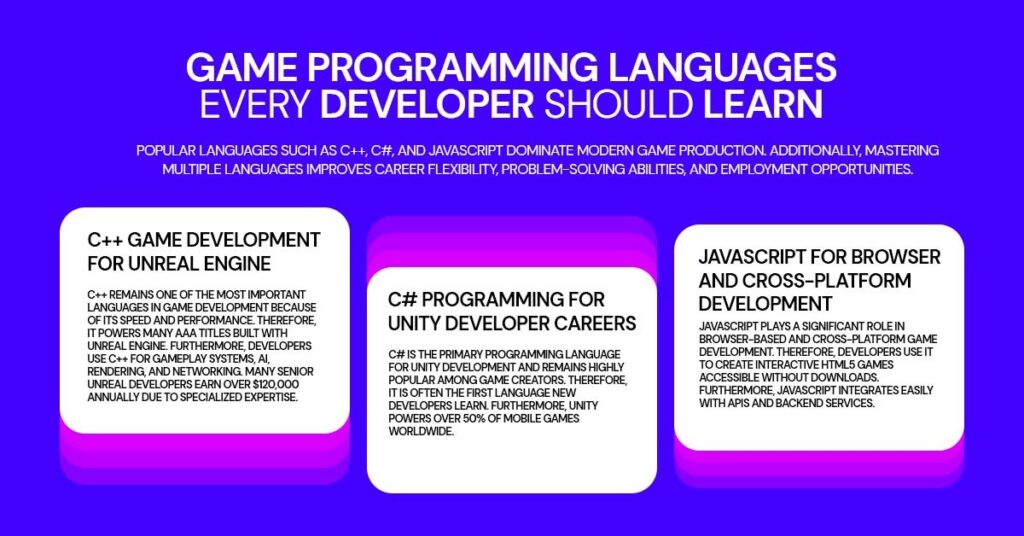
Programming languages form the foundation of game development and software engineering. Therefore, aspiring developers should learn technologies that support gameplay, backend systems, and deployment workflows. Popular languages such as C++, C#, and JavaScript dominate modern game production. Additionally, mastering multiple languages improves career flexibility, problem-solving abilities, and employment opportunities.
C++ Game Development for Unreal Engine
C++ remains one of the most important languages in game development because of its speed and performance. Therefore, it powers many AAA titles built with Unreal Engine. Furthermore, developers use C++ for gameplay systems, AI, rendering, and networking. Many senior Unreal developers earn over $120,000 annually due to specialized expertise.
C# Programming for Unity Developer Careers
C# is the primary programming language for Unity development and remains highly popular among game creators. Therefore, it is often the first language new developers learn. Furthermore, Unity powers over 50% of mobile games worldwide. Additionally, C# enables rapid development of gameplay systems, UI features, and multiplayer functionality.
JavaScript for Browser and Cross-Platform Development
JavaScript plays a significant role in browser-based and cross-platform game development. Therefore, developers use it to create interactive HTML5 games accessible without downloads. Furthermore, JavaScript integrates easily with APIs and backend services. Additionally, web gaming reaches billions of internet users, creating strong opportunities for developers with JavaScript expertise.
Understanding Game Engines and Gameplay Systems
Game engines provide the foundation for modern game development. Therefore, developers must understand rendering, physics, audio, networking, and gameplay systems. Additionally, engines like Unity, Unreal Engine, and Godot help accelerate production and improve development efficiency.
Server-Side Programming and Scalable Game Servers
Backend systems support multiplayer gameplay, matchmaking, leaderboards, and cloud saves. Therefore, developers must understand server-side programming. Furthermore, scalable architectures handle growing player bases efficiently. Additionally, cloud infrastructure ensures reliability, performance, and seamless gaming experiences.
Game Testing, Debugging, and Optimization Skills
Testing helps identify issues before release and improves overall game quality. Therefore, developers must continuously debug and optimize applications. Furthermore, performance tuning enhances frame rates and stability. Additionally, efficient optimization increases player satisfaction and long-term retention.
Git Version Control and Team Collaboration
Game development requires collaboration across multiple disciplines. Therefore, Git version control helps teams manage code changes efficiently. Furthermore, it reduces conflicts during development. Additionally, version control improves accountability, workflow organization, and project stability throughout production.
Mathematics, Physics Engines, and Animation Systems
Mathematics supports gameplay mechanics, movement systems, and physics calculations. Therefore, developers need strong analytical skills. Furthermore, physics engines create realistic interactions and animations. Additionally, mathematical knowledge improves problem-solving, gameplay accuracy, and technical implementation efficiency.
Linear Algebra in Game Mechanics
Linear algebra powers movement, positioning, and object transformations in games. Therefore, developers use vectors and matrices extensively. Furthermore, it supports rendering and physics systems. Additionally, mathematical knowledge improves gameplay programming and problem-solving efficiency.
Collision Detection and Physics Simulation
Collision detection enables accurate interactions between game objects and environments. Therefore, it is essential for gameplay mechanics. Furthermore, physics simulation creates realistic movement and behaviors. Additionally, optimized systems improve performance, responsiveness, and player immersion.
How to Become a Full Stack Game Developer
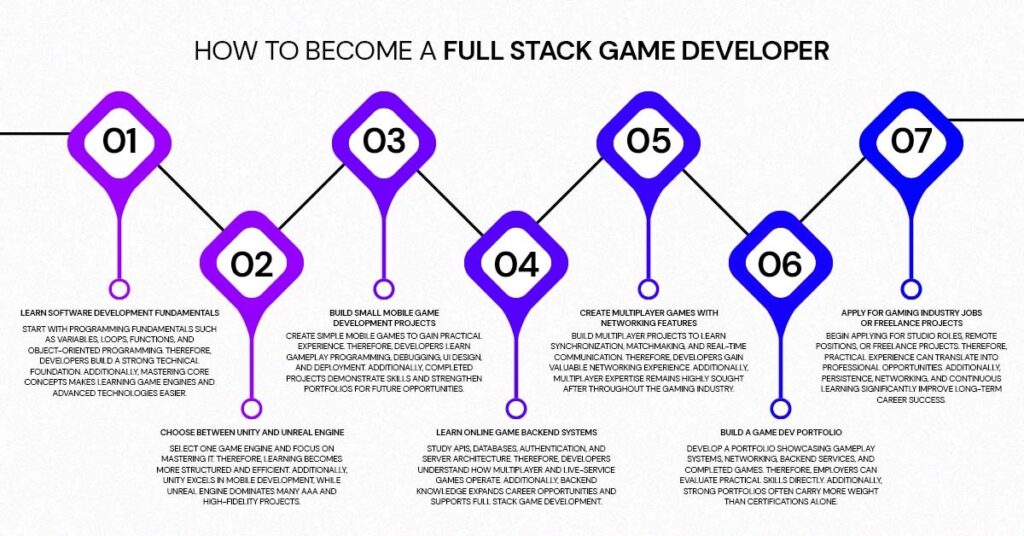
Building a successful game development career requires a structured learning approach. Therefore, developers should master core skills gradually through practical projects. Additionally, consistent practice, technical growth, and hands-on experience improve career opportunities and long-term success.
Step 1 – Learn Software Development Fundamentals
Start with programming fundamentals such as variables, loops, functions, and object-oriented programming. Therefore, developers build a strong technical foundation. Additionally, mastering core concepts makes learning game engines and advanced technologies easier.
Step 2 – Choose Between Unity and Unreal Engine
Select one game engine and focus on mastering it. Therefore, learning becomes more structured and efficient. Additionally, Unity excels in mobile development, while Unreal Engine dominates many AAA and high-fidelity projects.
Step 3 – Build Small Mobile Game Development Projects
Create simple mobile games to gain practical experience. Therefore, developers learn gameplay programming, debugging, UI design, and deployment. Additionally, completed projects demonstrate skills and strengthen portfolios for future opportunities.
Step 4 – Learn Online Game Backend Systems
Study APIs, databases, authentication, and server architecture. Therefore, developers understand how multiplayer and live-service games operate. Additionally, backend knowledge expands career opportunities and supports full stack game development.
Step 5 – Create Multiplayer Games with Networking Features
Build multiplayer projects to learn synchronization, matchmaking, and real-time communication. Therefore, developers gain valuable networking experience. Additionally, multiplayer expertise remains highly sought after throughout the gaming industry.
Step 6 – Build a Game Dev Portfolio
Develop a portfolio showcasing gameplay systems, networking, backend services, and completed games. Therefore, employers can evaluate practical skills directly. Additionally, strong portfolios often carry more weight than certifications alone.
Step 7 – Apply for Gaming Industry Jobs or Freelance Projects
Begin applying for studio roles, remote positions, or freelance projects. Therefore, practical experience can translate into professional opportunities. Additionally, persistence, networking, and continuous learning significantly improve long-term career success.
Education and Learning Paths for Game Development Careers
There is no single path into game development careers. Therefore, aspiring developers can learn through degrees, bootcamps, or self-study. Furthermore, practical projects build valuable skills. Additionally, consistent practice and experience support long-term career growth.
Computer Science Degrees for Game Programming
Computer science degrees teach programming, algorithms, mathematics, and software engineering fundamentals. Therefore, many game developers choose this path. Furthermore, universities offer internships and networking opportunities. Additionally, practical projects strengthen industry readiness and technical expertise.
Online Courses for Full Stack Game Development
Online courses provide flexible and affordable game development education. Therefore, many developers prefer self-paced learning. Furthermore, courses cover game engines, backend systems, and networking. Additionally, project-based training helps build practical, job-ready skills.
Bootcamps for Video Game Development
Game development bootcamps focus on intensive, hands-on training. Therefore, they support faster career transitions. Furthermore, students gain real-world project experience. Additionally, mentorship, portfolio development, and industry-focused learning accelerate technical growth.
Self-Taught vs Traditional Education in the Gaming Industry
Both self-taught and university-trained developers succeed in gaming careers. Therefore, employers prioritize practical skills and portfolios. Furthermore, each path offers unique advantages. Additionally, continuous learning and project experience remain essential for success.
Best Tools and Technologies Used in Full Stack Game Development
Modern game development depends on a diverse collection of tools and technologies. Therefore, developers must understand engines, frameworks, cloud platforms, databases, testing tools, and deployment systems.
The right technology stack depends on project goals and platform requirements. Furthermore, different studios adopt different workflows based on production needs.
Technology continues evolving rapidly. Additionally, developers who stay current with industry tools remain more competitive in the job market.
Understanding modern development ecosystems helps professionals build scalable, maintainable, and high-performing games.
Top Game Engines for Modern Video Games
Game engines simplify development by providing built-in tools for rendering, physics, audio, animation, and networking. Therefore, they serve as the foundation of modern game production. Furthermore, engines like Unity, Unreal Engine, and Godot support different project requirements. Additionally, mastering one engine thoroughly improves productivity, technical expertise, and career opportunities.
Unity Game Engine
Unity is widely used by indie developers and mobile game studios. Therefore, it remains a popular development platform. Furthermore, cross-platform deployment supports multiple devices. Additionally, C# programming, extensive documentation, and asset libraries accelerate development.
Unreal Engine for AAA Games
Unreal Engine powers many AAA game projects worldwide. Therefore, it is known for advanced graphics and performance. Furthermore, robust networking and rendering tools support complex games. Additionally, C++ customization enhances development flexibility.
Godot for Indie Game Developers
Godot is a growing open-source game engine favored by indie developers. Therefore, it offers affordable development opportunities. Furthermore, it supports both 2D and 3D projects. Additionally, its active community provides valuable resources and plugins.
Backend Technologies for Online Multiplayer Games
Backend technologies power matchmaking, authentication, player progression, analytics, and cloud storage systems. Therefore, they are essential for multiplayer gaming experiences. Furthermore, technologies such as Node.js, Python, Go, Java, and .NET support scalable services. Additionally, well-designed backend architectures improve performance, reliability, and long-term maintainability.
Cloud Gaming Infrastructure and Scalable Servers
Cloud infrastructure enables games to scale efficiently across global markets. Therefore, developers increasingly use platforms like AWS, Azure, and Google Cloud. Furthermore, automated scaling handles traffic spikes without service interruptions. Additionally, distributed server architectures reduce latency, improve availability, and support seamless multiplayer experiences.
Game Testing and Performance Optimization Tools
Testing and optimization tools help developers identify bugs and performance issues before release. Therefore, they play a critical role in software quality. Furthermore, profiling tools analyze memory, CPU, and frame-rate performance. Additionally, continuous optimization improves stability, responsiveness, and player satisfaction across multiple platforms.
CI/CD Pipelines for Game Production
CI/CD pipelines automate software building, testing, and deployment workflows. Therefore, development teams can release updates faster and more reliably. Furthermore, automation reduces manual errors and improves consistency. Additionally, continuous integration helps identify issues early, supporting efficient development and live-service game operations.
API Integration and Database Systems for Player Data
Databases and APIs manage player accounts, progression, achievements, inventories, and analytics data. Therefore, they are fundamental components of modern game infrastructure. Furthermore, APIs connect games with external services and platforms. Additionally, secure and scalable data management improves reliability, performance, and player trust.
Frontend vs Backend Development in Video Games
Frontend and backend systems work together to deliver complete gaming experiences. Therefore, developers should understand both layers. Additionally, full stack expertise improves collaboration, problem-solving, and system integration, helping studios build scalable, reliable, and engaging games efficiently.
Client-Side Gameplay Programming
Client-side development manages rendering, player input, and gameplay interactions. Therefore, it directly impacts responsiveness and engagement. Additionally, optimized gameplay systems, animations, and interfaces help improve performance, immersion, and player retention.
Server-Side Architecture for Multiplayer Games
Server-side architecture powers multiplayer functionality through synchronization, validation, and data processing. Therefore, reliable backend systems are essential. Additionally, scalable server infrastructure improves security, reduces downtime, and supports growing player communities.
Real-Time Synchronization in Online Gaming
Real-time synchronization keeps multiplayer environments consistent and responsive. Therefore, networking systems must process updates quickly and accurately. Additionally, optimized communication protocols reduce latency, improve gameplay quality, and enhance player satisfaction.
How Full Stack Developers Improve Player Experience
Full stack developers understand both gameplay systems and backend infrastructure. Therefore, they can optimize performance across the entire technology stack. Additionally, their expertise helps deliver stable, seamless, and engaging gaming experiences for players.
Types of Video Games Full Stack Developers Build
Full stack developers work across diverse gaming projects, genres, and platforms. Therefore, they contribute to gameplay systems, backend infrastructure, multiplayer networking, and cloud services. Additionally, their broad technical expertise helps studios build scalable, engaging, and modern gaming experiences efficiently.
Mobile Game Development
Mobile gaming generates over 50% of global gaming revenue. Therefore, developers build high-performance Android and iOS games. Additionally, expertise in Unity, backend services, analytics, and cloud saves remains highly valuable.
PC and Console Game Production
PC and console games require advanced gameplay systems, optimization, and networking infrastructure. Therefore, developers often work within large production teams. Additionally, many AAA titles operate as live services with continuous updates.
Browser-Based and HTML5 Games
Browser-based games offer instant accessibility without downloads. Therefore, developers commonly use JavaScript and HTML5 technologies. Additionally, online leaderboards, multiplayer features, and cloud integration help create engaging web-based gaming experiences.
Multiplayer Online Games and MMOs
Multiplayer games and MMOs demand scalable networking and backend infrastructure. Therefore, developers manage matchmaking, authentication, synchronization, and player progression systems. Additionally, MMO environments can support thousands of simultaneous players.
Cloud Gaming and Cross-Platform Development
Cloud gaming and cross-platform experiences continue growing rapidly. Therefore, developers build systems that synchronize gameplay across devices. Additionally, cloud infrastructure enables scalable content delivery, maintenance, and seamless player experiences.
Metaverse and Web3 Gaming Experiences
Metaverse and Web3 gaming introduce persistent virtual worlds and social interactions. Therefore, developers require expertise in networking, scalability, and online services. Additionally, these emerging technologies create new opportunities across interactive entertainment.
Career Opportunities in the Gaming Industry
The gaming industry offers diverse career opportunities for technical professionals. Therefore, full stack game developers can work in AAA studios, indie teams, startups, and freelance markets. Additionally, with the global gaming market exceeding $250 billion and remote hiring increasing worldwide, skilled developers remain in strong demand for long-term career growth.
Working at AAA Game Studios
AAA game studios create some of the industry’s largest projects. Therefore, they hire specialists across gameplay, networking, and backend systems. Additionally, leading studios often offer salaries exceeding $120,000 annually alongside structured career growth and advanced technical training.
Becoming an Indie Game Developer
Indie game developers manage multiple aspects of development and publishing. Therefore, full stack skills provide significant advantages. Additionally, platforms like Steam host over 100,000 games, giving independent creators unprecedented access to global audiences and revenue opportunities.
Freelancing in Game Programming
Freelance game programming continues expanding through global marketplaces and remote contracts. Therefore, developers can work with diverse clients and projects. Additionally, experienced freelancers often charge $30–$150 per hour depending on expertise and project complexity.
Remote Jobs in Software Development and Gaming
Remote game development roles have become increasingly common across the industry. Therefore, developers can access worldwide opportunities without relocation. Additionally, surveys show over 60% of game studios now support hybrid or fully remote development teams.
Technical Game Artist and Gameplay Programmer Roles
Technical artists and gameplay programmers combine creativity with engineering expertise. Therefore, these roles remain highly valuable in modern studios. Additionally, demand for technical artists has increased as game visuals and production pipelines become more sophisticated.
Explore More
Also Learn about Full Stack Mobile Developer: Complete Roadmap
Full Stack Game Developer Salary and Job Outlook
The demand for skilled game developers remains strong worldwide. Furthermore, salaries vary based on experience, location, and specialization. As gaming technologies evolve, developers with modern skills and continuous learning habits enjoy strong career growth and long-term opportunities.
Average Salary for Unity and Unreal Developers
Unity and Unreal developers earn competitive salaries worldwide. Therefore, compensation often reflects technical expertise and project complexity. According to industry reports, Unity developers earn an average of $80,000–$120,000 annually in the United States, while Unreal Engine developers frequently earn $90,000–$140,000 or more. Additionally, AAA studios often provide bonuses, stock options, and performance incentives.
Junior vs Senior Game Programming Salaries
Salary growth increases significantly with experience. Therefore, junior game developers typically earn between $50,000 and $80,000 annually, depending on location and studio size. Senior game programmers often earn $120,000–$180,000 or more because they lead architecture, optimization, and technical decision-making. Additionally, developers with multiplayer and cloud expertise can command premium compensation packages.
Global Demand for Multiplayer Game Developers
Multiplayer expertise remains one of the most sought-after skills in gaming. Therefore, studios actively recruit developers who understand networking and backend systems. Industry estimates show that over 80% of gaming revenue now comes from online and live-service experiences. Additionally, the global online gaming market is projected to surpass $300 billion by 2030, increasing demand for multiplayer specialists.
Future of Video Game Development Careers
The gaming industry continues expanding at a rapid pace. Therefore, career opportunities remain strong across development disciplines. Recent market reports value the global gaming industry at more than $250 billion, with continued growth expected through 2030. Additionally, cloud gaming, AI-powered development, and virtual reality technologies are creating new roles and specialization opportunities for future developers.
Challenges in Full Stack Game Development
- Balancing Frontend and Backend Expertise: Full stack developers must continuously learn new frontend frameworks, backend technologies, and development practices while maintaining proficiency across multiple technical disciplines.
- Optimizing Multiplayer Networking Systems: Managing synchronization, latency, scalability, and server performance requires extensive networking knowledge and continuous testing to ensure smooth multiplayer experiences.
- Preventing Lag and Improving Game Performance: Developers must optimize rendering, memory usage, CPU performance, and network communication to maintain responsive and enjoyable gameplay.
- Handling Security and Anti-Cheat Systems: Protecting player data, preventing cheating, and securing multiplayer environments requires authentication systems, encryption, monitoring, and regular security updates.
- Managing Game Crunch and Burnout: Long development cycles, tight deadlines, and increasing technical complexity can create stress, making sustainable workloads and healthy project management essential.
Best Programming Languages for Game Programming
| Programming Language | Primary Use in Game Development | Key Benefits | Common Applications |
| C++ | High-performance gameplay systems and AAA game development | Excellent performance, memory control, low-level optimization, industry standard for large games | Unreal Engine development, rendering engines, gameplay systems, networking components, AAA games |
| C# | Unity game development | Easy to learn, productive, readable syntax, extensive documentation and community support | Unity development, mobile games, indie games, cross-platform projects, gameplay programming |
| Python | Automation and backend services | Rapid development, scripting capabilities, versatile ecosystem, easy prototyping | Automation tools, analytics systems, backend services, development pipelines, server-side applications |
| JavaScript | Browser-based and web game development | Cross-platform compatibility, fast deployment, API integration, strong web ecosystem | HTML5 games, browser games, interactive experiences, web gaming platforms, frontend development |
| Rust | Scalable multiplayer server development | High performance, memory safety, reliability, efficient concurrency | Multiplayer servers, networking systems, backend services, real-time game infrastructure |
| Go (Golang) | Backend development and multiplayer architecture | Simplicity, scalability, concurrency support, strong performance | Game backend services, matchmaking systems, microservices, scalable multiplayer infrastructure |
Comparison at a Glance
| Language | Learning Difficulty | Performance | Best For |
| C++ | High | Excellent | AAA game development, Unreal Engine |
| C# | Medium | Very Good | Unity development, mobile and indie games |
| Python | Easy | Moderate | Automation, backend services, scripting |
| JavaScript | Easy-Medium | Good | Browser games, HTML5 gaming |
| Rust | High | Excellent | High-performance multiplayer servers |
| Go | Medium | Very Good | Scalable backend and networking systems |
How AI Is Transforming Video Game Development
Artificial intelligence is transforming game development by improving efficiency, automating repetitive tasks, and enhancing gameplay experiences. Furthermore, AI helps developers analyze player behavior, optimize performance, and streamline testing processes. As adoption grows across indie and AAA studios, understanding AI technologies becomes increasingly valuable for modern game developers.
AI NPC Systems and Procedural Game Mechanics
AI NPCs create realistic behaviors that react to player actions and changing environments. Additionally, procedural generation automatically creates levels, quests, and gameplay content, improving replayability, reducing development effort, and helping studios build larger, more dynamic game worlds.
Machine Learning in Interactive Entertainment
Machine learning analyzes player behavior and gameplay patterns to improve personalization and engagement. Furthermore, it helps developers optimize difficulty levels, predict retention trends, identify gameplay issues, and make data-driven decisions that enhance overall player experiences.
AI-Assisted Coding for Game Developers
AI coding tools help developers generate code, detect bugs, and automate repetitive programming tasks. Additionally, these solutions improve productivity, accelerate development workflows, maintain consistency, and allow developers to focus more on innovation and gameplay design.
AI-Based Game Testing and Optimization
AI testing tools automate quality assurance by identifying bugs, performance issues, and gameplay inconsistencies. Furthermore, machine learning supports optimization by improving memory usage, rendering efficiency, network performance, and overall software quality throughout game development projects.
Best Portfolio Projects for Aspiring Full Stack Game Developers
A strong portfolio demonstrates practical abilities more effectively than theoretical knowledge. Therefore, aspiring developers should focus on building projects that showcase diverse technical skills.
Portfolio projects should highlight gameplay programming, backend development, networking systems, cloud services, and deployment workflows. Furthermore, completed projects demonstrate problem-solving abilities and commitment to continuous learning.
Employers often evaluate portfolios before technical interviews. Additionally, high-quality projects help distinguish candidates in competitive job markets. The following project ideas provide excellent opportunities to demonstrate full stack game development expertise.
Multiplayer Shooter Game Project
Build a multiplayer shooter featuring movement systems, combat mechanics, matchmaking, and networking infrastructure. This project demonstrates gameplay programming, real-time synchronization, scalable server architecture, latency management, and backend development skills that employers highly value.
Online Leaderboard and Matchmaking System
Create a leaderboard and matchmaking platform using APIs, authentication services, ranking algorithms, and databases. This project highlights backend expertise, player data management, networking concepts, and scalable architecture commonly used in modern online gaming systems.
RPG Inventory and Player Progression Systems
Develop an RPG system with inventories, equipment management, experience tracking, player statistics, and progression mechanics. This project showcases gameplay programming, database management, API integration, and long-term player engagement systems used in role-playing games.
Mobile Game with Cloud Save Features
Build a mobile game featuring cloud save functionality, player synchronization, and secure data storage. This project demonstrates frontend development, backend integration, deployment workflows, cloud infrastructure knowledge, and modern mobile gaming development practices.
Cross-Platform Multiplayer Game Architecture
Create a multiplayer game supporting mobile, PC, console, and cloud platforms. This project demonstrates networking systems, scalable server architecture, player data synchronization, software design skills, and expertise in building modern cross-platform gaming experiences.
Common Mistakes Beginner Game Developers Make
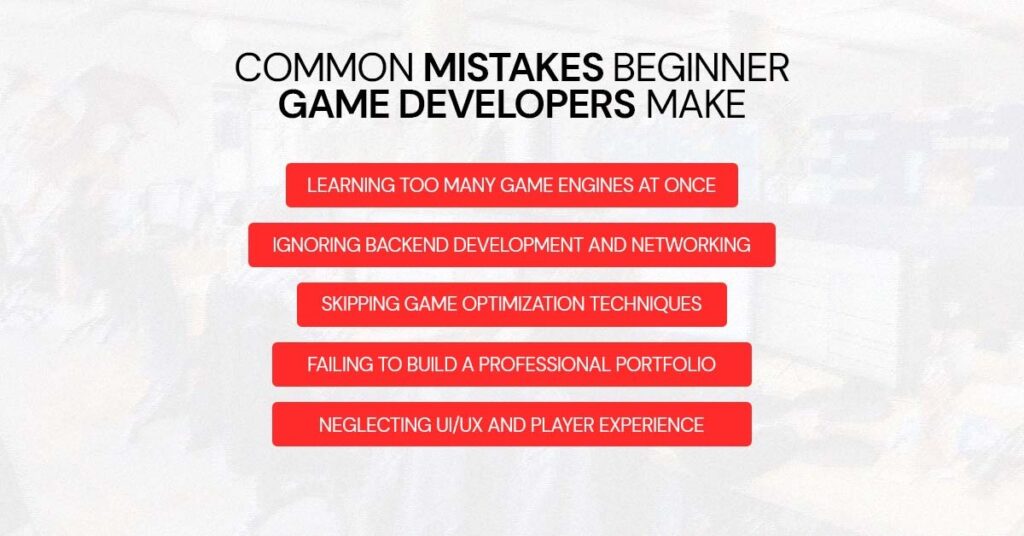
- Learning Too Many Game Engines at Once: Frequently switching between engines slows progress, prevents specialization, and makes it difficult to build strong technical foundations.
- Ignoring Backend Development and Networking: Focusing only on gameplay and visuals limits full stack skills and reduces opportunities in multiplayer game development.
- Skipping Game Optimization Techniques: Neglecting performance optimization causes frame rate issues, excessive resource usage, and poor player experiences.
- Failing to Build a Professional Portfolio: Studying without completing projects makes it harder to demonstrate practical skills and attract employers.
- Neglecting UI/UX and Player Experience: Poor interfaces and usability issues reduce engagement, retention, and overall player satisfaction.
Best Resources to Learn Full Stack Game Development
Learning resources continue expanding across online platforms and communities. Therefore, developers have access to more educational material than ever before.
Successful learning combines tutorials, practical projects, community engagement, and continuous experimentation. Furthermore, collaboration accelerates skill development. The following resources provide valuable support for aspiring professionals.
YouTube Channels for Game Programming
YouTube offers valuable game programming tutorials covering Unity, Unreal Engine, networking systems, and backend development. Furthermore, developers learn practical implementation through project-based lessons. Additionally, free content makes learning accessible for beginners while helping experienced developers improve technical skills continuously.
Online Communities for Unity and Unreal Developers
Unity and Unreal communities provide support, technical guidance, and networking opportunities. Furthermore, developers receive feedback, solve challenges, and learn industry best practices. Additionally, active participation helps build professional connections and stay updated with evolving game development trends.
Best Books on Game Architecture and Design
Game development books provide detailed knowledge about software architecture, gameplay systems, and design principles. Furthermore, they explain player psychology and development methodologies. Additionally, combining reading with practical projects helps developers build stronger technical foundations and long-term expertise.
Open Source Video Game Development Projects
Open source game projects expose developers to real-world codebases and collaborative workflows. Furthermore, contributors gain practical experience with gameplay systems and backend architecture. Additionally, participation improves coding skills, strengthens portfolios, and demonstrates commitment to professional development.
Game Jams and Developer Communities
Game jams challenge developers to build projects within limited timeframes. Furthermore, participants improve programming, design, testing, and teamwork skills. Additionally, these events provide networking opportunities, portfolio projects, and valuable experience that supports long-term career growth.
FAQs
Is Full Stack Game Development Hard to Learn?
Full stack game development requires programming, design, networking, and problem-solving skills. Consistent practice, projects, and learning resources make progress achievable.
Which Game Engine Is Best for Beginners?
Unity offers beginner-friendly tools, extensive documentation, and community support. Unreal Engine is powerful but usually requires more learning effort.
Do Full Stack Developers Need Mathematics and Physics?
Basic mathematics and physics help with gameplay mechanics, movement systems, and collision detection. Advanced concepts are useful but optional.
Can One Developer Build a Complete Multiplayer Game?
Yes, one developer can build a multiplayer game. Strong full stack skills, realistic scope, and proper planning improve success.
How Long Does It Take to Become a Game Programmer?
Most developers gain employable skills within one to three years. Learning speed depends on dedication, practice, and project experience.
Can I Become a Game Developer Without a Degree?
Yes, many developers succeed without degrees. Strong portfolios, practical projects, and technical skills often matter more than education.
Is Unity or Unreal Engine Better for Career Growth?
Unity excels in mobile and indie development. Unreal Engine dominates AAA projects. Both offer strong career opportunities globally.
Conclusion: Is Full Stack Game Development a Good Career in 2026 and Beyond?
Full stack game development offers strong career opportunities as gaming technology continues evolving. Furthermore, developers who master gameplay programming, backend systems, networking, and cloud infrastructure remain highly valuable. Additionally, growing demand for multiplayer, mobile, and cross-platform games creates long-term career potential, making this field an attractive choice for aspiring professionals. Hire Full Stack Developers From Techstack Digital.