

TL;DR – Quick Summary
As 2026 approaches, AI moves from experimentation to execution, becoming a core business driver across industries. This article explains how AI and tech trends are reshaping operations, governance, and competitive advantage. It highlights why 2026 is a turning point, driven by ROI expectations, regulatory pressure, and large-scale adoption.
The article covers ten top tech trends, including enterprise-grade generative AI, agentic and autonomous systems, AI-powered automation, and human-AI collaboration. It explains the rise of ethical, regulated AI, multimodal systems, edge AI, and specialized AI hardware focused on performance and sustainability. It also explores AI’s role in cybersecurity, healthcare, scientific discovery, and no-code democratization, balancing opportunity with misuse risks.
Additionally, it examines AI’s economic impact, new AI-driven business models, privacy-first architectures, and data sovereignty. Finally, it outlines how organizations can prepare through data maturity, reskilling, governance, and strategic roadmaps, showing how Techstack Digital helps convert these trends into real, measurable business outcomes.
10 AI and Tech Trends to Watch in 2026 for Business and Innovation
At Techstack Digital, we work closely with modern brands navigating rapid technological change. As 2026 approaches, AI and technology are no longer optional investments. They are core business drivers. This guide breaks down the most important AI and tech trends shaping industries, operations, and competitive advantage in the coming year. Each trend explains what is changing, why it matters, and how organizations should respond.
The AI-Driven Future of Technology in 2026
Why 2026 Is a Defining Year for AI and Technology
The year 2026 marks a shift from experimentation to execution. AI moves beyond pilots and demos into core systems. Furthermore, organizations now expect measurable ROI from AI initiatives. Boards demand results, not hype.
Additionally, regulatory pressure increases. Governments introduce clearer rules around data, AI usage, and accountability. As a result, technology leaders must balance innovation with compliance. These shifts place 2026 among the most critical top tech trends inflection points of the decade.
How AI Is Reshaping Industries at Scale
AI now reshapes entire value chains. It improves forecasting, personalization, automation, and decision-making. Furthermore, AI-driven systems operate continuously without fatigue.
Industries like finance, healthcare, retail, and manufacturing adopt AI at scale. They use it to reduce costs and improve customer experience. This widespread adoption defines modern AI and tech trends across sectors.
The Convergence of AI, Automation, and Data
AI, automation, and data platforms converge into unified systems. AI models depend on real-time data. Automation executes decisions instantly.
Additionally, organizations build data-first architectures to support AI. This convergence accelerates innovation while raising new governance challenges. It also sets the foundation for most top tech trends in 2026.
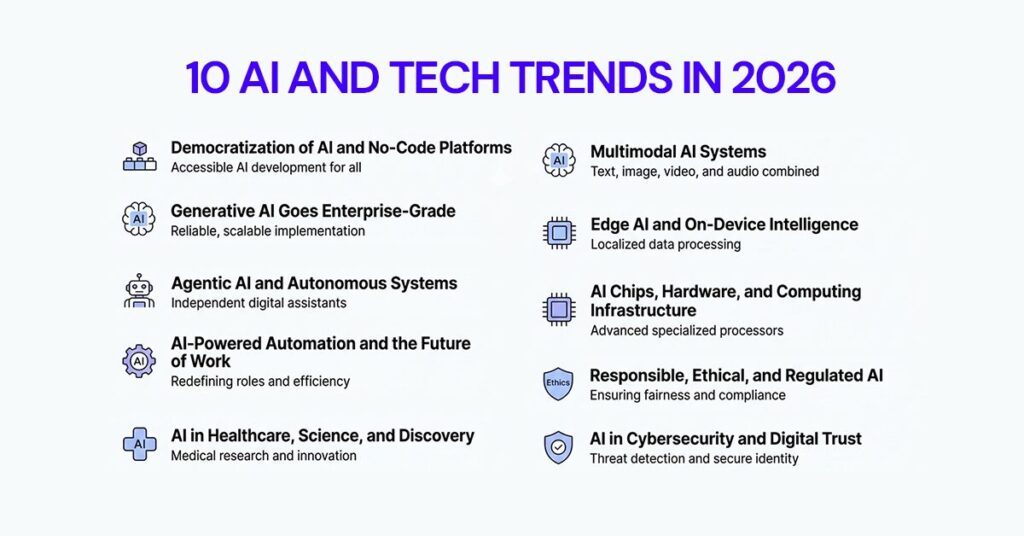
Trend 1 – Generative AI Goes Enterprise-Grade
From Experimental Tools to Mission-Critical Systems
Generative AI moves into production systems. Enterprises deploy it for customer support, documentation, and internal operations.
Furthermore, organizations integrate generative models into workflows instead of standalone tools. Reliability, uptime, and security become mandatory. This shift defines a major milestone in AI and tech trends.
Generative AI for Content, Code, and Design
Generative AI now assists across creative and technical domains. It writes content, generates code, and supports design workflows.
Additionally, teams use AI to accelerate delivery while maintaining quality. Human review remains essential. However, speed improves dramatically. This adoption strengthens generative AI’s place among top tech trends.
Governance and Risk Management of Generative AI
Enterprise adoption requires governance. Organizations define usage policies, data boundaries, and audit mechanisms.
Furthermore, they monitor hallucinations and bias. Risk management becomes as important as innovation. Companies that manage this balance gain long-term trust.
Trend 2 – Agentic AI and Autonomous Systems
What Is Agentic AI?
Agentic AI refers to systems that act independently toward goals. These agents plan, execute, and adapt.
Additionally, they interact with tools, APIs, and other agents. This capability shifts AI from reactive to proactive systems. It represents a core evolution in AI and tech trends.
Autonomous AI Agents Managing Workflows
Organizations deploy agents to manage workflows. Examples include incident response, scheduling, and customer follow-ups.
Furthermore, agents reduce manual coordination. They operate continuously and escalate issues when needed. This efficiency positions agentic AI among the top tech trends for operations.
Risks and Limitations of Autonomous AI
Autonomy introduces new risks, as AI agents may act incorrectly or operate beyond defined boundaries. Therefore, organizations must enforce strong guardrails, approval workflows, and continuous human oversight.
Clear operational limits, monitoring, and accountability frameworks ensure safety, reliability, and responsible deployment of autonomous AI systems at scale.
Trend 3 – AI-Powered Automation and the Future of Work
Hyperautomation Across Enterprises
Hyperautomation combines AI, RPA, and orchestration. Enterprises automate end-to-end processes instead of isolated tasks.
Furthermore, automation now handles complex decisions. This transformation improves productivity and consistency. It stands out strongly among AI and tech trends.
Human-AI Collaboration Models
AI augments humans rather than replacing them. Employees supervise, guide, and validate AI outputs to ensure accuracy, context, and accountability in critical workflows.
Additionally, teams redesign processes around collaboration instead of automation alone. This hybrid human-AI model improves decision quality, boosts productivity, and increases employee trust, engagement, and overall job satisfaction across organizations.
Workforce Reskilling for an AI-First Economy
AI adoption requires new technical and cognitive skills. Organizations invest in structured reskilling programs to prepare employees for AI-supported roles.
Furthermore, workers learn AI literacy, data interpretation, and critical thinking. Continuous learning becomes a competitive advantage, enabling teams to adapt faster as technology and job requirements evolve.
Trend 4 – Responsible, Ethical, and Regulated AI
Global AI Regulations and Compliance
Governments introduce AI laws focused on transparency and accountability. Compliance becomes unavoidable.
Additionally, enterprises align AI practices with legal frameworks. Regulation shapes future top tech trends as much as innovation.
Bias, Fairness, and Explainable AI
Organizations increasingly prioritize fairness and explainability in AI systems. They test models for bias, validate training data, and document decision logic to ensure accountability.
Furthermore, explainable AI builds trust with users, regulators, and stakeholders. As adoption grows, ethical and transparent AI practices become a baseline expectation rather than an optional feature.
Ethical AI as a Competitive Advantage
Companies that lead with ethical AI practices gain long-term trust. Customers and partners prefer organizations that operate transparent, responsible, and accountable AI systems.
Additionally, ethical AI reduces legal and reputational risk. Responsibility evolves into a strategic differentiator that strengthens brand credibility and competitive positioning.
Trend 5 – Multimodal AI Systems
Text, Image, Audio, and Video AI Integration
Multimodal AI processes text, images, audio, and video simultaneously, allowing systems to understand context more effectively than single-mode models.
Furthermore, this integration enables richer, more natural interactions across applications. As a result, multimodal capabilities expand AI use cases across customer experience, analytics, and decision-making workflows.
Multimodal AI Use Cases Across Industries
Retail applies multimodal AI to visual search and personalized shopping experiences. Healthcare uses it for diagnostics that combine medical images, notes, and patient data.
Additionally, media companies automate content tagging, moderation, and analysis. These cross-industry applications clearly reflect major AI and tech trends shaping modern digital ecosystems.
Infrastructure and Data Challenges for Multimodal AI
Multimodal AI models require massive datasets, high-performance compute, and advanced storage systems, significantly increasing infrastructure demands and operational costs.
Therefore, organizations optimize data pipelines, compress models, and redesign architectures. Efficient infrastructure planning becomes critical to scale multimodal AI sustainably and cost-effectively.
Trend 6 – Edge AI and On-Device Intelligence
Edge AI vs Cloud-Based AI
Edge AI runs models directly on devices, while cloud-based AI processes data in centralized servers. Each approach serves different operational needs and constraints.
Furthermore, edge AI reduces reliance on constant connectivity. This shift supports real-time applications where speed, reliability, and offline processing are critical.
Real-Time AI in IoT and Smart Devices
Smart devices increasingly use AI locally, including wearables, surveillance cameras, industrial sensors, and autonomous vehicles. Local processing enables immediate decision-making.
Additionally, real-time AI improves responsiveness and reliability. As adoption grows, edge intelligence emerges as a key top tech trend across connected ecosystems.
Privacy and Latency Benefits of Edge AI
Edge AI improves privacy by keeping sensitive data on-device rather than transmitting it to centralized servers. This approach aligns well with data protection requirements.
Furthermore, latency drops significantly because processing happens locally. These benefits accelerate adoption in regulated and time-sensitive industries.
Trend 7 – AI Chips, Hardware, and Computing Infrastructure
Specialized AI Chips and Accelerators
AI workloads increasingly require specialized hardware such as GPUs, TPUs, and custom accelerators to handle intensive computation efficiently and at scale.
Additionally, continuous chip innovation directly shapes AI performance and scalability. As a result, advanced hardware becomes central to emerging AI and tech trends.
Energy-Efficient AI Computing
Energy efficiency has become a critical priority as AI workloads expand. Organizations optimize models, algorithms, and hardware utilization to reduce unnecessary computation.
Furthermore, efficient AI computing lowers operational costs and carbon emissions. Sustainability now plays a direct role in shaping long-term technology investment decisions.
AI Data Centers and Sustainability Concerns
AI-driven data centers continue to grow rapidly, increasing overall energy consumption and environmental impact across regions.
Therefore, providers invest in renewable energy, advanced cooling systems, and green infrastructure. Sustainability evolves into a strategic priority for future AI scalability.
Trend 8 – AI in Cybersecurity and Digital Trust
Specialized AI Chips and Accelerators
AI workloads increasingly require specialized hardware such as GPUs, TPUs, and custom accelerators to handle intensive computation efficiently and at scale.
Additionally, continuous chip innovation directly shapes AI performance and scalability. As a result, advanced hardware becomes central to emerging AI and tech trends.
Energy-Efficient AI Computing
Energy efficiency has become a critical priority as AI workloads expand. Organizations optimize models, algorithms, and hardware utilization to reduce unnecessary computation.
Furthermore, efficient AI computing lowers operational costs and carbon emissions. Sustainability now plays a direct role in shaping long-term technology investment decisions.
AI Data Centers and Sustainability Concerns
AI-driven data centers continue to grow rapidly, increasing overall energy consumption and environmental impact across regions.
Therefore, providers invest in renewable energy, advanced cooling systems, and green infrastructure. Sustainability evolves into a strategic priority for future AI scalability.
Trend 9 – AI in Healthcare, Science, and Discovery
AI-Driven Drug Discovery and Research
AI accelerates drug discovery by analyzing massive biological datasets and identifying promising compounds faster than traditional research methods.
Additionally, AI models significantly reduce research timelines and costs. This acceleration enables faster clinical trials and speeds scientific progress across pharmaceutical and biotechnology industries.
Personalized Medicine and Predictive Healthcare
Healthcare increasingly adopts predictive AI models to personalize treatments based on patient data, genetics, and medical history.
Furthermore, early disease detection and risk prediction improve patient outcomes. This shift transforms healthcare delivery from reactive treatment to proactive, data-driven care.
AI Accelerating Scientific Breakthroughs
AI supports breakthroughs in physics, climate science, and materials research by processing vast datasets beyond human analytical capacity.
Additionally, AI-driven simulations and pattern discovery accelerate experimentation. As a result, scientific discovery enters a faster, more efficient, and innovative era.
Trend 10 – Democratization of AI and No-Code Platforms
No-Code and Low-Code AI Development
No-code and low-code platforms allow non-technical users to build and deploy AI solutions without deep programming expertise.
Furthermore, development accelerates across departments as experimentation becomes easier. This accessibility defines a major AI and tech trend driving broader organizational adoption.
AI Access for Small Businesses and Creators
Small businesses increasingly adopt AI tools without large budgets or dedicated engineering teams. Creators automate content, marketing, and operations efficiently.
Additionally, democratized AI lowers entry barriers and levels the playing field, enabling innovation beyond large enterprises and technology giants.
Security and Misuse Risks of Democratized AI
Greater accessibility increases the risk of misuse, including data leaks, biased outputs, and malicious applications.
Therefore, organizations implement governance, usage controls, and monitoring frameworks. Strong oversight remains essential to balance innovation with responsible AI adoption
Explore More
Also Learn about Top 20 Data Engineering Tools and Software
The Economic Impact of AI Adoption in 2026
AI as a Global Economic Growth Engine
AI drives global productivity growth by creating new markets, improving efficiency, and transforming industries. Furthermore, countries investing early gain lasting competitive advantages within emerging top tech trends.
New Business Models Enabled by AI
AI enables subscription automation, AI-as-a-service platforms, and outcome-based pricing models. Additionally, companies increasingly monetize intelligence, insights, and automation as core revenue streams.
AI, Data Privacy, and Digital Sovereignty
Privacy-First AI Technologies
Privacy-first AI architectures gain importance as regulations tighten. Techniques like federated learning minimize data exposure. Furthermore, user trust becomes a critical competitive factor in AI adoption.
Data Ownership and AI Governance
Organizations increasingly clarify data ownership and strengthen AI governance frameworks. Additionally, data sovereignty concerns influence where and how AI systems are deployed globally.
Explore More
Also Learn about Top 20 DevOps Consulting Companies
How Organizations Can Prepare for AI and Tech Trends
Building an AI-Ready Organization
AI readiness begins with strong data maturity, skilled teams, and an adaptive culture. Furthermore, leadership alignment ensures execution success. Organizational readiness ultimately defines long-term resilience in an AI-driven future.
Strategic AI Investment and Roadmapping
Organizations prioritize AI use cases with clear ROI and measurable impact. Additionally, phased investment roadmaps help balance innovation, cost control, and risk management effectively.
Final Thoughts on AI and Tech Trends in 2026
Balancing Innovation, Ethics, and Growth
Long-term success requires balancing innovation with ethics and sustainability. Furthermore, organizations that prioritize responsible growth achieve durable value, trust, and resilience beyond short-term technological gains.
What Business and Tech Leaders Should Do Now
Leaders should invest in skills, data foundations, and governance today. Additionally, staying informed on AI and tech trends ensures competitiveness. At Techstack Digital, we help organizations turn emerging trends into measurable business outcomes.