
Quick Summary
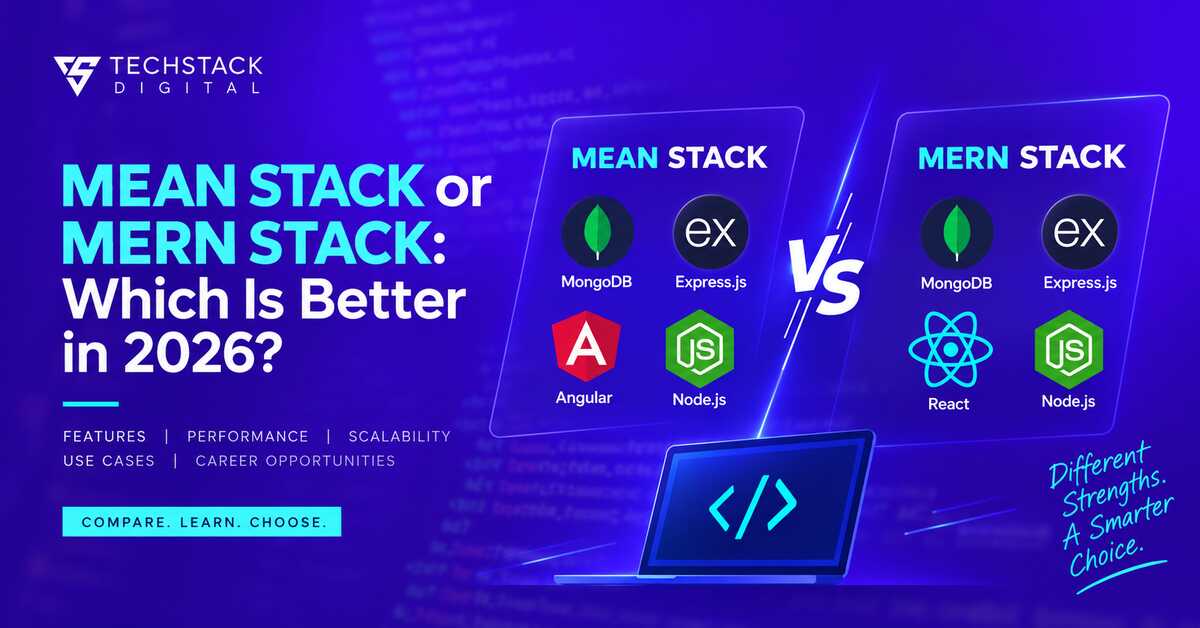
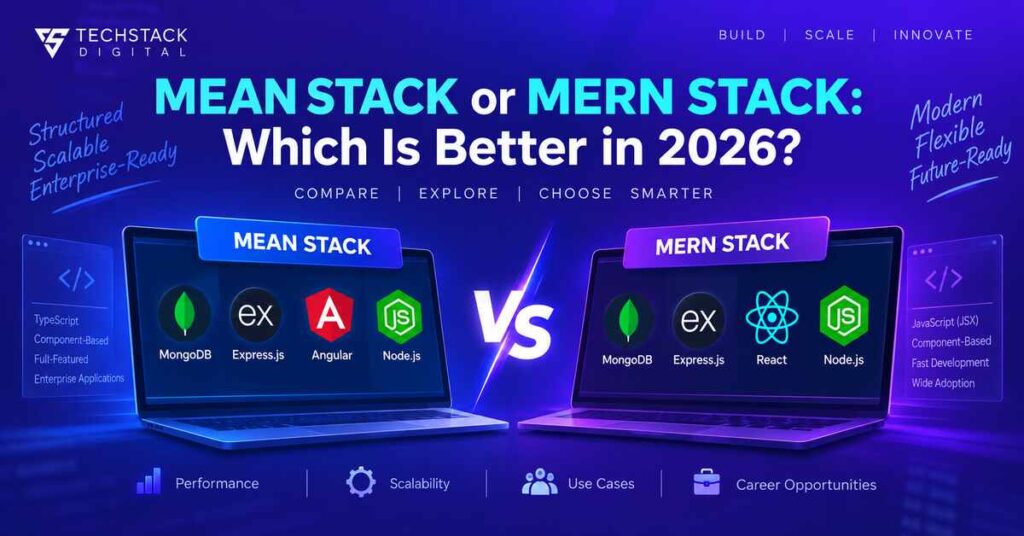
- MEAN uses MongoDB, Express.js, Angular, and Node.js.
- MERN uses MongoDB, Express.js, React, and Node.js.
- The main difference is Angular vs React.
- MEAN provides a more structured and convention-driven frontend approach.
- MERN provides greater frontend flexibility through React.
- MERN may feel more approachable for some beginners, while MEAN suits developers who prefer structured frameworks.
- Neither stack is automatically faster. Performance depends on architecture, APIs, database queries, caching, infrastructure, and code quality.
- Both MEAN and MERN can support scalable applications when designed correctly.
- Choose MEAN when your team has Angular expertise or needs stronger frontend conventions.
- Choose MERN when your team has React expertise or needs greater frontend flexibility.
- Neither stack is universally better. Project requirements, team skills, architecture, and frontend preferences should determine the choice.
MEAN Stack or MERN Stack: Which Is Better for Developers in 2027?
MEAN and MERN are popular full-stack approaches for building modern web applications. Both use JavaScript technologies across different application layers. Furthermore, they share MongoDB, Express.js, and Node.js. Their main difference appears in frontend development. MEAN uses Angular, while MERN uses React. This difference affects architecture, development workflow, flexibility, learning, and team practices. At Techstack Digital, selecting the right technology stack starts with understanding project requirements, architecture, and long-term development goals. Therefore, deciding MEAN stack or MERN stack which is better requires more than comparing popularity. The right choice depends on frontend preferences, existing systems, and team expertise.
MEAN vs MERN: Which Is Better? Quick Answer
The Short Verdict
Neither MEAN nor MERN is universally better. MERN may fit projects that require React, reusable UI components, and flexible frontend architecture. MEAN may fit teams that prefer Angular, TypeScript, and stronger framework conventions. Therefore, choose between them based on frontend requirements, existing skills, architecture, and long-term development needs.
What Should Your Decision Be Based On?
Your decision should focus on technical requirements rather than stack popularity. Both stacks share important backend technologies. Therefore, the frontend usually creates the biggest difference.
Frontend Technology Preference
Choose Angular when your developers prefer a comprehensive framework with established conventions. Choose React when your developers prefer component-based UI development and greater freedom when selecting supporting tools.
Project Requirements
Consider application complexity, UI requirements, integrations, existing systems, maintainability, and development workflows. Furthermore, evaluate whether your project benefits from stronger conventions or greater frontend flexibility.
Team Experience
Existing expertise can significantly influence development efficiency. An Angular team can often work faster with MEAN. Similarly, a React-focused team may gain more value from MERN.
What Is the Difference Between MEAN and MERN Stack?
MEAN and MERN provide JavaScript-centered approaches to full-stack web development. Their backend foundations remain largely similar. However, their frontend technologies differ.
What Technologies Do MEAN and MERN Share?
Both stacks use MongoDB, Express.js, and Node.js. Therefore, developers can apply many backend skills across either stack.
MongoDB
MongoDB provides the database layer. It stores data as flexible BSON documents and supports application data that does not always require traditional relational structures.
Express.js
Express.js provides a lightweight backend web framework for Node.js. Developers use it to create routes, middleware, REST APIs, authentication flows, and server-side application logic.
Node.js
Node.js provides the server-side JavaScript runtime. It supports asynchronous and event-driven application development. Furthermore, both stacks can use the same Node.js backend patterns.
What Is the Main Difference Between MEAN and MERN?
The main difference is Angular versus React.
MEAN Uses Angular
Angular provides a comprehensive frontend framework. It includes tools and conventions for components, routing, forms, dependency injection, HTTP communication, and other frontend requirements.
MERN Uses React
React provides a library for building user interfaces. Developers create reusable components and combine React with supporting libraries based on application requirements.
Why Does This Difference Matter?
Angular provides more built-in structure. React provides greater freedom around supporting technologies. Therefore, this difference affects frontend architecture, development conventions, tooling decisions, and team workflows.
What Is the MEAN Stack?
MEAN combines four technologies to support full-stack JavaScript application development.
Explore More
Also Learn about What is the MEAN Stack developer?
What Does MEAN Stand For?
MEAN stands for MongoDB, Express.js, Angular, and Node.js.
MongoDB
MongoDB manages application data through document-based storage.
Express.js
Express.js manages backend routes, middleware, APIs, and server logic.
Angular
Angular manages frontend interfaces and client-side application functionality.
Node.js
Node.js executes JavaScript on the server and connects backend application components.
How Does the MEAN Stack Work?
Angular handles the frontend interface. A user interacts with an Angular application, which sends HTTP requests to backend endpoints. Node.js runs the server, while Express.js processes routes and middleware. The backend then reads or writes information through MongoDB. After processing the request, the server sends a response to Angular.
Furthermore, developers can use JavaScript or TypeScript across much of this workflow. Angular commonly uses TypeScript, which can provide stronger typing and development tooling. This architecture creates a connected development environment while still separating frontend, backend, and database responsibilities.
What Type of Development Is MEAN Best Suited For?
MEAN can suit teams that already use Angular or prefer framework-driven frontend development. Angular provides established conventions that can help teams create consistent application structures.
Furthermore, MEAN can work for dashboards, enterprise applications, administrative platforms, business systems, and other applications that benefit from organized frontend architecture. However, Angular alone does not make an application enterprise-ready. Architecture, testing, security, infrastructure, and development practices remain important.
What Is the MERN Stack?
MERN combines MongoDB, Express.js, React, and Node.js. It replaces Angular in MEAN with React.
What Does MERN Stand For?
MERN stands for MongoDB, Express.js, React, and Node.js.
MongoDB
MongoDB provides document-oriented database storage.
Express.js
Express.js handles APIs, middleware, routes, and backend logic.
React
React builds interactive user interfaces through reusable components.
Node.js
Node.js provides the JavaScript runtime for server-side development.
How Does the MERN Stack Work?
React creates the frontend interface. Users interact with React components, which communicate with backend APIs. Express.js handles incoming requests on the Node.js server. The backend processes application logic and communicates with MongoDB.
The server then returns data to the frontend. React updates the required UI components based on application state. Furthermore, teams can add routing, state management, data-fetching, testing, and other tools according to project requirements.
What Type of Development Is MERN Best Suited For?
MERN fits applications where React is the preferred frontend technology. Teams commonly consider it for SaaS applications, dashboards, marketplaces, interactive platforms, and other UI-focused web applications.
Furthermore, React’s component model supports reusable interface development. MERN also gives developers significant freedom when choosing supporting frontend tools. However, teams must establish clear conventions as applications become larger.
MEAN Stack vs MERN Stack: Side-by-Side Comparison
MEAN vs MERN Comparison Table
| Factor | MEAN | MERN |
| Full Form | MongoDB, Express, Angular, Node | MongoDB, Express, React, Node |
| Frontend | Angular | React |
| Frontend Approach | Comprehensive framework | UI library |
| Database | MongoDB | MongoDB |
| Backend | Express + Node.js | Express + Node.js |
| Languages | JavaScript/TypeScript | JavaScript/TypeScript |
| Architecture | More convention-driven | More flexible |
| Learning Curve | More Angular concepts upfront | React core can be approachable, ecosystem adds choices |
| Flexibility | Structured | Higher frontend flexibility |
| UI Development | Component-based | Component-based |
| Development Speed | Depends on expertise | Depends on expertise |
| Scalability | Highly architecture-dependent | Highly architecture-dependent |
| Maintainability | Strong conventions can help | Strong team conventions can help |
| Ecosystem | Angular + Node ecosystem | React + Node ecosystem |
| Best Fit | Angular-oriented projects | React-oriented projects |
| Beginner Suitability | Suitable with structured learning | Suitable with JavaScript fundamentals |
What Are the Biggest Differences Between MEAN and MERN?
Frontend Framework vs UI Library
Angular provides a comprehensive framework. React focuses primarily on the UI layer. Therefore, Angular includes more capabilities and conventions within its core ecosystem.
Structure vs Flexibility
MEAN generally provides stronger frontend conventions through Angular. MERN gives developers more freedom to assemble supporting React tools.
Learning Experience
Angular introduces concepts such as dependency injection, services, decorators, RxJS patterns, and TypeScript-focused development. React starts with components, props, state, and hooks but expands through its wider ecosystem.
Project Suitability
Project requirements matter more than popularity. Existing expertise, architecture, integrations, UI requirements, and maintenance goals should guide the decision.
Angular vs React: The Key Difference Between MEAN and MERN
Angular in the MEAN Stack
Angular’s Framework-Based Approach
Angular provides a broad framework for building client-side applications. Developers receive integrated solutions for routing, forms, HTTP communication, dependency injection, and other common requirements.
Angular’s Development Conventions
Angular encourages consistent project organization. These conventions can help larger teams follow common development patterns. Furthermore, they can reduce some architectural decisions.
React in the MERN Stack
React’s Component-Based Approach
React builds interfaces through reusable components. Developers combine components to create pages, dashboards, forms, and interactive application experiences.
React’s Flexible Ecosystem
React lets teams select additional tools for routing, state management, data fetching, forms, and other requirements. This flexibility provides choice but also creates additional architectural decisions.
Angular vs React: How Does It Affect Your Stack Choice?
Choose Angular when structure and integrated framework capabilities align with your project. Choose React when frontend flexibility and ecosystem choice provide greater value.
Furthermore, existing skills should influence the decision. Moving an experienced Angular team to React without a technical reason may create unnecessary learning costs. The same principle applies when moving a React team to Angular.
Existing architecture also matters. Extending an established application usually creates less risk when teams remain compatible with its existing technology choices.
MEAN vs MERN: Which Is Easier to Learn?
MEAN Stack Learning Curve
Learning Angular
Angular requires developers to understand components, templates, services, dependency injection, routing, forms, and other framework concepts. Furthermore, TypeScript plays an important role in modern Angular development.
Learning the Backend Technologies
Developers also need MongoDB, Express.js, and Node.js knowledge. These technologies require an understanding of databases, APIs, asynchronous programming, middleware, authentication, and server architecture.
Explore More
Also Learn about MERN Stack Developer roadmap
MERN Stack Learning Curve
Learning React
React introduces components, JSX, props, state, hooks, events, and rendering concepts. Its core concepts can feel approachable to developers with solid JavaScript knowledge. However, production applications often require additional ecosystem tools.
Learning the Backend Technologies
MERN developers also learn Node.js, Express.js, and MongoDB. Therefore, the major learning difference remains frontend development.
Is MEAN or MERN Better for Beginners?
MERN for Beginners
MERN can provide an accessible starting point for learners who want to focus on React components and modern UI development.
MEAN for Beginners
MEAN can work well for learners who prefer structured frameworks and want established conventions.
Beginner Verdict
MERN may feel easier initially for some developers. However, MEAN can provide valuable structure. Learn JavaScript fundamentals first, then select Angular or React based on your goals.
MEAN vs MERN Performance: Which Is Faster?
Does MEAN Offer Better Performance?
MEAN does not automatically provide better application performance.
Angular Frontend Considerations
Angular provides extensive framework functionality. Developers should optimize rendering, bundles, change detection, network requests, and application architecture according to actual performance requirements.
Does MERN Offer Better Performance?
MERN is not automatically faster because it uses React.
React Frontend Considerations
React supports efficient UI updates, but application performance still depends on component design, state management, rendering behavior, bundle size, data fetching, and code quality.
What Actually Determines MEAN and MERN Performance?
Several technical factors influence performance.
Application Architecture
Good architecture reduces unnecessary processing and improves application efficiency.
Frontend Optimization
Optimize rendering, assets, bundles, components, and data loading.
API Design
Efficient APIs reduce unnecessary requests and data transfer.
Database Queries
Indexes and optimized queries can significantly improve backend response times.
Caching
Strategic caching can reduce repeated computation and database access.
Network Performance
CDNs, compression, payload size, and geographic infrastructure affect response times.
Code Quality
Poorly designed code can reduce performance regardless of the selected stack.
MEAN vs MERN Performance Verdict
Neither stack is universally faster. Angular and React have different runtime characteristics and architectural models. However, real application performance depends heavily on implementation. Therefore, benchmark your actual workloads instead of choosing a stack based on generic performance claims.
MEAN vs MERN for Scalability
Is the MEAN Stack Scalable?
MEAN can support scalable applications when developers design the system correctly.
Frontend Structure
Angular conventions can help organize complex frontend applications.
Backend Scalability Considerations
Node.js services can scale horizontally. Furthermore, teams can optimize MongoDB through indexing, replication, partitioning strategies, and appropriate data modeling.
Team-Level Scalability
Angular conventions can support consistency as teams grow.
Is the MERN Stack Scalable?
MERN can also support scalable applications.
Frontend Flexibility
React components can support modular UI architecture.
Explore More
Also Learn about React Force Rerender:Complete Guide
Backend Scalability Considerations
MERN uses the same Node.js, Express.js, and MongoDB foundation as MEAN. Therefore, many backend scalability considerations remain identical.
Team-Level Scalability
Teams need coding standards, architecture guidelines, testing strategies, and component conventions as React applications grow.
Which Is More Scalable: MEAN or MERN?
Neither provides automatic scalability.
What Matters More Than the Stack Name?
Application Architecture
Design services and application boundaries carefully.
Database Design
Create efficient schemas, indexes, and queries.
Infrastructure
Use appropriate hosting, load balancing, caching, and monitoring.
Code Quality
Maintain efficient and testable code.
Team Practices
Establish standards, reviews, testing, and documentation.
Both stacks can scale. Architecture matters more than the acronym.
MEAN vs MERN for Development Speed and Flexibility
Development Speed With MEAN
Angular’s Built-In Features
Angular includes many capabilities developers otherwise need to select separately. This approach can reduce technology selection time.
Consistent Development Conventions
Established conventions help experienced Angular teams maintain predictable workflows.
Development Speed With MERN
React’s Flexible Approach
React lets developers create interfaces without adopting one complete frontend framework architecture.
Choosing Supporting Libraries and Tools
Teams can choose tools that match specific requirements. However, evaluating and maintaining these dependencies can require additional work.
Which Stack Provides More Flexibility?
MEAN’s Structured Approach
MEAN provides flexibility, but Angular encourages stronger framework conventions.
MERN’s Flexible Approach
MERN generally provides more frontend architectural freedom because React focuses on UI development.
Which Is Better for Rapid Development?
The faster stack is usually the stack your team already knows. An experienced React team can build rapidly with MERN. An experienced Angular team can achieve similar advantages with MEAN. Therefore, prioritize expertise and requirements over generic speed comparisons.
MEAN vs MERN for Large and Complex Applications
Is MEAN Good for Large Applications?
Structured Architecture
Angular provides conventions that can support organized frontend development.
Team Consistency
Shared Angular patterns can help developers follow common approaches.
Long-Term Maintenance
Strong typing, testing, documentation, and consistent architecture can improve maintainability.
Is MERN Good for Large Applications?
Flexible Architecture
React allows teams to design frontend architecture around specific application requirements.
Component-Based UI Development
Reusable components can support large interface systems.
Importance of Team Conventions
Flexibility creates responsibility. Large React projects need clear rules for state, components, data access, testing, and folder structures.
MEAN or MERN for Large Projects: Which Should You Choose?
Consider team size, application complexity, existing expertise, architecture, and maintenance requirements. MEAN may suit teams that value Angular’s conventions. MERN may suit teams that already have mature React architecture practices. Neither stack wins solely because the application is large.
MEAN vs MERN for Jobs and Career Opportunities
Which Skills Are Shared Between MEAN and MERN?
JavaScript
Both require strong JavaScript fundamentals.
MongoDB
Both can use MongoDB for application data.
Express.js
Both commonly use Express.js for backend APIs.
Node.js
Both use Node.js for server-side JavaScript.
Which Skills Are Different?
Angular Skills for MEAN
MEAN roles require Angular concepts, TypeScript, services, routing, forms, and related frontend knowledge.
React Skills for MERN
MERN roles require React components, hooks, state management, JSX, routing, and relevant ecosystem knowledge.
Should You Learn MEAN or MERN for Your Career?
If You Want React-Focused Roles
Consider MERN and strengthen your React knowledge.
If You Want Angular-Focused Roles
Consider MEAN and develop strong Angular and TypeScript skills.
Check Your Target Job Market
Search current job listings in your target region before deciding. Technology demand changes by location, industry, company type, and experience level. Therefore, avoid choosing solely from generalized salary or popularity claims.
Advantages and Disadvantages of the MEAN Stack
Advantages of MEAN
Structured Frontend Development
Angular provides clear frontend conventions.
Angular’s Comprehensive Framework
Angular includes many features required by complex applications.
Consistent Development Conventions
Teams can follow established patterns across projects.
JavaScript/TypeScript Full-Stack Ecosystem
Developers can use closely related languages across application layers.
Suitable for Angular-Experienced Teams
Existing expertise can reduce training and development costs.
Disadvantages of MEAN
Angular Learning Curve
Angular introduces several framework-specific concepts.
More Framework Concepts to Learn
Developers need to understand Angular’s architecture before using it effectively.
Less Frontend Freedom for Teams Wanting a Highly Flexible Setup
Angular’s conventions may feel restrictive to teams that prefer assembling their frontend architecture from independent tools.
Advantages and Disadvantages of the MERN Stack
Advantages of MERN
React-Based UI Development
React provides a mature component-based approach to UI development.
Component-Based Architecture
Reusable components can reduce duplication and improve UI consistency.
Flexible Frontend Ecosystem
Teams can choose supporting libraries according to requirements.
JavaScript Full-Stack Workflow
JavaScript skills transfer across frontend and backend development.
Suitable for React-Experienced Teams
React expertise can accelerate MERN development.
Disadvantages of MERN
More Architectural Decisions
React leaves many technology and architecture choices to development teams.
Need for Supporting Libraries in Some Projects
Teams may need additional packages for routing, state, forms, and other requirements.
Team Conventions Become Important as Projects Grow
Flexible architecture can become inconsistent without standards and documentation.
When Should You Choose the MEAN Stack?
Choose MEAN When Your Team Already Uses Angular
Existing Angular Skills
Experienced Angular developers can use familiar tools, patterns, and workflows.
Reduced Technology Switching
Staying with Angular reduces unnecessary retraining and migration.
Choose MEAN When You Want a Structured Frontend Framework
Framework Conventions
Angular provides established approaches for common frontend requirements.
Consistent Architecture
These conventions can help teams maintain predictable application structures.
Choose MEAN for Existing Angular-Based Projects
Existing technology should strongly influence stack decisions. Replacing Angular with React creates migration work, testing requirements, retraining costs, and architectural changes. Therefore, continuing with MEAN can make sense when an existing Angular application already meets project requirements.
When Should You Choose the MERN Stack?
Choose MERN When Your Team Already Uses React
Existing React Skills
React developers can apply existing component, state, routing, and UI knowledge.
Reduced Technology Switching
Remaining within React reduces unnecessary learning and migration costs.
Choose MERN When Frontend Flexibility Matters
Flexible Tool Selection
React lets teams select supporting technologies based on project requirements.
Component-Based UI Development
Components help teams build reusable and interactive interfaces.
Choose MERN for Existing React-Based Projects
Maintaining an established React ecosystem can reduce architectural disruption. Furthermore, teams can reuse components, internal libraries, development standards, and existing expertise. Therefore, switching to Angular should require a clear technical or business reason.
MEAN or MERN: Which Should Beginners Learn First?
Start With JavaScript Fundamentals
Core JavaScript
Learn variables, functions, arrays, objects, modules, classes, closures, and modern syntax.
Asynchronous JavaScript
Understand promises, async/await, event loops, and asynchronous operations.
Basic Web Development Concepts
Learn HTML, CSS, HTTP, APIs, browser fundamentals, Git, and debugging.
Decide Between Angular and React
Learn Angular If…
Learn Angular if you prefer a comprehensive framework or target jobs and projects that use Angular.
Learn React If…
Learn React if you prefer component-based UI development or target React-focused opportunities.
Learn the Shared Backend Technologies
Node.js
Learn server-side JavaScript and asynchronous backend development.
Express.js
Build routes, middleware, authentication, and APIs.
MongoDB
Learn documents, collections, indexes, queries, and data modeling.
Beginner Verdict: MEAN or MERN?
MERN may provide a more approachable initial frontend path for some beginners because React lets learners start with focused UI concepts. However, MEAN can suit learners who prefer stronger framework structure. Your target jobs and projects should determine the final choice.
MEAN vs MERN: Which Is Better for Your Project?
Choose MEAN If…
You Prefer Angular
Angular matches your frontend requirements and development approach.
Your Team Has Angular Experience
Existing expertise reduces training requirements.
You Want Strong Frontend Conventions
Angular provides comprehensive framework patterns.
Your Existing Application Uses Angular
Maintaining compatible architecture can reduce unnecessary migration.
Choose MERN If…
You Prefer React
React matches your UI development requirements.
Your Team Has React Experience
Existing React knowledge can accelerate development.
You Want Frontend Flexibility
React allows teams to select supporting tools.
Your Existing Application Uses React
Remaining within React can simplify maintenance and development.
Neither Stack Is Automatically Better If…
Performance Is Your Only Concern
Measure real application workloads before choosing.
Scalability Is Your Only Concern
Architecture and infrastructure matter more.
Your Team Has No Experience With Either
Evaluate learning requirements and project needs first.
Another Technology Better Fits the Requirements
Do not force MEAN or MERN into every project. Relational databases, server-rendered frameworks, different backend languages, or other architectures may better match specific requirements.
MEAN vs MERN: Final Comparison by Use Case
Which Is Better for Beginners?
MERN may feel more approachable initially for learners who want to start with React. However, beginners targeting Angular jobs should learn MEAN instead.
Which Is Better for React Developers?
MERN is the natural choice because React already forms its frontend layer.
Which Is Better for Angular Developers?
MEAN fits Angular developers because it preserves their existing frontend expertise.
Which Is Better for Structured Development?
MEAN may provide an advantage when teams specifically want Angular’s comprehensive framework conventions.
Which Is Better for Frontend Flexibility?
MERN generally provides greater frontend flexibility because React lets teams choose more of their supporting architecture.
Which Is Better for MVP Development?
Either can support MVP development. Choose MERN when your team builds faster with React. Choose MEAN when your team already has Angular expertise. Furthermore, evaluate product complexity and future maintenance requirements.
Which Is Better for Large Applications?
Neither wins automatically. MEAN offers Angular’s framework conventions, while MERN supports large applications through disciplined React architecture. Team practices, testing, system design, and maintainability matter more.
Which Is Better for Long-Term Projects?
Long-term success depends on architecture, documentation, maintainability, dependency management, team expertise, testing, and technology support. Therefore, select the stack your organization can maintain effectively.
MEAN vs MERN Overall Winner
There is no universal winner. Choose MEAN when Angular’s structured framework approach fits your requirements. Choose MERN when React’s component model and frontend flexibility provide a better fit. The Angular versus React decision usually creates the most meaningful difference.
Frequently Asked Questions About MEAN vs MERN
Which is better, MEAN or MERN?
Neither is universally better. MEAN suits Angular-focused and convention-driven development. MERN suits React-focused projects and teams that value frontend flexibility.
What is the main difference between MEAN and MERN?
MEAN uses Angular, while MERN uses React. Both commonly use MongoDB, Express.js, and Node.js for the remaining application layers.
Is MERN better than MEAN for beginners?
MERN may feel easier initially for some learners because React’s core UI concepts can provide a focused starting point. However, Angular can suit learners who prefer comprehensive frameworks.
Is MERN faster than MEAN?
Not automatically. Application architecture, rendering, APIs, database queries, caching, infrastructure, and code quality determine real-world performance.
Which is more scalable, MEAN or MERN?
Both can support scalable systems. Database design, infrastructure, application architecture, monitoring, code quality, and team practices have a greater impact on scalability.
Which is better for large projects, MEAN or MERN?
Both can support large applications. MEAN provides stronger Angular conventions, while MERN provides React flexibility. Existing expertise and architecture should guide the decision.
Is MEAN or MERN better for web development?
Both support modern web development. Choose MEAN for Angular-oriented requirements and MERN for React-oriented requirements.
Should I learn MEAN or MERN for a job?
Check current job listings in your target market. Learn MERN for React-focused roles and MEAN for Angular-focused positions. Furthermore, strengthen shared JavaScript and backend fundamentals.
Can I switch from MEAN to MERN later?
Yes. Both share MongoDB, Express.js, Node.js, and JavaScript concepts. Therefore, much of your backend knowledge transfers. You mainly need to learn React when moving from MEAN to MERN.
Do MEAN and MERN both use Node.js?
Yes. Both use Node.js as their server-side JavaScript runtime.
Do MEAN and MERN both use MongoDB?
Yes. MongoDB represents the “M” in both MEAN and MERN.
Is Angular the only major difference between MEAN and MERN?
The primary technology difference is Angular versus React. However, that frontend choice creates additional differences in architecture, tooling, conventions, learning, and development workflows.
Conclusion: MEAN Stack or MERN Stack—Which Is Better?
Choosing MEAN stack or MERN stack which is better depends on project requirements rather than a universal ranking. Both provide capable JavaScript-based development approaches. Furthermore, both share MongoDB, Express.js, and Node.js. Angular and React create the central difference. MEAN provides Angular’s comprehensive framework structure, while MERN provides React’s flexible component-based approach. Additionally, performance and scalability depend heavily on architecture, code quality, databases, infrastructure, and optimization. At Techstack Digital, we evaluate these technical factors alongside business requirements to select the right technology stack for each project. Teams should consider existing expertise, frontend requirements, maintenance, and development workflows before making a decision. The best stack is the one that fits the project and team effectively.
Final MEAN vs MERN Verdict
Choose MEAN When…
Choose MEAN when Angular fits the project, your developers already understand Angular, or your organization values stronger frontend framework conventions. It can also provide a practical choice when an existing application already uses Angular.
Choose MERN When…
Choose MERN when React fits your UI requirements, your developers already have React expertise, or frontend flexibility matters. It also makes sense when you want to remain compatible with an existing React application and ecosystem.
The Final Decision
Neither MEAN nor MERN is universally better. The primary difference remains Angular versus React. Both share MongoDB, Express.js, and Node.js. Therefore, evaluate the frontend technology first. Then consider application architecture, team experience, development workflow, scalability requirements, maintenance, and long-term technical goals. Choose MEAN when Angular provides the better fit. Choose MERN when React provides the better fit. Project requirements should make the final decision.