
TL;DR-Quick Summary
JavaScript is the better choice for frontend development, interactive websites, full-stack applications, and cross-platform mobile apps. Python is generally better for artificial intelligence, machine learning, data science, automation, and scientific computing.
Python is usually easier for beginners because of its readable syntax, while JavaScript offers broader opportunities in web development. JavaScript often delivers faster runtime performance, whereas Python prioritizes simplicity and developer productivity.
Choose JavaScript if you want to become a frontend or full-stack developer. Choose Python if you want to work in AI, analytics, automation, or backend development. Learning both provides the most versatile skill set because the two languages complement each other rather than directly replace one another.
JavaScript vs Python: Key Differences, Pros & Best Uses
JavaScript and Python rank among the most popular programming languages in modern software development. Both power millions of applications across web development, cloud computing, artificial intelligence, automation, and enterprise systems. However, they solve different problems and follow different design philosophies. Furthermore, choosing the right language depends on your project goals, career plans, and technical requirements. This complete comparison by Techstack Digital explains their differences, similarities, strengths, limitations, performance, ecosystems, and practical use cases. By the end, you will understand which language fits your needs and when learning both provides the greatest long-term advantage.
JavaScript vs Python at a Glance
JavaScript and Python dominate today’s development landscape because they support different aspects of modern software engineering. JavaScript primarily creates interactive web experiences and full-stack applications, while Python focuses on automation, artificial intelligence, scientific computing, and backend services. Furthermore, both languages continue evolving through active communities, modern frameworks, and cloud-native development practices.
Quick Comparison Table
The following JavaScript vs Python table provides a quick feature comparison for developers evaluating both languages. This side-by-side comparison serves as a practical programming language comparison chart before exploring technical details.
| Feature | JavaScript | Python |
| First Release | 1995 | 1991 |
| Creator | Brendan Eich | Guido van Rossum |
| Primary Purpose | Interactive web applications | General-purpose programming |
| Syntax | Curly braces and semicolons | Indentation-based |
| Typing | Dynamic, weakly typed | Dynamic, strongly typed |
| Runtime | Browser, Node.js | CPython, PyPy |
| AI Support | Limited but growing | Industry standard |
| Web Development | Frontend and backend | Primarily backend |
| Mobile Development | React Native | Kivy, BeeWare |
| Desktop Development | Electron | Tkinter, PyQt |
| Package Manager | npm | pip |
This language comparison highlights where each programming language performs best. However, selecting one depends on your objectives rather than technical specifications alone.
Key Differences Summary
Several major differences separate JavaScript and Python despite their widespread popularity. JavaScript executes inside browsers and powers interactive interfaces. Python focuses on readability, automation, and scientific computing. Furthermore, JavaScript follows an event-driven model, whereas Python emphasizes simplicity and developer productivity. These key distinctions define most JavaScript vs Python differences discussed throughout this Python and JavaScript comparison, including their similarities and differences.
Which Language Is Better Overall?
There is no single best programming language for every project. Instead, the answer depends on your goals. Developers building websites often choose JavaScript. Meanwhile, professionals working with AI, automation, or analytics generally select Python. Therefore, if you ask which language is better or which language should you learn, the answer becomes Python or JavaScript based on your intended career path rather than overall superiority.
What Is JavaScript?
JavaScript is a high-level programming language that enables developers to build dynamic and interactive digital experiences. Initially designed for browsers, it now supports frontend interfaces, backend services, desktop software, mobile applications, and cloud computing through Node.js. Furthermore, JavaScript remains one of the most widely adopted technologies in modern software development because of its flexibility and extensive ecosystem.
History of JavaScript
Brendan Eich created JavaScript at Netscape in 1995 to make web pages interactive. Initially developed within days, the language rapidly evolved alongside browser technology. Furthermore, JavaScript later became standardized under ECMAScript, ensuring consistent implementation across platforms. This JavaScript history demonstrates continuous innovation throughout its JavaScript evolution, transforming a simple scripting language into a foundation of modern web development.
Key Features
JavaScript offers numerous capabilities that support scalable software development. It functions as a dynamic language and an interpreted language, allowing rapid execution without manual compilation. Furthermore, it supports event-driven programming, prototype-based inheritance, asynchronous execution, and cross-platform deployment. These features help developers create responsive applications across browsers, servers, mobile devices, and desktop environments.
Advantages
JavaScript provides several advantages for modern application development. It powers client-side scripting, enabling instant interaction without constant server communication. Furthermore, excellent browser compatibility allows consistent execution across major platforms. Its fast execution, extensive developer community, and millions of npm packages create a huge ecosystem that accelerates software development while reducing implementation time.
Limitations
Despite its strengths, JavaScript has several technical limitations. Browser security restrictions limit direct system access to protect users. Furthermore, asynchronous programming may create callback hell in poorly structured applications. JavaScript also remains primarily single-threaded, which introduces certain runtime limitations when handling CPU-intensive operations without additional tools such as Web Workers.
Common Use Cases
JavaScript supports nearly every area of software development. Developers use it for frontend development, backend development through Node.js, interactive web applications, mobile apps using React Native, and desktop apps with Electron. Furthermore, JavaScript powers serverless platforms, cloud services, browser extensions, and modern APIs, making it one of the industry’s most versatile programming languages.
What Is Python?
Python is a high-level, general-purpose programming language that emphasizes simplicity, readability, and productivity. Developers use it for artificial intelligence, automation, backend systems, scientific computing, cybersecurity, and data analysis. Furthermore, Python continues gaining popularity because its clean syntax enables faster development while supporting some of the largest software ecosystems available today.
History of Python
Guido van Rossum introduced Python in 1991 to simplify software development without sacrificing flexibility. Since then, the open-source language has undergone continuous improvement through community contributions. Furthermore, Python history reflects decades of innovation, while its ongoing Python evolution has expanded its role from scripting language to one of the world’s leading technologies for AI and enterprise software.
Key Features
Python offers several characteristics that improve developer efficiency. It functions as a high-level programming language with highly readable syntax, reducing code complexity. Furthermore, Python supports dynamic typing, object-oriented programming, and multiple programming paradigms. This multi-paradigm approach allows developers to build applications using procedural, functional, or object-oriented techniques depending on project requirements.
Advantages
Python simplifies software development for beginners and professionals alike. Its easy to learn syntax shortens the learning process while promoting clean code. Furthermore, extensive libraries accelerate development across AI, automation, web services, and analytics. Python encourages rapid development, improves developer productivity, and supports reliable cross-platform deployment for diverse operating systems.
Limitations
Python prioritizes readability over raw execution speed. Consequently, slower execution may affect highly performance-sensitive applications. Furthermore, increased memory consumption can become noticeable in large workloads. The Global Interpreter Lock (GIL) also limits traditional multithreading for CPU-intensive programs, although alternative approaches often improve overall runtime speed.
Common Use Cases
Python supports a broad range of industries and technical disciplines. Developers use it for artificial intelligence, machine learning, data science, automation, web development, and scientific computing. Furthermore, Python powers cybersecurity tools, cloud automation, robotics, financial analysis, and research environments, making it one of the most versatile programming languages available today.
JavaScript vs Python: Detailed Comparison
Although JavaScript and Python solve many of the same programming problems, they approach development differently. JavaScript emphasizes event-driven execution and browser-based applications. Meanwhile, Python focuses on readability and rapid development. Furthermore, comparing syntax, performance, typing, scalability, concurrency, security, and error handling helps developers choose the right language for specific projects.
Syntax Comparison
Syntax significantly affects developer productivity and code maintenance. JavaScript uses curly braces, semicolons, and flexible syntax rules. Meanwhile, Python relies on indentation and minimal punctuation. Furthermore, both languages remain beginner-friendly, although Python generally requires fewer lines of code for similar functionality.
Code Readability
Python promotes readable syntax through mandatory indentation, making programs easier to understand. JavaScript uses curly braces and explicit blocks, offering greater flexibility. Furthermore, both languages encourage clean code when developers follow consistent coding style practices.
Hello World Example
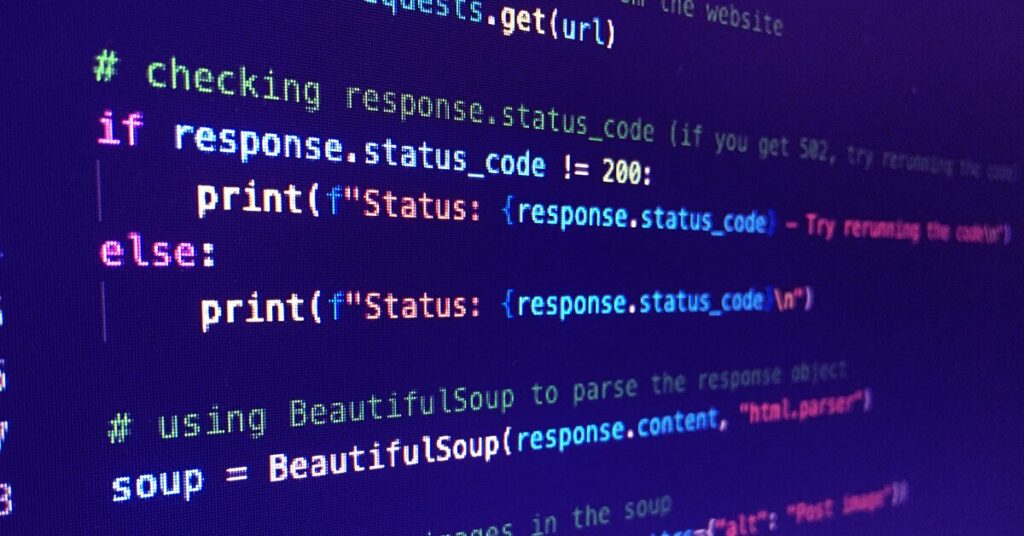
The classic Hello World program demonstrates the basic syntax of each language. Python prints output with one simple statement. Meanwhile, JavaScript uses the browser console or Node.js runtime. This beginner example highlights Python’s cleaner syntax.
Python
print(“Hello, World!”)
JavaScript
console.log(“Hello, World!”);
Variable Declaration
JavaScript supports let, const, and the older var keyword for variable declaration. Meanwhile, Python variables require only simple variable assignment without explicit keywords. Furthermore, Python’s approach reduces syntax while JavaScript offers finer control over scope.
Python
name = “Alice”
age = 25
JavaScript
const name = “Alice”;
let age = 25;
Functions
JavaScript supports traditional functions and modern arrow functions for concise syntax. Python uses standard function declaration with the def keyword and supports lambda functions for simple expressions. Furthermore, both languages treat functions as first-class objects and provide reusable methods.
Python
def greet(name):
return f”Hello {name}”
JavaScript
const greet = (name) => `Hello ${name}`;
Loops
Both languages provide efficient for loop and while loop structures for iteration. Python simplifies collection traversal with direct iteration. Meanwhile, JavaScript offers multiple loop syntax options, including for…of and forEach() for modern applications.
Python
for item in items:
print(item)
JavaScript
for (const item of items) {
console.log(item);
}
Classes & OOP
Both languages fully support classes, objects, inheritance, encapsulation, and polymorphism. JavaScript originally relied on prototypes before introducing ES6 classes. Meanwhile, Python has always emphasized object-oriented design alongside procedural and functional programming.
Learning Curve
Both languages are beginner-friendly but target different learning paths. Python minimizes syntax complexity, while JavaScript introduces concepts related to browsers and asynchronous programming. Furthermore, learning becomes easier through consistent practice and real-world projects rather than memorizing syntax.
Which Is Easier for Beginners?
Python remains one of the most beginner friendly options because of its readable syntax and simple structure. Additionally, many educational platforms recommend it as an easy programming language for students beginning learning programming or exploring coding for beginners.
Common Challenges
Beginners often encounter syntax errors, debugging issues, and unfamiliar programming concepts. Furthermore, selecting quality learning resources and building practical practice projects significantly improves long-term understanding regardless of the language chosen.
Performance
Performance depends on runtime implementation rather than syntax alone. JavaScript executes through highly optimized engines, while Python prioritizes simplicity and readability. Furthermore, both languages achieve excellent results when developers optimize applications according to their intended workloads.
Execution Speed
JavaScript generally delivers better runtime performance because Google’s V8 Engine compiles code using Just-In-Time optimization. Meanwhile, the standard Python interpreter executes code differently, leading to slower results in many speed benchmark comparisons.
Memory Usage
Both languages implement automatic memory management through garbage collection. However, Python generally consumes more memory because of its object model. Additionally, JavaScript often demonstrates lower RAM usage in browser and server-side applications.
Runtime Environment
JavaScript primarily runs inside browsers and Node.js environments. Meanwhile, Python executes through CPython, although alternatives like PyPy improve performance in certain workloads. Furthermore, both languages support cross-platform deployment across major operating systems.
Typing System
Both JavaScript and Python use dynamic typing, reducing the need for explicit type declarations. However, their type systems behave differently during runtime. Furthermore, optional static analysis tools improve code quality in large software projects.
Dynamic Typing
Both languages implement dynamic typing, allowing variables to change types during execution. However, JavaScript follows relatively weak typing, while Python enforces stronger runtime rules associated with strong typing, reducing unexpected behavior.
Type Checking
Developers increasingly adopt static analysis tools to identify programming mistakes before deployment. Furthermore, Python supports optional type annotations, while both languages continue using runtime type checking during execution.
TypeScript vs Python Type Hints
TypeScript extends JavaScript with optional static typing and improved type safety. Meanwhile, Python introduces optional type hints that enhance editor support without changing runtime behavior. Furthermore, both approaches improve maintainability for enterprise applications.
Explore More
Also Learn about Java vs Javascript difference
Scalability
Both languages scale effectively when developers follow sound architectural principles. However, their strengths differ across industries. Furthermore, scalability depends more on infrastructure, design patterns, and optimization than the programming language itself.
Enterprise Applications
Large enterprise applications frequently use JavaScript for customer-facing interfaces and Python for automation, analytics, and backend processing. Additionally, both languages integrate effectively with cloud platforms and distributed systems.
Large Projects
Modern large-scale applications require modular architecture, testing, and continuous deployment. Furthermore, JavaScript and Python both support scalable architecture through mature frameworks, cloud services, and continuous performance optimization techniques.
Concurrency
Concurrency enables applications to handle multiple operations efficiently. JavaScript emphasizes asynchronous execution, while Python supports several concurrency models. Furthermore, selecting the right approach depends on workload characteristics rather than language preference.
Async Programming
JavaScript excels at async programming through Promises and the event loop. Meanwhile, Python provides Asyncio for asynchronous workflows. Additionally, both approaches improve responsiveness during network and I/O operations.
Multithreading
Python supports multithreading, although the Global Interpreter Lock limits CPU-intensive execution. Furthermore, developers often combine threading with multiprocessing to maximize hardware utilization across multiple processor cores.
Event Loop
JavaScript’s event loop efficiently manages asynchronous tasks without blocking execution. Additionally, Python’s Asyncio implements a similar scheduling model, allowing scalable handling of network requests and background operations.
Security
Security depends on secure development practices rather than language choice alone. Both JavaScript and Python provide robust security capabilities when developers follow established standards. Furthermore, regular updates reduce exposure to emerging vulnerabilities.
Common Vulnerabilities
JavaScript applications commonly face XSS and CSRF attacks when input validation is insufficient. Meanwhile, Python applications also encounter similar security vulnerabilities if developers neglect proper authentication and validation practices.
Secure Coding Practices
Developers should always implement secure coding principles, including input validation, output encoding, authentication, and dependency updates. Furthermore, regular security testing significantly reduces application risk across both ecosystems.
Error Handling
Effective error handling improves application stability and simplifies maintenance. Both languages provide structured mechanisms for detecting and recovering from runtime failures. Furthermore, proper logging helps developers diagnose production issues quickly.
Exceptions
Python manages exception handling using try, except, and finally blocks. Meanwhile, JavaScript uses try catch statements to recover from runtime errors while maintaining application stability.
Debugging Tools
Modern IDEs provide advanced debugging capabilities, including breakpoints, variable inspection, and integrated stack trace analysis. Furthermore, browser developer tools and Python debuggers significantly accelerate issue resolution during development.
performance-sensitive applications. Furthermore, increased memory consumption can become noticeable in large workloads. The Global Interpreter Lock (GIL) also limits traditional multithreading for CPU-intensive programs, although alternative approaches often improve overall runtime speed.
Common Use Cases
Python supports a broad range of industries and technical disciplines. Developers use it for artificial intelligence, machine learning, data science, automation, web development, and scientific computing. Furthermore, Python powers cybersecurity tools, cloud automation, robotics, financial analysis, and research environments, making it one of the most versatile programming languages available today.
JavaScript vs Python by Use Case
Choosing between JavaScript and Python depends on the type of application you want to build. JavaScript dominates interactive web experiences and full-stack development. Meanwhile, Python leads artificial intelligence, automation, and data science. Furthermore, both languages continue expanding into cloud computing, DevOps, desktop software, and emerging technologies.
Web Development
Both JavaScript and Python play major roles in modern web development, but they serve different purposes. JavaScript powers interactive user interfaces, while Python primarily handles backend logic and APIs. Furthermore, many organizations combine both languages to build scalable web applications.
Frontend Development
JavaScript remains the standard for frontend development because browsers execute it natively. Developers use it to build responsive user interfaces, SPA architectures, and interactive components. Furthermore, modern frameworks simplify client-side development while improving performance and maintainability.
Backend Development
JavaScript supports backend services through Node.js, while Python powers REST APIs using frameworks like Django and FastAPI. Additionally, both languages build scalable backend systems, authentication services, and REST API architectures. They also support SSR for improved performance and SEO.
Artificial Intelligence & Machine Learning
Python dominates AI, machine learning, deep learning, and Generative AI because of mature frameworks like TensorFlow and PyTorch. Meanwhile, JavaScript supports browser-based AI using TensorFlow.js. Furthermore, Python remains the preferred language for building modern LLM applications and intelligent automation systems.
Data Science & Analytics
Python leads data science because it offers powerful libraries like NumPy, Pandas, and visualization tools. Developers frequently perform data analysis, build dashboards, and work inside Jupyter Notebook environments. Furthermore, Python simplifies statistical modeling and predictive analytics for research and business intelligence.
Automation & Scripting
Python excels at automation scripts, task automation, and system administration because of its clean syntax and extensive standard library. Developers also perform web scraping and browser automation using Selenium. Meanwhile, JavaScript automates browser workflows through Node.js and browser APIs.
Game Development
Both languages support game development but target different platforms. Python developers frequently build educational games using Pygame. Meanwhile, JavaScript powers browser games through Phaser.js. Additionally, developers sometimes integrate Python with Unity scripting workflows for automation and tooling.
Mobile App Development
JavaScript dominates cross-platform mobile development through React Native, enabling shared code across Android and iOS. Meanwhile, Python offers frameworks like Kivy and BeeWare for mobile applications. Although capable, they remain niche Flutter alternatives compared with JavaScript ecosystems.
Desktop Applications
Developers build cross-platform desktop software using JavaScript with Electron, powering applications like Visual Studio Code. Meanwhile, Python supports desktop GUI development through Tkinter and PyQt. Furthermore, both languages simplify modern Desktop GUI application development.
Cloud Computing
Both languages integrate seamlessly with modern cloud platforms. Developers deploy JavaScript and Python applications on AWS Lambda, Azure Functions, and Google Cloud. Furthermore, both languages support Serverless architectures that reduce infrastructure management and improve scalability.
DevOps & Infrastructure Automation
Python remains a leading language for DevOps because of tools like Ansible and infrastructure automation libraries. Meanwhile, JavaScript increasingly supports deployment workflows through Node.js tooling. Furthermore, both languages integrate with CI/CD, Docker, Kubernetes, and Infrastructure as Code practices.
IoT Development
Python plays a significant role in IoT through MicroPython, especially on Raspberry Pi devices and embedded systems. Meanwhile, JavaScript also supports IoT using Node.js. Furthermore, both languages help developers build connected devices and edge computing solutions.
Blockchain & Web3 Development
JavaScript dominates frontend blockchain applications using Web3.js for interacting with decentralized applications. Developers also work with Solidity to create smart contracts on Ethereum. Furthermore, JavaScript remains essential for modern blockchain development, while Python supports backend blockchain tooling and automation.
Frameworks and Libraries
Frameworks significantly improve development speed by providing reusable components and standardized architecture. JavaScript and Python both offer mature ecosystems that support enterprise software, cloud services, AI platforms, and web applications. Furthermore, choosing the right framework depends on project requirements rather than popularity alone.
Popular JavaScript Frameworks
JavaScript provides one of the industry’s largest ecosystems for frontend and backend development. Frameworks simplify application architecture, improve maintainability, and accelerate deployment. Furthermore, they support everything from single-page applications to enterprise cloud platforms.
React
React is a component-based JavaScript library for building interactive user interfaces. Furthermore, it supports reusable components, virtual DOM rendering, and strong ecosystem integration for scalable frontend applications.
Angular
Angular is a comprehensive frontend framework maintained by Google. Additionally, it offers dependency injection, TypeScript support, routing, and enterprise-ready architecture for large-scale web applications.
Vue
Vue.js combines simplicity with flexibility, making it popular among startups and enterprises. Furthermore, its reactive data model enables developers to create maintainable and high-performance user interfaces efficiently.
Next.js
Next.js extends React by adding server-side rendering, static site generation, routing, and API support. Furthermore, it improves SEO, application performance, and developer productivity for modern web platforms.
Express.js
Express.js is a lightweight backend framework for Node.js that simplifies routing, middleware management, and API development. Furthermore, it serves as the foundation for many enterprise backend services.
Popular Python Frameworks
Python offers a mature ecosystem covering web development, artificial intelligence, scientific computing, and automation. Furthermore, its frameworks help developers build secure, scalable, and high-performance applications across diverse industries.
Django
Django is a high-level Python framework following the batteries-included philosophy. Furthermore, it provides authentication, ORM, security, and rapid development features for enterprise web applications.
Flask
Flask is a lightweight Python framework that gives developers greater flexibility when building APIs and web services. Additionally, it supports modular architecture and extensive third-party extensions.
FastAPI
FastAPI focuses on high-performance API development using modern Python features. Furthermore, automatic documentation, asynchronous support, and type validation make it popular for cloud-native backend services.
TensorFlow
TensorFlow is one of the world’s leading machine learning frameworks. Developers use it for deep learning, neural networks, natural language processing, and production-scale artificial intelligence systems.
Pandas
Pandas simplifies structured data manipulation, transformation, and analysis. Furthermore, it enables developers and analysts to process large datasets efficiently for business intelligence and scientific research.
NumPy
NumPy provides efficient multidimensional arrays and mathematical operations. Additionally, it serves as the foundation for many scientific computing, machine learning, and numerical analysis libraries.
Ecosystem Comparison
The strength of a programming language depends heavily on its ecosystem. JavaScript and Python both benefit from active communities, extensive libraries, and continuous innovation. Furthermore, mature ecosystems reduce development time and improve long-term software maintainability.
Package Managers
JavaScript primarily uses npm, while developers also choose Yarn and pnpm for dependency management. Meanwhile, Python relies on pip to install packages from PyPI. Furthermore, both ecosystems provide millions of reusable libraries that accelerate software development.
Community Support
JavaScript and Python have some of the largest developer communities worldwide. Developers actively contribute through GitHub, answer technical questions on Stack Overflow, and improve projects within the global open source community. Furthermore, community support ensures continuous learning and long-term ecosystem growth.
Documentation
Both languages maintain excellent official documentation supported by detailed API reference guides and extensive tutorials. Furthermore, developers can quickly learn new technologies through books, online courses, documentation, and community-created educational resources.
Open Source Ecosystem
JavaScript and Python both thrive because of open-source collaboration. Millions of GitHub repositories, reusable libraries, and community packages help developers solve common problems without rebuilding existing functionality. Furthermore, active contributors continuously improve tools, frameworks, and security across both ecosystems.
JavaScript vs Python Job Market
Both programming languages offer excellent career opportunities because organizations increasingly invest in software, artificial intelligence, cloud computing, and digital transformation. Furthermore, demand continues growing across startups, enterprises, healthcare, finance, education, and technology companies worldwide.
Salary Comparison
Average developer salary depends on location, industry, and experience rather than language alone. However, experienced Python developer and JavaScript developer roles generally offer competitive compensation because both skill sets remain highly valuable across modern software engineering.
Job Opportunities
The demand for programming jobs continues increasing worldwide. JavaScript developers frequently work in frontend and full-stack positions, while Python professionals dominate AI and automation roles. Furthermore, both languages provide strong career opportunities because of sustained hiring demand across industries.
Industry Demand
The global tech industry continues adopting JavaScript and Python for digital transformation, cloud-native software, automation, and artificial intelligence. Furthermore, increasing developer demand and positive employment trends indicate strong long-term career stability for professionals skilled in either language.
Career Paths
JavaScript developers commonly become frontend developer, backend developer, or full-stack developer professionals. Meanwhile, Python specialists often pursue careers as AI engineer, data scientist, automation engineer, or machine learning engineer. Furthermore, learning both languages significantly expands career flexibility and employment opportunities.
Which Language Should You Learn First?
The best language to learn depends on your career goals rather than popularity. JavaScript is ideal for web developers because browsers run it natively. Meanwhile, Python simplifies automation, AI, and data science. Furthermore, both languages offer excellent career opportunities, active communities, and long-term industry demand.
If You Want to Become a Web Developer
Choose Learn JavaScript if your goal is frontend or full-stack development. Additionally, JavaScript enables interactive websites, modern frameworks, and browser applications. It forms the foundation of most web development careers.
If You Want to Become a Data Scientist
Choose Learn Python because it dominates analytics, machine learning, and scientific computing. Furthermore, libraries like Pandas, NumPy, and TensorFlow simplify data processing and predictive modeling.
If You Want to Build AI Applications
Python remains the preferred AI programming language because of its mature machine learning ecosystem. Additionally, frameworks like TensorFlow and PyTorch simplify deep learning and Generative AI development.
If You Want to Become a Full Stack Developer
Learning JavaScript first provides immediate frontend and backend capabilities through Node.js. Furthermore, adding Python later expands your backend, automation, and AI expertise for complete programming roadmap development.
If You Want to Get a Job Quickly
JavaScript offers abundant frontend and full-stack opportunities, while Python opens careers in automation and AI. Furthermore, your success depends more on projects, portfolios, and practical skills than language choice alone.
Can You Learn Both JavaScript and Python?
Yes. Learning both languages provides one of the strongest skill combinations in modern software development. JavaScript covers interactive web applications, while Python strengthens automation, backend engineering, and artificial intelligence. Furthermore, mastering both improves career flexibility and long-term professional growth.
Recommended Learning Path
Start with one language and master its fundamentals before switching. This career roadmap helps developers understand core programming concepts while avoiding unnecessary confusion. Furthermore, learning both languages becomes easier after building a strong foundation.
Learning Timeline
Most beginners understand programming fundamentals within a few months of consistent practice. Additionally, developers typically become productive in both languages after completing real-world projects and following a structured full-stack roadmap.
When to Switch Between Them
Switch after becoming comfortable with variables, functions, object-oriented programming, and debugging. Furthermore, continuing your programming journey with a second language becomes significantly easier because programming concepts remain transferable.
Real-World Companies Using JavaScript and Python
Many of the world’s largest technology companies rely on JavaScript and Python to build scalable software, cloud services, artificial intelligence, and enterprise platforms. Furthermore, these languages continue supporting millions of users worldwide.
Companies Using JavaScript
Companies including Netflix, PayPal, LinkedIn, and Uber extensively use JavaScript for frontend interfaces, backend services, and scalable web applications. Furthermore, JavaScript remains essential for modern digital platforms.
Companies Using Python
Organizations such as Google, Instagram, Spotify, Dropbox, Reddit, and NASA use Python for backend systems, automation, artificial intelligence, and scientific computing. Furthermore, Python continues powering mission-critical applications across industries.
Companies Using Both
Technology leaders including Meta, Microsoft, Amazon, and Airbnb combine JavaScript and Python throughout their technology stacks. Furthermore, using both languages allows teams to leverage each language’s strengths across different application layers.
JavaScript vs Python Comparison Table
The following comparison summarizes the most important differences between JavaScript and Python. Furthermore, it provides a quick reference when selecting a language for your next project.
Side-by-Side Feature Comparison
| Feature | JavaScript | Python |
| Syntax | Curly braces and semicolons | Indentation-based syntax |
| Performance | Faster for web applications | Slower but highly productive |
| Learning Curve | Moderate | Beginner friendly |
| AI | Limited ecosystem | Industry leader |
| Web Development | Frontend & Backend | Mainly Backend |
| Data Science | Limited | Excellent |
| Libraries | npm ecosystem | PyPI ecosystem |
| Community | Very large | Very large |
| Job Market | Strong demand | Strong demand |
This feature comparison highlights differences in performance comparison, syntax comparison, and ecosystem comparison while demonstrating that both languages remain excellent long-term choices.
Pros and Cons
Both JavaScript and Python provide significant advantages while presenting certain limitations. Furthermore, understanding these strengths and weaknesses helps developers make informed decisions based on project requirements rather than popularity.
JavaScript Pros
The primary advantages of JavaScript include browser compatibility, fast execution, full-stack development, asynchronous programming, and an extensive ecosystem. Furthermore, the benefits of JavaScript continue expanding through modern frameworks and cloud-native technologies.
JavaScript Cons
The main disadvantages of JavaScript include callback complexity, browser inconsistencies, and asynchronous debugging challenges. Furthermore, these JavaScript limitations require developers to understand event-driven programming and secure coding practices.
Python Pros
The advantages of Python include readable syntax, rapid development, artificial intelligence, automation, and scientific computing. Furthermore, the benefits of Python make it one of the most beginner-friendly programming languages available.
Python Cons
The primary disadvantages of Python include slower execution speed, higher memory usage, and Global Interpreter Lock restrictions. Furthermore, these Python limitations mainly affect performance-sensitive applications rather than general software development.
Common Misconceptions
Many beginners misunderstand the relationship between JavaScript and Python because both languages are widely used. Furthermore, separating myths from facts helps developers make better learning and technology decisions.
Is JavaScript Related to Java?
Despite similar names, Java vs JavaScript represents two completely different technologies. Their syntax, runtime environments, ecosystems, and design philosophies differ significantly. Furthermore, understanding these programming language differences prevents confusion among beginners.
Is Python Too Slow?
Python performance is slower than compiled languages in many benchmarks. However, optimized libraries handle computationally intensive work efficiently. Furthermore, developers improve execution speed through optimized algorithms, alternative runtimes, and hardware acceleration.
Can Python Replace JavaScript?
Python cannot replace JavaScript for frontend development because browsers execute JavaScript natively. Furthermore, each language solves different problems, making complete language replacement neither practical nor necessary.
Can JavaScript Do Machine Learning?
Yes. Frameworks such as TensorFlow.js and Brain.js allow developers to build browser-based AI applications. Furthermore, AI in JavaScript continues growing as WebGPU and modern browser technologies evolve.
Frequently Asked Questions
Which is easier, JavaScript or Python?
Python generally offers simpler syntax and better readability. Therefore, most beginners find Python easier to learn before exploring JavaScript.
Which language pays more?
Salary depends on experience, industry, and location. However, both JavaScript and Python developers receive competitive compensation in today’s software industry.
Which language is faster?
JavaScript usually delivers faster execution because of modern JavaScript engines like V8. Meanwhile, Python prioritizes readability and productivity over raw speed.
Is Python replacing JavaScript?
No. JavaScript remains essential for browser development, while Python dominates AI, automation, and data science. Both languages continue growing together.
Which is better for AI?
Python remains the leading language for artificial intelligence because of its mature ecosystem, extensive libraries, and strong research community.
Which is better for backend development?
Both languages perform well for backend development. JavaScript excels with Node.js, while Python offers powerful frameworks like Django and FastAPI.
Can I learn both together?
Yes. However, mastering one language first creates a stronger foundation before learning the second language.
Which language has more jobs?
JavaScript generally offers more web development positions. Meanwhile, Python continues expanding rapidly across AI, automation, and cloud computing.
Which language is best for freelancing?
Both languages provide excellent freelance opportunities. JavaScript dominates website development, while Python leads automation, scripting, and AI projects.
Which language has a better future?
Both languages have strong long-term futures because businesses continue investing in web development, artificial intelligence, automation, and cloud technologies.
Final Verdict
JavaScript and Python remain two of the most valuable programming languages in modern software development. Rather than competing directly, they complement each other across different domains. Furthermore, choosing the right language depends on your career goals, project requirements, and long-term learning objectives.
Choose JavaScript If…
Choose JavaScript if you want to build interactive websites, pursue frontend development, or become a full-stack development professional. Furthermore, JavaScript remains the foundation of modern web applications and browser-based software.
Choose Python If…
Choose Python if you want to specialize in AI, machine learning, data science, or automation. Furthermore, Python’s readable syntax and extensive ecosystem make it an excellent choice for intelligent software development.
Learn Both If…
Learn both languages if your goal is becoming a full-stack developer with expertise in AI, automation, and cloud computing. Furthermore, mastering both supports cross-platform development, accelerates career growth, and prepares you for modern software development across diverse industries.
Conclusion
JavaScript and Python are both essential programming languages, but they serve different purposes. JavaScript powers interactive websites, frontend development, and full-stack applications. Meanwhile, Python excels in artificial intelligence, machine learning, automation, and data science. Furthermore, both offer strong ecosystems, active communities, and excellent career opportunities. At Techstack Digital, we recognize that rather than choosing one universally, the best approach is to select the language that aligns with your goals. Learning both provides a versatile skill set and prepares you for modern software development across diverse industries and technologies.