
Quick Summary
Full stack development companies provide end-to-end solutions, handling frontend, backend, databases, APIs, and DevOps to build scalable applications. Furthermore, they simplify development by offering a single, coordinated team. This guide highlights top companies based on technical expertise, portfolios, pricing models, and client reviews. Additionally, it explains popular tech stacks like MERN, Django, and cloud-based solutions. Businesses can compare options based on project needs, budget, and scalability goals. Therefore, choosing the right full stack partner ensures faster development, better performance, and long-term digital growth with reliable support and modern architecture.
How to Hire a Full Stack Developer?
Hiring the right Full Stack Developer is critical for modern Software Development and Web Development projects. A full stack engineer works across frontend, backend, database, and deployment layers. Furthermore, this versatility simplifies team structure and improves speed. Additionally, businesses reduce dependency on multiple specialists when they hire full stack engineers.
The full stack developer role covers Frontend, Backend, Database, and DevOps tasks in one workflow. Therefore, companies prefer this approach for agility and cost control. This hiring developers guide explains how to hire full stack developer effectively while avoiding common mistakes. Additionally, companies like Techstack Digital leverage full stack expertise to deliver scalable, efficient, and high-performance development solutions.
It helps you plan recruitment, evaluate candidates, and build efficient development teams.
What Is a Full Stack Developer?
A Full Stack Developer handles complete application development. Furthermore, they work on frontend technologies like HTML, CSS, and JavaScript to build user interfaces. Additionally, they manage backend systems using Node.js, APIs, and server logic. They also handle database management and deployment processes.
This role bridges multiple layers of development. Therefore, businesses rely on full stack developers for end-to-end execution. They understand how frontend interacts with backend systems. Additionally, they ensure smooth data flow and application performance. This makes them ideal for modern, fast-paced projects.
Why Hire a Full Stack Developer?
Hiring one developer instead of multiple specialists reduces cost. Furthermore, communication becomes faster and more efficient. Additionally, project delivery improves due to fewer dependencies.
Full stack developers act as all-in-one developers. Therefore, they speed up product development cycles. Additionally, they adapt easily to changing project requirements. This flexibility makes them valuable for startups and growing businesses.
Key Benefits of Hiring Full Stack Developers
- Versatile and cross-functional engineers
- Faster product development
- Cost-effective resource allocation
- Better collaboration across teams
- Simplified project management
Understanding the Role of a Full Stack Developer
A full stack developer manages both client-side and server-side logic. Furthermore, they work with REST APIs, databases, and deployment tools. Additionally, they ensure application performance, scalability, security, maintainability, and seamless integration across systems.
What Does a Full Stack Developer Do?
They design UI, build APIs, manage servers, and handle deployment. Furthermore, they debug issues across the stack. Additionally, they optimize performance, improve user experience, ensure code quality, and maintain efficient workflows across development processes.
Front-End Responsibilities
They build UI using frameworks like React, Angular, and Vue.js. Furthermore, they ensure responsive design and usability. Additionally, they enhance accessibility, optimize loading speed, maintain design consistency, and create intuitive interfaces for better engagement.
Back-End Responsibilities
They develop server logic using Node.js, Python, PHP, or Java. Furthermore, they create APIs and manage authentication. Additionally, they handle business logic, data processing, system integration, error handling, and ensure backend scalability and reliability.
Database Management and DevOps Tasks
They manage databases like MySQL, MongoDB, and PostgreSQL. Furthermore, they deploy applications using tools like AWS and Docker. Additionally, they maintain CI/CD pipelines, monitor system performance, ensure security, and handle infrastructure scaling.
Types of Full Stack Developers by Tech Stack
MERN Stack
Uses MongoDB, Express.js, React, and Node.js. Furthermore, it supports modern JavaScript development. Additionally, it enables full-stack applications using a single language across frontend and backend.
MEAN Stack
Uses MongoDB, Express.js, Angular, and Node.js. Additionally, it offers structured frontend architecture. Furthermore, it supports scalable applications with strong typing, modular design, and enterprise-level development practices.
LAMP Stack
Uses Linux, Apache, MySQL, and PHP. Furthermore, it supports traditional web development. Additionally, it provides stability, wide hosting support, cost efficiency, and strong compatibility with legacy systems.
Django / Python Stack
Uses Django and Flask frameworks. Additionally, it supports scalable backend systems. Furthermore, it enables rapid development, clean code structure, strong security features, and efficient handling of complex applications.
When Should You Hire a Full Stack Developer?
Ideal Use Cases
- Startups building MVP development
- Small agile teams
- Early-stage product development
- Rapid prototyping projects
Furthermore, full stack developers help reduce team size. Additionally, they accelerate development timelines.
When a Full Stack Developer Is Not the Right Choice
For large enterprise systems, specialization is required. Furthermore, complex architectures need dedicated experts. Additionally, high-scale systems demand deep technical focus.
Define Your Hiring Requirements
Define Your Project Scope
Clearly define project goals and features. Furthermore, outline expected deliverables. Additionally, identify technical challenges early.
Identify the Required Tech Stack
Choose technologies like React, Node, Laravel, or Spring Boot. Furthermore, align tech stack with business goals. Additionally, consider scalability and maintenance.
Decide the Hiring Model
Freelance Developers
Flexible and cost-effective. Furthermore, suitable for short-term projects, quick tasks, and businesses needing specialized skills without long-term commitments.
In-House Developers
Better control and long-term stability. Additionally, ideal for core teams, ongoing projects, and maintaining consistent development processes within the organization.
Development Agencies
Provide full team support. Furthermore, they handle complete project delivery, from planning and design to development, testing, and deployment efficiently.
Set Budget and Timeline
Estimate development cost and timelines. Furthermore, define hourly rates and milestones. Additionally, align the budget with the project complexity.
Skills to Look for in a Full Stack Developer
Essential Technical Skills
Front-End Technologies
Strong knowledge of HTML, CSS, and JavaScript. Furthermore, experience with React and Angular for building responsive, scalable, and user-friendly interfaces.
Back-End Technologies
Experience with Node.js, Python, and PHP. Additionally, frameworks like Express.js and Django for handling server logic and application functionality efficiently.
Databases
Understanding of SQL and NoSQL systems. Furthermore, experience with MySQL and MongoDB for managing structured and unstructured data effectively.
APIs and Integrations
Ability to build REST APIs and GraphQL services. Additionally, integration with third-party tools for seamless communication between different systems and services.
Soft Skills
Communication Skills
Clear communication with teams and stakeholders. Furthermore, ability to explain technical concepts simply, collaborate effectively, and ensure alignment across cross-functional teams.
Problem-Solving Ability
Strong analytical thinking and debugging skills. Additionally, ability to identify root causes, break down complex problems, and deliver efficient, scalable solutions quickly.
Adaptability
Ability to learn new tools and technologies quickly. Furthermore, adjust to changing project requirements, environments, and workflows without compromising productivity or performance.
Additional / Advanced Skills
Cloud Platforms
Experience with AWS, Azure, and Google Cloud. Furthermore, ability to deploy, manage, and scale applications efficiently in cloud environments.
DevOps and CI/CD
Knowledge of Jenkins, Docker, and Kubernetes. Additionally, ability to automate deployments, manage pipelines, and ensure continuous integration and delivery processes effectively.
Security Best Practices
Understanding of OWASP and encryption standards. Furthermore, ability to implement secure coding practices, protect data, and prevent common vulnerabilities in applications.
Where to Find Full Stack Developers
Freelance Platforms
Use Upwork, Freelancer, and Toptal. Furthermore, they provide access to global talent for short-term and project-based hiring needs.
Developer Communities
Explore GitHub and Stack Overflow. Additionally, assess contributions, code quality, and problem-solving ability through real developer activity and discussions.
Recruitment Agencies
Use recruitment agencies for faster hiring. Furthermore, they provide pre-screened candidates, reduce hiring effort, and help match technical requirements with qualified professionals efficiently.
Job Boards
Post jobs on LinkedIn and Indeed. Additionally, reach a wide audience and attract candidates with diverse skills and experience levels.
Local vs Remote Hiring
Remote hiring expands talent pool globally. Furthermore, offshore hiring reduces cost, while local hiring improves communication, collaboration, and alignment with business operations and time zones.
Step-by-Step Process to Hire a Full Stack Developer
- Step 1: Write a Clear Job Description: Define roles, responsibilities, and required skills clearly. Furthermore, include project scope, tech stack, expectations, and growth opportunities to attract relevant and qualified candidates.
- Step 2: Source Candidates: Use platforms, referrals, and networks. Furthermore, explore job boards, developer communities, and recruitment agencies to find diverse candidates with suitable experience and technical expertise.
- Step 3: Screen Resumes and Portfolios: Evaluate past projects and experience. Furthermore, assess technical skills, technologies used, and project complexity to shortlist candidates who match your hiring requirements effectively.
- Step 4: Conduct Technical Interviews: Test coding and problem-solving skills. Furthermore, evaluate understanding of system design, APIs, and debugging ability to ensure candidates meet technical expectations and real-world requirements.
- Step 5: Assign a Test Project: Assess real-world capability. Furthermore, give practical tasks to evaluate coding style, efficiency, problem-solving approach, and ability to deliver functional and scalable solutions.
- Step 6: Make the Final Offer: Finalize compensation and terms. Furthermore, discuss salary, benefits, timelines, and expectations clearly to ensure alignment and secure the best candidate for your team.
Interview Questions to Ask Full Stack Developers
Technical Interview Questions
- Explain REST APIs and their use
- How do you optimize performance?
- Describe your preferred tech stack
Behavioral Interview Questions
- How do you handle deadlines?
- Describe a challenging project
Scenario-Based Questions
- Debugging issues
- System design problems
Explore More
Also Learn about full stack development interview questions
How to Evaluate a Full Stack Developer
Portfolio Evaluation
Review real-world projects and case studies. Furthermore, assess complexity, technologies used, and problem-solving approach. Additionally, check consistency, scalability, and relevance to your project requirements.
Code Quality and Testing Skills
Analyze code structure, readability, and best practices. Furthermore, check knowledge of testing frameworks and debugging methods. Additionally, ensure they follow clean coding standards and version control practices.
Problem-Solving and Logical Thinking
Evaluate how they approach challenges. Furthermore, use real-world scenarios or coding tasks. Additionally, assess their ability to break down problems and deliver efficient, scalable solutions.
Cultural Fit and Communication
Assess clarity in communication and teamwork. Furthermore, evaluate how they explain technical concepts. Additionally, ensure alignment with team culture and collaboration style.
Cost of Hiring a Full Stack Developer
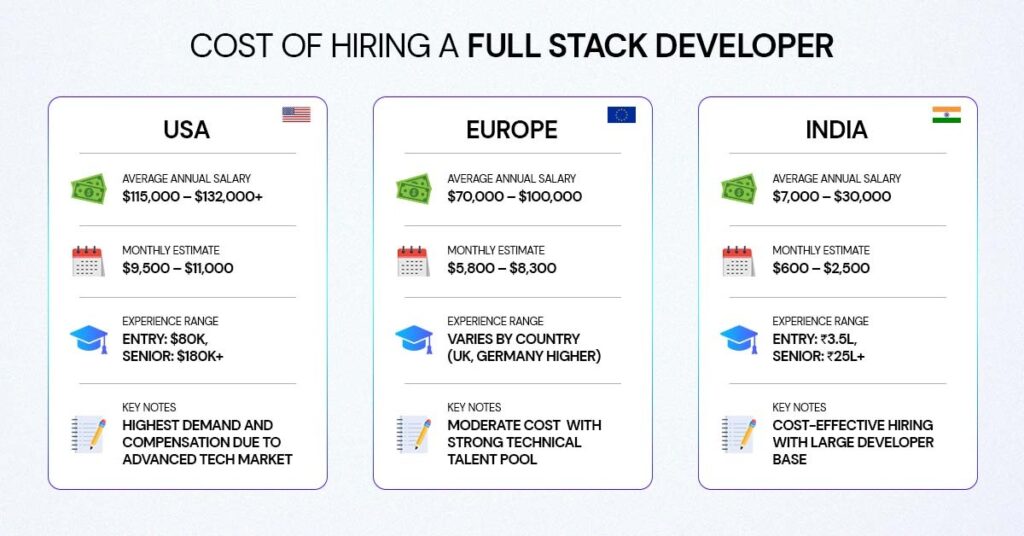
Average Salary by Region
| Region | Average Annual Salary | Monthly Estimate | Experience Range | Key Notes |
| USA | $115,000 – $132,000+ | $9,500 – $11,000 | Entry: $80K, Senior: $180K+ | Highest demand and compensation due to advanced tech market |
| Europe | $70,000 – $100,000 | $5,800 – $8,300 | Varies by country (UK, Germany higher) | Moderate cost with strong technical talent pool |
| India | $7,000 – $30,000 | $600 – $2,500 | Entry: ₹3.5L, Senior: ₹25L+ | Cost-effective hiring with large developer base |
Key Insights
- The USA offers top-tier talent but at premium cost.
- Europe balances cost and quality, suitable for mid-budget hiring.
- India provides highly cost-efficient developers, ideal for outsourcing and remote hiring.
- Remote developers globally average around $70,000 annually depending on region.
This variation helps businesses choose hiring locations based on budget, complexity, and scalability needs.
Freelance vs Full-Time Cost Comparison
Freelancers cost less in the short term because you pay per project or hourly. Furthermore, they reduce overhead like benefits, office space, and long-term commitments. However, consistency and availability can vary.
Full-time developers require higher upfront investment, including salary, benefits, and infrastructure. Additionally, they provide long-term stability, better collaboration, and deeper understanding of your product, making them suitable for ongoing development and scaling.
Cost by Experience Level
Junior Developers (Low Cost)
Junior developers charge lower rates due to limited experience. Furthermore, they are suitable for simple tasks, maintenance work, and support roles under supervision.
Mid-Level Developers (Moderate Cost)
Mid-level developers offer balanced cost and expertise. Additionally, they handle independent tasks, build features, and contribute effectively to most development projects.
Senior Developers (High Cost)
Senior developers command higher salaries due to deep expertise. Furthermore, they handle complex architecture, lead teams, solve critical problems, and ensure scalability, performance, and long-term system stability.
Benefits of Hiring a Full Stack Developer
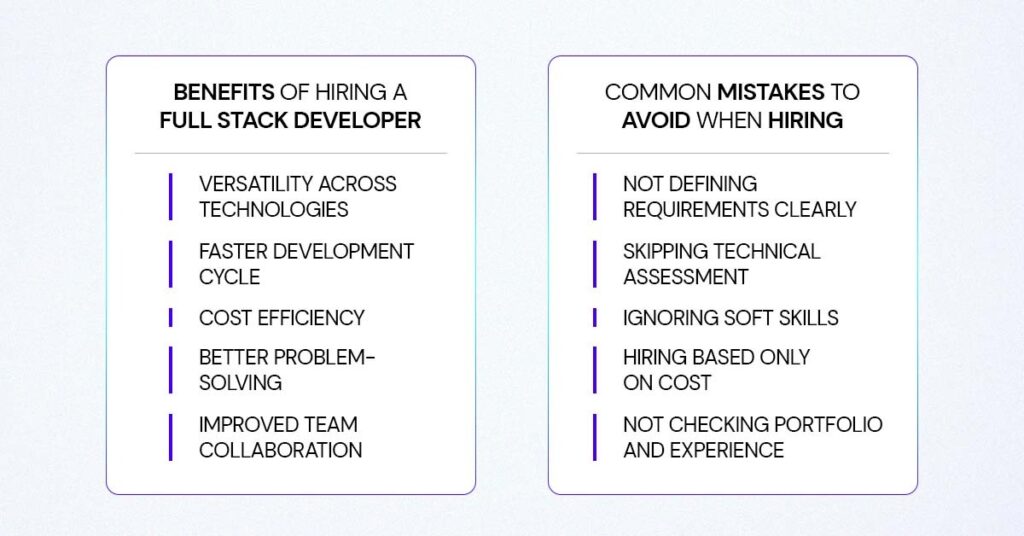
- Versatility Across Technologies
Full stack developers handle frontend, backend, and databases. Furthermore, they reduce dependency on multiple specialists and streamline development workflows. - Faster Development Cycle
They manage end-to-end development. Additionally, this reduces communication gaps and speeds up product delivery and iteration cycles. - Cost Efficiency
Hiring one full stack developer costs less than multiple specialists. Furthermore, it lowers operational and hiring expenses significantly. - Better Problem-Solving
They understand the entire system. Additionally, they identify issues quickly and fix problems across different layers efficiently. - Improved Team Collaboration
Full stack developers bridge gaps between teams. Furthermore, they ensure smoother coordination between design, development, and deployment processes.
Common Mistakes to Avoid When Hiring
- Not Defining Requirements Clearly
Unclear project scope leads to mismatched expectations. Furthermore, it results in poor hiring decisions and delays in development progress. - Ignoring Soft Skills
Lack of communication and teamwork affects collaboration. Additionally, it creates misunderstandings and reduces overall productivity within the development team. - Skipping Technical Assessment
Hiring without proper testing increases risk. Furthermore, it leads to poor code quality, performance issues, and unreliable development outcomes. - Hiring Based Only on Cost
Choosing cheaper developers compromises quality. Additionally, it often results in rework, delays, and higher long-term expenses. - Not Checking Portfolio and Experience
Ignoring past work leads to wrong hiring decisions. Furthermore, it prevents proper evaluation of real-world skills and practical development capabilities.
Alternatives to Hiring a Full Stack Developer
Hiring Separate Front-End and Back-End Developers
Hiring separate front-end and back-end developers works better for complex systems. Furthermore, it allows deeper specialization, improved scalability, and better handling of advanced architecture requirements.
Offshore Software Development Company
Partnering with an offshore software development company reduces costs significantly. Furthermore, it provides access to global talent, faster turnaround, and scalable resources for long-term or large projects.
Using No-Code or Low-Code Platforms
Using no-code or low-code platforms like Bubble and Webflow simplifies development. Furthermore, it enables quick launches, reduces cost, and suits simple applications without heavy customization.
Future Trends in Hiring Full Stack Developers
Rise of AI-Assisted Development
AI-assisted development tools like GitHub Copilot improve productivity. Furthermore, they automate repetitive tasks, enhance code quality, and help developers build applications faster with fewer errors.
Demand for T-Shaped Developers
T-shaped developers combine deep expertise with broad knowledge. Furthermore, they adapt across technologies, collaborate effectively, and provide flexibility in modern, cross-functional development environments.
Remote and Global Hiring Trends
Remote and global hiring expands access to worldwide talent. Furthermore, it increases competition, improves quality, reduces costs, and enables businesses to build diverse, distributed development teams.
Explore More
Also Learn about Top 10+ Full Stack Development Companies
FAQs About Hiring Full Stack Developers
How long does it take to hire a full stack developer?
It usually takes 2–6 weeks. Furthermore, timelines depend on hiring process complexity, candidate availability, interview stages, and current market demand for skilled developers.
What skills should a full stack developer have?
They need frontend, backend, database, and DevOps skills. Additionally, strong problem-solving, debugging ability, and understanding of APIs, frameworks, and system design are essential.
How much does it cost to hire a full stack developer?
Cost varies by region and experience level. Furthermore, freelancers typically cost less than full-time hires, while senior developers demand higher salaries due to expertise and versatility.
Where can I find full stack developers?
You can find them on freelance platforms, job boards, and developer communities. Furthermore, networking, referrals, and recruitment agencies also help source qualified full stack developers.
Should I hire freelance or full-time developers?
Choose freelance developers for short-term or flexible projects. Additionally, hire full-time developers for long-term goals, better collaboration, and consistent development support within your team.
Conclusion
Hiring the right Full Stack Developer requires clear planning and structured execution. Furthermore, understanding roles, skills, and hiring models helps you make better decisions. Additionally, evaluating both technical and soft skills ensures long-term success.
This guide simplifies how to hire full stack developer by covering every stage of the process. From defining requirements to final selection, each step matters. Therefore, focus on quality, not just cost. Additionally, companies like Techstack Digital apply structured hiring approaches to build high-performing development teams and deliver scalable solutions based on project needs.