
Quick Summary
AI will not replace full-stack developers. Artificial Intelligence is transforming full stack development by automating repetitive tasks like code generation, testing, and deployment. Furthermore, tools such as GitHub Copilot, TensorFlow, and Jenkins improve productivity and efficiency. However, AI cannot replace full stack developers due to limitations in creativity, problem-solving, and design thinking.
Additionally, human skills like communication, collaboration, and understanding user needs remain critical. The future of software development lies in AI-assisted development, not replacement. Developers must adapt by learning AI, cloud computing, and system architecture. Therefore, full stack developers will evolve into hybrid roles, ensuring strong demand and relevance in the AI-driven tech landscape.
Will AI Replace Full Stack Developers? Future, Skills & Trends
Artificial Intelligence is reshaping how software gets built. Furthermore, tools powered by machine learning in coding are now assisting developers at every stage. Companies like OpenAI, Google, and IBM continue to push innovation forward. Additionally, AI-assisted development and automation in development are becoming standard practices. Tools such as GitHub Copilot, TensorFlow, and Tabnine already influence daily workflows. However, a major question remains. Will AI replace full stack developers entirely? This debate around automation of software development and AI-driven tools is growing fast. Understanding the reality behind this shift is critical for developers, businesses, and modern tech ecosystems.
Understanding Full Stack Development
What is full stack development?
Full stack development refers to building both front-end and back-end systems. Furthermore, at Techstack Digital, full stack developers handle complete application flow from UI to database. Technologies like React and Angular power the front-end. Additionally, Node.js and Django manage server-side logic.
Core components:
- Front-end technologies: React, Angular for UI
- Back-end technologies: Node.js, Django for logic
- Databases & version control: SQL, Git for data and collaboration
Full stack developers connect all layers. Therefore, they ensure smooth communication between interfaces and systems. Additionally, they optimize performance, security, and scalability across the stack.
Skills required for full stack developers
Full stack developers require a broad skill set. Furthermore, they must understand web development deeply. They work across backend architecture and front-end development.
Key skills include:
- Programming in JavaScript, Python, or similar languages
- Understanding APIs and system integrations
- Managing databases and server environments
- Handling deployment and DevOps basics
Additionally, they must debug issues across layers. Therefore, their role demands flexibility and problem-solving ability.
Importance of Full stack developers in the ecosystem
Full stack developers play a central role. Furthermore, they reduce dependency on multiple teams. Companies prefer them for faster delivery and streamlined execution. In fact, many businesses actively look to hire full stack developer talent to handle end-to-end product development efficiently.
Benefits:
- Faster development cycles
- Better system understanding
- Reduced communication gaps
Additionally, full stack frameworks simplify workflows. Therefore, they remain critical in modern development environments.
The Rise of AI in Software Development
AI’s impact on software engineering
AI is transforming software engineering rapidly. Furthermore, machine learning and predictive analytics in software improve efficiency. Tools like OpenAI Codex, Microsoft solutions, and IBM Watson assist developers.
Key impacts:
- Faster code generation
- Improved debugging accuracy
- Better system predictions
Additionally, AI reduces manual workload. Therefore, developers focus more on strategy.
AI tools used by developers today
Developers actively use AI-powered development tools. Furthermore, code generation with AI is becoming common.
Popular tools:
- GitHub Copilot
- Tabnine
- Codex
- Kite
Applications:
- Code generation tools (Copilot, GPT-based tools)
- AI-assisted testing and debugging
- Deployment automation
Additionally, these tools improve productivity. Therefore, developers complete tasks faster.
Automation in development
Automation is reducing repetitive work. Furthermore, CI/CD pipelines streamline delivery.
Key technologies:
- GitHub for version control
- Jenkins for automation
- Docker for containerization
Additionally, automated testing improves reliability. Therefore, development becomes more efficient.
Can AI Replace Full Stack Developers?
Tasks AI can already perform
AI can handle several technical tasks. Furthermore, it supports code writing and refactoring.
Capabilities:
- Writing boilerplate code
- Debugging and optimization
- Basic database management
Tools like GitHub Copilot and OpenAI Codex assist heavily. Additionally, TensorFlow supports data-driven systems. Therefore, AI handles repetitive coding well.
Limitations of AI in development
AI has clear limitations. Furthermore, creativity in coding remains human-driven.
Challenges:
- Complex problem-solving in coding
- System architecture design
- UX/UI thinking
Additionally, AI struggles with context. Therefore, human developers remain essential.
The human touch
Development is not just technical work. Furthermore, strong team dynamics, clear communication, and collaboration help developers align solutions with business goals and deliver meaningful, user-focused software products.
Humans provide:
- Collaboration
- Decision-making
- Contextual understanding
Additionally, UX/UI design with AI still requires human input. Therefore, teams cannot rely on AI alone.
How AI is Assisting Full Stack Developers
AI as a co-pilot
AI acts as a helper, not a replacement. Furthermore, AI-assisted development improves workflow.
Tools like OpenAI and GitHub Copilot assist developers. Additionally, they reduce manual effort. Therefore, developers focus on complex tasks.
Automation of tedious tasks
AI handles repetitive work effectively. Furthermore, it reduces manual effort, saves time, and improves overall developer productivity.
Examples:
- Code completion and suggestions
- Code reviews and bug fixes
Tools:
- Tabnine
- GitHub
- Jenkins
Additionally, this reduces development time. Therefore, teams become more productive.
Efficiency improvements
AI improves speed significantly across development workflows. Furthermore, it accelerates coding, testing, and deployment while enhancing productivity and reducing overall project timelines.
Benefits:
- Faster prototyping
- Faster deployment
- Better productivity
Technologies:
- Docker
- Kubernetes
- AWS
Additionally, developers deliver projects quicker. Therefore, businesses gain faster results.
Explore More
Also Learn about Will AI replace data engineers?
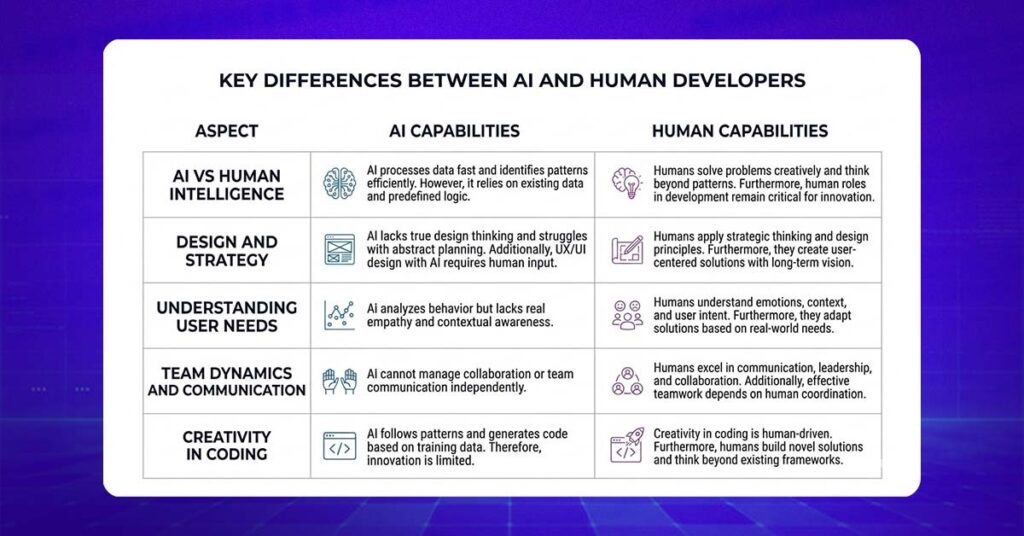
Key Differences Between AI and Human Developers
| Aspect | AI Capabilities | Human Capabilities |
| AI vs Human Intelligence | AI processes data fast and identifies patterns efficiently. However, it relies on existing data and predefined logic. | Humans solve problems creatively and think beyond patterns. Furthermore, human roles in AI development remain critical for innovation. |
| Design and Strategy | AI lacks true design thinking and struggles with abstract planning. Additionally, UX/UI design with AI requires human input. | Humans apply strategic thinking and design principles. Furthermore, they create user-centered solutions with long-term vision. |
| Understanding User Needs | AI analyzes behavior but lacks real empathy and contextual awareness. | Humans understand emotions, context, and user intent. Furthermore, they adapt solutions based on real-world needs. |
| Team Dynamics and Communication | AI cannot manage collaboration or team communication independently. | Humans excel in communication, leadership, and collaboration. Additionally, effective teamwork depends on human coordination. |
| Creativity in Coding | AI follows patterns and generates code based on training data. Therefore, innovation is limited. | Creativity in coding is human-driven. Furthermore, humans build novel solutions and think beyond existing frameworks. |
AI-Driven Tools Shaping Development
Code completion tools
Tools like GitHub Copilot, Tabnine, and Kite improve coding speed significantly. Furthermore, they reduce errors by suggesting accurate and context-aware code snippets.
AI-powered testing frameworks
Frameworks like TensorFlow and PyTorch assist in automated testing processes. Additionally, they improve system reliability by identifying bugs and performance issues early.
CI/CD tools
Tools like Jenkins, CircleCI, and Travis CI automate deployment pipelines. Furthermore, they ensure consistency, faster releases, and reduce manual errors in delivery processes.
DevOps automation
Technologies like Docker, Kubernetes, AWS, and Azure manage infrastructure efficiently. Additionally, AI improves system monitoring, scaling decisions, and overall operational performance in production environments.
Explore More
Also Learn about How Can a DevOps Team Take Advantage of Artificial Intelligence?
Will Full Stack Development Become Obsolete?
Predictions about the future
AI will change development, not replace it. Furthermore, the future of software development includes collaboration.
Changing skillset
Developers must adapt. Additionally, AI-adjacent skills like cloud computing are becoming essential.
Evolution into AI experts
Full stack developers may evolve into hybrid roles. Furthermore, developers with AI expertise will dominate.
New opportunities
AI creates new roles across industries. Additionally, career transition in tech becomes easier as demand for AI-related skills increases.
Niche roles
Certain areas remain safe from automation. Furthermore, AI cannot easily replace complex, human-driven roles requiring creativity, strategy, and deep contextual understanding.
Staying Relevant as a Developer
Upskilling strategies
Developers must learn AI and machine learning. Furthermore, tools like Python and TensorFlow are essential.
Focus areas:
- AI fundamentals
- Cloud technologies
- Data handling
Shifting to high-level tasks
Developers should focus on architecture and design. Furthermore, they must handle system planning, scalability decisions, and align technical solutions with business goals effectively.
Key areas:
- System architecture
- Business analysis
- User experience
Technologies:
- AWS
- Google Cloud
Importance of soft skills
Soft skills matter more than ever in modern development environments. Furthermore, creativity in coding, communication, adaptability, and collaboration help developers solve complex problems and work effectively within cross-functional teams.
Explore More
Also Learn about Full Stack Development Interview Questions
Case Studies
Businesses using AI
Major tech companies are integrating AI deeply into development workflows. For example, Microsoft reports that up to 30% of its code is now generated by AI systems. Furthermore, tools like Microsoft Copilot are widely adopted, with 75% of developers using AI tools and 90% reporting increased productivity.
Additionally, Meta has shifted engineering workflows significantly. Internal reports show engineers are expected to use AI for 50–80% of coding tasks, improving efficiency and reducing dependency on large teams.
IBM also uses AI through platforms like Watson and watsonx Code Assistant to automate code generation, refactoring, and enterprise-level decision-making.
Success stories
AI is accelerating development without replacing developers. A controlled study by Microsoft found that developers using GitHub Copilot completed tasks 55.8% faster compared to those without AI assistance.
Furthermore, a large-scale enterprise study involving 300 engineers showed:
- 31.8% reduction in code review time
- 28% increase in code shipped to production
- Up to 61% increase in code output for top users
Additionally, a government trial with 14,500 employees showed AI tools saved an average of 26 minutes per day, with over 70% reporting reduced time on repetitive tasks.
These results clearly show AI improves speed and efficiency while keeping developers central to the process.
Workflow improvements
AI tools are significantly improving developer workflows and productivity. Research on open-source projects shows tools like GitHub Copilot increased project-level productivity by 6.5% and individual productivity by 5.5%.
Furthermore, AI adoption improves efficiency rather than raw activity. Studies show teams achieve higher performance without increasing workload, meaning developers produce more value per task.
Additionally, enterprise adoption data shows:
- 88% improvement in throughput
- 71% increase in customer value delivery
- 62% improvement in job satisfaction
These numbers confirm a clear trend. AI is not replacing developers. Instead, it is amplifying their capabilities, optimizing workflows, and enabling faster, higher-quality software delivery.
Impact on Job Market
Hiring trends
AI will influence hiring patterns across tech roles. Furthermore, job displacement in tech will occur in limited areas, mainly repetitive tasks.
Rise of hybrid roles
Developers with AI expertise will be in high demand. Additionally, hybrid roles combining development and AI knowledge will grow rapidly.
Job transformation
Jobs will evolve rather than disappear in the tech industry. Furthermore, AI replacing developers completely remains unlikely due to human-centric tasks.
Demand predictions
Demand for developers will remain strong across industries. Additionally, AI in the job market will create more opportunities than it replaces.
Ethical and Social Implications
Ethical dilemma
AI raises concerns about job replacement versus augmentation. Furthermore, maintaining ethical standards in development ensures responsible innovation and balanced workforce impact.
Diversity and inclusion
AI can improve diversity in tech by reducing bias in hiring. Additionally, fairness must be ensured through responsible data and model design.
Transparency
AI transparency is essential for building trust in systems. Furthermore, fairness in AI must be maintained through explainable models and clear decision processes.
Future of work
AI will reshape the software industry by automating tasks. Additionally, collaboration between humans and intelligent systems will define future roles and productivity.
Additional Insights
AI limitations in complex projects
AI struggles with complex coding challenges and undefined problems. Furthermore, human developers design scalable architectures and create innovative solutions that require deep contextual understanding.
Human intuition
Human intuition in coding enables better judgment and decision-making. Additionally, empathy in software helps developers design experiences that align closely with real user needs.
AI and developer collaboration
AI and developers work together to enhance productivity and accuracy. Furthermore, tools like GitHub Copilot and OpenAI streamline workflows and reduce repetitive coding effort.
Future-proofing careers
Developers must focus on AI-adjacent skills to remain relevant. Additionally, learning cybersecurity, cloud computing, and data-driven systems helps build resilient and future-proof tech careers.
AI’s impact on workflows
AI enhances development workflows by automating repetitive processes. Furthermore, platforms like GitHub, Docker, and Kubernetes improve deployment speed, collaboration, and overall system efficiency.
Conclusion
AI is transforming software development significantly. However, it is not replacing full stack developers. Furthermore, it is enhancing how they work. AI-driven tools automate repetitive tasks and improve efficiency. Additionally, developers now focus more on strategy, architecture, and user experience. The future is not about replacement. It is about collaboration between humans and AI.
Developers who adapt and learn AI-related skills will stay ahead. Therefore, at Techstack Digital, the role of full stack developers will evolve rather than disappear. AI will remain a powerful assistant. However, human creativity, problem-solving, and decision-making will continue to define successful software development in the modern era.