
TL;DR-Quick Summary
- Both Full Stack Development and Data Science offer strong career growth, high demand, and competitive salaries, driven by digital transformation and data-driven decision-making.
- A Full Stack Developer builds complete Web Applications, handling Front-End Development (HTML, CSS, JavaScript, React, Angular) and Back-End Development (Node.js, Python, Ruby, PHP) along with APIs, MySQL, MongoDB, and server-side logic.
- A Data Scientist focuses on Data Analysis, Machine Learning, and insights using Python, SQL, Data Visualization (Tableau), data cleaning, and AI techniques.
- The Full Stack Developer vs Data Science Job differs in purpose: developers build systems, while data scientists analyze data to support decisions.
- In the Skills Comparison: Full Stack Developer vs Data Scientist, developers prioritize coding and system design, while data scientists rely on Math, Statistics, and analytical modeling.
- The Career Path in Full Stack vs Data Science shows structured growth in both fields, from junior roles to senior and leadership positions.
- The Full Stack Developer vs Data Scientist Salary is competitive in both fields, with data science sometimes offering higher averages depending on region and expertise.
- The Job Growth for Data Science and Full Stack Developers remains strong globally, with developers driven by product demand and data scientists by AI and analytics adoption.
- Full Stack Development vs Data Science Trends indicate developers are essential for building platforms, while data scientists are critical for business intelligence and forecasting.
- The answer to Which Career is Better: Full Stack or Data Science depends on preference: choose development for building products and systems, or data science for analysis, predictions, and data-driven strategy.
Full Stack Developer vs Data Science: Career, Skills & Salary Guide
The demand for skilled tech professionals continues to grow as businesses depend on digital platforms and data-driven decisions. At Techstack Digital, this shift makes choosing the right career path more important than ever. Two of the most popular options today are Full Stack Development and Data Science. Both fields offer strong career growth, competitive salaries, and long-term stability.
However, they differ in skills, responsibilities, and daily tasks. A Full Stack Developer focuses on building web applications, while a Data Scientist works on analyzing data and generating insights. Additionally, both roles play a critical part in modern business success. This guide explores the Data Science vs Full Stack Developer Job, compares key skills, and explains the Career Path in Full Stack vs Data Science. Understanding these differences helps you make an informed decision based on your interests, strengths, and future career goals in the tech industry.
What is a Full Stack Developer?
Definition of Full Stack Developer
A Full Stack Developer builds and manages complete Web Applications. This role combines Front-End and Back-End Development into one workflow. Developers design user interfaces and also handle server-side operations. They work with Front-End Development (HTML, CSS, JavaScript, React, Angular) to create interactive experiences. Additionally, they manage Back-End Development (Node.js, Python, Ruby, PHP) to process logic and handle requests.
Explore More
Also Learn about How to update Node.js to the latest version
Furthermore, they connect systems using APIs, manage Data Storage, and work with databases like MySQL, MongoDB. This makes Full Stack Web Development highly versatile. Developers control both visual and functional aspects of applications. As a result, companies prefer them for agile and fast-moving projects.
Skills Required for Full Stack Development
A Full Stack Developer must master multiple layers of development. First, they learn Front-End tools like HTML, CSS, and JavaScript. Additionally, they use frameworks such as React or Angular to create responsive interfaces. On the server side, they use technologies like Node.js and Python to handle Server-side Logic.
Furthermore, they manage databases such as MySQL, MongoDB for efficient Data Storage. They also build and integrate APIs for communication between systems. Strong knowledge of Programming is essential.
Additionally, soft skills play a key role. Developers must solve problems quickly and communicate effectively with teams. Teamwork improves productivity in complex projects. Therefore, Full Stack Development requires both technical depth and adaptability.
Job Role and Responsibilities
A Full Stack Developer designs, develops, and maintains complete applications. They create user-friendly interfaces and ensure smooth performance. Additionally, they write backend logic that processes user data.
Furthermore, they handle database integration and optimize queries for performance. They build and test APIs for seamless system communication. Managing deployment and debugging issues is also part of their role.
They often collaborate with designers and product teams. This ensures the application meets business requirements. Additionally, they focus on performance, scalability, and security.
In many organizations, a Full Stack Developer acts as a bridge between teams. This makes them valuable in startups and product-based companies. Their role directly impacts user experience and system reliability.
Career Growth and Salary
The Career Growth for a Full Stack Developer follows a structured path. Professionals start as junior developers and move toward senior roles. Additionally, they can become tech leads or architects.
Furthermore, companies value developers who understand both Front-End and Back-End systems. This increases promotion opportunities. The Full Stack Developer vs Data Scientist Salary comparison often shows competitive pay for both roles.
Additionally, demand continues to rise due to increasing digital products. The Job Growth for Data Science and Full Stack Developers indicates strong hiring trends globally. Full stack developers remain essential for building scalable applications.
As experience grows, developers can specialize or move into leadership roles. This ensures long-term stability and career expansion.
What is Data Science?
Definition of Data Science
Data Science focuses on extracting insights from data. A Data Scientist uses Data Analysis, Machine Learning, and statistical techniques to understand patterns. Businesses rely on these insights to make decisions.
Additionally, Data Science involves working with large datasets. Professionals clean, organize, and process data for analysis. They use tools like Python, SQL, and Data Visualization (Tableau) to present findings.
Furthermore, the role supports decision-making across industries. Companies use data to improve products and strategies. This makes AI (Artificial Intelligence) and analytics critical components.
The Data Science vs Full Stack Developer Job comparison highlights that data science focuses more on insights than system building.
Skills Required for Data Science
A Data Scientist requires strong analytical and technical skills. First, they learn Python and SQL for data handling. Additionally, they use Machine Learning algorithms to build predictive models.
Furthermore, Data Cleaning is a core task. Clean data ensures accurate results. They also use tools like Data Visualization (Tableau) to present insights clearly.
Additionally, knowledge of Math, Statistics is essential. It helps in understanding trends and probabilities. Professionals must also understand business problems to deliver meaningful insights.
Soft skills also matter. Communication helps explain complex results to non-technical teams. Therefore, Data Science combines technical expertise with analytical thinking.
Job Role and Responsibilities
A Data Scientist collects and analyzes data to find patterns. They clean raw data and prepare it for analysis. Additionally, they build models using Machine Learning techniques.
Furthermore, they create visual reports using Data Visualization (Tableau). These reports help stakeholders understand insights easily. They also test models and improve accuracy.
Additionally, they work with large datasets and automate processes. They collaborate with business teams to solve real-world problems.
Unlike developers, their focus is not on building applications. Instead, they focus on extracting value from data. This makes their role critical for strategy and forecasting.
Career Growth and Salary
The Career Growth in Data Science is strong and expanding. Professionals start as junior analysts and move toward senior data scientist roles. Additionally, they can specialize in AI or machine learning.
Furthermore, companies invest heavily in data-driven systems. This increases the Future Job Opportunities in Full Stack vs Data Science significantly.
The Full Stack Developer vs Data Scientist Salary comparison often shows higher averages in data science roles. However, both careers offer competitive compensation.
Additionally, the Job Growth for Data Science and Full Stack Developers remains strong due to digital transformation. Data scientists play a key role in innovation.
With experience, professionals can move into leadership or research roles. This ensures long-term career stability.
Full Stack Developer vs Data Scientist: Key Differences
Job Role Comparison
The Data Science vs Full Stack Developer Job differs in core responsibilities. A Full Stack Developer builds and manages Web Applications. They focus on user interfaces, backend systems, and APIs.
Additionally, they ensure smooth application performance. They handle Front-End and Back-End Development together.
In contrast, a Data Scientist focuses on data insights. They analyze trends and build predictive models. Furthermore, they support decision-making through analytics.
Industries also differ slightly. Developers are common in tech and product companies. Data scientists are in finance, healthcare, and analytics-driven firms.
Both roles are essential but serve different purposes in business operations.
Skills Comparison
The Skills Comparison: Full Stack Developer vs Data Scientist highlights clear differences. A Full Stack Developer focuses on coding and system design. They use JavaScript, Python, and frameworks like React.
Additionally, they work with databases like MySQL, MongoDB and build APIs.
On the other hand, a Data Scientist focuses on analysis and modeling. They use Python, SQL, and Machine Learning tools.
Furthermore, they rely heavily on Math, Statistics and data interpretation.
Both roles require strong Programming skills. However, developers focus on building systems, while data scientists focus on analyzing data.
Career Growth and Job Market
The Career Path in Full Stack vs Data Science shows strong growth in both fields. Developers benefit from increasing demand for digital products. Additionally, startups rely heavily on Full Stack Development.
Furthermore, data science continues to grow due to AI and analytics adoption. The Job Growth for Data Science and Full Stack Developers remains high globally.
Salary trends also reflect demand. The Full Stack Developer vs Data Scientist Salary varies by region and experience.
Additionally, both roles offer long-term stability and growth opportunities. Professionals can specialize or move into leadership roles.
Which Role is More In Demand?
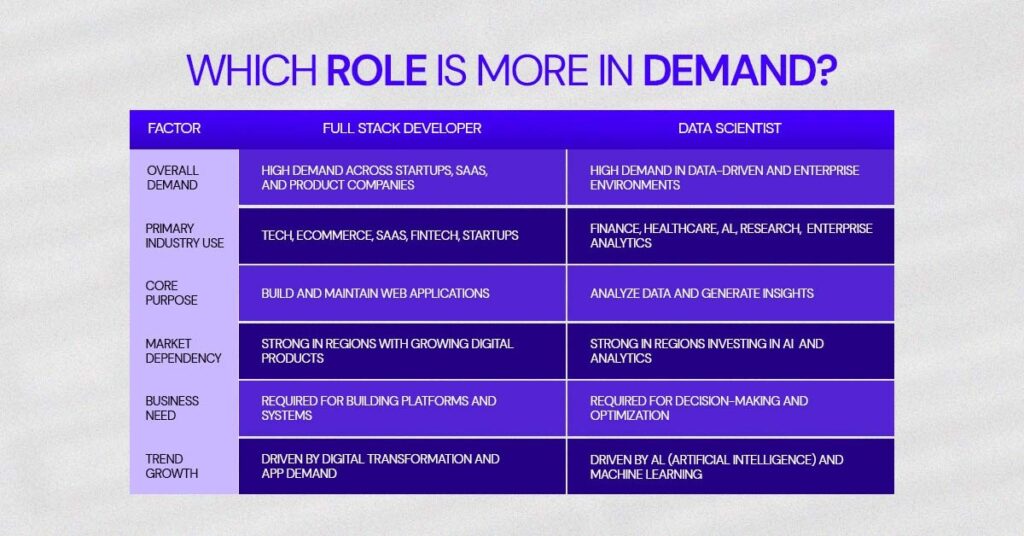
| Factor | Full Stack Developer | Data Scientist |
| Overall Demand | High demand across startups, SaaS, and product companies | High demand in data-driven and enterprise environments |
| Primary Industry Use | Tech, eCommerce, SaaS, fintech, startups | Finance, healthcare, AI, research, enterprise analytics |
| Core Purpose | Build and maintain Web Applications | Analyze data and generate insights |
| Market Dependency | Strong in regions with growing digital products | Strong in regions investing in AI and analytics |
| Business Need | Required for building platforms and systems | Required for decision-making and optimization |
| Trend Growth | Driven by digital transformation and app demand | Driven by AI (Artificial Intelligence) and Machine Learning |
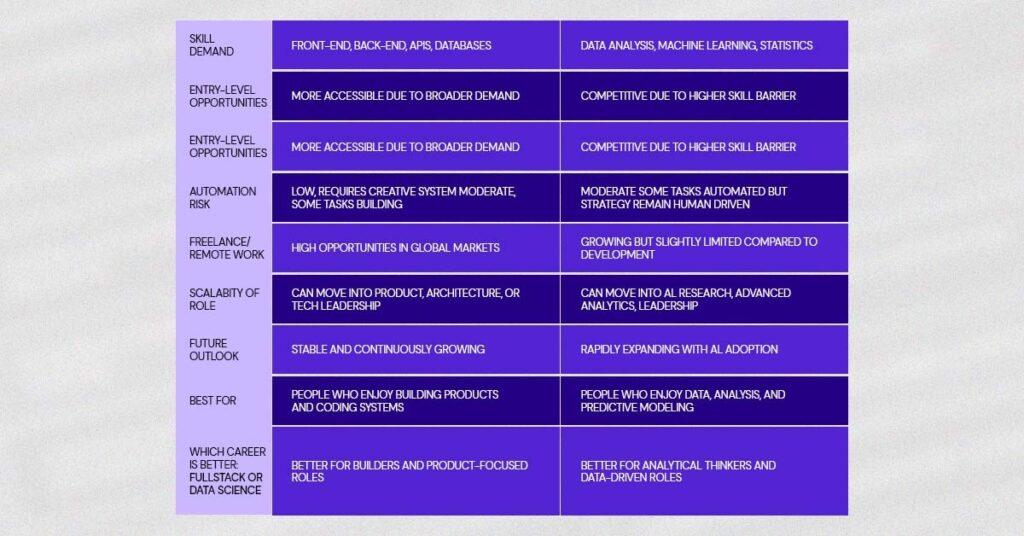
| Skill Demand | Front-End, Back-End, APIs, databases | Data Analysis, Machine Learning, statistics |
| Entry-Level Opportunities | More accessible due to broader demand | Competitive due to higher skill barrier |
| Automation Risk | Low, requires creative system building | Moderate, some tasks automated but strategy remains human-driven |
| Freelance/Remote Work | High opportunities in global markets | Growing but slightly limited compared to development |
| Scalability of Role | Can move into product, architecture, or tech leadership | Can move into AI research, advanced analytics, leadership |
| Future Outlook | Stable and continuously growing | Rapidly expanding with AI adoption |
| Best For | People who enjoy building products and coding systems | People who enjoy data, analysis, and predictive modeling |
| Which Career is Better: Full Stack or Data Science | Better for builders and product-focused roles | Better for analytical thinkers and data-driven roles |
Which Career Path Should You Choose?
Consider Your Interests
Choosing between roles depends on your interests. A Full Stack Developer builds applications and user interfaces. They enjoy creating systems and solving technical problems. Additionally, they work on Front-End and Back-End Development tasks daily. A Data Scientist focuses on numbers and insights.
They analyze trends and build models. Furthermore, they work with data rather than interfaces. If you enjoy coding and building products, choose development. If you prefer analysis and predictions, choose data science confidently.
Explore More
Also Learn about Top java full stack developer skills employers want 2026
Consider the Job Market
The Career Path in Full Stack vs Data Science shows strong demand for both roles. Additionally, global hiring trends support both fields. Developers are needed in almost every industry. Furthermore, digital transformation increases demand across startups and enterprises. Data science roles grow rapidly due to AI adoption.
Additionally, companies invest in analytics to stay competitive. Both careers offer stability and growth. However, market demand may vary by location, industry needs, and evolving technological trends worldwide.
Personal Development and Skills Growth
Both careers offer continuous learning opportunities. A Full Stack Developer learns new frameworks and tools regularly. Additionally, technology evolves quickly across web ecosystems. A Data Scientist learns new algorithms and techniques. Furthermore, AI advancements create new opportunities for innovation.
Both roles require strong Programming skills. Additionally, they demand continuous improvement and adaptability. Choosing the right path depends on your strengths. Evaluate your skills, interests, and long-term goals carefully before making a decision.
Conclusion
The comparison of Full Stack Developer vs Data Science shows that both careers offer strong opportunities. A Full Stack Developer focuses on building applications and managing systems. In contrast, a Data Scientist focuses on analyzing data and generating insights.
Furthermore, the Full Stack Development vs Data Science Trends indicate growing demand in both fields. The choice depends on your interests, skills, and career goals.
If you enjoy creating products, choose development. If you enjoy solving problems with data, choose data science. Hire Full stack developer from Techstack digital
Ultimately, the answer to Which Career is Better: Full Stack or Data Science depends on your direction. Both paths lead to strong growth, high demand, and long-term success.